

Virtual Fitting in an Interactive Kiosk: How to Retain Customers
When visitors cannot quickly try on an item, they often leave without buying. Queues for fitting rooms, poor fit, and lack of time directly hurt revenue.
The longer a person waits, the stronger the irritation, and by the time they reach the fitting room they already want to leave. Each such departure is a lost customer who will be difficult to win back.
A virtual fitting room in an interactive kiosk removes these barriers. In a few seconds, shoppers see the product on themselves, change colors and models without undressing.
This is especially valuable in clothing, footwear, and eyewear stores, where purchase decisions are made emotionally.
The kiosk also helps the salesperson: they see customer preferences, suggest the right size and complementary items. As a result, virtual fitting turns a scattered assortment into a personalized selection.
For the brand, this is a customer retention tool. Visitors stay longer in the store, return for new collections, and recommend you to friends. People share vivid digital experiences on social media — you get extra reach without an advertising budget.
This is how virtual fitting transforms a one-time visit into a long-term relationship with the brand.
We create virtual fitting tailored to your business needs: from quick catalog selection to realistic product display on a figure. We adapt the interface to your audience, and the kiosk fits easily into your interior.
Our solutions already help stores reduce walkouts without purchase and increase average customer dwell time. It is a proven way to make fitting part of the brand impression.
What Business Gets from an Interactive Kiosk with 3D Models
An interactive kiosk with 3D models turns a display window into a live sales tool. Shoppers see the product in volume, change color and details, “try it on” — and decide faster.
Attention is held much longer than by a screen with pictures: this is the first step toward a purchase.
Growth in average check is the main benefit. The kiosk suggests additional items and bundles that cannot be shown on a display. After choosing the main item, people are more willing to take accessories if they see them in combination. Each session brings more revenue.
High engagement works for the brand: the customer controls the model themselves, experiments, and gets an emotional experience. This increases loyalty and increases time at the kiosk by 2–3 times — guests do not leave until they have viewed the entire line.
The kiosk collects preference data: which models were viewed, what was changed, what was set aside. You see real demand and adjust the assortment without surveys or guesses. This is a ready-made source of ideas for advertising.
Finally, savings on staff: the device answers frequent questions about sizes, colors, and availability. Sales associates focus on those ready to buy instead of repeating the same answers. The flow is supported without expanding headcount.
Return on investment comes from higher checks, engagement, accurate data, and reduced team load. Tell us which products you need to show — we will propose an interactive format for your task.
Virtual Fitting Formats for an Interactive Kiosk to Suit Your Task
The kiosk format determines exactly how visitors interact with virtual fitting. If the point of sale is in a high-traffic area, a stationary version is convenient; if mobility is needed at exhibitions, a portable one.
An error in choosing the format leads to losses: guests do not wait at a bulky structure, and employees waste time on manual consultations instead of selling.
We choose the format based on your business task, not the other way around. We compared the main options so you can immediately see which one suits your store, showroom, or event.
| Format | Who it is for | What it gives the customer |
|---|---|---|
| Stationary kiosk | Clothing, footwear stores, eyewear salons | A permanent point of attraction in the hall, high footfall, and repeat fittings by regular customers |
| Portable kiosk | Exhibitions, pop-ups, promo events | Mobility without losing quality: sets up in 10–15 minutes, easy to transport, and quick to launch |
| Desktop kiosk | Compact stores, pickup areas, boutiques | Saves retail space, quick start, and the ability to use the screen as a consultant’s assistant |
| Multi-touch panel | Showrooms, flagship stores | Simultaneous fitting for several people, a “wow” effect, and viral photos on social media |
We adapt each format to your interior, assortment, and purchase scenario. During a consultation, we will show which one will pay back faster with your visitor flow, and configure it so that virtual fitting leads to real sales.
How the Project Goes: From Request to Kiosk Launch
We have structured the process so that launching a kiosk does not become a series of confusing calls and technical details for you.
At every stage you see what is happening, the project timeline, and what result you will get in the end — from initial request to a working device in your space.
-
Request and task discussion. You tell us where the kiosk will be located, who will use it, and what result matters: increasing sales, engaging visitors, or reducing queues. We clarify the details and propose a solution for your task.
-
Technical specification and estimate. We fix the functionality, operating scenarios, and appearance of the kiosk. You receive a clear document with kiosk launch stages and deadlines — without hidden conditions or unexpected surcharges.
-
Interface prototype. We show what the screens will look like and how users will interact with them. At this stage, you can make edits before 3D application development begins, so the final result matches expectations.
-
3D application development. We build an interactive scene taking into account your materials, formats, and corporate style. Professional graphics, refined tools, and server architecture ensure stable operation even under high load.
-
Testing and debugging. We check scenarios on real equipment: picture quality, response speed, usability for different users. We fix issues before the kiosk reaches you.
-
Delivery, installation, and launch. We bring the device, configure it at your location, and train your staff. You receive a ready-to-operate kiosk — with instructions and contacts for quick support.
-
Support and development. After launch, we stay in touch: update content, add features, monitor stability. If you want to expand your kiosk network, we will handle replication and configuration of all devices.
What Is Included in the Interactive Kiosk Delivery
By ordering development from us, you get not just a program but a ready-to-operate interactive terminal under a turnkey model.
We take care of the full kiosk delivery package — from the housing to updates — so you do not need to find separate contractors and coordinate their work.
-
Housing and touch screen — a durable construction resistant to constant visitor touch, and a responsive display. There is no need to buy or mount anything separately: the terminal arrives assembled and ready for installation in the sales area.
-
Virtual fitting application — the main software through which customers choose products, view them in volume, and “try them on”. It works stably and without delays: visitors get a quick result rather than irritating freezes.
-
Administration interface — a simple panel for your employees. Through it, you can change the catalog, prices, promotions, add new items, and view usage statistics. No training required — anyone who can use a tablet will understand it.
-
Operating instructions — a clear guide in Russian: how to turn on the kiosk, restart the application, and replace consumables if needed. Your staff can resolve minor issues themselves without involving you.
-
Updates and support — we regularly update the system and support the project remotely. If a failure or question arises, you will not be left alone with non-working equipment: our specialists will connect and solve the problem.
-
Documentation and warranty — a full set of documents for accounting and legally clean paperwork. Warranty service provides confidence that your investment is protected.
As a result, you get a working tool for increasing sales and customer engagement, not a do-it-yourself kit. Everything is tested, configured, and ready for the first visitor on installation day.
Case Study: Customers Instantly Choose and Return to Buy
In one of the stores of the Garderob chain, customers took a long time to choose clothes: queues for fitting rooms grew, and salespeople could not keep up with helping them.
As a result, visitors left without buying — especially those who wanted to try several sizes or combinations at once. The chain asked us to develop a 3D application for an interactive kiosk.
We proposed a virtual fitting room: the shopper stands in front of the screen, selects a model, and sees how it fits on their figure, switching colors and sizes in a couple of seconds. No changing clothes — the selection process becomes a game. That immediately removed the main barrier between interest and purchase.
Results of the Interactive Kiosk
One month after launch, selection time almost halved — from 15–20 minutes to 5–7. Queues for fitting rooms disappeared, and conversion to purchase increased by a third: customers approached the checkout with a ready list of items.
An important metric was behavior after the visit. Every second person who used the kiosk returned to the store within a week — some to buy an item they had set aside, others to show their purchase to friends.
The share of repeat visits grew by a quarter, and the average check increased thanks to additional combinations.
The virtual fitting case itself became a signature service: the client expanded the project to all flagship stores.
Now the kiosk is not an experiment but a working tool that speeds up selection, brings customers back, and increases revenue without additional advertising investment.
How to Choose the Right Interactive Kiosk Format for Your Task?
How to choose a kiosk for a specific task? Start with the question of what the visitor should do: quickly find information, navigate the premises, or virtually try on a product.
For fitting, you need a vertical screen in front of which a person can stand at full height — this changes the requirements for installation location and structure dimensions.
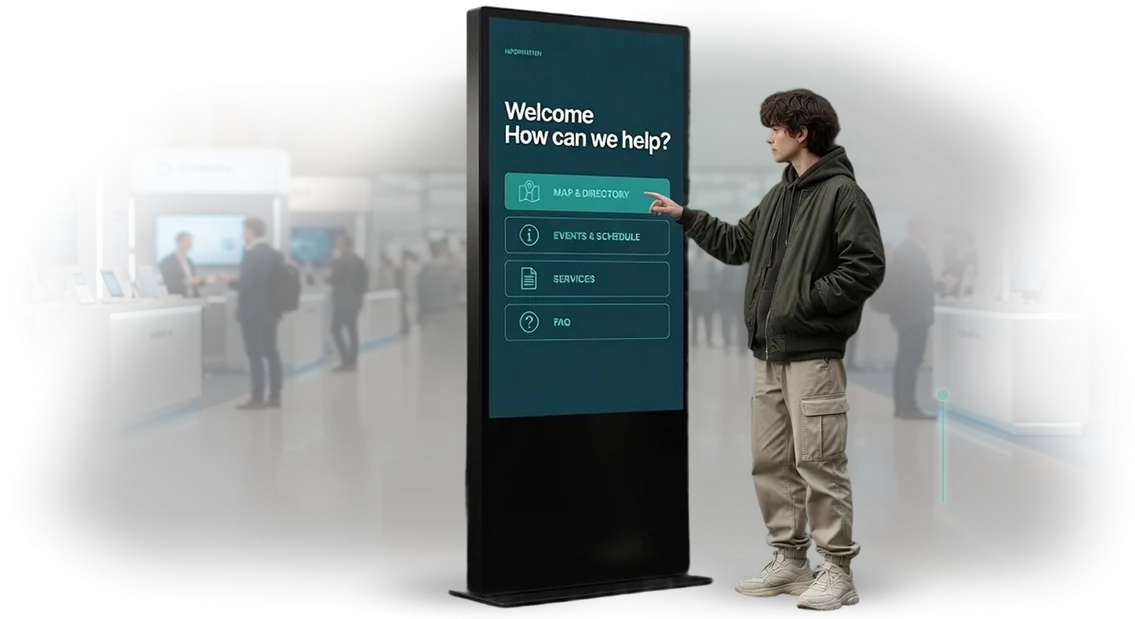
In high-traffic areas where people are moving past, the best format is a floor-standing kiosk with a large display and bright visuals. It acts as a visual magnet, stops the eye, and draws the visitor into interaction.
If space is limited — near a column, in a corner, or next to the checkout — it is wiser to choose a wall-mounted or countertop version. It takes up no useful floor space but performs the same function.
Choosing a format is always a balance between budget, premises, and use scenario. An information stand in the lobby and an interactive fitting room in a store solve different tasks, so copying someone else’s solution is not worth it.
For example, virtual fitting requires a clear area in front of the screen, while a navigation kiosk needs a comfortable viewing angle and quick touch response.
We select the configuration for your conditions: we analyze the layout, traffic, and scenario, and propose 2-3 options — from a compact basic model to a premium one with a custom housing design.
That way, you get a kiosk that solves the task rather than overpaying for unnecessary options. The right format is already half the success: it blends into the space, does not interfere with visitors, and begins delivering value from day one.
Addressing Doubts Before Ordering a Kiosk
You are not investing in a kiosk for a month — it must work reliably, require no constant oversight, and stay relevant over time. Below we break down the most common concerns so you can make a balanced decision.
What if the kiosk breaks down?
The kiosk is covered by a warranty. If a malfunction occurs during the warranty period, we will fix it or replace the device. The equipment is selected with a load margin, so sudden failures are rare.
Who will service the kiosk?
Servicing does not require a separate IT specialist. You get a clear management interface, and content updates and diagnostics are performed remotely — our team specialists are in touch. In essence, the kiosk works on its own, and you focus on your business.
Will the kiosk become outdated in a year?
We use professional equipment that remains relevant for several years. But the key part is the software: we regularly refine functionality, and you can change kiosk content without buying new hardware. Your investment is protected.
If you still have doubts, see the answers to frequently asked questions below or write to us, and we will review your scenario.Launch an Interactive Kiosk That Pays Off
We have already helped dozens of companies launch interactive kiosks that genuinely pay off: guests get drawn into the experience, queues shrink, and the brand gains a memorable sales tool.
Instead of abstract promises, we will give you a calculation for your task — how many visitors the kiosk can serve, what content will attract attention, and how many months it will take for the investment to return.
Leave a request for a consultation — we will discuss the format, timeline, and use scenarios. We will show examples of solutions for your industry and design a kiosk that works for your results.
We handle design, production, and content setup — you do not need to dive into technical details. We are in touch at every stage: from the brief to the moment the kiosk starts generating requests.
What you get when ordering:
- Return-on-investment calculation before the project starts;
- Demonstration of solutions on your scenario;
- Clear timelines and fixed cost;
- Support at all stages — from concept to launch;
- Content and design adaptation to your brand;
- Staff training for a quick start.
Ordering an interactive kiosk means getting not just a beautiful stand but a working tool that benefits customers and you. Leave your contact in the form — we will call you back within a business day, answer your questions, and prepare a personal offer.