

Interactive kiosks for banks: solving the queue problem
Queues in a bank are not just waiting — they are a direct blow to customer service.
Every extra 10 minutes at the window costs the bank trust, repeat visits, and loyalty: customers switch to mobile services or to competitors, while employees spend time on routine instead of consultations.
The problem feeds itself: overloaded staff serve customers more slowly, the queue grows, and irritation builds up. As a result, the branch's reputation suffers, and with it revenue and the cost of acquiring new customers. This scenario is familiar to every manager responsible for the efficiency of a branch network.
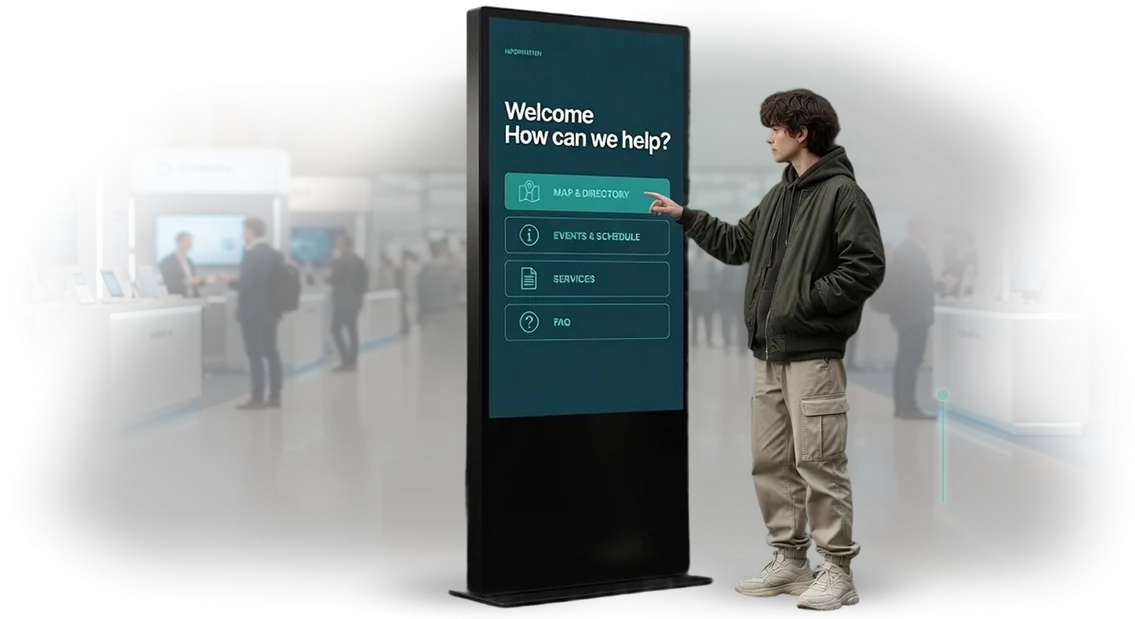
An interactive kiosk in a bank changes this dynamic. Visitors independently perform typical operations — statements, certificates, payments, data updates — without a teller’s help and at any time, even when the windows are busy.
This removes peak load, reduces bank queues several times over, and gives employees back their core value: live interaction with complex customers.
Customer service becomes predictable: the average visit time drops and satisfaction rises. The kiosk acts as an extra “employee” that never gets tired, never makes a mistake in the scenario, and frees staff for truly important tasks. Branch automation thus becomes a measurable tool for improving service quality.
We have already helped banks implement such solutions: we analyze branch traffic, design scenarios for specific operations, and launch kiosks so they fit naturally into the service.
This experience eliminates the pain of queues and dissatisfaction — only the reduced waiting-time figure and grateful customers remain.
What you get from implementing interactive kiosks
Benefit: customer loyalty
Customers value fast service, especially for everyday banking operations. An interactive kiosk lets them get a statement, pay for a service, or get a consultation without a queue — at a convenient time. This reduces frustration and increases the likelihood of repeat visits.
We design kiosks so that the interface is clear to any user and the screen does not look out of place in your office. The result is that customers perceive the kiosk as part of the bank’s care, not as a replacement for live communication.
Benefit: service speed
The kiosk handles typical requests: balance checks, top-ups, and certificate orders. Tellers are freed up for complex questions, and average service time is cut significantly. The bank processes more customers without expanding staff.
This is especially important for high-traffic branches: the kiosk relieves peak hours and smooths out queues. Employees can devote more attention to tasks that really require expertise.
Benefit: digital bank recognition
A modern touchscreen kiosk is a noticeable office element that reinforces the image of a tech-savvy bank. It shows that the bank keeps pace with customer expectations and draws attention to digital services. The kiosk acts as additional advertising and increases trust in the brand.
Such a kiosk fits easily into the branch design and becomes a magnet for visitors. They try new services, learn about the mobile app, and gradually switch to digital banking.
Formats of interactive kiosks for banks
An interactive kiosk in a bank solves three tasks: it shortens the queue, suggests products to the client, and collects data for managers. But the same scenario does not suit both a branch and an outdoor event. That is why we offer three formats — each with its own logic and its own set of screens.
Three formats for your needs
| Format | For whom | What the client gets |
|---|---|---|
| Branch kiosk | Visitors who want to quickly get a certificate, book an appointment with a specialist, or calculate a loan | Reduces staff workload, cuts waiting time, suggests suitable products to the client |
| Mobile kiosk for events | Participants of exhibitions, forums, and conferences where a bright stand is needed without depending on a power outlet or internet | Attracts attention, engages in game scenarios, collects applications and contacts in one place |
| Mobile office kiosk | Clients on the go: in remote areas, at enterprises, when serving legal entities | Provides the full range of services as in a branch, issues products on the spot, presents the bank as modern and technological |
Kiosk software is configured for each format: strict operations on a stationary stand, a bright quiz with prizes at events, and quick startup in a mobile office. All changes are made remotely, without an engineer visit.
As a result, the customer gets not just a stand with a screen, but a tool that truly relieves staff and attracts new customers. We select the format, configure the scenarios, and handle the launch.
Project development stages for kiosks
For banks, not only the technology itself matters, but also process manageability: when every stage is clear, deadlines are transparent, and the result can be accepted in phases.
We structure the work so that you always know what stage the project is at, what decisions are being made, and what comes next.
Below is a typical kiosk implementation process that we have refined on projects for banks and retail. It is adjusted to your specifics, but the logic remains clear and repeatable.
- Brief and immersion into the tasks. We study your branches, service scenarios, and customer expectations. The output is a document with project goals and success criteria so that everyone involved understands where we are heading.
- Project plan and solution architecture. We define stages, deadlines, responsible parties, and control points. You get a work schedule and a budget understanding before development begins.
- Design concept and interface scenarios. We design the screen logic and visual style that fits your brand image. Layouts are approved before programming starts — this saves time on rework.
- Development and integration with banking systems. We connect the kiosk to your services in compliance with security and data protection requirements. At this stage, you see a working version and can test it in parallel with the team.
- Launch preparation. We test on real equipment, check stability and interface usability for different types of users. We eliminate issues before a visitor ever sees the kiosk.
- Pilot launch and staff training. We install the kiosk in one branch, collect feedback from employees and customers, and make final adjustments. We conduct training — your specialists become confident users of the solution.
- Scaling and support. We roll the project out to all locations, connect monitoring and regular updates. If necessary, we develop the functionality — adding new services or scenarios without stopping operations.
In the end, you get not just a technical delivery, but a manageable project with clear stages and a guaranteed result: kiosks launch on time, work reliably, and genuinely simplify service for your customers.
What is included in the interactive kiosk delivery package
An interactive kiosk for a bank is not just a touchscreen terminal. When delivering kiosks, we provide a complete package: enclosure, software, installation, and staff instructions. On installation day, you receive a ready-made turnkey solution.
- Enclosure and screen — a durable design with scratch and glare protection. The model is selected according to the branch format or self-service area.
- Pre-installed software — customer interface: currency rates, products, branches, and ATMs. We adapt the design to the bank’s corporate style.
- Admin panel — a web interface for employees. Allows changing promotions, adding news, and managing content without involving developers.
- Installation and setup — delivery, installation, network and power connection. We test scenarios from power-on to customer interaction.
- Staff instructions — printed and electronic guides: starting the kiosk, updating information, and actions in an emergency.
- Staff training — a short training session for administrators so that employees can help visitors and do not call support for minor issues.
- Warranty and support — remote technical support and an on-site visit when necessary.
In the end, you get a kiosk package that is ready to work immediately. You will not have to assemble a “construction set” from different contractors — one contract, one responsible party, one clear result.
Case study: conversion growth after kiosk installation
For a regional bank, we designed and installed interactive kiosks in three high-traffic branches.
The goal was not just to “put a customer in front of a screen,” but to reduce the load on tellers and speed up the issuance of standard certificates — these were exactly what created queues during peak hours.
After a quarter, the bank recorded changes based on its own statistics and observations from floor managers.
Implementation results
The main effect: queues in branches dropped by 40%. Customers stopped waiting for a specialist to get a statement or certificate: the document is printed at the kiosk in a couple of minutes, without calls to the call center or repeat visits.
The number of certificates issued grew by almost a third, and tellers gained free time for consultations on deposits and credit products.
The conversion growth was also visible in visitor behavior. In a post-visit survey, more than 70% of customers noted that service had become faster, and a third of respondents deliberately returned to the branch where the kiosk was installed.
For the bank, this means not only loyalty, but also an additional flow of inquiries without increasing staff or advertising investment.
Positive feedback also concerned staff work: employees stopped being distracted by routine operations and began to spend more time on complex requests. Floor managers note that queues dissipate faster even on payout days, when the hall used to be overcrowded.
The project was implemented on the HTML5 platform we use, which integrates easily with banking systems and does not require installing additional software on workstations.
The successful case was scaled to other bank branches — this confirms the reliability of the solution and the accuracy of the embedded scenarios.
What matters most to the client is that the effect is measured not by terminal uptime, but by real metrics: reduced queues, an increased number of issued documents, and satisfied customers.
How to choose a kiosk format for banks?
The answer depends not on trendy features, but on two questions: what tasks the bank wants the kiosk to solve and how many visitors it should serve. If you need to relieve the branch and speed up certificate issuance, a compact wall-mounted solution at the entrance is sufficient.
If the goal is to inform customers about products and engage them in dialogue, you will need a touch panel with a large screen and an intuitive interface. We start from business goals, not from a “standard set of functions”.
Kiosk selection criteria for banks typically fall into four groups. The first is usage scenarios: issuing electronic queue tickets, appointment booking, viewing products, accepting applications.
The second is branch foot traffic: the higher the flow, the more important fast response and stable operation throughout the day. The third is placement: in the lobby, at the information desk, or in the waiting area — this determines the dimensions and mounting method.
The fourth is the kiosk budget, which determines the choice between a basic model and an extended configuration.
At the same time, you should not look for a single right format — it is often better to combine. One large kiosk at the entrance for navigation and several compact ones in the operating hall for urgent certificates.
This scheme reduces the load on employees and shortens queues, while the customer gets service at any convenient location. We help plan the layout and number of devices based on real traffic, so that overpaying for unused functions does not eat the budget.
The kiosk budget includes not only equipment, but also interface development and ongoing support. A simple menu for one task will cost significantly less than a multi-level portal with a personal account.
Therefore, at the start, we define mandatory and desired functionality: this allows us to choose a format that fully covers the bank’s current tasks and leaves room for expansion without completely replacing the device.
The main advice is to start with an audit of tasks and premises, not with choosing the enclosure. We conduct this audit and, within a few days, provide a cost estimate with clear usage scenarios for each kiosk. You get a solution that pays off and, months later, remains convenient for both visitors and staff.
Frequently asked questions about kiosk development
Before ordering an interactive kiosk, bank customers ask the same questions about kiosks: reliability, development timelines, the kiosk warranty, and repair in case of breakdown. This is expected — how often the terminal sits idle affects branch workload and visitor impressions.
We have collected short answers to the main questions. If your scenario is not here, write to us and we will suggest a solution.
What is the kiosk warranty and what does it cover?
The kiosk warranty covers the enclosure, touchscreen, payment module, and pre-installed software. During the warranty period, we fix faults at our own expense: replacement of components, sensor adjustment, and firmware updates.
How long does kiosk development take?
A typical project takes 3–6 weeks from the moment layouts are approved. Timelines depend on the scope of functions: from a service menu to appointment booking and payment acceptance. At the start, we set a schedule and stick to it.
What should I do if the kiosk breaks down after launch?
Engineers are available during working hours. We solve most problems remotely: we connect to the kiosk and restore operation in one session. If parts need to be replaced, we arrange kiosk repair at a service center and return the device after testing.
Can the kiosk be modified after launch?
Yes, menus and scenarios are updated without stopping the kiosk. You can add new banking products, change tariffs, or launch promotions. This is not a new project but a modification request: you leave a request, we estimate the timeline and make the changes.
Start your project: interactive kiosks for your bank
Interactive kiosks have long become the entry point to a digital bank: they accept applications, issue certificates, and help with services — without a queue or a consultant.
We have been delivering such turnkey solutions for 10 years, so we handle the entire journey: from the touchscreen scenario to installation and support.
What you get after placing an order
- Turnkey development — from interface design to testing on real equipment; you do not deal with technical issues but control timelines and results.
- A kiosk that fits your brand — corporate colors, adaptation to your products and customer service logic.
- Lower branch workload — customers handle typical operations themselves, while employees focus on complex issues and sales.
- Fast launch — only a few weeks pass from brief to working kiosk, not months, so you quickly see results.
- Post-launch support — content updates, problem resolution, and scenario refinements according to your needs.
Simply leave a request on the website — we will send examples of banking projects, calculate the cost, and show how the kiosk will pay off in your branch.
In 30 minutes, we will discuss the scenario that solves your challenge and offer an option that fits your budget and timelines.
Do not postpone the modernization of customer service: the earlier we start, the sooner your visitors will appreciate the convenience and your branch will appreciate the reduced queues. Call or write to us — we will call back, answer your questions, and prepare a commercial proposal.