

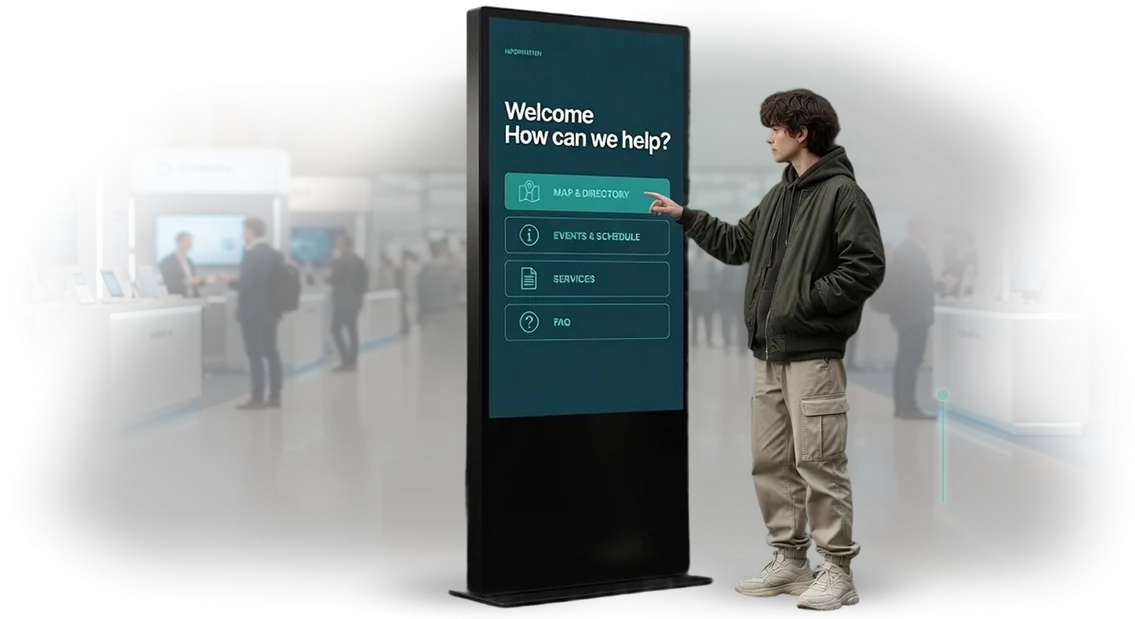
Interactive Kiosks for Construction Companies: Why You Need Them
A visitor to a construction company's sales office arrives with one key question: does the layout suit them, when will the building be completed, and what has already been done on the site.
While the manager is busy with other clients, some potential buyers get tired of waiting and leave for a competing project. Every such departure is a lost deal that even good advertising cannot compensate for.
A touchscreen kiosk for a developer solves this problem. Interactive kiosks installed in the sales office take over the routine: the buyer selects the building, floor, and apartment type, explores layouts, and reviews property specifications.
The manager steps in once it's clear what the client needs — and spends time discussing details instead of delivering the initial presentation.
A sales office kiosk never gets tired and never gets distracted. Information kiosks save the day during peak hours when there are more visitors than the team can handle: no one is left without attention, the queue moves faster, and consultations happen at a comfortable pace.
For a construction company, this means higher conversion from inquiry to deal and satisfied clients who recommend the project to their friends.
What's more, a touchscreen kiosk for a developer creates the image of a modern company that respects its buyers' time — a nice bonus in the competitive battle for customers in the real estate market, where buyers today choose not just an apartment but also the level of service.
What a Modern Information Kiosk Brings to Your Business
Increased Trust in the Company
A modern information kiosk immediately sets a company apart from competitors where clients have to wait for a manager or search through printed materials. A touchscreen in a sales office or showroom creates the impression of a tech-savvy and reliable business.
Visitors see that the company invests in comfort and service — and this directly influences the purchase decision.
This matters especially in construction: buying an apartment, house, or building materials involves large sums and long timelines.
When a developer greets a client with a convenient navigator and a clear showcase of properties, trust grows even before the conversation with the manager.
Faster Service Without Queues
The kiosk handles routine questions: showing layouts, explaining finishing options, calculating material costs, or booking a viewing. The client gets an answer in a couple of screen taps, while the consultant focuses on those who really need live communication. During peak hours, this relieves staff and shortens wait times.
Even if several visitors are in the office at once, each can independently explore properties and options. As a result, no one leaves without information, and the company doesn't lose potential sales to rush and queues.
Additional Sales
The kiosk can offer more than the client asked for. By showing promotions, current projects, or add-on services — for example, mortgage program selection, parking, or storage rooms — it gently increases the average ticket. On-screen prompts work at the right moment and don't require staff involvement.
Additionally, the kiosk collects visitor contacts and preferences. This data can be used for follow-up communications: sending a selection of suitable options, reminding about a booking, or announcing new properties. A one-time visit becomes a long-term relationship with the client.
Business Benefits That Are Easy to Measure
An information kiosk pays for itself through three sources: higher brand trust, faster service without hiring additional staff, and more sales thanks to automatic prompts.
For construction companies, it's also a way to present information about all properties consistently, so clients get the same quality experience at any sales office.
A modern kiosk is not just a screen in the corner — it's a full-fledged tool that delivers measurable value to the business.
Formats of Interactive Kiosks for Construction Companies
For a construction company, it's important not just to show a property on a website, but to let clients explore layouts, calculate mortgages, and compare options on their own at the moment they want to.
An interactive kiosk takes some of the load off managers and helps visitors make decisions faster. But for it to work, you need to choose the right format — based on installation location, usage scenario, and company style.
Here are the main touchscreen kiosk formats we develop for construction companies:
| Format | Where It's Used | What It Gives the Client |
|---|---|---|
| Wall-mounted kiosk | Sales office entrance area, hallway, small space | Compact placement, takes up no usable floor space. Visitors explore current projects and layouts while waiting for a meeting with the manager |
| Floor-standing information kiosk | Showroom, exhibition stand, spacious office | Attracts attention, builds the image of a modern company. Allows detailed virtual tours of properties and comparison of finishing options |
| Tabletop kiosk (for sales offices) | Documentation area, manager's workstation | Speeds up option selection: client and staff together change floor, view, check price and availability, and immediately book the options they're interested in |
The key point is not just the type of housing but ease of use. The screen should be at the right height, the interface should be clear to someone with no training, and the design should fit the interior without creating barriers.
We manufacture housings to custom sizes and tailor the configuration to your task: from anti-vandal versions for public areas to lightweight constructions for exhibitions.
We'll help you choose the kiosk format for your sales office, showroom, or exhibition stand, and provide a cost estimate and timeline. Leave a request — we'll show you examples of our work and prepare an interactive solution that will work for your results.
How Kiosk Development Works: Stages for the Client
A clear path from the first brief to a working kiosk — without unnecessary technical complexity. We've structured the process so that you see results at every stage, understand the timeline, and can influence the work, while we handle all the technical details.
To order an information kiosk, just start with the first stage — we'll guide you by the hand all the way to launch.
-
We discuss the task and gather requirements. You tell us where the kiosk will be placed — in a sales office, at an exhibition, or in the company lobby. We find out what matters most: showing layouts, telling the story of the developer, or helping visitors choose an apartment. We agree on the list of materials needed from you and confirm deadlines for each stage.
-
Analytics and prototype. Based on your task, we develop the kiosk structure: sections, navigation logic, visitor scenarios. We build a clickable prototype — you see how the interface will work before development begins.
-
Design and content preparation. We create design mockups in your company's brand style. We help structure photos, layouts, and project texts. If materials are missing, we offer our own options and finalize them.
-
System assembly on professional equipment. We install the touchscreen, connect the kiosk, and configure all sections for fast operation. At this stage, you can already test the logic and make edits before the official launch.
-
Testing and acceptance. We test the kiosk in real conditions: navigation comfort, response speed, correct display of layouts and prices. We go through all scenarios together with you — from the main menu to submitting a request. Only after your approval do we move to installation.
-
Launch and staff training. We mount the kiosk on site and set up remote information updates. We provide brief training for your managers: how to turn the kiosk on, change a promotion, or add a new building to the database — no special skills required.
-
Support and development. After launch, we stay in touch. We remotely update content, add new features, and expand the structure when needed. We provide a warranty on equipment and work.
This process makes the launch of a touchscreen kiosk transparent and safe: you always know where you are, what you'll get, and what you're paying for. We manage the project turnkey — from idea to a working sales tool.
What's Included in the Interactive Kiosk Delivery
When you order an interactive kiosk for a construction company, you get not just a touchscreen panel but a complete, launch-ready solution. We handle the entire delivery scope — from the usage scenario to staff training.
That's why the cost includes everything needed for a quick start and comfortable day-to-day operation.
- Scenario and interface design. We develop the kiosk logic around construction industry needs: project catalog, layouts, cost calculation, promotions, sales department contacts. Visitors find what they need on their own without a manager's help.
- Building a modern web application. The kiosk runs on any touchscreen, starts quickly, and stays stable under peak-hour load. Content updates require no dismantling or complicated re-flashing.
- Equipment selection and delivery. We offer housing options: floor-standing towers, wall-mounted panels, and outdoor models. All equipment is certified and covered by the manufacturer's warranty.
- On-site installation and setup. We deliver, mount, connect, and configure the kiosk for your network and premises. We verify everything works before handover.
- Administration and content management. We provide an easy-to-use system where you can change prices, property descriptions, photos, and news yourself. No need to wait for a programmer for every edit.
- Staff training. We instruct managers and administrators: how to use the kiosk, solve common problems, and assist visitors.
- Warranty support. For the agreed period, we support the project: phone consultations, prompt issue resolution, and system updates when new features are released.
This delivery scope covers all business needs: you get a tool that works from day one, not a box of parts to assemble and configure. Everything included in the cost is documented in the contract — no hidden charges.
Case Study: Interactive Kiosk in a Sales Office — Measurable Results
A major developer, StroyInvest, had a serious problem in its sales office: queues reached 15 people during peak hours, managers repeated the same information for 20 minutes at a time, and some clients gave up waiting and left for competitors. The losses were obvious — every family that left meant a missed deal.
To relieve staff and speed up service, we developed a touchscreen kiosk for the sales office. The screen shows all the company's projects, current layouts, prices, construction stage, and even a preliminary mortgage calculation.
Visitors find answers to typical questions on their own, and the manager steps in at the live conversation stage.
What Changed After Installation
Wait time dropped from 15 to 3 minutes, and the number of inquiries grew by a third. The kiosk became an additional sales tool: clients spend time studying options, comparing apartments, and this increases visit-to-inquiry conversion. The developer saw measurable results in the first month.
Two months later, the company ordered the same kiosks for all its sales offices. The system now runs around the clock, and management notes that the kiosk has become a point of attraction for buyers — even people just walking through the residential complex stop to use it.
For us, this project confirms that a properly built interactive kiosk pays for itself and becomes part of the customer experience. You don't need technical details — you need results that make sense to the business: faster service, more inquiries, satisfied clients.
How to Choose the Right Interactive Kiosk Format for Your Task?
Choosing a kiosk format isn't about technology — it's about the tasks it must solve in your business.
The same touchscreen can be a showcase for new developments, a residential complex navigator, a price catalog, or a lead-generation tool — it all depends on where it stands and who it serves.
The first step is to define the scenario. In a sales office, clients come for specifics: layouts, timelines, mortgages. Here the kiosk works as a "sales consultant" that answers typical questions and shows visualizations.
At an off-site exhibition or in a shopping mall, the task is different — attract attention, engage visitors, and quickly capture contact details.
In a developer's lobby, it can be an information kiosk that relieves the administrator and creates the impression of a tech-forward company.
The second factor is the installation location and usage scenario. A floor-standing kiosk with a large screen suits busy places where people can spend time. A wall-mounted model saves space and complements the reception area.
For a meeting room, a tablet in a docking station works well — it's mobile and can be handed around for presentations. Each configuration has its own logic and service life depending on traffic and room conditions.
The third point is the depth of interaction. If all you need is to show 5 layouts and 3 photos, a simple presentation is enough.
But if you want visitors to filter apartments by parameters, compare options, and leave inquiries, you need a full catalog with cost calculation and CRM integration.
We choose the format based on the outcome: a one-time promotion, a long-term showcase, or a permanent sales department tool.
Don't try to pick a "universal" kiosk — it doesn't exist. Instead, start with a 15-minute brief: describe your situation, and we'll offer three implementation options with different budgets.
The result is a tool that pays for itself: reduces manager workload, increases inquiry conversion, and builds the image of a company people enjoy doing business with.
Frequently Asked Questions and Concerns Before Ordering
Before trusting us with a project, clients usually ask a few questions. That's normal: it's important to understand how the work will go, how quickly you'll get results, and what happens if something fails. We've gathered the most common concerns — and we answer them honestly, with no fine print.
How long will kiosk development take?
The timeline depends only on the amount of content and required features. We launch a basic kiosk with a property catalog, layouts, and contacts in 2–3 weeks.
If you need CRM integrations, a personal account, or interactive layouts, the timeline increases — but you'll always get a clear schedule with fixed milestones.
Can our staff update information without a programmer?
Yes. We build a user-friendly admin panel where you can upload new layouts, change prices, or add a promotion. Training takes a couple of hours, and all actions come down to simple forms — no code involved.
What happens if the kiosk freezes or breaks down?
The system automatically reboots after a failure — that's the standard scenario. We also set up remote monitoring that alerts us about issues in advance, often before visitors even notice. All equipment is under warranty, and the contract specifies our response time to your request.
Who is responsible for the hardware and servers?
We can provide the full cycle: supply reliable touchscreen panels, set up secure access, and regularly update the system. You get a single point of responsibility — no need to search for separate contractors.
We've already delivered projects for several construction companies and know how to make a kiosk a working sales tool rather than a source of headaches. Terms — timelines, guarantees, support procedures — are fixed in the contract so you can make your decision with no hidden risks.Order a Turnkey Interactive Kiosk — Start with a Technical Specification
To order an interactive kiosk, you don't need to dive into technical details. Just describe the task — we'll handle the rest. We'll advise on the most effective format for a construction company: project showcases, residential complex layouts, or a material catalog with prices. You'll get a solution that speeds up your managers' work and boosts visitor engagement.
Leave a request for a touchscreen kiosk — and within one business day, we'll send you a clear proposal with timeline and cost details. Right after you reach out, we will:
- discuss your goals and recommend which kiosk usage scenarios will deliver the best results;
- prepare a technical specification for your site, sales office, or exhibition stand;
- calculate the exact turnkey kiosk development cost with no hidden charges;
- show examples of solutions for the construction industry: property presentations, interactive layouts, finishing visualizations;
- handle development, assembly, and equipment setup — you get a launch-ready kiosk;
- provide a warranty and post-launch support so technology never distracts you from sales.
This comes with no obligation. You'll learn what goes into a turnkey kiosk and can decide at your own pace. Just send the request — we'll take care of the rest.