

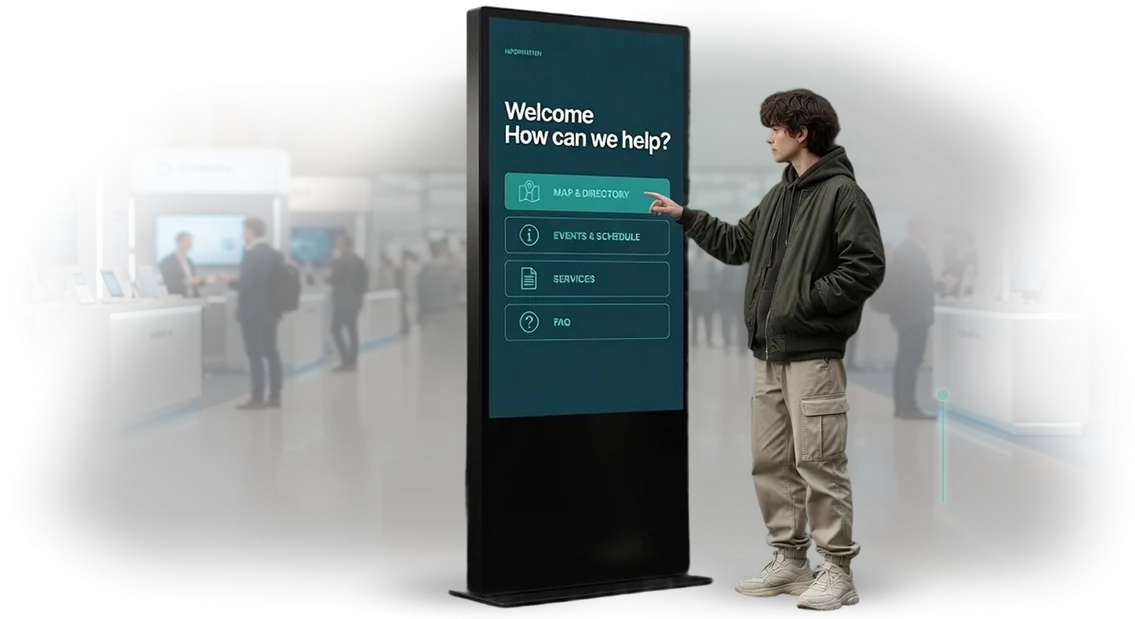
Airport navigation: how interactive kiosks eliminate queues
In a large airport, a passenger spends more time finding the right gate than going through check-in itself. Confusion, queues at information desks, repeated questions to staff — a familiar picture for anyone who has flown unaccompanied.
Airport navigation becomes the first impression and the decisive factor in whether a passenger makes their flight or stays in the waiting area with negative feelings.
For the airport, this is also a direct loss: overloaded staff, boarding delays, negative reviews, and strain on infrastructure. Every extra question at the desk is minutes that other passengers lack.
That is why modern airports are shifting passenger service to a clear self-service format — interactive kiosks that work like a personal navigator.
Interactive kiosks replace part of the functions of classic information desks: they show the route to the check-in counter, gate, cafe, pharmacy, or connection point. The passenger gets an answer in seconds, without waiting in line and without staff involvement.
The system instantly accounts for changes: flight rescheduling, gate closure, or gate replacement — information is always up to date and requires no repeated explanation.
The main result is that the airport evens out the flow of people, reduces the load on staff, and decreases the number of missed flights. Passengers feel confident at every stage, worry less, and are more willing to return to the airport again.
Management gets manageable airport navigation that is easy to scale and update without retraining staff.
We have been working on such solutions for more than ten years and know how to integrate them into airport operations without failures or a long adaptation period.
Our interactive kiosks are not just screens but part of a passenger service system that saves staff hours and makes every flight calmer. In short: we solve the navigation pain, turning chaos into a clear route.
What you get from interactive kiosks: key benefits
At an airport, every passenger minute matters. Interactive kiosks help passengers quickly get the information they need, arrange a service, or find their boarding gate — without queues and stress.
This is immediately noticeable: passengers feel cared for, and the airport gains a reputation as modern and convenient.
Image benefits
Passengers remember not only the cleanliness and signage, but also how easy it was to resolve their question. A kiosk with a clear interface and a terminal map creates an impression of high service standards.
Guests willingly share this experience in reviews and on social media — that is free advertising for the airport.
In addition, modern kiosks look technological and neat, reinforcing the brand identity. Interactive panels can tell passengers about destinations, services, and special offers — every passenger sees that the airport is developing and cares about details.
Operational efficiency benefits
Interactive kiosks take over routine questions: how to get to the check-in counter, where the luggage storage is, how to call a taxi. Staff stop repeating the same answers and focus on actually helping passengers — especially during peak hours. This reduces the load on personnel and speeds up service.
Kiosks also collect statistics: which sections are in demand, where passengers go most often. Based on this data, navigation can be improved and passenger flows redistributed — the benefits of kiosks become measurable. The improvement in service is noticeable to both passengers and management.
The main point is that the benefits of interactive kiosks are not limited to comfort. They free up staff time, make airport operations more predictable, and provide a foundation for further development of digital services.
As a result, you get a calmer, more manageable, and more modern waiting area — and passengers appreciate it.
Information kiosk formats for different airport zones
An airport passenger always has two tasks — making it to their flight on time and quickly finding their way around an unfamiliar place.
The same kiosk does not solve these tasks equally well in the departure and arrival zones, so the format is chosen to match the specific navigation point.
Departure zone: speed and route
A floor-standing kiosk installed near check-in counters or before security helps a passenger build a route to the boarding gate and estimate travel time.
A touchscreen stand in the waiting area shows the terminal layout, shops, and cafes — the person stops searching for signs and gets down to business.
Arrival zone: greeters and transit
In the arrival zone, wall-mounted kiosks are more common — they do not block the way and are visible even in a crowd.
Near baggage claim and at the terminal exit, such a kiosk shows flight status, a city map, hotels, and transfers: a greeter plans their route in advance, while a transit passenger checks their connection time.
| Kiosk format | Airport zone | What it gives the passenger | What it gives the airport |
|---|---|---|---|
| Floor-standing kiosk | Departure zone | Route to the gate, time to boarding | Fewer inquiries to staff |
| Wall-mounted kiosk | Arrival zone | City map, transfer, hotels | Additional services and revenue |
| Touchscreen stand | Transit zone and gates | Navigation assistance, flight check | Relieves information desks |
The formats are easy to combine: a floor-standing kiosk in the center of the hall, wall-mounted units along the way to the gates. We select the configuration based on passenger flow and terminal layout — so that every screen answers the passenger's main question.
Interactive kiosk development stages: from brief to launch
Developing a kiosk for an airport is not just installing a device; it is a structured process where each project stage protects you from missed deadlines and hidden costs.
That is why we have divided the work into clear steps — you see what you pay for and what you get at each stage.
- Brief and task analysis. You tell us which scenarios passengers need: schedules, terminal map, advertising, service booking. We study the audience, installation points, and people flow.
- Plan and estimate. We lock in the functions, section structure, and timelines. You get a transparent plan with no hidden work.
- Design approval. We show a prototype of the screens: button placement, fonts, colors in your brand style. We make revisions before development starts.
- Development. We build the kiosk: interface, navigation logic, connection to the schedule and airport systems. We use professional equipment to ensure a stable result.
Testing and launch
- Testing. We check real-life scenarios: touchscreens, bright light, queues at the kiosk. You try the kiosk yourself and approve readiness.
- Kiosk launch. We install the device on site, set up communication with servers, and train staff to update content.
- Support and development. After launch, we quickly make schedule changes, add sections, and monitor performance.
In summary: we do not hand over a "raw" product — we deliver a working kiosk that is convenient for passengers and does not require constant supervision on your part.
What is included in the delivery: a complete kit for your kiosk
Everything needed to launch the kiosk is already in the package. You get not a "raw development" but a ready-made solution: installed software, operating instructions, and support at all stages.
You do not need to search for, purchase, or configure anything additional — you simply connect the kiosk and hand it over to visitors.
Basic package
- Ready-made software with a usage license — the interactive interface is adapted for the touchscreen, works stably, and requires no technical knowledge from your staff.
- Operating instructions — simple and clear reference guides for personnel: how to turn on the kiosk, change content, restart it if necessary. No "technical hell."
- Staff training — we conduct a short training session for your team: 30–40 minutes, and administrators confidently work with the system, update schedules, and add information.
- Warranty on software and hardware — we formalize the warranty period in the contract. If failures occur, you are not left alone with the problem.
- Technical support — available by phone and in messengers. We help with setup, answer staff questions, and promptly resolve abnormal situations.
- Basic analytics — access to interaction statistics: how many visitors used the kiosk, which sections are viewed most often, how much time they spend. This data helps improve navigation and content.
Additional options
For those who want to expand functionality, we offer optional modules: booking system integration, CRM data loading, multilingual interfaces, remote content management, a display window for promotions and special offers. We can also implement a custom design code for your brand and non-standard enclosure form factors.
The outcome: after project delivery, you have everything you need — from installed software to a trained team. You focus on passenger service, and the technical side stays with us.
Real result: navigation became simpler and faster
At airports, every passenger minute costs money: a missed flight means a lost connection, a queue at the counter, and strain on staff. Ordinary signs and waiting areas do not solve the main task — quickly and stress-free guiding a person from the entrance to the right gate.
We built interactive navigation based on touchscreen kiosks for one regional airport, which solved this pain.
Project details
How it worked: a passenger approaches the kiosk, selects their flight or enters a destination — the system builds a route based on the current terminal and gates. The map loads without delays, and the interface is clear even to first-time flyers.
At the core are refined mapping data similar to what Yandex Maps uses, so the accuracy of object placement was verified against the real building geometry.
"In the first month of kiosk operation, passengers began spending on average a quarter less time getting to their boarding gate.
The number of questions to staff at navigation desks nearly halved, and we placed the repeat order for the next season without discussion" — head of the airport's passenger transportation service.
The result for the airport was measured not in technical parameters but in business metrics: the speed of getting to the gate increased, staff stopped being constantly distracted by "where is my terminal," and the kiosk itself became a point of attraction — passengers photograph the map and share it on social media, which additionally boosts the airport's recognition.
We delivered this project in four weeks from brief to launch, with the flight schedule integration configured so that data updated automatically.
For the airport, this means the kiosk does not become outdated when the flight network changes and does not require constant manual intervention.
How to choose the right kiosk format for your task?
When choosing a kiosk, focus not on the device model but on the task it solves. The same scenario can work in different enclosures — what matters is how the passenger interacts with the screen and where it is installed.
Therefore, selecting a format should start with two questions: what should a person do at the kiosk, and how much time do they have for it.
For quick operations — flight search, boarding gate lookup, viewing the terminal map — vertical stands with a large screen are convenient. They are visible from afar, fit naturally into the passenger flow, and do not create queues.
If the kiosk must replace a live check-in or information window, a design with a seating area and a private zone is better. This format lowers the barrier to interacting with technology and allows all steps to be completed at ease.
The key criterion is the installation location and accessibility. In the waiting area or near the entrance, a floor-standing kiosk with reinforced impact and vandal protection is appropriate.
For an information counter where staff are nearby, a compact wall-mounted panel works well. And for spaces with limited room — a mobile stand that can be moved during peak hours.
Choosing the right format is not a matter of appearance but a matter of how many passengers can easily use the service without staff assistance.
If you are unsure which kiosk to choose for the airport, start with a scenario audit: count the flows, identify peak loads, and typical passenger questions.
Based on this, we will select the construction, placement, and interface — there are proven developments and ready-made solutions for each format.
The result is a kiosk that is convenient for guests and requires minimal maintenance, not "expensive hardware for the sake of a checkbox."
Frequently asked questions about interactive kiosk development
Before launching kiosks at an airport, clients ask the same questions about kiosks: how quickly the solution will pay off, what happens during a failure, and who is responsible for maintenance. We explain the essentials — without technical details that do not affect passengers.
Is the kiosk reliable? Will it fail during peak hours?
This is the most common question, and we answer it honestly: kiosks are designed for round-the-clock operation in high passenger flow areas. They are built on industrial components with surge protection, and built-in diagnostics report potential issues in advance.
If necessary, modules can be replaced within minutes, so even on a busy day passengers do not notice failures. All systems are covered by warranty and a maintenance contract.
Development and implementation timelines depend on the number of locations and the complexity of integration with the flight schedule, but on average a project takes from several weeks to a couple of months.
We lock in the stages in advance and deliver the work with a test period so airport staff have time to get used to the system.
If you still have questions about your airport's specific tasks, send them to us — we will explain how to solve the problem in your conditions.
Get a consultation and launch a kiosk into operation
An information kiosk at an airport is not a screen with a menu but a tool that relieves staff, reduces queues, and increases passenger loyalty. But any mistake in logic or interface immediately hits reputation and traffic.
To avoid this, you need not just a developer but a partner who will take on the entire journey — from idea to launch.
Leave a request for a consultation — and we will review your task during a meeting. We will explain how the kiosk will fit into airport operations and which scenarios will deliver the greatest return.
After your inquiry, you will receive:
- Expert assessment of the task — an analysis of current processes and points where the kiosk will reduce the load on staff and speed up passenger service.
- A prototype of the interface within the first days — you will see how the kiosk will look and work before development even starts, and you can make changes without extra costs.
- Turnkey development — we handle design, programming, and content preparation for your tasks.
- Integration with your services — online flight boards, booking system, service database — everything you already use will be connected.
- Testing in real conditions — we verify stability under peak loads so the kiosk does not fail at rush hour.
- Launch assistance and ongoing support — we provide support after launch, monitor updates, and respond quickly to inquiries.
We work remotely and have been implementing projects for airports and transport hubs for more than 10 years. This means you get a proven process, clear timelines, and a result that will not require rework.
Do not postpone the launch — we will discuss your task at the consultation, propose a solution, and show how the kiosk will pay off. Leave a request right now, and we will contact you within one business day.