

Why Corporate Onboarding Loses New Employees
The first weeks in a new company are the riskiest time: a significant percentage of newcomers leave without even waiting for the end of their probation period.
Most often the reason is simple — corporate onboarding looks like a set of boring presentations, PDF instructions, and long lectures that have nothing to do with reality. Instead of a sense of belonging, a person gets routine, and within a few days begins to doubt their choice.
For business, this is a double loss: on one hand — the budget spent on recruiting and training, on the other — lost profit because key positions remain open. Employee adaptation doesn't work if it doesn't evoke emotions and doesn't immerse a person in the company's culture.
Without employee engagement, it's impossible to build loyalty, and thus — reduce turnover and grow team stability.
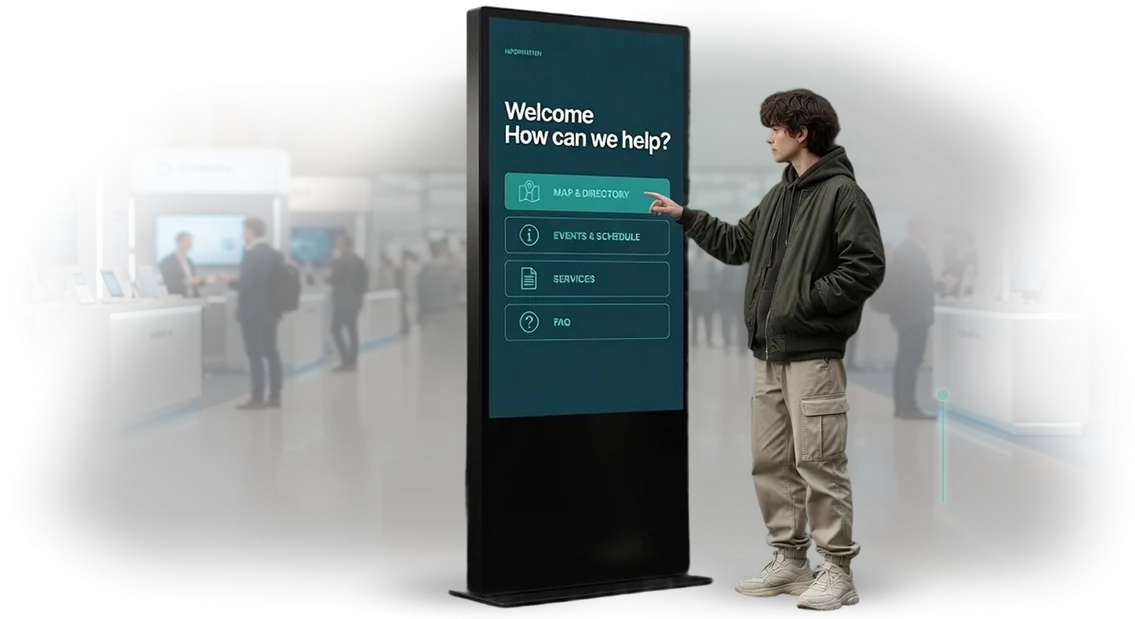
What do we offer? An interactive kiosk with a 3D application developed specifically for your corporate onboarding tasks.
Instead of dry texts — a living immersion: the new employee explores the office themselves, meets the team, learns the brand history and key rules through game scenarios on a touch panel. This approach engages from the first minute, making information easier and faster to absorb.
Corporate onboarding ceases to be a formality: a person enters the company's culture naturally, quickly adopts its values, and starts bringing real value sooner.
An interactive kiosk is not just equipment, but a tool that shortens the path from "newcomer" to fully-fledged employee.
By implementing it, you solve several tasks at once: increase employee engagement, reduce turnover, and create a modern employer image attractive to candidates.
What an Interactive Kiosk Gives to Business
An interactive kiosk is not just a screen in the lobby, but a full-fledged onboarding tool. It accelerates new employee adaptation, relieves HR of the routine of repetitive questions, and sets a unified information standard for the entire company.
All the advantages of kiosks come down to one thing: business gets a fast and predictable result without expanding staff and additional training costs.
A newcomer goes through the introductory material at a comfortable pace — not through two tedious days of lectures, but through short interactive sessions.
Engagement grows through 3D scenes and game mechanics: a person remembers values and regulations through action, not through reading.
The time to productivity is reduced several times over — from the first days, the employee understands the company's structure, rules, and expectations.
Adaptation without HR becomes a reality: the manager gets a person who already knows the basic processes and asks only substantive questions.
A single source of truth is another advantage. Information kiosks show everyone equally relevant data: changes in regulations, news, training modules. Content updates happen centrally and take effect instantly, so no one works with outdated instructions.
This is especially important for companies with multiple offices or regular hiring waves: all new employees in any location receive the same baseline.
To make the kiosk useful for years, we develop applications on the professional Unity engine. This delivers smooth 3D graphics, stable touchscreen performance, and easy integration with your internal systems.
You get not a "screen with text," but a manageable communication channel that pays off with every hiring wave and remains a talent development tool for a long time.
How to Choose the Format of Corporate Onboarding on Kiosks
The kiosk format determines how an employee interacts with the content: whether they'll approach the screen, how much time they're willing to spend, and how comfortable it will be to study the material.
It's not enough to install a monitor — it's important that the design matches the onboarding scenario and physically fits the office or lobby space.
We compared three popular options and broke down which one solves which specific task. At the core of all our solutions is a refined 3D platform Unity, so the image remains stable on any screen: from a compact desktop to a panoramic floor-standing unit.
| Kiosk format | Who it's for | What it gives the client |
|---|---|---|
| Floor-standing | Large lobbies, high-traffic areas, mass flows of newcomers | High visibility, engages even casual passersby. Suitable for immersive introduction to the brand and company history. |
| Wall-mounted | Narrow corridors, meeting rooms, waiting areas | Saves floor space, works as a permanent information point. Convenient for quick references: regulations, contacts, office map. |
| Desktop | HR offices, small groups up to 5 people | Personal training format — the employee goes through the scenario at their own pace. Ideal for knowledge testing and feedback. |
The choice comes down to three questions: how many people will use the kiosk simultaneously, what volume of information needs to be delivered, and where the device stands. A floor-standing kiosk pays off when onboarding is part of the company impression.
A wall-mounted one handles current questions without distracting from work tasks. A desktop one is great when an individual path and results control matter.
If in doubt, start with a pilot scenario in one format — we'll help you choose the design for your space and budget. An engineer visit, layout preparation, and test launch take from two weeks, and adapting to a new flow of employees doesn't require reworking the content.
Stages of Launching an Interactive Kiosk
We've built the kiosk launch as a transparent six-stage process. You always understand where the project is, what's already done, and what's next. No surprises in timelines — each step ends with an agreed result.
-
Brief and immersion. We study the company's tasks, audience, and corporate onboarding goals. We take into account who will use the kiosk and what scenarios are needed. We record the requirements and create a development plan with clear deadlines.
-
Prototype and scenarios. We show the screen structure and navigation logic between sections. You see the future kiosk at an early stage and make edits before expensive development begins — this saves time and budget.
-
Design and content. We create an interface in the brand style, prepare texts and training materials. The client gets not just a technical device, but an element of corporate culture that engages new employees.
-
Kiosk application development. We build the functionality: navigation, videos, mini-tests, feedback collection. We use proven tools, so the system doesn't need to be redone after launch.
-
Testing and kiosk deployment. We check all scenarios on a real device and train your team to work with the system. Then we install the kiosk in the desired location and connect it — everything works without failures on the first day.
-
Support and analytics. After launch, we stay in touch: update content, monitor stability, provide usage reports. You understand which sections interest employees and improve onboarding based on facts, not guesses.
What's Included in the Interactive Kiosk Delivery
You receive a turnkey solution — from choosing the enclosure to trained staff. No need to hire multiple contractors and coordinate their work: we're responsible for the entire cycle, and the kiosk works on launch day.
The standard package includes everything needed for launch and day-to-day operation:
- Kiosk hardware: touchscreen, protected enclosure, cables, and mounts — designed for intensive use in high-traffic areas.
- Design and content: interfaces, screensavers, texts, and videos in your brand style, ready to display.
- Software: an installed application with a simple admin panel. Content is changed without a programmer's help.
- Installation and connection: our engineer will come to the site, install the kiosk, connect power and network, and check all scenarios.
- Employee training: a short training session and instructions — how to update materials, turn the kiosk on and off, and resolve typical tasks.
- Warranty and service: coverage for equipment and work. In case of failure, we'll quickly replace components to keep operations running.
- Post-launch support: phone consultations and remote updates of software and content upon your request.
In the end, you get not "hardware," but a tool that solves the task of onboarding new employees. The whole team is responsible for the result — all you have to do is use the kiosk and track the effect.
Case Study: How a Kiosk Increased Engagement in a Company
When the federal hypermarket chain TorgProm approached us, the problem was familiar: new employees went through adaptation formally, didn't remember corporate standards, and nearly a third quit within the first six months without visible reasons.
The HR director complained that presentations and brochures didn't work — people flip through but don't engage.
We proposed replacing the boring introduction to the position with an interactive kiosk with a 3D application. It's not just a stand with text: the newcomer goes through a short game scenario where they get acquainted with the company's history, service principles, and team. The exercises make them apply knowledge immediately, not just read.
Results after launch
Two months after implementation, the number of employees successfully completing adaptation in the first week grew from 32% to 88%. Attrition during the probation period nearly halved, and the average score on the standards knowledge test rose from 3.4 to 4.9.
The HR department stopped spending time on repeated introductory lectures — the kiosk works on its own.
"The kiosk has become the favorite stage of onboarding," noted the HR director. "Newcomers approach it themselves and redo the scenario to improve their result. In the first three months, we cut adaptation costs by a third and saw real engagement."
Now the company is rolling out the solution to all regional branches. This case clearly shows: an interactive kiosk is not a lobby decoration, but a tool that measurably increases loyalty and speed of getting up to speed.
What to Do If You Need a Non-Standard Kiosk?
Yes, for many companies a standard kiosk with a screen and menu is just a starting point. The real request is often more complex: you need a non-standard enclosure shape, a special interaction scenario, or integration with the business's internal systems.
In such cases, a standard solution doesn't fit — and that's normal. We design the kiosk turnkey based on your specifics, not from a catalog of ready-made models.
An individual project starts with questions: who is your audience, what task does the kiosk solve, where will it stand, how will it fit the brand style.
The answers form the basis of the technical specification, according to which we develop the design, software, and usage scenarios.
You get not a "box with a menu," but a tool that solves a specific business task — whether it's employee onboarding, office navigation, or an interactive product presentation.
Importantly, non-standard doesn't mean long timelines and an unpredictable budget. We have proven approaches for creating non-standard kiosks: we pre-define requirements, approve the layout, and show the result stage by stage. You always understand what you'll get and when. The project also comes with a warranty and technical support — the kiosk works stably after launch.
If your task doesn't fit standard frameworks — that's more of a plus than a complication. A non-standard kiosk sets you apart from competitors and stays in visitors' memory. Tell us about your idea, and together we'll find a solution that works for your business. And below — answers to the questions clients most often ask when ordering an individual kiosk.
Frequently Asked Questions About Kiosk Development
A kiosk for corporate onboarding is an investment, and before launch, clients have the same doubts: won't it be expensive, will deadlines slip, will a programmer be needed for updates, what to do if the equipment fails on a crucial day.
We understand these fears, so we answer the main questions without technical jargon — in the language of business value.
How much does kiosk development cost?
The cost depends on the scenario: a single screen menu with materials will be cheaper than a full-fledged interactive orientation game with several scenes. In any case, we fix the estimate after the brief and write it into the contract. You know the final amount in advance and won't face hidden surcharges.
What are the development timelines?
A typical project takes from three to six weeks: from scenario and design to testing and equipment installation.
In the contract, we specify a concrete delivery date, not a vague "as soon as ready." If the kiosk is needed for an event — we build in a time buffer and deliver the finished system a couple of days before the start.
Is it difficult to update content?
No. You don't need a developer for every replacement: texts, photos, and videos are uploaded through a simple administration interface. An employee without technical background can change a schedule, add news, or update a presentation in a couple of minutes.
What happens if the kiosk breaks down?
The equipment and software are covered by warranty. If a problem occurs, we run remote diagnostics and quickly replace components or the kiosk itself. For ongoing programs, we offer a support agreement — a specialist will be available on every day of onboarding.
The kiosk shouldn't become a source of stress for the team. We handle the entire technical side — from assembly to warranty service — and you focus on the training content and the impression new employees get.Order an Interactive Kiosk for Your Company
An interactive kiosk for a company is a tool that immediately starts working for the business: it helps new employees get up to speed faster, reduces the workload on the HR department, and creates a modern employer image.
But value comes not from the enclosure with a screen itself, but from a well-thought-out scenario, interface, and content. That's exactly what we design for your task — from a branded welcome to navigation through internal regulations.
You receive a turnkey solution: we take on development, setup, launch, and support. You control the result, not the processes you don't need to understand.
What you get when you order a kiosk from us:
- Accurate cost calculation for your task — you see the numbers before work starts, with no hidden surcharges.
- A consultation with a specialist who speaks the language of business, not technical terms.
- A clear project plan with timelines and stages — you know what and when you'll receive.
- An onboarding scenario adapted to your company: from brand history to employee instructions.
- Kiosk launch and staff training — your team spends minimum time on adaptation.
- Post-launch support: timely updates and fast assistance.
Leave a request to get a cost calculation and consultation within one business day. We'll answer your questions, offer options for your budget, and show how the kiosk will fit into your processes. Ordering a kiosk is simple — start with a message or a call, and we'll take care of the rest.