

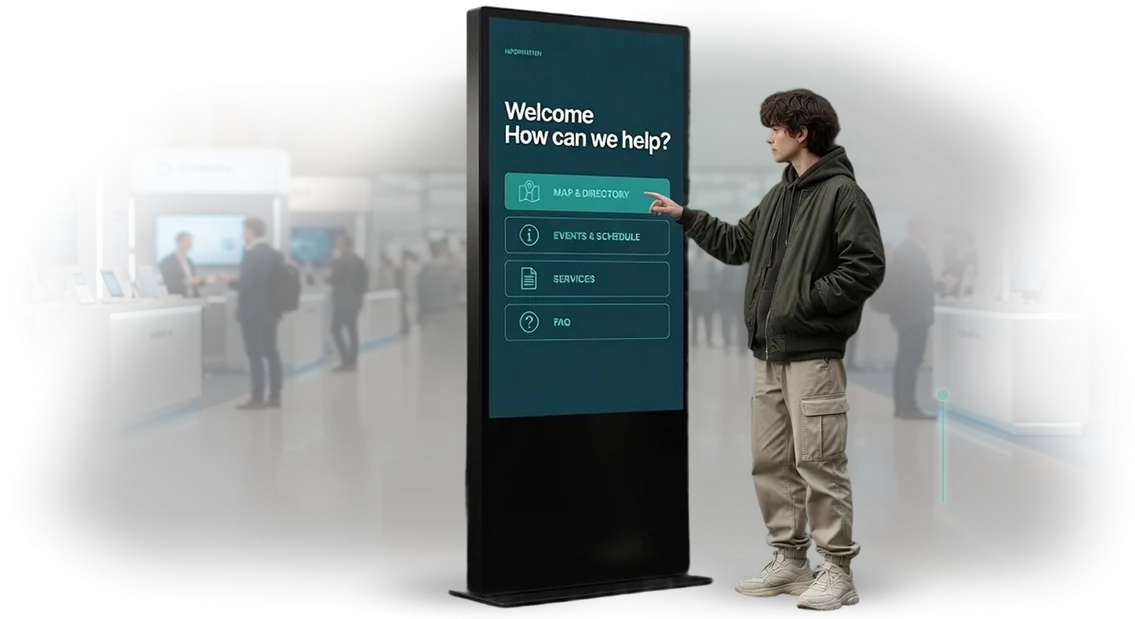
Why Government Agencies Need Interactive Kiosks
Visitors to government agencies often waste time finding the right office, clarifying the list of required documents, and figuring out how to receive a service. Queues to staff for simple certificates create tension among people and distract staff from their direct duties.
An interactive kiosk removes this burden: it gives visitors independence and allows employees to focus on complex issues.
An information kiosk is not just an electronic display, but a full-fledged assistant in navigating government services. It points out the right office, shows working hours, the list of documents, and the conditions for receiving a service.
A visitor gets an answer in a few minutes without waiting for a consultant, while the agency gains a tool for uniformly informing all citizens.
Transparency and up-to-date data are especially important for building trust in government structures. The kiosk always displays the latest changes in regulations, contacts of responsible specialists, and the procedure for appealing decisions.
This eliminates contradictory information from different sources and makes interaction clear and predictable.
In addition, the interactive kiosk raises the status of the institution: visitors perceive it as a modern, client-oriented service.
The number of verbal inquiries on typical issues decreases, staff get less tired from repetitive requests, and the average waiting time in the service area is noticeably reduced.
Even if citizens come for a single certificate, the kiosk can show them other available electronic services, expanding coverage without the involvement of staff.
We develop interactive kiosks for government agencies taking into account accessibility requirements and a user-friendly interface. We design navigation logic and content structure so that a person of any age can quickly find their bearings.
You get a ready-made solution that solves the real tasks of visitors, staff, and administration — not just a sign with a touchscreen.
What Interactive Kiosks Give Government Agencies
Visitors to government agencies most often face two problems: long lines and not understanding where to go and what documents are needed.
An interactive kiosk at the entrance removes both issues: a person chooses the needed service themselves, sees a room map, and receives a ticket without staff involvement. This reduces the load on the information desk and significantly speeds up service during peak hours.
For guests, the kiosk means predictability and comfort. Instead of searching for signs or asking again, a visitor finds the needed information in a few minutes, signs up for an electronic queue, or receives reference data.
Accessibility is also worked out separately: large buttons, clear hints, and adjustment for people with disabilities make the institution truly open to everyone.
Employees get the main thing: freed-up time. Routine questions like "where is the office?", "what documents?", "when will a specialist see me?" no longer distract staff from their direct duties.
Instead, specialists focus on handling specific requests, and therefore serve those who really need help faster and better.
For the head of an institution, kiosks mean manageability and objective data. The system records requests, collects statistics on popular services, and shows when the load is highest.
Based on these numbers, it is easier to allocate staff, adjust the reception schedule, and reasonably change visitor routes. Feedback through the screen also becomes part of management reporting — you see bottlenecks in operations and quickly close them.
As a result, interactive kiosks work on three levels at once: for guests — comfort and clear navigation, for employees — relief from routine, and for management — process transparency and measurable results.
This is an investment that pays off through shorter queues, higher satisfaction, and increased efficiency of the entire institution.
Kiosk Formats for Different Tasks and Spaces
The right kiosk format is half the success. A bulky stand in a narrow reception area will obstruct visitors, and a fragile screen at the entrance will quickly fail.
That is why we select the hardware configuration based on the specific space and usage scenario — from compact wall-mounted panels to protected outdoor terminals.
To help you navigate, we have put together a comparison of standard formats. Consider the visitor flow, the area of the space, and the main task: navigation, issuing certificates, or appointment scheduling.
| Format | Who it is for | What it gives the client |
|---|---|---|
| Floor-standing kiosk | Lobbies, foyers, waiting areas with active visitor flow | Catches the eye, convenient for standing interaction, accommodates a large-diameter screen for maps and schedules |
| Wall-mounted kiosk | Narrow corridors, elevator lobbies, points near offices | Saves space, does not obstruct passage, handles local tasks — booking a specific specialist or information about working hours |
| Outdoor kiosk | Entrance groups, areas near the facility | Works in any weather, protected against vandalism, provides access to information even outside working hours |
| Touchscreen kiosk stand | Reception areas, MFCs, self-service halls | Replaces a window with an employee for typical requests, reduces queues, and relieves staff |
We adapt each format to your specific circumstances: we adjust the height, screen tilt angle, set of help buttons, and even the enclosure design so that it fits the interior and style of the institution.
If you are unsure about the choice, send us a floor plan and describe the visitor flow — we will recommend the optimal configuration for your task.
How a Kiosk Implementation Project Proceeds
A transparent process is half the success. Implementing a kiosk in a government institution proceeds in stages, with approval at each step, so you always understand what is happening and what result you will get.
We handle the project turnkey — from selection to training — while all you have to do is accept the finished work.
-
Brief and task audit. You tell us what the kiosk should be able to do: appointment booking, issuing certificates, building navigation. We study the visitor flow and suggest a suitable device format — floor-standing, wall-mounted, or desktop.
-
Kiosk and equipment selection. We choose the enclosure and screen for your space, providing protection against damage and overheating. You get reliable hardware without overpaying for unnecessary options.
-
Interface approval. Based on your content, we prepare a screen prototype: menu structure, texts, feedback forms. You can make edits before development starts — this saves time and budget.
-
Development and configuration. We build the interface, connect your directories or schedule, and create an administrative panel. Employees will be able to update news and working hours themselves without a programmer.
-
Installation and commissioning. We deliver the kiosk, mount it in the agreed location, connect it to the network, and launch it. On the installation day, the device is already ready to welcome its first visitors.
-
Staff training. We conduct a short briefing: how to update information, replace consumables, and handle non-standard situations. The team quickly gets up to speed without wasting time on guesswork.
-
Support and maintenance. We remain available after launch: we help with content, solve technical issues, and if necessary, quickly replace components. For a government institution, this means stable operation without downtime.
The result is clear implementation stages, at each of which you can see the status and outcome. Contact us to discuss your project and get a work plan.
What Is Included in Kiosk Delivery and Setup
When a government institution orders a kiosk, it is important to understand that you are not just getting a device with software, but a fully ready turnkey solution.
We handle the entire cycle: from enclosure design and hardware selection to installation, configuration, and training your staff. In the end, you get a working kiosk integrated into the institution's processes, with a full set of documents and support.
Here is what is included in the standard delivery and scope of work:
- supply of a touchscreen kiosk in a configuration tailored to your tasks: floor-standing, wall-mounted, or desktop stand with a protected enclosure;
- installation of equipment at the site, connection to power supply and the institution's network — in accordance with accessible environment requirements;
- system configuration: menu structure, content loading, employee access rights, and visitor work scenarios;
- interface design in the institution's corporate style and adaptation for people with disabilities: large font, audio versions, convenient screen height;
- connection to reference materials, schedules, route maps, and other data sources that need to be updated;
- operating instructions and short staff training: how to change information, work with reports, and handle typical situations;
- warranty maintenance and technical support: remote monitoring, content updates, and engineer visits upon request.
All work is carried out under a contract with clear deadlines. You receive a kiosk that works from day one, and you do not waste time searching for contractors for installation, setup, or maintenance — that is our area of responsibility.
This approach is convenient for government structures: one responsible contractor, a complete set of documentation, and clear interaction procedures. The kiosk is not "forgotten" after launch — we support the project throughout the entire service life of the device.
Example Implementation: How a Kiosk Eliminated Queues at a Government Agency
When visitors to a government agency spend half a day in line, it hurts both its reputation and its budget. Employees are distracted by repetitive questions, people leave without results, and complaints pile up.
The client came to us with exactly this problem: peak hours in the reception area, an overloaded front office, and no appointment system without live contact.
We proposed interactive kiosks for self-service appointment booking. Instead of a live queue — an electronic one, with a ticket and reminders. Implementation took three weeks: two devices in the lobby, integration with the internal appointment system, and administrator training.
What changed after launch
- Average waiting time dropped from 40 to 12 minutes — a 3.5-fold reduction.
- In one month, the kiosks handled 2,300 requests — 70% of all appointments at the agency.
- The number of complaints about queues fell by 85%.
- Employees stopped manually registering visitors — freeing up about two hours of work time per day.
Three months later, the client ordered additional equipment for three more branches. Now the kiosks operate at five locations, and the repeat request became the best confirmation of effectiveness for us.
Why did this work? The kiosk does not replace a live specialist, but takes on the routine. The system itself directs visitors to the right window, suggests the list of documents, and prints a ticket.
People get to their appointments faster, and the agency gains clear figures for monitoring workload.
For the Citizen Service Center, we adapted the interface for users of any age — from students to retirees. That is why the result at each institution is stable and measurable.
If you want to see the same effect at your agency, we will start with a visitor flow audit — and show how much time and money the kiosks can return specifically to your organization.
How to Choose an Interactive Kiosk for the Public Sector?
Choosing an interactive kiosk for the public sector begins not with the device's specifications, but with the tasks it needs to solve. One kiosk is useful for appointment scheduling, another for paying state fees, and a third for building navigation and information.
Clearly define what actions visitors will take, and then it becomes clear which features are critical and which are not worth overpaying for.
For government institutions, not only functionality is important, but also reliability in continuous operation. The kiosk must withstand intense visitor flow, be easy for users of different ages, and not require a technician to be constantly present.
Pay attention to remote monitoring and content update capabilities — this will save your staff time and reduce operating costs.
Budget is the second key factor. A cheap solution often results in downtime, repairs, and visitor dissatisfaction. Evaluate the total cost of ownership: this includes not only purchase, but also maintenance, support, and possible modifications to comply with changing regulations.
A competent contractor will help you stay within budget by offering the best option in terms of price and reliability.
Finally, check how well the solution meets public sector requirements: accessibility for people with disabilities, data protection, and the ability to integrate with your information systems. These requirements influence the choice of both the software and the kiosk enclosure.
We have been developing interactive solutions for government institutions for over 10 years — we will help you select a configuration for your task, budget, and regulations, and we will also handle development, implementation, and support.
Frequently Asked Questions About Kiosk Implementation
Implementing an information kiosk in a government institution typically raises the same questions: will the equipment fit into the existing system, who will handle maintenance, and what happens if it breaks down.
We have gathered answers to the main objections — so you understand all stages of cooperation even before the project starts.
How does the kiosk fit into the institution's infrastructure?
Our application runs in the browser on any touch device, so it does not require replacing servers or installing additional software. You just need to provide the kiosk with access to the institution's network.
If necessary, we connect the kiosk to your information systems — this is discussed on an individual basis.
Who will maintain the kiosk after launch?
We provide employees with clear instructions; basic skills are enough for daily operation. Content updates — for example, the reception schedule or list of services — can be done independently.
We take on technical support and warranty repairs: we respond according to procedures and visit the site if needed.
What guarantees do you provide?
We work under an official contract that specifies the launch deadlines and scope of work. The equipment and software are covered by a warranty for the entire contract term. If anything breaks down, we fix the issue free of charge.
How stable is the kiosk under a large visitor flow?
We design the interface for continuous operation during peak hours. We use professional equipment and proven tools, so the kiosk copes with high loads throughout the day and does not "freeze" at the most inconvenient moment.
How quickly can the project be launched?
Timelines depend on complexity: from two weeks for a standard solution to 2–3 months for a fully custom project with integrations. The exact stage plan is fixed in the contract and we stick to it — no "surprises" after signing.
So you get a working kiosk with transparent implementation terms, support, and clear maintenance procedures — without hidden risks for your institution.Leave a Request — We Will Select a Kiosk for Your Task
Every government institution faces the question: which kiosk will work so that both visitors are satisfied and staff are not overloaded.
This cannot be figured out on the fly — it requires consideration of the specifics of the space, visitor flows, the list of services, and security requirements.
Leave a request, and we will select a kiosk for your task, not offer a "one-size-fits-all" option. We will start with a consultation: we will listen, clarify the details, and prepare a cost estimate and project plan.
Then we will take care of everything — from equipment selection to interface configuration and launch.
What you get after submitting a request:
- A consultation on choosing the kiosk format — floor-standing, wall-mounted, or with additional damage protection.
- Cost and timeline calculation — transparent, without hidden work.
- A custom project: section structure, design, and logic tailored to your services and visitors.
- Equipment selection taking into account loads and operating conditions in a government institution.
- Technical support after launch — updates, staff consultations, and quick resolution of issues.
We have been working with kiosks for government institutions for many years, so we understand the requirements for reliability and accessibility. Leave a request, and we will contact you at a convenient time, answer all your questions, and prepare a proposal.
Fill out the form below or call us. It is not binding — but it will help you understand in advance how your kiosk will work and what is needed for that.