

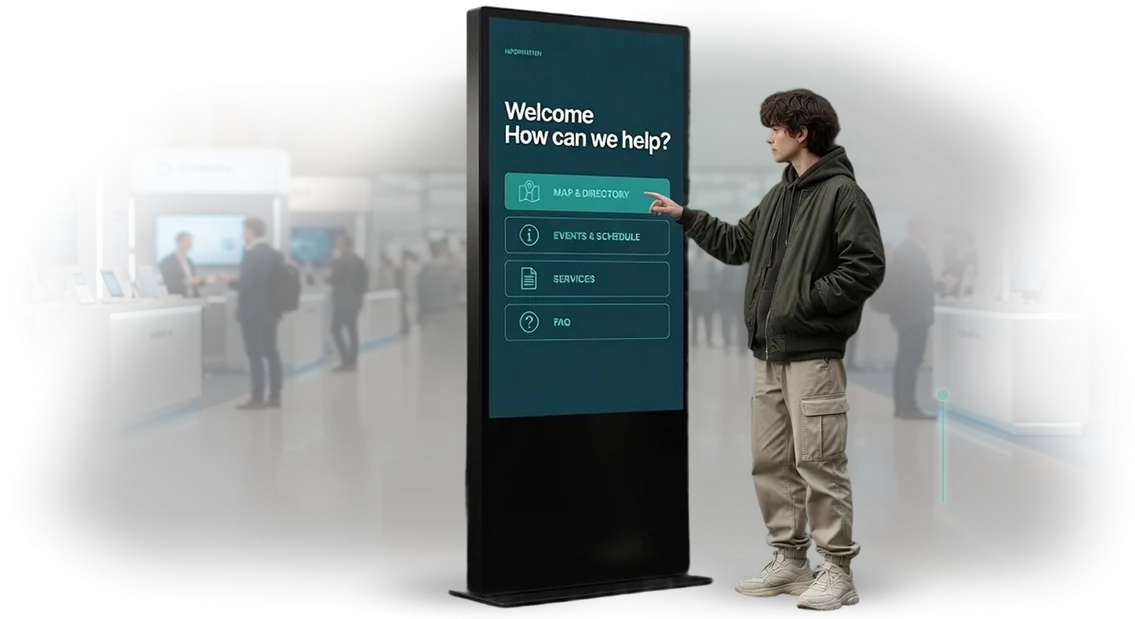
Why Kiosks for Children's Entertainment Centers Don't Pay Off
Kiosks for children's centers are often bought "on a whim": they set up a touchscreen, load standard games, and expect it to start generating profit by itself.
In reality, such an interactive kiosk works for a couple of days and turns into an expensive coat rack or a place where children just poke at random buttons.
Parents don't understand why it's needed—and there's no result: no additional revenue, no loyalty, no memorable impression.
The main problem isn't the equipment itself, but how well it serves the goals of the children's center.
A standard solution doesn't take into account how children perceive the interface, how parents decide on purchasing tickets and services, or how the kiosk fits into the overall atmosphere.
This creates a vicious circle: the touchscreen kiosk doesn't deliver real value, no one uses it, management becomes disappointed in the idea of automation and writes the project off as a loss.
The payback of an interactive kiosk starts with the right scenario: it should entertain, engage, and subtly lead to target actions—buying a ticket, booking a party, joining a workshop.
The child should get an emotional experience, and the parent should get the understanding that this place is interesting and convenient. Only then does a kiosk for children's centers become a tool that pays off through increased average check and repeat visits.
We design and develop kiosks tailored to the specific center's needs: taking into account the age of guests, the logic of services, and behavioral scenarios.
We solve kiosk-related issues in children's centers already at the planning stage—so clients don't just buy a screen, they get a solution that delivers measurable results. That's exactly what we'll talk about next.
What a Manager Gets When an Interactive Kiosk Appears in the Center
You get not just a touchscreen stand, but a tool that works for your business. First and foremost—growth in average check: while the child is engaged in a game or quiz, parents have time to order drinks and desserts, and you get additional sales without expanding the space. The kiosk turns "boring waiting time" into a monetization point.
For children's entertainment centers, such a stand becomes both an animator and an administrator's assistant. By keeping the child occupied for 10–15 minutes, you help parents calmly talk and spend time on themselves—which means they are more willing to stay longer.
Extending the visit directly affects revenue: every additional hour of stay means new orders from the café and vending machines.
The kiosk gives the manager transparent process control. You see which games and sections are in demand, what time of day has more visitors, and which leisure scenarios get the best response.
This is live data for decisions: where to place a lounge area, which drinks to add to the menu, and when to run promotions. No guesswork—only facts.
Guest engagement is another plus. An HTML5 interactive kiosk gently "holds" the child: he returns to favorite scenarios, and parents see that the center cares about developmental leisure.
This works for loyalty: guests return more often and bring friends, and word of mouth brings new visitors without spending on advertising.
For the manager, convenience lies in simplicity. There's no need to train staff on complex interfaces: the stand is autonomous, fits easily into any interior, and doesn't require constant supervision.
The child gets joy, the parent gets free minutes, and you get growth in key metrics without extra strain on the team. An interactive kiosk pays off not only in money but also in the time you get back in your workday.
Interactive Kiosk Formats for Different Tasks
Different tasks in a children's center require different touchscreen kiosk formats. One thing is keeping children occupied in line, another is providing information to parents or helping with navigation.
The format determines how much visitor attention you hold and how often staff get distracted by routine questions.
Below are the main options we install in children's entertainment centers, along with a guide to which format fits which task.
| Format | For Whom | What It Gives the Client |
|---|---|---|
| Floor kiosk for children | Children's zones, mazes | The child plays at full height, launches animations, gets prizes. Holds attention and enlivens the space. |
| Wall-mounted kiosk for the center | Reception, waiting area | Compact, doesn't obstruct walkways. Shows schedule, promotions, map—parents find answers themselves. |
| Mobile stand with screen | Animators, parties | Easy to move between halls. Launches quests, quizzes, photo zones anywhere in the center. |
| Kiosk for a custom task | Non-standard processes | We design the enclosure and interface for your scenario: party booking, loyalty program, reviews. |
What format should you choose? If you need to quickly orient visitors at the entrance—wall-mounted. If you want children to get involved in the game from the doorstep—floor. For events and multiple halls, a mobile stand is convenient. We'll help you decide and offer a solution that fits your budget.
How the Project Goes: From Brief to Launch
When ordering an interactive kiosk, you don't want to dive into technical details or control every step of the contractor. You need a result: an interface that children understand, stable operation during peak hours, and launch right on time for opening.
That's why we've structured the process so that minimal action is required from you—from a short brief to handing over a turnkey kiosk.
How We Work
-
Brief and goals. You tell us what age the games are for, what entertainment scenarios you plan, and whether you have a brand style. Based on this, we prepare a concept and a cost estimate—you understand what you're paying for before development starts.
-
Scenario design. Our specialists propose the menu structure and interaction logic for the touchscreen. You see how the child will move between entertainment, animations, and tasks—it's convenient to approve this before the programming stage.
-
Design concept. We show screen mockups in the style of your center. You make edits once or twice, then we take the approved version into development without unnecessary rework.
-
Development and assembly. We create the application itself and configure it on professional equipment—so the kiosk works stably even under high load when a queue of active children forms at the screen.
-
Testing with real users. We check how children of different ages play, whether they get confused in the menu, and whether touch response lags. This helps identify nuances that aren't visible during a standard check.
-
Launch and handover. We deliver, install, connect, and show staff how to turn on and maintain the kiosk. After that, you get a fully working setup—all that's left is to welcome guests.
For most projects, three approvals are enough: concept, design, and test version. If you have examples of games your young visitors like, send links right in the brief—this will shorten the first stage.
What's Included in Delivery and Warranty Support
When you order an information kiosk for a children's entertainment center, it's important to understand in advance what's included in the package and how we work after installation.
Below is the full list of what's included in the kiosk delivery and the support terms, so you get a ready-made solution rather than a "semi-finished product."
- A touchscreen kiosk in a durable, vandal-resistant enclosure—withstands heavy use by young guests and serves as an interior decoration.
- Pre-installed software with an intuitive interface: children choose games, tasks, and information themselves.
- Installation, connection, and setup at your site—a specialist will deliver the equipment, install it, and verify that it works.
- Staff training: in 30 minutes, employees will learn to turn on the kiosk, change content, and resolve simple issues.
- Content management panel—you independently update posters, schedules, and game scenarios without calling a programmer.
- Warranty service: free replacement of faulty parts and specialist visits during the warranty period.
- Technical support by phone and online—we help quickly resume operation if something happens.
Kiosk support doesn't end on launch day. We stay in touch: we accept requests, diagnose the problem remotely, and promptly arrive if repairs are needed.
The kiosk's warranty support covers all costs for parts and labor during this period—you won't have to look for third-party technicians or buy components.
Updating kiosk content has been made as simple as possible. Through the management panel, you can change promotions, add new tasks for parties, or adjust navigation around the center.
This keeps information up to date without stopping the kiosk and without additional investment—everything you need is already included in the basic package.
Case Study: How an Interactive Kiosk Doubled Revenue
The client came to us with a typical pain point for children's entertainment centers: a queue was piling up at the reception desk, administrators were answering the same questions, and additional services—the café, show programs, photo zone—went unnoticed.
The owners wanted to relieve staff and at the same time show parents how much could be offered to a child.
Situation
On a typical day, 10–15 people stood at the counter: some were signing up for the game zone, others were asking about parties. The administrator physically couldn't keep up with requests, and guests learned about promotions and shows only if they remembered to ask themselves.
Solution and Result
We installed an Interactive Kiosk with a simple touchscreen interface that is equally convenient for adults and children. The guest chooses the desired section themselves: prices, available slots, descriptions of parties, photo stories.
Within the first few weeks, staff stopped spending time on typical questions, and parents spent time exploring the menu of additional services.
Within two months, the center's operating revenue doubled. The average check increased because every family saw promotions and show programs they simply hadn't known about before. Party bookings were made directly at the kiosk, without waiting in line.
What changed for the business:
- Guest waiting time decreased threefold
- Almost half of all party bookings came through the kiosk
- Administrators switched from repetitive answers to live interaction with visitors
- A follow-up order for refinements cost four times less than developing from scratch
We continue to support the project: we update the content, monitor stable operation, and see statistics on popular services. The client doesn't need to keep their own programmer—our team handles everything.
How to Choose a Kiosk Format for Non-Standard Requirements?
Standard kiosks are often the same, but the needs of children's centers differ. One needs queue sign-up for animators, another needs navigation through a large maze, a third needs café ordering without a line.
If a standard interface doesn't fit into your process, that's no reason to give up automation. A custom format addresses the task with your layout, visitor age, and service scenario in mind.
We help you choose such a non-standard touchscreen kiosk through a short consultation: we discuss where it will be placed—at the entrance, in the hall, or in the café; who will use it—children, parents, or animators; and what should happen after a touch.
This lets us offer a floor, wall-mounted, or mobile option that doesn't create queues and fits easily into the interior.
The main thing is to understand what business problem the kiosk solves: party booking, quest search, activation of game sessions, or contact collection. The screen size, menu structure, and payment scenario depend on that.
We work out the logic before launch, so you don't overpay for unnecessary features and get a predictable result: faster service, fewer crowds, easier work for administrators.
After the format is chosen, we take care of setup, integration with your services, and staff training. If requirements change, the interface adapts without replacing equipment.
This approach saves your budget and turns the kiosk into a tool that speeds up the center's operations and increases guest satisfaction. Not sure which option fits? Write to us—we'll advise you on how to choose a non-standard kiosk based on your tasks.
Frequently Asked Questions and Doubts Before Ordering: Straight Answers
Doubts before ordering a kiosk are normal. You're investing money and time, so you want to be sure: the equipment won't fail in the middle of an event, content can be changed without a programmer, and the contractor won't disappear after launch. We'll answer these questions directly.
We structure our work so that after project delivery you're never left alone with problems. Below are the most common questions and our concrete answers.
What happens if the kiosk breaks down?
Any equipment can fail, so we provide an official warranty on the hardware and service maintenance. Within the warranty period, repairs and part replacement are on us.
If the breakdown is serious and takes time, we'll provide a replacement device so your location or event doesn't stand idle.
After the warranty, you can extend the service contract—it's cheaper than urgently looking for a specialist at the height of the season.
Will we be able to update content without a developer?
Yes. We hand over an easy-to-understand management panel: you can upload a new video, change prices, add a promotion, or update the schedule in 5–10 minutes.
You don't need to know code—the interface is intuitive, and we'll provide a short training session and record video instructions for your staff.
If you need to change content frequently and automate loading from your website or CRM, we'll plan that scenario at the project stage.
What about support after launch?
The kiosk operates autonomously, but we don't disappear. After project delivery, you get a communication channel with our team: we answer questions, help with configuration, consultations, and refinements. We respond quickly to critical failures so your business doesn't lose customers.
If you need new features, we'll send an estimate of time and cost, and you decide whether to do it now or later. You're not held hostage by us: all source codes and logins stay with you.
Order Turnkey Interactive Kiosk Development
To order an interactive kiosk for a children's entertainment center, you don't need to understand technology. You leave a request—we take on the entire journey: from idea to installation and team training.
Our team works remotely across the country—the result is equally stable in the capital and in the regions.
Turnkey kiosk development is a complete solution, not a set of services. We study the hall, visitor flow, and goals: entertainment, navigation, upselling.
We design a scenario for the age group and tasks, manufacture the enclosure, and run it on professional equipment that works reliably without failures.
The package includes:
- an interface that a child masters in seconds without adult help;
- content management: change games, promotions, and menus without a programmer;
- a server side that withstands weekend peak loads;
- technical support and remote monitoring—breakdowns won't catch you off guard;
- staff training: launch the kiosk in 10 minutes;
- updates for new tasks—the kiosk grows with your business.
You get a tool that pays off: fewer queues, children are occupied while parents choose services, and data for new promotions. Guarantees are fixed in the contract: launch timelines, stages, and final acceptance.
Leave a request to order an interactive kiosk tailored to your center's needs. Within one business day, we'll send you a cost estimate and launch plan and show you how the solution will fit into your hall. We'll start with a brief, not a sales pitch.