

Why a Hotel Loses Guests at the Registration Desk
Imagine a Friday evening: several tour buses arrive at the same time, and a live queue grows at the hotel's registration desk. Guests are tired from the road — they need a room, a key, and a shower — but instead they stand waiting for 20–30 minutes.
Every minute of waiting is a minute of irritation that the guest will remember and most likely describe in a review. And it's from the moment of check-in that their impression of the hotel begins, with first impressions often proving decisive.
Lost bookings are another hidden threat. Some guests, seeing a long queue, simply turn around and head for the hotel next door, even if the prepayment has already been made. Others begin to doubt the level of service and choose a different hotel next time.
So, because of simple disorganization at the front desk, the hotel loses current revenue, future repeat bookings, and positive recommendations — while attracting a new guest costs many times more than retaining a regular one.
Staff suffer no less. Front desk administrators are forced to work in a state of constant stress: processing documents, answering questions, taking calls, and calming impatient guests all at once.
At this pace, the number of registration errors grows — from incorrectly entered data to confusion over room numbers. Tired employees quit more often, and training new ones takes time and money.
In the end, the queue problem turns into a vicious circle: the worse the process is organized, the higher the load on people and the lower the quality of service.
A solution exists, and it has been working in leading hotels around the world for a long time. Interactive self-check-in kiosks integrated with an electronic queue let guests complete hotel registration in a couple of minutes, without waiting for their turn at the desk.
This not only relieves the staff but also turns check-in into a fast and pleasant experience. When we take on a project like this, we address all the pain points listed above — all that's left is choosing the right scenario for your hotel.
What a Kiosk Gives the Hotel and Its Guests
Guests arrive after a long trip and want to get to their room as quickly as possible, not stand in line at reception. A hotel kiosk solves this problem: registration takes a couple of minutes instead of the usual fifteen, and the guest immediately receives a key or access code.
The speed of check-in directly affects the first impression — a person remembers that the hotel respects their time and is far more likely to come back.
The advantages for staff are just as obvious: the administrator is freed from routine data entry, booking verification, and paperwork. Those minutes can be redirected to live communication with guests, handling unusual requests, and taking care of those who need help. The hotel saves staff time without expanding the team, while service quality grows.
The kiosk works both as a stand-alone check-in tool and as an addition to the registration desk: at peak hours it takes over the flow, reducing queues, and in quieter periods it remains a convenient option for guests who prefer fast self-service.
This boosts loyalty across different audiences — from business travelers to families with children, who no longer have to wait around with their luggage.
Finally, the kiosk's benefits are visible in service too: it shows guests information about the hotel, its services, and the surrounding area, offers to extend their stay, or lets them order additional services.
So the hotel not only speeds up check-in but also increases the average check through convenient upselling at the moment the guest is ready to use a service. All of this translates into higher satisfaction, repeat visits, and positive reviews that work for the hotel's reputation.
Interactive Kiosk Formats: Registration, Booking, Navigation
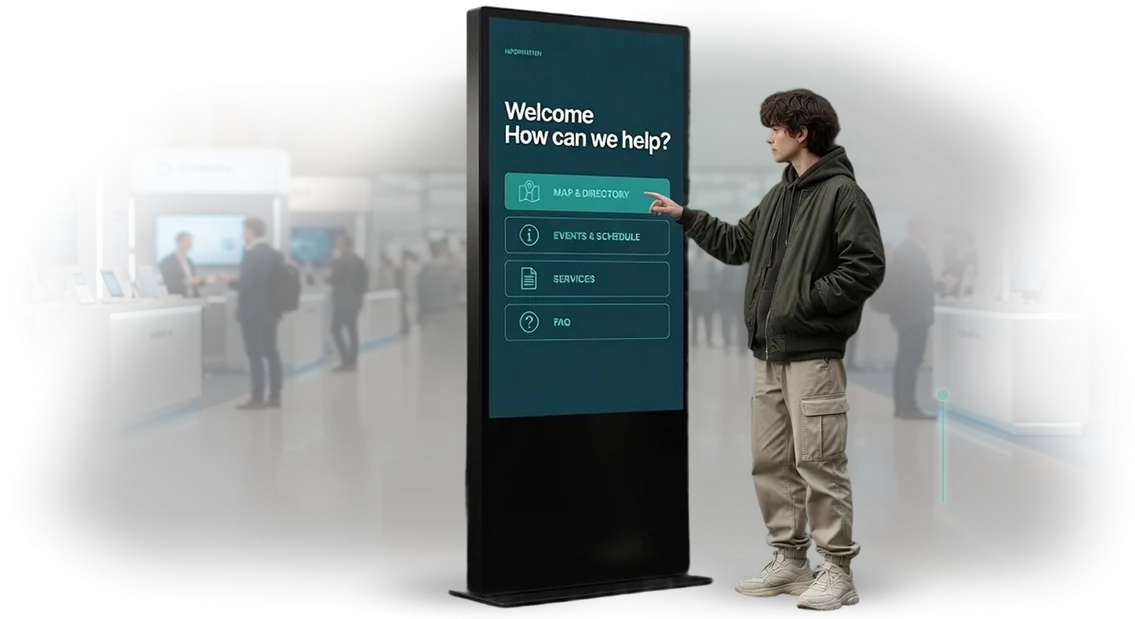
Interactive kiosk formats differ not in design but in the task they solve. A floor-standing terminal at the entrance shortens the reception queue, a wall-mounted one relieves the desk at peak hours, and a registration station takes over part of the administrator's work.
The right combination of formats eliminates queues where they appear most often — and the guest turns to staff less frequently for trivial matters.
For a hotel where service is both the main expense item and the main loyalty factor, this is tangible savings: the administrator handles complex questions while the kiosks take on the routine.
| Format | Where it is placed | What it gives the hotel |
|---|---|---|
| Floor-standing kiosk | Lobby, entrance area | Self-service check-in and check-out without a queue |
| Wall-mounted kiosk | Corridors, SPA, fitness, conference areas | Booking of services and meeting room reservations at any time |
| Registration station (fixed kiosk) | Instead of or next to the front desk | Relieves the administrator, contactless check-in, seamless transfer of guest data to the hotel management system |
Floor-standing kiosk is the most popular format for check-in automation. The guest presents a document, confirms the booking, and receives a key — without the administrator's involvement. This speeds up check-in by 3–4 times and noticeably shortens the queue at peak hours.
Wall-mounted kiosk is light and compact, taking up minimal space. It is ideal for areas where there is no desk: spa appointments, breakfast orders to the room, conference hall reservations.
The guest gets the service with a single touch; the hotel gets additional sales without staff involvement.
Registration station is a full-fledged replacement for the classic front desk for those who want to reduce payroll costs.
The system is synchronized with the hotel management system: check-in, check-out, visit history, guest requests — everything is recorded automatically, without manual entry errors.
We will select a combination of formats to suit your hotel's space, guest flow, and goals. We build kiosks on professional hardware — the client gets stable 24/7 operation without failures or downtime.
How the Project Goes: From Brief to Kiosk Launch
We have structured the process so that kiosk implementation is predictable and transparent. You get a turnkey project and understand what happens at every development stage — without surprises or downtime.
-
Brief and audit of the hotel's tasks. We analyze which guest flows you work with, where queues most often form, and which services should be automated first. Based on the results, we prepare a clear proposal.
-
Development stage plan and timeline approval. We fix the scope of work, checkpoints, and your area of responsibility. You can see when the kiosk launches and plan your staff workload.
-
Interface and scenario prototype. We show how the guest will interact with the screen: check-in, spa booking, ordering additional services. At this stage, you can make changes without extra costs.
-
Integration with the hotel management system. We connect the kiosk to your booking database and loyalty program. All data goes into a single system, so administrators do not need to transfer information manually.
-
Assembly and testing on real hardware. We check how the kiosk behaves under peak load, how quickly each operation runs, and whether there are any glitches in the scenarios. We solve all problems before the device meets its first guests.
-
Kiosk launch and team training. We install the equipment, run a test check-in together with your administrators, and show how to act in unusual situations. We are on call on launch day.
-
Support after implementation. We monitor stability, update content, and refine functions as the hotel's needs change. You get not a one-time service but a reliable partner for developing your service.
What's Included in Kiosk Supply and Setup
When you order a kiosk, you receive a complete turnkey solution: hardware with pre-installed software, design mockups, and integration with the hotel management system.
We handle installation, connection, and staff training — all you need to do is turn on the kiosk and welcome guests.
The supply and setup package includes:
- Touchscreen kiosk with housing and stand — we select the model to fit the lobby size and interior style.
- Software for service booking, electronic queueing, and self-registration — already configured for your scenarios.
- Branded screen design: the hotel logo, colors, buttons, and prompts in the required languages.
- Integration with the hotel management system you use — data on arrivals, departures, and services loads automatically, without manual entry.
- Installation and connection on site: checking power, network, and all operating scenarios before opening.
- Training for administrators and service staff — a short hands-on session and instructions for unusual situations.
- Warranty on hardware and software, plus technical support with remote diagnostics.
Setup is completed before launch so that the kiosk does not stand idle for a single day. All work, timelines, and responsibilities are fixed in the contract — you see a transparent process from the first meeting to acceptance of the finished solution.
Case Study: How We Sped Up Check-in at the Baltika Hotel
At the Baltika hotel, guest check-in took an average of 15 minutes: a queue at the administrator's desk, paperwork, and key issuance.
During peak hours this created tension — guests were in a hurry to get to their rooms, and staff could not keep up with questions and assistance for new arrivals. We proposed solving the problem through automation: installing a self-service check-in kiosk.
Together with the hotel team, we developed a kiosk interface for their specific tasks. The guest independently enters the booking details, confirms check-in, and receives a key card — the process takes a couple of minutes.
The system was integrated with the hotel management software without stopping operations, and staff needed only a short training session to help the first guests get comfortable.
The results of the implementation were immediately visible: check-in time dropped from 15 to 3 minutes.
Queues disappeared even during mass arrivals; administrators stopped spending time on routine and focused on live interaction with guests — recommending routes, resolving unusual requests, and caring for their comfort.
Guests appreciated the speed and independence: positive reviews about fast check-in appeared on booking platforms. For the hotel, this is added value — automation increased loyalty and relieved the staff without adding headcount.
The case study confirmed that a hotel kiosk does not replace people but amplifies their effectiveness. After the successful launch, the hotel ordered additional scenarios — for guest check-out and stay extensions — to automate the entire stay cycle.
How to Choose a Kiosk Format for Your Needs?
Choosing a kiosk starts not with the hardware model but with the task it should solve at the desk or in the lobby. Fast registration requires one format, spa or restaurant booking requires another, and hotel navigation requires a third.
So first define the main scenario: what do your guests most often do at the desk, and where do queues form?
If your main pain point is check-in, choose a kiosk with a self-registration function: the guest enters the data themselves, receives a key, and goes to the room without losing time waiting for an administrator.
This reduces the load on staff and speeds up the flow, especially at peak hours. This format also works well as an additional desk rather than a replacement for a live employee.
For booking services — a restaurant, spa, conference hall, or excursion — a kiosk with an electronic queue and reservations is the right fit. The guest sees available slots, chooses a convenient time, and receives confirmation.
This streamlines the flow and reduces the number of unprocessed requests, and the administrator does not have to be distracted by every request.
The third common scenario is navigation and information. A kiosk with a property map, schedule, and hotel facilities helps guests find the pool, restaurant, or meeting room on their own.
This is convenient both for those who are hesitant to ask and for staff freed from repetitive questions. An information kiosk is often combined with booking so that one device covers several needs at once.
Choosing the right format is a balance between your tasks, guest flow, and hotel management system.
We help with this at a consultation: we analyze your front desk scenarios, visitor numbers, and integrations, then propose a specific kiosk configuration, interface, and screen logic.
You get a solution that works for check-in, booking, and service at the same time — not just a nice-looking terminal.
If you are not sure which format suits you, start with a short consultation. Tell us how your guest flow works today, and we will propose an option that reduces the load on staff and speeds up service. We'll prepare a selection tailored to your task.
Common Concerns: What If the Kiosk Isn't Right for You?
The client looks at the kiosk from the guest's point of view: will it break down on the busiest day, will guests get confused, will all the processes have to be reworked?
Believe us, we hear these questions from every other hotelier — and we have prepared answers before you even asked them.
The solutions have long been refined, the equipment does not fail during the season, and support responds faster than you can notice a problem. Here is how the typical fears are addressed.
What if the kiosk breaks down at the peak of check-in?
Hardware rarely fails, but we automatically cover this risk: the system sends a signal about the kiosk's status around the clock, and the on-call team responds to any failure.
For hotels with 200+ rooms, we have backup hardware configured — while one unit is being repaired, check-in continues on another. Average recovery time is up to two hours, handled as a priority.
Will older guests be able to handle the kiosk?
The interface is built on large buttons, on-screen prompts, and basic gestures — just like an ATM. The "three screens to the result" formula holds up with guests of any age: registration or payment takes less than a couple of minutes.
If a guest still wants to see an administrator, the kiosk does not block them — it calmly redirects them. Staff training takes an hour, and the entire manual fits on two pages.
Is integration with our hotel system long and painful?
We connect the kiosks to your internal booking system through standard data exchange protocols — without changing the core and without making employees retrain.
Bookings, keys, additional services, reports — everything stays in the same system; it's just that data now flows into it without the administrator's involvement. Integration is carried out remotely, usually over a few days, with testing on your scenarios.
What will it cost and when will it pay off?
The main savings come not from the kiosk's price but from how much administrator time is returned to the guests who bring in revenue. At 70–80% hotel occupancy, the kiosk removes up to a third of the load from the registration desk.
This makes it possible to process check-ins faster, avoid expanding staff for the season, and shorten queues at peak hours. And guests note the absence of waiting in reviews even more often than the kiosk's own speed.
Each of these points is spelled out in the contract: the hardware warranty, the support regulations, the replacement procedure, and staff training. We take on exactly the risks you are worried about — so that the kiosk works like a reliable employee, not a source of surprises.Get a Project Estimate in One Working Day
Submit a request for development — and by the next working day you will receive a project estimate and a commercial proposal.
No lengthy approvals and no "call back in a week": we understand that the kiosk is needed by the season opening, by a conference, or by the moment guests start checking in en masse.
Here is what working on your estimate looks like:
- You submit a request on the website — we contact you within a couple of hours and clarify your hotel's tasks.
- We request only the necessary inputs: the number of desks, use scenarios, and booking system integrations.
- In one working day, we put together a solution: selecting hardware and software to fit your budget and goals.
- We prepare a commercial proposal with a transparent estimate — no asterisks and no hidden surcharges.
- We attach an implementation plan: stages, timelines, responsible parties, and launch date.
- After approval, we start development — you get a working kiosk delivered turnkey.
So in one day, you understand the budget, timelines, and scope of work — and can make a decision without stepping away from operational tasks. And the estimate comes with no obligation.
You can order development right now: fill out the request form below. We will get in touch, answer your questions, clarify the details, and prepare a commercial proposal with an implementation plan by the next working day.