

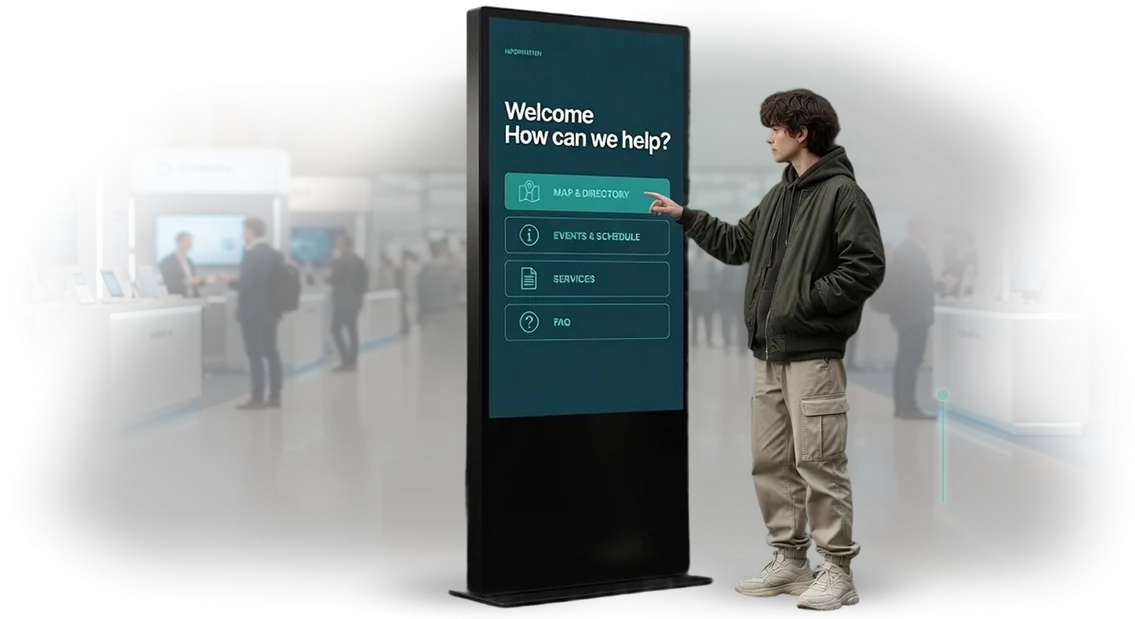
Electronic Queue at the MVD: Visitors Leave, Staff Overloaded
In MVD departments, the queue is the main source of tension for everyone. Visitors wait without any information for 30–40 minutes, some leave without being seen and return another day along with new applicants.
In the morning a dense flow forms, then a lull — the load on service windows is distributed chaotically, and people lose time.
For the manager, this results in repeat visits, complaints, and missed performance targets. Staff are forced to answer the question "when is my turn?" instead of processing documents.
Constant questions and crowds at the windows add to fatigue, service speed drops, and visitors leave with a negative impression of the department.
The electronic queue at the MVD solves this task systematically: the visitor takes a ticket, sees the current number and approximate waiting time, and if necessary books an appointment in advance through an interactive kiosk.
This reduces queues without expanding staff, smooths peak hours, and makes the process transparent. The employee sees which visitor with which question is coming to the window and has time to prepare.
We have been working on such projects for over ten years and handle this task turnkey: from configuring the operating logic to launch and further support. You don't need to understand technical details — just specify the number of windows, working hours, and types of services.
The client gets predictable workload, satisfied visitors, and a working system that pays for itself through order in the department and peace of mind for staff.
What an Information Kiosk Changes in Working with Visitors
People come to an MVD department with a specific task, but often get lost before even reaching the office: they don't understand where to go, how long they will wait, and which documents are needed. This creates queues, return visits, and extra load on staff.
The information kiosk changes the very service scenario — the visitor gets answers and an appointment with a specialist in a couple of taps, rather than through personal inquiries.
Service speed increases immediately through navigation and self-service selection of the service. The visitor sees the current waiting time and the route to the right window, so they don't linger at the administrator's counter or create a bottleneck. Staff stop repeating the same instructions ten times over and can focus on the actual requests.
Booking an appointment through the kiosk eliminates hours of sitting in the hallway. A person chooses a convenient time in advance and, if needed, gets information about available slots for the coming days. This reduces the number of visits for a single matter and makes the service truly predictable.
Visitor comfort directly affects the atmosphere in the hall: when the flow is distributed and people don't crowd around the counters, there is less irritation and conflict. Each visitor feels that their time is respected, and staff work in a less stressful environment.
For the department manager, the kiosk provides transparent visit statistics: how many people were served, at what hours peaks occur, how often booking is used. With this data, it's easy to build duty schedules, redistribute workload, and prepare service quality reports.
Interactive Kiosk Formats for the MVD
A touchscreen kiosk in an MVD department covers different tasks: the visitor needs reference information, a ticket for the electronic queue, or an appointment booking.
The choice of format determines how quickly a person finds their way and whether there will be unnecessary crowding at the counter.
The table shows three typical kiosk formats and their benefits for the applicant and for your department.
| Kiosk format | What task it handles | What it gives the visitor and you |
|---|---|---|
| Information stand | Navigation around the department, list of services, document samples | Visitors find answers on their own, staff workload is reduced |
| Ticket-issuing kiosk | Electronic queue for the waiting hall | Transparent order, fewer disputes, visitor flow is organized |
| Booking terminal | Appointment with the required specialist | Time savings, guaranteed time slot for the visit, window load report |
The information stand and the ticket-issuing kiosk are the basis for most departments. If the visitor flow is large and booking for a specific time is needed, the booking terminal eliminates live queues and allows the load on staff to be distributed evenly.
One kiosk can combine several scenarios: issue a ticket and immediately offer to book the next appointment.
We select the kiosk format for your task — based on the number of windows, daily flow, operating hours, and typical services. This way the device fits into the process rather than adding complexity.
Contact us — we'll calculate the load, recommend the optimal configuration, and advise on implementation.
Stages of Turnkey Kiosk Development and Implementation
We have built a transparent process that we have refined in projects for government institutions, including MVD departments.
At every step you understand what is happening and what result you will get: from brief to working kiosk — six predictable implementation stages with control points.
- Brief and task analysis. We study what services visitors need, how the kiosk will fit into the existing queue and into the premises. We document the requirements.
- Plan and cost estimate. We agree on the scope of work, timelines, and budget. You receive a calendar plan with clear dates for implementation control.
- Logic and layout approval. We show an interface prototype and operating scenarios. You approve the appearance before development begins — no disagreements at the finish.
- Implementation and testing. We create the software and verify the connection with the queue and booking system. We simulate real loads — the kiosk operates stably by launch.
- Launch and training. We install the kiosk, configure the equipment, and train the staff. We remain in touch during the first few days.
- Maintenance and support. We monitor performance after launch: data updates, monitoring, refinements on request. The warranty is secured by contract.
What's Included in Solution Delivery and Support
You receive a ready-made "turnkey" solution — from premises preparation to day-to-day technical support. You won't have to coordinate a separate equipment contractor, developers, and integrators: we take on all stages ourselves and are responsible for the result.
The delivery and support package includes:
- Premises preparation — we help choose the installation location, check power supply and network, so the kiosk works stably and doesn't create obstacles for visitors.
- Equipment — we supply professional anti-vandal touchscreen kiosks designed for high daily loads and a long service life.
- Interface — we develop intuitive screen forms for MVD services: appointment booking, electronic queue, application status check. Even a person using a kiosk for the first time can figure it out.
- Integration — we connect the kiosk to your booking and electronic queue system and configure data exchange so current appointment times and visitor information are always at hand.
- Staff training — we provide instruction for employees: how to help visitors, quickly resolve common questions, and monitor kiosk operation.
- Technical support — we provide round-the-clock support: remote monitoring, prompt response to failures, and on-site engineer visits when necessary.
- Warranty and updates — we provide a warranty on equipment and software, regularly updating the interface and functionality to reflect changes in regulations and services.
As a result, you get not just a kiosk, but a working tool that reduces staff load, shortens queues, and increases visitor satisfaction. We take care of all technical matters; you focus on the core activities of the department.
Case Study: How a Kiosk Changed the Operations of an MVD Department
Kiosk implementation at an MVD department
Queues at MVD offices are a familiar pain: visitors lose entire days, staff work under constant stress, and "call to book" arrangements leave room for errors.
For the MVD Department of Russia for the Central District, we developed an interactive kiosk with an electronic queue.
Instead of a chaotic stay in the hall, a person selects the required service on the screen and receives a ticket with a waiting time. The employee sees the current queue in the system and calls the next visitor — without shouting, fuss, or misunderstandings.
Results and client feedback
In the first month of operation, the queue was cut in half: average waiting time dropped from 48 to 20 minutes. Visitors stopped occupying the queue from the morning, and those who needed certificates booked an appointment right at the kiosk — no repeat visit required.
The department head assessed the implementation case this way: "Previously we couldn't keep up with the flow; now employees have the opportunity to work calmly rather than at a grueling pace." This client feedback is confirmed by the numbers: the number of people served per shift grew by 30%, and complaints about waiting practically disappeared.
The kiosk was easily adapted to different services — registration, passport replacement, certificates. That is why it continues to perform even on peak days, and a repeat order from the same department became the best confirmation of the project's success.
How to Choose the Right Kiosk Format for Your Department?
A universal kiosk that equally suits every department does not exist. The choice of format depends on three things: how many visitors pass through your location per day, what tasks you want to solve, and what budget is allocated for the project.
Based on these parameters, you can choose a solution that won't sit idle or need replacement within a year.
If the visitor flow is large and queues form at peak hours, it's worth considering a floor-standing kiosk with a touchscreen. It allows people to join the electronic queue on their own without crowding at the administrator's window.
For departments with a small number of visitors, a compact wall-mounted terminal that takes minimal space and handles information and ticket-issuing functions is sufficient.
Functionality is the second key point. Think about which operations should be available to visitors: appointment booking, ticket issuing, application status check, reference information. The more scenarios you build into the kiosk, the more load you take off staff. But don't overload the interface either — extra functions only confuse people.
Budget is not just the cost of equipment, but also maintenance costs, software updates, and possible expansion. Our specialists help assess the total cost of ownership and select a configuration that will pay for itself through staff time savings and reduced administrator load.
We also take the future into account: if you plan to add new services within a year, the design should allow that.
The main thing is not to choose a kiosk "by eye." Come for a consultation: we'll examine your flow, premises, and tasks, and offer two or three options with load calculations and recommendations. This is non-binding.
As a result, you'll get a solution that works for order in your department, not just one that stands nicely in the corner.
Frequently Asked Questions About Kiosks for the MVD
Before implementing kiosks, clients regularly have similar questions. We've gathered the main ones — about system reliability, protection of personal data, customization options, and launch timelines. Below are short answers that show what the work looks like in practice.
What happens if the kiosk fails or the network goes down?
The system is designed so that data isn't lost and visitor service doesn't stop.
If the connection to the server is interrupted, the kiosk continues to operate autonomously: the ticket or booking is saved locally, and when the connection is restored, the information is automatically synchronized.
Service won't stop either: the equipment is selected for round-the-clock load, and remote monitoring allows us to detect deviations before they affect visitors.
How is visitors' personal data protected?
We operate in accordance with personal data legislation. Information entered on the kiosk is transmitted over secure channels, stored on servers with access control, and used only for the purposes of the electronic queue and booking.
Only strictly defined employees have access to the data, and all actions are logged. This covers accountability and security requirements in the provision of government services.
Can the system be customized for a specific department?
Yes, the scenario is configured to your processes: list of services, schedule, reference information, integration with an existing queue. If regulations or the list of services change, modifications are made promptly, without implementing from scratch.
This allows the kiosk to be used not as a "boxed" solution, but as a tool that adapts to the current work of the department, not the other way around.
What are the implementation timelines and system warranty?
A typical project from brief to launch takes a few weeks. At every stage you see intermediate results, so by the time of delivery the system fully matches your tasks.
An official warranty covers the software and the work: we support the project after launch, update scenarios, consult employees, and help when expanding functionality.
If you have a non-standard question — ask it at the consultation. We'll review your case and suggest an implementation format that covers the department's tasks without wasting time and resources.Get a Cost Calculation and Implementation Plan for an MVD Kiosk
Leave a request — and we'll turn the task "we need a kiosk" into a clear plan with numbers and timelines.
In a 10–15 minute conversation, we'll find out the current situation, visitor flow, and bottlenecks, then define a solution that will actually reduce queues and simplify booking.
After contacting us, you receive:
- an analysis of the task and kiosk usage scenarios specifically for your department;
- a format recommendation — stand, wall-mounted terminal, or a combined solution;
- a cost calculation based on volumes, required functionality, and electronic queue requirements;
- a step-by-step implementation plan: preparation, installation, configuration, launch, and handover to operation;
- consultation on integration with the booking system and existing processes;
- preliminary timelines — from development to full-scale operation.
Each item answers the questions "what are we doing, who is responsible, when will it be ready." No abstract promises — only a transparent basis for a decision.
Leave a request via the form or call us: we'll discuss the details and prepare the calculation. It's non-binding, but you'll get an understanding of which format suits your office, how long implementation will take, and where you can save at the start.