

Bank queues eat up time and customers
A customer comes to a branch to resolve an issue quickly — and ends up in a live queue. Every minute of waiting without a clear estimate is irritation that builds up before the person even reaches the window.
As a result, some customers simply leave: someone goes to a competing bank, someone to a mobile app, someone with the thought "I'll come back later." Bank queues are not a minor inconvenience but a direct loss of profit: unissued loans, unopened deposits, uncollected fees, and a damaged impression of the service.
While a person stands in an unstructured crowd, they see chaos and feel that their time is not valued.
Even if the service later turns out to be fast, the negative impression is already formed — and they leave with a bitter aftertaste, tell colleagues about it, and leave a lukewarm review.
This loses not only current deals but also future referrals, which bring in new customers at a lower cost than any advertising.
An electronic queue changes this dynamic. The customer sees what number they have, roughly how long the wait will be, and where to go next — the uncertainty disappears.
They take a number, sit in the waiting area, watch the display, and have time to calmly prepare their documents. Service at the bank becomes predictable, and employees get visibility into their workload: who is free, which windows are missing, and when peak load occurs. Based on this data, it's easy to redistribute staff and reduce idle time.
The result for the bank — fewer customers who leave, more completed transactions, and higher conversion into cross-sales: while a person waits, an employee can offer them related products. Predictable service brings people back: they know their time is respected here.
This is exactly what we deliver — we design and implement an electronic queue system tailored to a specific branch, from flow analysis to launch and support. The bank gets order in the lobby, loyal customers, and measurable growth in key metrics.
Benefits of interactive kiosks
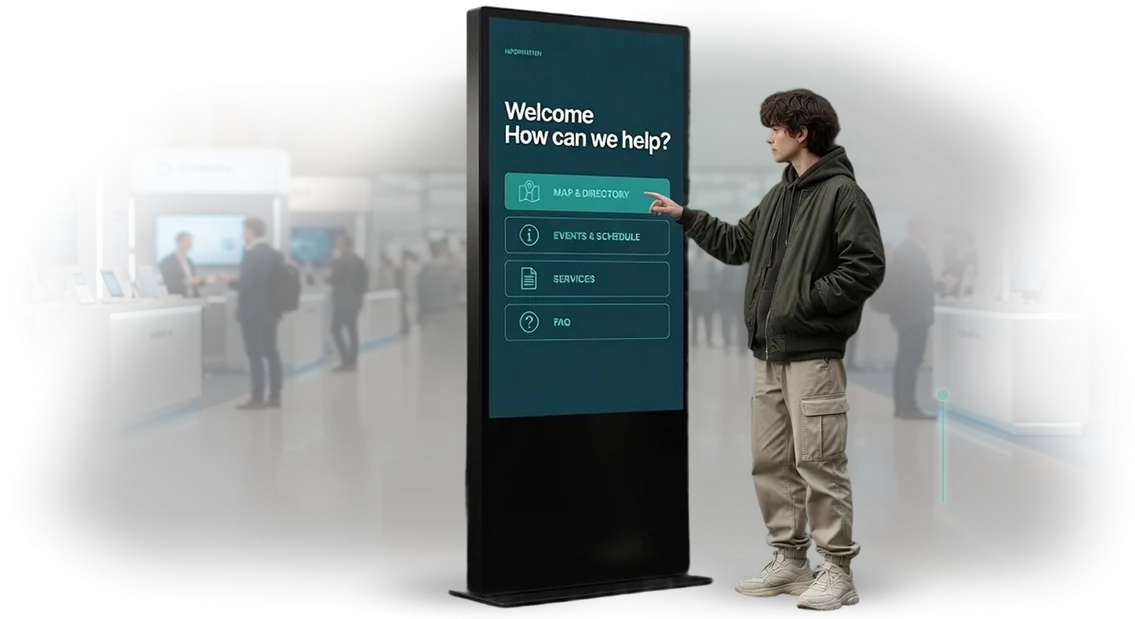
Interactive kiosks in a bank are not just "touch panels for information." They turn routine operations into a fast self-service process that saves customers time and relieves the branch.
Implementing such a solution at our team delivers measurable results for the bank: shorter queues, more processed applications, and staff freed up for complex tasks.
Here are the main benefits you get right after launch:
-
Speed of service. Balance inquiry, statement, payment by details — all of this takes under a minute. Customers complete key operations without waiting in line, and average service time is reduced several times over.
-
Growth in applications. The kiosk can suggest suitable products: loan, deposit, debit card. While the customer waits for a consultation, they can leave an application right in the interface — this increases conversion without employee involvement.
-
Reduced staff workload. Employees stop answering routine questions like "where is the ATM" or "what's my balance." Instead, they focus on sales and complex consultations — where a human is needed.
-
24/7 availability. The kiosk works even when the branch is closed. Customers can get a statement or book an appointment at any time — this boosts loyalty and relieves peak-hour load.
-
Fewer errors. Automatic entry of passport data and verification of payment details eliminate the human factor. Fewer errors in applications — faster processing and higher customer satisfaction.
These benefits work together: the customer leaves sooner with their issue resolved, and the bank gets more applications with the same resources.
Assess which item on this list is critical for your branch — the rest is covered with the kiosk implementation tailored to your processes.
Kiosk formats for your bank
Different zones in a bank solve different tasks: some need fast navigation, some need appointment scheduling with a specialist, and some need an electronic queue without crowding.
A universal kiosk rarely covers all scenarios at once, so we match the configuration to a specific location: lobby, service area, or consultant's window.
Below are the standard formats we implement for banks. Each option solves its own business task and easily integrates into the existing service process.
| Kiosk format | For whom | What it gives the bank's customer |
|---|---|---|
| Electronic queue kiosk | Branch visitors | Take a ticket in 30 seconds, no crowd at the counter — predictable waiting and a clear service order |
| Service appointment kiosk | Customers with a scheduled meeting | Choice of a convenient date and time, reduced queues during peak hours, confidence that a specialist is expecting you |
| Information kiosk (self-service) | Visitors who need a reference | Fast answers to common questions: opening hours, list of services, office locations — without waiting for a consultant |
| Combined kiosk (appointment + queue) | Branches with high foot traffic | One device covers both ticketing and appointments — less equipment in the lobby, simpler administration |
The business benefit is obvious: customers spend less time on routine, and employees focus on consultations rather than explaining where to go. We help you choose the format and number of devices based on your traffic, so no visitor is left without assistance.
How turnkey development works
Turnkey work means one clear path: you describe the task, and we handle the entire cycle — from brief to a working kiosk in the branch. For the bank, this means predictable timelines and minimal involvement on your part: at each stage you see the result and control the process. Here's what it looks like in practice.
-
Brief and branch audit. We document which bank services should be available through the kiosk, who your target audience is, and which appointment scenarios with specialists are most frequent. We clarify where the device will be placed to account for customer flow and space constraints.
-
Project approval. We prepare the concept: menu structure, electronic queue logic, appointment scenario. You get a clear document with screens and descriptions of user flows — easy to approve within the bank and with the security department.
-
Design prototype and equipment procurement. We design the interface in the bank's brand style and get your approval. We select professional kiosks with touch screens and anti-vandal enclosures — built for round-the-clock operation in the branch.
-
Development and integration. We program the interface and the integration with your electronic queue and appointment system. We set up administrator roles so managers can manage schedules and accept applications.
-
Testing and training. We verify all scenarios: appointment booking, ticket issuance, queue call, terminal operation during peak hours. We train your staff — both administrators and consultants who will assist visitors with the kiosk.
-
Kiosk launch and support. We install the device, connect it to your network, and perform final configuration. We remotely support the launch during the first days to ensure everything runs stably.
-
Ongoing support and development. We stay in touch after launch: update the interface when bank services change, monitor stability, and help with administration. If needed, we extend functionality — adding new services or integrations.
This approach allows you to launch the kiosk predictably, without surprises at the start. Our team accompanies the project even after opening, so you can always contact us for enhancements and technical support. Your key win is a working appointment system that reduces queues in the branch and relieves staff.
What's included in delivery and installation
The kiosk must work on launch day, so the scope of delivery is fixed in the contract: from the enclosure to staff training. You know in advance what you receive — no hidden conditions or additional charges.
Standard scope includes:
- kiosk hardware: touch screen, system unit, thermal printer, card reader — professional grade for 24/7 operation;
- electronic queue and appointment software configured for the bank's services and window schedules;
- interface branding in the bank's style;
- installation and commissioning: connection, network setup, verification of all scenarios from ticket to appointment;
- integration with your accounting system so appointment data reaches tellers automatically;
- staff training: administrators, cashiers, consultants;
- warranty service and support.
Scope of work by stage:
| Stage | What's included | Result for the bank |
|---|---|---|
| Equipment | Assembly, testing, delivery of the kiosk | The kiosk arrives ready for installation |
| Installation and configuration | Connection, software setup, integration | The kiosk works on launch day |
| Training and support | Instruction, remote diagnostics, updates | The branch operates without downtime |
You get a turnkey package: equipment, software, installation, and training. All work is already included in the specification — all that's left is to launch the kiosk and welcome your first customers.
Case study: how queues resolve 2x faster
At a bank branch, customers faced the main pain point — a live queue. During peak hours, waiting stretched to 15–20 minutes, some visitors left for competitors, and tellers wasted time on "who's last?" questions instead of serving customers.
We implemented an information kiosk with an electronic queue module and self-service appointment booking in the bank. Customers choose their service on their own, receive a ticket, and see the current status on the screen. It's an unobtrusive but radical change to the branch's logistics.
The results were visible after the first month: waiting time was cut in half, and the number of customers served during peak hours grew by a third. Tellers stopped being distracted by queue management and focused on consultations and sales.
For Partner Bank, this is not just service quality but a direct financial benefit: higher conversion into banking products without additional staff.
The kiosk paid back faster than planned — thanks to reduced staff idle time and growth in cross-sales in the branch. After the first launch, the bank ordered additional kiosks for three more branches. Each subsequent launch took less than a week — from installation to staff training.
Now this is the standard for banks: customers manage their own time, queues don't build up, and the branch operates without losses. The metrics speak for themselves: less waiting — more satisfied customers and a higher average ticket.
How to choose the right format for your task?
There is no such thing as a universal kiosk — the format must solve your specific task, otherwise you overpay for unnecessary functionality or, on the contrary, get a device that can't handle customer flow.
To choose correctly, start not from specifications but from three questions: what the customer should do at the kiosk, how many visitors pass through the branch during peak hours, and how the device will fit into staff operations.
The first step is to define the primary function. If the key goal is to relieve peak load from tellers and eliminate the live queue, you need an electronic queue terminal with waitlist booking.
If customers need to get statements or references without employee involvement — that's a different class of device with a printing function.
Banks often combine both scenarios in one kiosk, but it's important to understand: each additional module complicates the interface and increases the cost. Start with one task to automate first.
The second criterion is the usage scenario. In a high-traffic branch, the kiosk must be as fast and durable as possible, because it operates non-stop during peak hours. In a compact office or premium service zone, the priority shifts toward design and simplicity of first contact.
Also consider who will use the device: if many of your customers are older adults, the interface must be large and understandable from the first screen; if the main audience is younger people, speed and integration with a mobile app matter more.
And the third point — requirements for placement and maintenance. The kiosk must fit the branch layout, not create bottlenecks, and be easy to service.
Think about how the device will be updated: schedule changes, adding services and promotional materials should happen without stopping operation or calling an engineer.
It's ideal when content and kiosk status management happen remotely — this saves hours of your staff's time and ensures information is always up to date.
We help you select a configuration for your tasks and budget, rather than selling "the most powerful hardware." Over 10 years, we've implemented kiosks in branches of various sizes and know which configuration pays off and which turns out to be excessive.
Come for a consultation — we'll review your scenario and offer a format that solves the task without unnecessary costs.
Addressing your doubts before purchase
We understand: before buying a kiosk for a bank, the same questions always come up — what if it breaks, how fast can we configure it, won't customer data leak.
We answer briefly, without technical details — only what matters for your peace of mind and the stable operation of the branch.
What happens if the kiosk breaks down?
Any equipment can fail, but we minimize this risk. We use professional hardware with a long service life and configure it so that key components aren't overloaded.
If a breakdown does occur, you won't have to deal with it on your own. Under the contract, we promptly send a technician on-site or connect remotely, restore operation, and verify that everything works. Average resolution time — from a few hours to one business day, depending on complexity.
What warranty is on the kiosk and how real is it?
We provide an official warranty on equipment and work — it's documented in the contract, not just verbal. During the warranty period, repairs and component replacements are carried out at our expense.
Importantly, the warranty doesn't end on paper: your personal manager stays in touch and remembers the project history. So any issue is resolved without long explanations "from scratch" — we already know your specifics.
Who will configure the kiosk and how long will it take?
Configuration is our responsibility. We handle software installation, loading your scenarios, connection to the electronic queue system, and verification of appointment scenarios in the bank.
We typically complete basic configuration in 1–2 days, while training your staff in parallel. You don't need to hire a separate specialist or spend your IT department's time — everything is ready by launch.
How secure is bank customer data?
The security question is addressed at the architecture level: data is transmitted in encrypted form, and access to settings is protected. The kiosk works only with the scenarios you've approved and doesn't store anything extra.
If needed, we configure the integration with your internal system so that appointment booking and the electronic queue work quickly without exposing critical information to outsiders. All solutions are coordinated with your security department.
If you still have doubts — that's normal; it's better to ask questions before purchase than to face surprises afterward. Common questions and detailed answers are collected below. And if you didn't find what you need — just call us, we'll tell you everything honestly and offer a solution for your bank.Order kiosk development now
Order a kiosk now — and we'll structure the work so you get a finished solution without unnecessary hassle. We handle all stages: from the first consultation to launch and support. You don't need to understand technical details — just tell us about your bank's objectives.
How the order works:
- Kiosk consultation. You describe visitor flow, the list of services, and the installation location — we propose the optimal solution.
- Cost calculation and commercial proposal. We lock in the cost and timelines, with no hidden surcharges.
- Interface development. We create a clear scenario: electronic queue, appointment booking, references.
- Testing and configuration. We verify the system under real conditions so the kiosk works stably from day one.
- Delivery, installation, and training. We install the equipment and show employees how to manage the system.
- Post-launch support. Warranty service and prompt assistance — you're never left alone with the technology.
After you reach out, you receive:
- An accurate cost estimate and work plan before signing the contract;
- Adaptation to your bank's processes;
- Staff training and an employee manual;
- A warranty on completed work;
- The ability to make enhancements as load grows.
Leave a request — we'll call back within one business day, answer your questions, and prepare a proposal for your task. Order a kiosk now so your customers are served without queues within a few weeks.