

Why does a diagnostic center lose patients at the front door?
A patient rarely comes without a reason: usually they are scheduled for a specific exam, but right at the entrance they run into confusion. While they search for the right office, while they try to make sense of the signs, while they figure out where to go — irritation builds up.
Add a live queue that moves unpredictably, and a visit to the center turns into an ordeal. As a result, the person who suffered through the chaos tells their friends about it — and more eagerly than they talk about your professionalism.
The main pain point is losing the patient before the appointment even begins. A person who has wasted an extra 30–40 minutes waiting and wandering will next time choose a clinic where the queue is visible on a screen and scheduling happens without an administrator.
Even the best doctors and equipment won't save you if the first impression is shaped by a crowd in the corridor and confusing navigation.
Every such departure is not only lost revenue from the service today, but also a lost repeat visit, a contrast between expectations of service and reality.
A modern patient compares you not with the "average hospital" but with a bank and delivery service, where everything is clear and fast, where they remind you about your appointment and no one jostles in line.
They are willing to pay extra for comfort and respect for their time. A diagnostic center that manages patient flows and answers the key questions — "where to go, how long to wait, when will I be seen" — becomes the number one choice even at a higher price.
Retaining a patient on the first visit costs less than attracting a new one through advertising — and this is exactly where the decision is made whether they will come back.
Properly organized scheduling, an electronic queue, and clear navigation remove the chaos before the patient even sees a doctor.
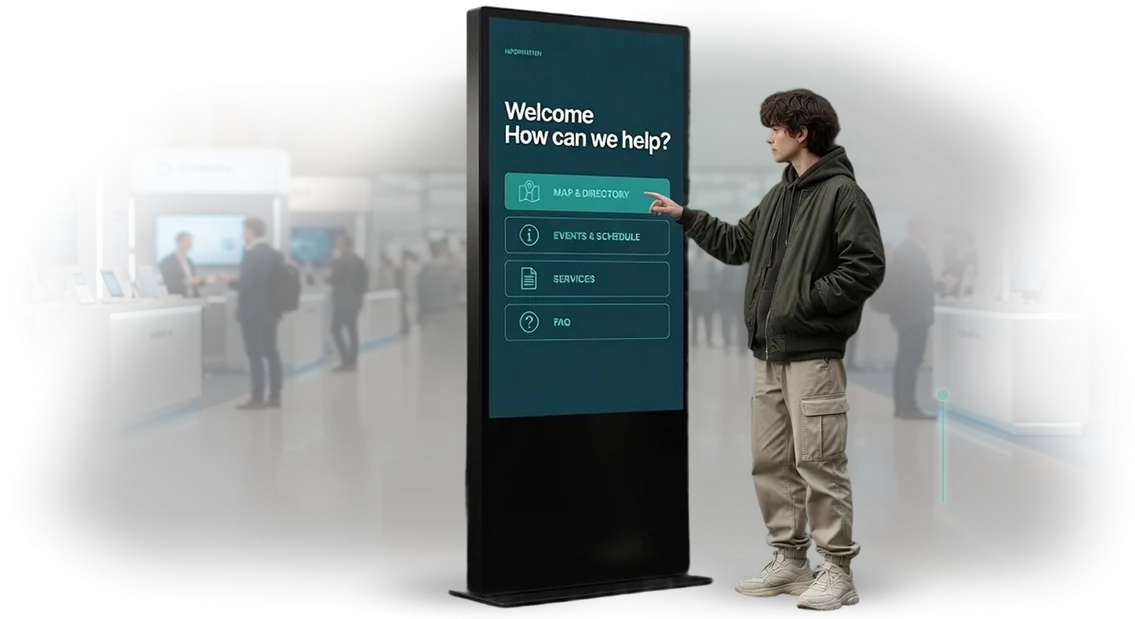
An information kiosk in the lobby is not a "screen for show" but a tool that saves 15–20 minutes of each visitor's life and shows that the center respects their time.
Queues become a thing of the past, staff stop acting as dispatchers and focus on their actual work, and the patient gets predictability instead of stress.
We have been implementing such solutions for over 10 years and know how to turn the entrance area from a source of irritation into a point of loyalty. Below — about what you can implement within the next few weeks and what effect it will bring to your business.
What benefits does a clinic get from an information kiosk
Order is important for a diagnostic center: the patient flow is large, and every extra question at the reception desk creates a queue. An information kiosk takes over routine operations — scheduling, appointment confirmation, navigation to rooms. Your staff is freed from mechanical work and focuses on what truly requires human involvement.
Increased patient loyalty
A modern kiosk shows that the clinic keeps up with the times and cares about comfort. Patients appreciate the ability to independently choose a convenient time and not stand in line to see an administrator.
The easier it is to get an appointment, the more willingly they return and recommend you to friends. And a satisfied patient means repeat visits and positive reviews that work for your reputation.
Reduced staff workload
Administrators no longer need to explain the schedule ten times, manually check time slots, and fill out paper forms. The kiosk automates repetitive actions, and employees spend time only on complex questions, talking with patients, and working with those who need help.
As a result, staff get less tired, make fewer mistakes, and work more calmly — this also affects the atmosphere in the clinic.
Faster scheduling
Self-service scheduling through the kiosk takes less than a minute — this is especially important during peak hours when the queue grows before your eyes.
Patients get to the right specialist faster, are not late for procedures, and the clinic sees more people without expanding staff. Fast scheduling also reduces no-shows: if a person chose a convenient time themselves, they are more likely to come.
In the end, the kiosk solves three tasks at once: it increases loyalty, relieves staff, and speeds up scheduling. We work with professional equipment that reliably handles an intensive flow of visitors, and we support the project after launch.
Diagnostic center: which kiosk formats should you choose?
In a diagnostic center, visitors come with different goals: some are here for test results, some are scheduling an appointment with a specialist for the first time, and some have already received a referral and want to take a place in the queue.
If the kiosk format does not match the scenario, even a convenient interface creates confusion and unnecessary crowds. The right configuration of terminals separates the flows so that each guest handles their own business without blocking others.
We select the format based on the logic of your lobby rather than imposing a template solution. For clarity, let's look at three basic types that cover the typical tasks of a diagnostic center.
Which format solves which task
| Kiosk format | Who it is for | What it gives the client |
|---|---|---|
| Compact infomat | Quick schedule check and ticket printing without talking to an administrator | Relieves the reception desk, reduces the live queue during peak hours |
| Floor-standing scheduling kiosk | Self-service scheduling with the right doctor or procedure | Increases throughput without expanding staff |
| Electronic queue kiosk | Queue number control and call to examination rooms | Makes waiting transparent, removes chaos and disputes in the lobby |
All three formats work on a single platform, so the software can be easily adapted to the installed equipment. You can start with one terminal in the lobby and later add compact infomats in departments — appointment data will stay synchronized.
This guarantees that expanding the system will not require stopping patient service or repeated investment in development.
Stages of implementing an electronic queue and kiosk scheduling
Implementing an electronic queue and kiosk scheduling is not buying a "boxed solution" but a transparent project that follows strict stages.
We structure the process so that the diagnostic center gets a working system without failures, and the client understands at every stage what is happening and what they are paying for.
You know the timeline and result of each step in advance. This allows you to plan administrator workload, avoid distracting doctors, and smoothly transfer visitor flow to the new format.
- Brief and process audit. We study how scheduling works in your diagnostic center today: the number of windows, peak hours, typical visitor questions. The result is a clear understanding of what functionality is needed.
- Interface mockups. We show the kiosk screens: service selection, doctor scheduling, ticket receipt. We approve them before development begins — any changes at this stage do not require code rework.
- Software development. We create a system tailored to the specific needs of a diagnostic center: referrals, urgent scheduling, integration with reception. We work on professional equipment and proven tools — the client gets a stable result.
- Installation and setup. We deliver the kiosk, install it in the lobby, connect it to the network and database. We check ticket printing and communication with the reception desk.
- Launch and training. We put the system into operation and train administrators to work with the interface. In the first days, we are present on site and help visitors adapt.
- Support and development. We monitor the system, answer questions, update the software, and add new functions as the load grows. You are never left alone with the technology.
What is included in the supply and setup package
When you order a kiosk for a diagnostic center, you get a complete turnkey solution. We take care of everything — from equipment selection to staff training — so you do not need to coordinate several contractors or dive into technical details.
The supply and setup package includes:
- Kiosk equipment: a reinforced enclosure and protected screen are designed for round-the-clock operation in a high-traffic location. The hardware is tested and serviced before installation — you get a device that works without failures.
- Electronic queue and scheduling software is already installed and configured for your center. The system is ready to use immediately after powering on.
- Custom interface design mockups: screensaver, main menu, brand colors, and logo. Patients recognize your center and navigate more easily.
- A complete set of documentation: operating instructions, maintenance regulations, and an administrator guide. Everything is presented clearly — staff get up to speed quickly, and inspections go smoothly.
- Staff training: we conduct instruction sessions for administrators and those who will help patients. Your team works with the kiosk confidently from day one.
- Technical support during launch and further under the contract. If questions arise, you contact us — there is no need to look for third-party specialists.
Everything listed above is included in the agreed project budget and fixed in the contract. You get a single document and clear deadlines — without hidden work or additional payments.
Real case: reducing queues and increasing appointments
When peak hours hit at a diagnostic center, administrators cannot manage to answer calls and simultaneously schedule patients at the reception desk. The queue grows, people get nervous, and some visitors leave for a neighboring clinic.
Managers think the problem is staffing levels, but most often it is the speed of scheduling — that is what becomes the bottleneck of the entire intake process.
We implemented interactive kiosks at a diagnostic center.
Instead of standing in line to see an administrator, the patient walks up to the kiosk, chooses the required exam and a convenient time, receives an electronic queue ticket — and immediately proceeds to the waiting area.
Administrators stopped doing routine work at the computer and focused on tasks that require personal involvement.
What changed after launch
Scheduling speed increased almost 5 times: whereas previously registering one patient took several minutes, it now takes 30–60 seconds.
About 70% of visitors scheduled through the kiosk without an administrator, so queues at the reception desk practically disappeared even during morning peak hours.
For staff, the workload also decreased: administrators were able to serve more patients per shift, and the number of scheduling errors dropped because patients controlled the entered data themselves. Fewer conflicts, fewer rescheduling efforts — both staff and visitors are calmer.
The diagnostic center continued working with the kiosks on a daily basis and then ordered a similar solution for a second branch. The repeat order was the main confirmation for us: the clinic got a measurable result, not just "modern equipment."
Metrics that matter to a manager
- Scheduling speed increased 5 times — from several minutes to 30–60 seconds.
- Up to 70% of patients scheduled themselves, bypassing the administrator station.
- Peak-hour queues were reduced, and staff were freed up for live communication with patients.
- The clinic scaled the solution to a new branch without additional modifications.
The same result is achievable in any diagnostic center: we match the number of kiosks to patient flow, configure the electronic queue around the clinic's internal processes, and support the launch until stable operation.
How to choose the right kiosk format for your task?
Start with the question of where and how the kiosk will be used — that is what determines the model. In a diagnostic center, the main scenarios are scheduling with a doctor, electronic queue, ticket printing, and sometimes payment for services.
If visitors need to quickly get information without standing in line at the reception desk, choose a device with an intuitive interface and a minimum number of steps.
The main criterion is the location and flow of people. For a spacious lobby, a floor-standing kiosk with a large screen works well: it is visible, comfortable for people of different heights, and can handle many patients at once.
A wall-mounted format saves space and fits well into narrow corridors or waiting areas. Estimate how many people will use the kiosk during peak hours — this determines the durability of the enclosure, screen size, and system response speed.
Be sure to think through what operations the kiosk must perform. If you only need an electronic queue, a simple menu is enough. For scheduling with specific specialists, you will need a calendar and integration with your medical system.
Ticket printing is already an additional module that saves patients from filling out paper cards by hand. Also consider the age of visitors: most diagnostic center patients are comfortable with large buttons, on-screen hints, and the option to ask an administrator for help.
One more point — room for growth. A modular design allows you to add a barcode scanner, card reader, or payment terminal when you expand your list of services. We select the configuration for your current task but design it with the possibility of further development.
If you are unsure which format suits your department, we will send a detailed comparison of models and bring a demo unit so you can evaluate convenience before purchasing.
Frequently asked questions and concerns before launch
Before launching interactive kiosks, the head of a diagnostic center always has doubts: will the equipment break down, will patients understand it, will the solution fit into current processes. This is normal — any new tool in medicine requires confidence.
We have been working with diagnostic centers for many years, so we have collected answers to the questions we hear most often.
What if the kiosk breaks or freezes?
The kiosk runs on professional equipment designed for high loads. We configure crash protection and automatic recovery after errors. If a problem still occurs, your staff will not be left alone with it — our support team will connect remotely and help within the working day.
Will elderly patients manage with the kiosk?
The interface is created for your audience: large buttons, clear labels, step-by-step hints. We test scenarios on different age groups — from young patients to elderly people who use a touch screen for the first time. On average, a person needs less than a minute to schedule or get a ticket.
Is it difficult to integrate the kiosk with our system?
Integration is configured around your infrastructure: the kiosk can transfer data about appointments, tickets, and queues to your accounting system or work autonomously.
We handle the coordination of exchange protocols and testing on your data so the launch happens without stopping the reception desk.
We resolve these concerns at the turnkey stage: we do not just supply equipment, we take responsibility for its stable operation, ease of use for patients, and seamless connection with your processes.Let's discuss your project? Get a cost estimate for your clinic
Send a request — and right at the start you will receive a preliminary cost calculation tailored to your clinic: how many kiosks you need, which scheduling and electronic queue scenarios will handle patient flow without queues.
We will ask the right questions ourselves so the estimate is accurate rather than generic. This takes a couple of minutes.
During the consultation, we will go through your project step by step: how scheduling works now, which offices are overloaded, where peak loads occur.
We will show how kiosks fit into your infrastructure and what they will give visitors — from self-service scheduling to ticket calling. This carries no obligation.
As part of the estimate, you will receive:
- preliminary project cost and timeline;
- recommendations on the number of kiosks and their functionality;
- scenario development: scheduling, electronic queue, call to the doctor;
- an integration plan with your scheduling system and doctor schedules;
- the scope of work for installation, staff training, and support.
From there it's simple: send a request — we will call you back, clarify the details, and prepare a cost estimate for your clinic. No obligations, only a focused conversation. We will show how the kiosk will relieve the reception desk and speed up scheduling. Fill out the form below or write to us in a messenger.