

Queues at testing laboratories drive patients away
Patients do not forgive lost time: the morning peak at a testing laboratory means an hour of waiting in a stuffy hallway, frayed nerves, and the risk of leaving without having tests done.
While some lab technicians are busy collecting samples, others spend 3-5 minutes per patient just to verify data in a log — and the queue grows exponentially. As a result, the laboratory loses up to 15-20% of potential clients who chose to go to a neighboring medical center.
The problem is not the speed of staff work, but the system of flow organization. A chaotic live queue creates tension at the reception desk, patients get nervous, and administrators are forced to perform the uncharacteristic role of dispatchers. This provokes conflicts, registration errors, and reputational risks that directly hit revenue.
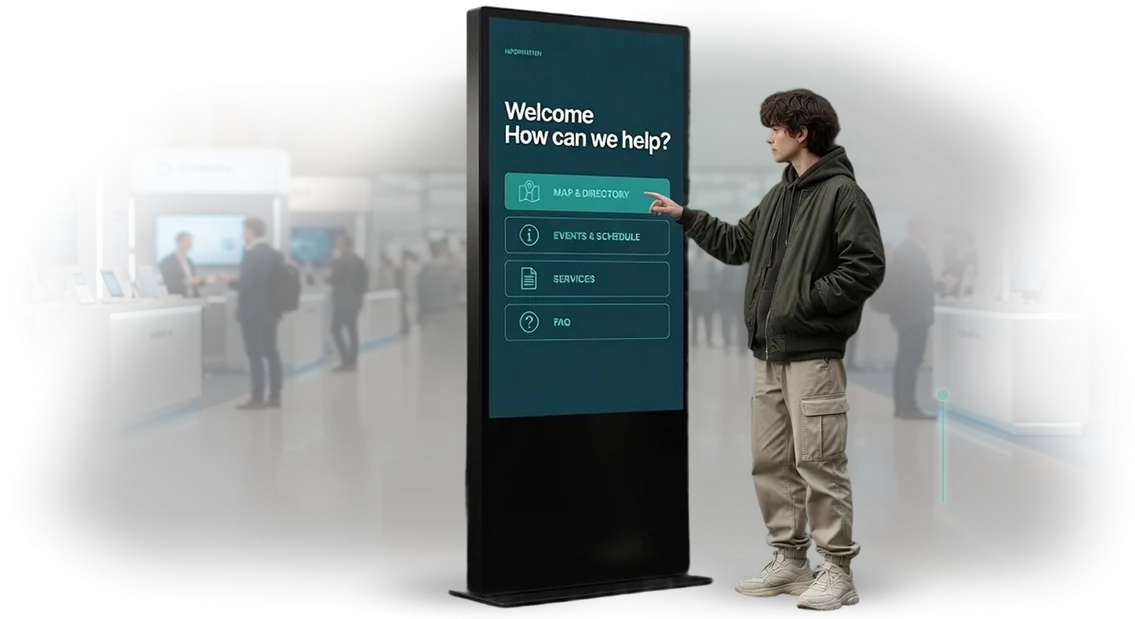
A digital electronic queue in the laboratory solves the task comprehensively: the patient pre-registers via a kiosk or smartphone, and upon visit checks in and sees the exact time until appointment.
This approach reduces waiting time by 40-60% and completely eliminates disputes about turn order. For example, one laboratory chain Gemotest after implementing the system noted a 12% decrease in service refusals per quarter, while staff utilization increased by a third.
The patient feels care even before entering the office — this increases loyalty and the number of repeat visits.
For the laboratory, this is not just a service, but a tool for managed workload: distribute flows by hour, relieve morning peaks, and get predictable revenue without additional staff costs.
We help implement such an electronic queue kiosk and kiosk-based registration turnkey in 2-3 weeks — from scratch to a working system.
What an electronic queue and booking will give your clinic
In a lab's reception area, there is always a queue in the morning: patients arrive without an appointment and ask the same questions while the staff member enters data manually. Others wait—and some leave for the neighboring lab.
An electronic queue with a booking kiosk solves this problem: the patient independently chooses a time, receives a ticket, and goes to have tests done without extra waiting.
Service speed without queues
The booking kiosk takes a minute: the patient selects the type of test, a convenient time, and immediately receives confirmation. Waiting time during peak hours is reduced several-fold—this is visible both in front desk workload and in patient satisfaction.
Those who arrive without an appointment join the electronic queue and see the actual waiting time, not “wait about 30 minutes.”
Relieving the front desk and staff
Front desk automation eliminates routine data entry: personal data, order number, referral—everything enters the system without an administrator’s help.
Employees stop answering the same questions, “When will the result be ready?” and focus on work that requires their qualifications. This reduces staff workload and decreases the number of errors caused by fatigue.
Data accuracy and convenience for patients
Electronic booking eliminates manual entry errors: patients enter their own data, and it immediately goes into the lab system. Repeat tests are processed faster, history is not lost, and results are sent to the specified contact. The patient does not need to remember where to go—the kiosk suggests the next step.
Our team develops such kiosks for the needs of a specific lab: from choosing booking scenarios to integration with your records system. Implementation takes several weeks, and the effect is immediate—fewer queues, more available staff, and more accurate data for each patient.
Interactive kiosk formats for your medical facility
Patients dislike queues at the laboratory — especially in the morning, when tests have to be taken on an empty stomach. Every extra minute of waiting means irritation, complaints, and the risk that the person will leave for the nearest competing center.
Interactive kiosks take the load off the front desk and speed up the flow, but the format must match the tasks of a specific laboratory.
We develop and supply various configurations of touchscreen terminals. All of them run on a single software platform, so you can combine formats within one network — appointment and ticket data will be synchronized. Below is a comparison by typical scenarios.
Comparison of formats for laboratory tasks
| Format | For which task | What it gives the medical center |
|---|---|---|
| Floor-standing kiosk | Self-booking for tests and issuing tickets in the waiting area | Reduces the queue at the front desk; patients choose a convenient time without an administrator's help |
| Wall-mounted kiosk | Quick booking in high-traffic areas and narrow corridors | Saves floor space, does not obstruct the flow of people, works as an additional entry point |
| Kiosk with ticket printing | Automatic issuing of referrals and queue numbers | Eliminates confusion with a live queue; the patient sees their number and prepares for the appointment in advance |
| Multifunctional kiosk | Payment, booking, printing of documents and results | Replaces the administrator's window: covers the full cycle from booking to payment without staff involvement |
| Touchscreen terminal for healthcare | Navigation and reference information about the laboratory | Relieves staff from repetitive questions such as "where is the office?" and "which tests should I take?" |
Floor-standing models with a large screen are suitable for high-traffic lobbies. Wall-mounted ones — for placement in corridors, near blood collection rooms, and in branches with limited space.
Multifunctional terminals with a payment and printing module are optimal for private laboratories that want to fully automate reception.
We manufacture housings from impact-resistant materials and use professional touchscreen displays that withstand constant pressing. The terminal runs without interruption in non-stop mode — this is critical during peak hours.
We will help you choose a configuration for your laboratory, calculate the number of points needed for your patient flow, and prepare a proposal taking into account the layout of the premises.
Stages of kiosk implementation in your clinic
Implementing an interactive kiosk in a laboratory is not just installing a machine in the lobby. We run the project in stages, with approvals at every step, so that the system fits precisely into your patient flow and does not require rework after launch.
- Brief and process analysis. We study the patient flow, the current appointment booking in the laboratory, and queue bottlenecks. We gather requirements from administrators and the manager, and define scenarios for the kiosk.
- Design and approval. We prepare screen mockups and the operating logic: test selection, time-slot booking, ticket printing. You approve the specification — only then does implementation begin.
- Preparation and configuration. We configure the software, integration with your laboratory system, and access rights. We prepare the equipment for installation.
- Test launch. We run through the scenarios together with administrators, adjust settings, and train staff to work with the terminal.
- Launch of the interactive terminal. We install the kiosk in the lobby, connect it, and put it into operating mode. During the first days we provide support — responding quickly to patient questions.
- Support and development. We provide technical support, updates, and usage analysis. We suggest improvements: new services, changes to scenarios to suit your needs.
What is included in the kiosk delivery package
The kiosk delivery package for a laboratory is a ready-made turnkey solution: equipment, software, configuration, and staff training. You will not have to buy anything extra or look for contractors — all work and components are included in the contract.
The complete kiosk package is as follows:
- Touch kiosk — a durable enclosure and bright screen designed for round-the-clock operation in the waiting area. The device easily withstands high visitor traffic and accidental mechanical impacts, so it will not require frequent repairs.
- Self-service software — electronic queue and test booking. With just a couple of taps, the patient selects the type of test, a convenient time, and receives a ticket without contacting the administrator. This reduces the load on the registration desk and shortens physical queues.
- Administrator module — a panel for managing the schedule, viewing workload, and controlling appointments. You can see during which hours visitor flow peaks and can promptly redistribute resources.
- Integration with the laboratory information system — appointments automatically enter the staff’s work queue without manual transfer. Errors and delays are eliminated: nurses see an up-to-date patient list, and test results are not lost.
- Staff training — we conduct hands-on sessions for administrators and medical staff, and provide instructions and reference guides. Employees quickly master the system and can help patients within the first days of operation.
- Warranty for the kiosk and software — the entire package is covered by a warranty, and technical support is available by phone and email. We handle requests promptly so that the laboratory’s operations do not stop.
Additionally, we adapt the enclosure design to your corporate branding and help you choose the installation location. The scope of delivery is fixed in the contract — you know exactly what you are getting and what support you can count on.
Case study: diagnostic laboratory reduced the queue by 40%
Problem and solution
Queues in a diagnostic laboratory are not only a waste of patients' time but also a direct threat to reputation. People go to other clinics, while staff work at their limit trying to serve everyone.
The laboratory chain BioPro faced exactly this: peak hours turned into chaos, and administrators did not have time to answer questions and guide patients. Records were lost, complaints grew, and repeat visits declined.
We proposed installing an interactive kiosk with an electronic queue and pre-booking function. The patient selects the required service, receives a ticket, and sees the current waiting time.
This reduces the burden on administrators and gives people a clear process — they no longer wait in uncertainty. In addition, the kiosk operates around the clock, meaning one can book at any convenient time.
Result and feedback
After implementing the kiosk, the queue decreased by 40%, and patients' time in the laboratory was halved. The number of repeat visits increased because people stopped being afraid of going to the laboratory — now it is fast and predictable.
Staff focused on their work instead of calming visitors. The effect was noticeable already in the first month.
The head of the chain notes: "The kiosk has become our best investment in customer service. Patients praise the new format, and employees finally work calmly." After such a result, we received an order to replicate the solution across all locations in the chain.
Now the laboratory plans to add doctor appointment booking to the kiosk — new opportunities are opening up as the project develops.
How to choose a kiosk format for your tasks?
Choosing a kiosk for a laboratory directly affects the speed of service and patient experience. Before buying a terminal, you should answer the question: what tasks should it perform — appointment scheduling for tests, issuing results, payment, electronic queue, or all together. This determines the configuration, the software, and the location.
The first thing we pay attention to is patient flow. If you have a small laboratory, one compact terminal at the entrance is enough, which will relieve the administrator's load during peak hours.
For a large medical center with high traffic, several kiosks with separated functions will be required: an information zone, a registration zone, and a results issuing zone.
This reduces queues and allows patients to independently perform some operations without staff involvement.
The second point is the physical requirements for the kiosk. The housing must be stable, made of impact-resistant materials, with a moisture-proof surface — a laboratory is typically an area with increased hygiene requirements.
It is important to plan where the terminal will be located: next to the registration desk, in the lobby, or in a separate room. We recommend models with adjustable screen height and the ability for the patient to work in gloves — this reduces barriers to use.
The third aspect is integration with your information system. A laboratory kiosk must exchange data with doctor schedules, the queue, and the registration program. Check in advance whether the terminal supports schedule import and synchronization with the results database.
We always check compatibility before installation so that you get a unified system, not separate devices that work on their own.
If you are unsure which kiosk to buy, send us the parameters of your laboratory: the number of patients per day, the list of services, the size of the premises. We will conduct a short audit and offer a suitable option for your tasks and budget.
You will receive not just a terminal, but a tool that already in the second week noticeably relieves staff and speeds up service.
Frequently asked questions about appointment and queue kiosks
Implementing a kiosk in a testing laboratory often raises questions — and usually they concern not functionality, but how the equipment will fit into existing processes.
Below we have gathered the most common doubts that laboratory managers bring to us and briefly explained how these issues are resolved in practice.
Is it difficult to install a kiosk and get it up and running?
No. We take on the entire process: from measuring the location to setup and a test launch. On the day of installation, the kiosk can already accept its first patients, and your team will not have to change its usual processes.
Usually everything happens within one day, including connection to your network and testing of appointment scenarios.
Will the kiosk be able to work with our laboratory system? Yes. We set up data exchange with your laboratory information system and scheduling database.
The patient selects a service, sees available times, and books an appointment — the information immediately goes where the administrator can see it. If operating rules change, the schedule updates automatically.
What happens if the kiosk breaks down or the internet goes down? The kiosk remains operational in standalone mode: appointments continue to be collected locally, and after connectivity is restored, the data synchronizes.
We set up automatic monitoring of equipment status and notify you of abnormal situations so that you know about a problem before patients notice it.
Do staff need training to work with the kiosk? Staff only need to know how to open the administrator page and change the schedule — this takes 15 minutes.
For patients, the interface is as simple as possible: large buttons, prompts at every step, and the ability to cancel an appointment directly at the kiosk. Your administrators will continue to work as before, but will receive fewer routine appointment requests.
If you are still unsure whether a kiosk is right for your laboratory, send us a description of your current appointment process. We will advise you on how to integrate the kiosk without downtime and without extra workload for staff.
Submit a request to implement a kiosk
Submit a request to implement a kiosk for an analysis laboratory — and as soon as the next day we will hold a consultation, clarify your tasks, and prepare a project cost calculation.
You will learn how the kiosk will speed up patient service, relieve administrators, and increase registration accuracy, even before work begins. One call — and you get a clear plan, timeline, and budget.
The launch process is structured so that you control every stage and get results quickly:
- Request. You leave your contact details — we get in touch at a convenient time.
- Kiosk consultation. We discuss patient flow, registration scenarios, integration with your laboratory's records system.
- Kiosk cost calculation. We fix the scope of work, timeline, and budget in a commercial proposal.
- Scenario design. We agree on the interface and operating logic for your internal processes.
- Development and testing. We prepare the kiosk for operation and test all scenarios under real loads.
- Launch and staff training. We install the equipment, configure it, and show employees how to work with the new system.
- Post-launch support. We stay in touch and help with updates and further development.
What you get by deciding to order a kiosk from us:
- Faster patient registration without queues and confusion.
- Reduced workload for administrators — they handle only complex matters.
- Fewer errors: data goes directly into the system from the patient.
- Adaptation to your laboratory: scenarios, branding, schedule.
- Warranty for equipment and software.
- Russian-language support and quick response to requests.
Submit a request for a consultation and cost calculation — it does not obligate you to anything. We will send a clear proposal, and you will decide how convenient it is for your laboratory. We will start the project as soon as you are ready.