

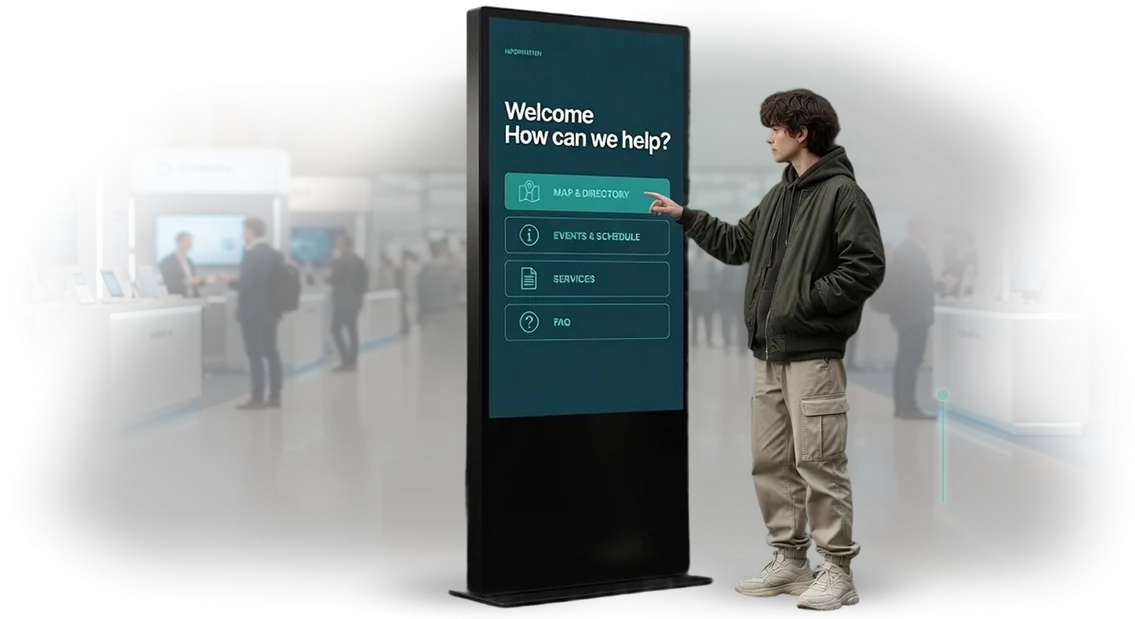
Registry Office Under Load: How to Eliminate Queues and Speed Up Booking
In a registry office, a queue is not just waiting. It is dozens of people in the corridor worrying about whether they will make it in time to submit their application, and staff forced to repeat the same thing ten times over.
On peak days, the chaos intensifies: visitors do not know where to go, who is after whom, and employees are distracted from processing documents by organisational issues.
For the institution itself, this results in lower service quality and extra burden on staff. People leave with negative impressions, and employees spend time not on paperwork but on calming the queue.
In the end, the registry office's reputation suffers, and repeat visits become inevitable due to confusion about appointments.
An electronic queue and self-service booking through an interactive kiosk solve this problem systematically. Visitors choose the service themselves, receive a ticket, and see the call order — without fuss or arguments.
Staff see who has arrived and for what matter, so they can serve each visitor faster and prepare in advance.
The interactive kiosk takes over the routine: registration, ticket issuance, appointment reminders. This cuts queues without expanding staff or adding to administrators' workload.
We help configure such a kiosk to the needs of a specific registry office — so visitors receive services faster and staff work more calmly.
What Changes After Deploying Interactive Kiosks
Visitors will no longer stand in physical queues or waste time waiting at the window. The interactive kiosk lets them choose a service, book a convenient time, and get a ticket in just a few screen touches.
This cuts the visit time from a half-hour wait to a few minutes, while also reducing stress for staff and guests.
Registry office staff are freed from routine tasks: repeating schedules, explaining where to go, and manually registering every visitor.
The kiosk handles the initial intake, routing, and appointment reminders, leaving staff more time for meaningful conversations and quality assistance. Fewer operational errors mean fewer disputes and complaints.
For the institution's management, interactive kiosks become a tool for order and control. The entire workload at each window is visible in real time, with clear data on peak hours and popular services.
Based on this, it is easy to adjust schedules and distribute workload, while the registry office itself looks modern and tech-savvy — enhancing its image and public trust.
Visitors see the kiosk as a sign of respect for their time: the electronic queue and appointment system eliminate the rush and "who's next" conflicts.
This is especially important for newlyweds and parents of newborns — on such a day, they want peace, not confrontation in the corridor. The kiosk helps preserve the ceremonial atmosphere even under heavy flow.
As a result, the very logic of work changes: the institution stops being a "queue for a certificate" and becomes a clear service with predictable appointment times.
The manager gets calm employees and satisfied visitors, and, most importantly, measurable improvements in service speed and the registry office's reputation.
Implementation Formats: From Simple Booking to Full Flow Management
Every registry office faces the same task: managing both visitor flow and bookings for formal ceremonies so that people do not crowd the corridors and employees are not distracted by the "live" queue.
An information kiosk addresses this in several formats — from a simple self-service terminal to a full-fledged flow management system that connects the visitor, the service window, and the employee's workstation.
We adapt the solution to the scale of your institution. Whether it is a small department with a single window or a large wedding palace with a dozen halls, the kiosk is configured to fit your processes and scales along with them.
Which Format Suits Your Registry Office
| Kiosk format | Who it is for | What it gives the client |
|---|---|---|
| Basic — self-service booking for an appointment or ceremony | Registry office with a small visitor flow that needs self-service booking without complex scenarios | Reduces the administrator's workload, removes the reception queue, visitors book themselves in 1–2 minutes |
| Advanced — electronic queue with call to the window | Registry office with moderate workload and several service windows | Organises the flow, directs the visitor to the correct window, the employee sees the next visitor and calls them with a button press |
| Full flow management — kiosk + display board + SMS notifications + priorities | Large registry offices and wedding palaces with multiple halls | Eliminates chaos during peak hours, allows setting priorities (preferential categories, formal ceremonies), visitors receive notifications and do not wait at the window |
The choice of format depends on your objectives: some only need booking to relieve staff, while others need real-time visibility of hall occupancy and the ability to manage peak days.
In any case, the kiosk works as part of your infrastructure — no extra cables, with an intuitive interface for people of all ages.
We will help you determine the optimal format during a consultation and show how the solution will fit into your registry office's current processes.
How the Kiosk Is Developed and Deployed: Step by Step
We structure our work so that you understand what is happening at every stage and can influence the outcome. No surprises and no hidden tasks: project approval, timeline control, and a transparent plan — that is what guarantees a smooth kiosk launch in a registry office.
- Brief and task analysis. We identify which processes need automation: electronic queue, appointment booking, visitor information. We study visitor flows and regulations to propose optimal scenarios.
- Scenario and logic design. We prepare the kiosk's workflow: step-by-step visitor scenarios, integration with your existing electronic queue, staff permissions. We approve the project before development begins — you see the logic and make adjustments without unnecessary costs.
- Design and content. We adapt the interface to the registry office's branding and make it understandable for people of all ages. We write texts and prompts that answer questions and speed up booking.
- Software development. We configure interaction with your electronic queue, appointment database, and reference materials. We use reliable professional equipment to ensure the kiosk operates smoothly even on peak days.
- Testing and debugging. We check all scenarios, from registering a newborn to marriage registration, and simulate peak-hour load. You get a stable system, not a "raw" product.
- Installation, launch, and training. We install the kiosk, connect it to your infrastructure, and start pilot operation. We provide brief staff training on helping visitors, handling emergencies, and tracking statistics.
- Support and ongoing development. We stay in touch after launch: regular software updates, stability monitoring, and prompt improvements based on your requests.
In the end, you get a working kiosk that relieves staff, reduces queues, and increases visitor satisfaction. We take care of the technical side so you can focus on your own tasks.
What Is Included in the Delivery: A Complete Package for Launch
The delivery package includes everything needed to launch an information kiosk in a registry office from day one. We cover all stages, from equipment selection to staff training, so you do not need to hire separate contractors.
- A touchscreen kiosk with a vandal-resistant enclosure: withstands the demands of waiting areas, resistant to accidental impact and damp cleaning.
- Software with an electronic queue and appointment booking: visitors choose the service themselves and receive a ticket, while administrators see the queue in real time.
- An administrator panel: schedule changes, service settings, ticket management, and reporting — intuitive, no programmer required.
- Content and screen templates: screens with registry office branding, hall navigation, information about required documents — all styled consistently.
- Staff training: we conduct sessions on-site or remotely so that your team works confidently with the system from the very first day.
- Technical support and warranty: phone consultations, remote issue resolution, and on-site visits if needed.
All of this is already included in the cost — you get a kiosk ready to work with no hidden surcharges or lengthy approvals.
Real Example: How We Cut Waiting Time by 3x
When the Registry Office Administration came to us, the main complaint was not about staff performance but about constant queues. On peak days, up to 15–20 people gathered at the windows, many came without appointments, and the wait stretched to half an hour. This created stress for visitors and extra pressure on staff.
We proposed installing an interactive kiosk with an electronic queue and self-service booking. Visitors select the required service themselves — from submitting an application to birth or marriage registration — receive a ticket, and see the current waiting time on the screen. The administrator monitors window workload and redirects flows during peak hours.
The results exceeded expectations. Average waiting time dropped by 3x: from 24 minutes to 8 minutes. During two hours of peak load, up to 30 couples were served instead of 12 — without increasing staff or adding windows. People stopped crowding around the counters, and staff gained a calmer work rhythm.
"We used to answer the same questions every ten minutes; now guests find their way using the kiosk. Formal ceremonies start on time, and you can feel it in the visitors' mood," noted the department head.
After the successful launch, the registry office ordered two more kiosks for other halls — the repeat order confirmed that the solution works.
How to Choose the Right Format for Your Registry Office's Needs?
The right format is determined not by trends but by the specific needs of your registry office.
If queues build up in the hall during peak hours and employees are distracted by visitor questions, you need an electronic queue that distributes the flow and relieves pressure on staff.
If most citizens arrive at pre-selected times, the priority becomes an advance booking module that synchronises schedules and eliminates confusion.
Often, the best approach is to combine both modes: booking for formal procedures and a live queue for certificates and consultations.
The selection criteria are always individual: how many visitors come per day, how many windows are in operation, whether there are seasonal peaks, and which services are most in demand.
It also matters how well the solution fits into current processes: whether it is needed only for information, or whether it should manage flows, collect statistics, and simplify the work of registrars.
The answers to these questions determine the equipment composition and interface logic — and these are exactly what we find out at the start of the project.
A good format does not create extra work for staff and does not require complex training. Citizens should understand in 10–15 seconds where to go and what to do, and staff should get a clear tool rather than another source of stress.
That is why we configure kiosks for each specific registry office: from a compact display with a live queue to a full suite with advance booking, a waiting screen, and document information.
To avoid choosing blindly, all it takes is a short consultation: we will analyse your tasks, assess your premises and visitor flow, and suggest a format that solves your specific problem rather than just installing equipment.
It carries no obligation — but you will get a clear understanding of what suits your registry office and what results to expect after launch.
Frequently Asked Questions About Kiosk Operation: Addressing Your Concerns
Before ordering a kiosk, managers usually have three concerns: will it work reliably, is staff training easy, and are visitor data protected. We answer these questions so you can make a confident decision.
What happens if the kiosk freezes or loses power?
The system will restart automatically, and the current operation will be saved. The visitor continues from the same step, and booking will not stop even during peak hours. Failure scenarios have been tested in real projects.
How difficult is it to maintain the kiosk?
Management comes down to simple steps: replace paper, update the schedule, view statistics. A short briefing is enough for staff; the interface guides them through the rest. If a question arises, support will help remotely.
Are visitors' personal data safe?
Data is transmitted and stored in encrypted form, and access is role-based. The kiosk does not retain unnecessary information and complies with personal data processing requirements.
Will the technical department face additional workload?
No. The kiosk operates independently, and settings are configured remotely. Technical specialists are only needed during installation — to connect network and power. After that, administrators manage the system through a simple panel.
Still have doubts? Ask us — we'll show examples for a registry office and explain how the kiosk will fit into your booking system.Ready to Simplify Visitor Booking? Leave a Request
Leaving a request is the first step toward a kiosk that relieves registry office staff and cuts queues in the hall. No complex forms: you describe your task, we suggest a suitable solution, and immediately calculate a preliminary cost estimate.
After you reach out, we will contact you within one business day, clarify the details, and prepare a commercial proposal. From there, the process is clear: from calculation and modernisation to kiosk launch and support. To order a kiosk for registry office booking, simply start with a short request.
Immediately after contacting us, you receive:
- A preliminary cost estimate for your task — no hidden surcharges during the approval stage.
- A kiosk format selection: floor-standing kiosk, wall-mounted terminal, or a compact solution for the administrator's counter.
- A booking interface prototype: an intuitive scenario for visitors of all ages and skill levels.
- Modernisation options if you already have equipment — we will update the software and integrate it with the electronic queue.
- An implementation plan and work schedule with milestones, so you can see the status at every stage.
- Technical support after launch: updates, backups, and staff consultations.
Right now, you have two options: leave a request and get a ready action plan, or keep spending your staff's time on manual booking. Choose the first — we'll start with a consultation and cost estimate, and take care of the rest.