

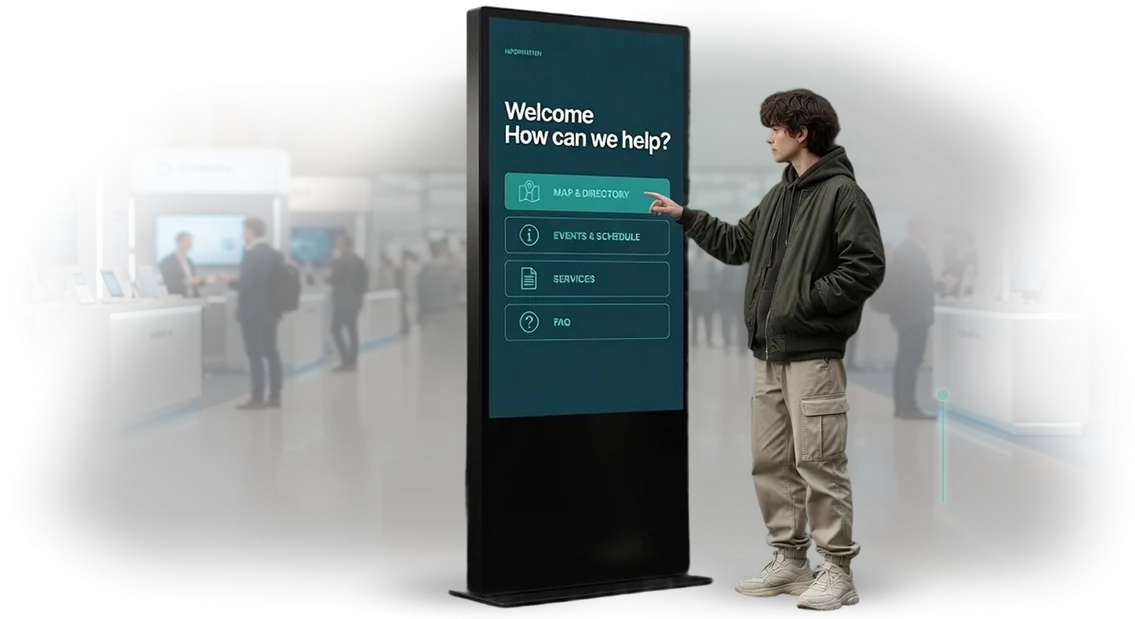
Visa center loses applicants due to queues and complicated booking
The visa center loses applicants every day, literally at its doorstep. People arrive with documents, see a long physical line, and leave — some go to a neighboring center, others postpone their trip entirely.
Each such departure means lost staff time, missed services, and a reputation that suffers because of a single unpleasant impression.
The second pain point is booking an appointment at the visa center. Phone calls and correspondence drag on for days, available slots are snapped up quickly, and an applicant who does not receive confirmation in time simply gives up.
The more difficult the client’s path to a visa, the higher the risk that they will choose a competitor or cancel at the last moment — and this scenario repeats every day.
These are exactly the problems an interactive kiosk with an electronic queue and visa center booking solves. The applicant independently chooses a convenient time, registers a visit in a couple of taps, and immediately receives confirmation.
The system distributes the flow so that people do not crowd in the lobby but are called in as staff become ready — predictably and without chaos.
For management, the result is shorter queues and retaining applicants who used to leave before their turn. The center stops being a stressful place, staff work more calmly, and positive visitor experiences turn into recommendations and repeat visits.
The kiosk pays off not as “just another screen” but as a tool that wins back every second lost client.
What a touchscreen kiosk for visitor reception delivers
Visitors to a visa center come with one desire — to process their documents quickly. But a physical queue, manual form filling, and repeated clarifications at the administrator’s desk stretch the visit into hours.
A touchscreen kiosk removes this routine: the person selects the needed service, books an available slot, and enters contact details. Only complex questions and document checks remain for staff, so the load on the registration desk visibly decreases.
For a manager, such a kiosk is also a window into the real queue picture. The system accumulates data for each day: at what hours visitor flow peaks, how long service takes, and which services are ordered most often.
Based on this analytics, shifts can be adjusted, service windows added during peak periods, and employee overload prevented in advance.
Service speed becomes a competitive advantage. The visitor enters data before meeting the operator, so the specialist does not retype the application but checks the request immediately. The queue moves faster, and the center handles more applicants per day.
At the same time, there is no need to expand staff — the same employees manage to serve more people.
At our team we build such kiosks with visa center specifics in mind: we support multiple interface languages, integrate with the electronic queue, and make management understandable even for technical staff.
The ready-made solution already helps our clients reduce queues and increase visitor loyalty. See how it can affect your center — we will send a calculation tailored to your volumes.
Kiosk formats: for any reception task
A kiosk is not just a screen on a counter. The format determines whether it will do its job: orient the guest, book an appointment, or organize queues without an administrator’s involvement.
The right kiosk format saves visitors’ time and relieves staff — which means it increases throughput and reduces costs.
| Format | For whom | What it gives the client |
|---|---|---|
| Information stand | Visitors in the lobby who need navigation and answers to frequently asked questions | Quick orientation, fewer requests to staff, calm atmosphere |
| Self-booking kiosk | Visa centers and branches with a flow of advance appointments | Booking without calls and queues, fewer errors, more successful visits |
| Electronic queue | Waiting areas and multi-function reception zones | Transparent order, control of load and waiting time, fewer conflicts |
| Touchscreen wayfinding and display boards | Large spaces where it is hard to find the right office | Clear route to the office, fast service, higher satisfaction |
These are the basic scenarios, but one kiosk can combine functions — for example, self-booking and electronic queue ticket dispensing. We select the format for your task, layout, and visitor flow, so you get maximum value from every square meter and every person who comes in.
Tell us what you want to automate — we will suggest a suitable kiosk format and calculate the impact for your visa center.
How we implement kiosks: the process for your visa center
Implementing an information kiosk in a visa center is a well-structured process that takes minimal time from your team. We handle all stages: from a detailed brief to launch and ongoing support.
You get a complete solution tailored to your visa center’s tasks, not a “raw” product that needs finishing.
- Brief and implementation plan — we discuss what scenarios the kiosk should cover: booking for document submission, electronic queueing, and status information. We set deadlines and responsibilities.
- Interface approval — we show a screen prototype: how the visitor selects a service, joins a queue, and receives a ticket. You make edits before development starts — this saves budget and time.
- Development and configuration — we build the electronic queue and booking system, connect ticket printing and, if needed, integration with your records system. We configure for peak loads.
- Testing on real scenarios — we check how the kiosk behaves at rush hour, during unusual visitor actions, and during failures. We fix everything before launch.
- Kiosk launch — we install the equipment, set it up in your lobby, and train administrators. You get a working kiosk without service interruption.
- Support — we stay in touch: update information, add functions, and resolve issues quickly. If processes change, we adapt the kiosk to new tasks.
What is included in the kiosk delivery and setup
You receive a kiosk that starts working on the day of installation — without lengthy approvals or fine-tuning. We configure the machine for your specific visa center’s processes: connect it to the booking system, upload rules, and verify ticket printing. Everything else is included in the delivery package.
- Assembled kiosk with touchscreen, enclosure, and board — all components are already compatible, nothing to select.
- Preinstalled electronic queue and booking software — the “select a service → get a ticket → wait for your call” scenario works immediately.
- Integration with your database and schedule — slots and visa categories load automatically, without manual entry.
- Logic configuration: limits on categories, priority for urgent cases, prevention of duplicate bookings for the same date.
- Load testing: simulation of a queue of 50 visitors, verification during connection drops and kiosk restarts.
- Instruction manual for staff and administrators: how to change the schedule, print a report, restart the kiosk.
- After-sales support — updates, backup, and help from those who installed the system.
This approach eliminates the risk of a “raw” project: you know in advance what you will get, and we know what we are responsible for. If questions arise during operation, technical support will help remotely or come on site.
Case study: how we halved the load on the reception area
When a visa center’s reception area is overloaded, both visitors and staff suffer. People travel dozens of kilometers, wait in line for hours, and leave without results, while managers waste time on repeated questions and manual document collection.
This is exactly the situation a client brought to us — a regional visa center with peak waiting times of up to 40 minutes during reception hours.
We suggested not expanding staff but moving routine steps to an interactive kiosk. At the entrance, the visitor selects a service, scans documents, and joins the electronic queue. The manager only checks and processes the application — no paper gathering or manual data entry. This removes the main load precisely at the moments when the reception area is completely full.
Result for the visa center
Just one month after the kiosk was deployed, the reception queue was cut in half. Average waiting time dropped from 40 to 15 minutes, and 65% of visitors completed self-check-in at the kiosk without staff assistance.
Staff stopped being distracted by duplicate questions — the freed-up time went toward receiving more clients per hour.
Importantly, this is not a one-time campaign but a stable daily result. The kiosk operates without failures, visitors get from the entrance to the window faster, and the administrator sees the lobby load in real time and regulates the flow.
The visa center appreciated the effect so much that it ordered three more kiosks for other branches.
For the business, this means: throughput grows without expanding staff, complaints about waiting disappear, and visitors receive the level of service they are used to from banks and government services.
If your reception area is also overloaded — we will show you how to quickly get out of this situation.
How to choose the right kiosk format for your task?
Choosing a kiosk format starts not with the device model but with two questions: how many visitors pass through the area per day and what function the kiosk should perform — information, appointment booking, ticket dispensing, or all of them at once.
In a visa center with peak hours and queues, speed and stability are what matter, not the look of the enclosure. So first we analyze the layout and visitor flow, and only then suggest a suitable configuration.
The main criterion is load. If the expected flow is up to several hundred people per day, a compact floor-standing kiosk with a touchscreen is enough.
If booking runs from morning to evening and a line constantly forms at the kiosk, a more durable enclosure and a well-planned location are needed so visitors do not interfere with each other.
We account for how a person approaches the screen, how long an operation takes, and where staff are at that moment — these factors determine how many kiosks to install and which option to choose.
The room layout determines the installation type: wall-mounted, floor-standing, or tabletop. In a narrow corridor, a compact stand is more convenient; in a spacious lobby, a full-fledged column with several zones: self-check-in, document printing, and payment.
It is important to plan access for people with disabilities in advance — for visa and government institutions this is a mandatory requirement, and we incorporate it into the project from the very beginning.
Budget is the third component of the choice. We offer several equipment levels: from a basic kiosk for booking only to a modular solution that can easily be extended with new functions.
Together with you, we calculate not the price of a single device but the total system cost: how many kiosks will be needed so queues do not delay visitors, and how quickly the solution will pay off through reduced staff workload.
The main thing is not to choose a kiosk from a picture. We visit the site or study the floor plan, assess real flows, and select a format that fits the interior, withstands the load, and stays within the planned scope. As a result, you get a working solution from day one, without rework or hidden costs.
Common concerns: what if the kiosk breaks down or guests don’t like it?
Technology can fail, and clients rightly ask about reliability and ease of use. We answer directly: in 10 years of implementations, our team has made customer care part of the service — warranty, support, and training are included in the project.
What happens if the kiosk breaks down on the busiest day?
All equipment is supplied with a warranty. A spare kit or quick replacement is provided. The system reports problems on its own — we often resolve them before guests notice.
How quickly do you respond to a failure?
There is a dedicated technical support line. An engineer connects remotely and resolves the issue in a single session. If an on-site visit is needed, we respond according to the agreed procedure.
What if visitors don’t understand how to use the kiosk?
We test the interface on real users before launch. On-screen hints and an administrator call button help even a first-time user manage.
Will staff need training and how long will it take?
Training is included in the project: a short briefing and a reference card for administrators. Staff are freed from routine and only handle non-standard tasks.
If doubts remain — we invite you to a demo: we will show the kiosk in action, let you test the scenario, and answer questions specific to your case. Better to try it once than to read descriptions.Leave a request — get a calculation and implementation plan
A request is not an obligation but a way to get exact figures for your case. We will analyze how the queue and booking work in your visa center and prepare a cost calculation, timelines, and an implementation plan.
The ultimate goal is for you to understand the result before work begins and make a decision without rushing.
Then everything follows a proven pattern:
- Consultation: you tell us about your visitor flow, and we ask clarifying questions.
- Process analysis: we identify places where queues form and applicants are lost.
- Cost calculation: we fix the scope of work and budget without hidden surcharges.
- Implementation timeframe: we break the project into stages and give the launch date.
- Implementation plan: we show who does what and what is needed from your team.
- Demonstration of the solution on your booking scenarios — before the final decision.
You receive not an abstract price list but a project roadmap. Deadlines and budget are fixed at the calculation stage, so you can calmly plan the visa center’s operations without relying on “surprises” at launch.
Leave a request via the form — a manager will contact you within one business day and arrange a convenient time for a consultation. This is non-binding: you can make your decision after you see the calculation and implementation plan.