

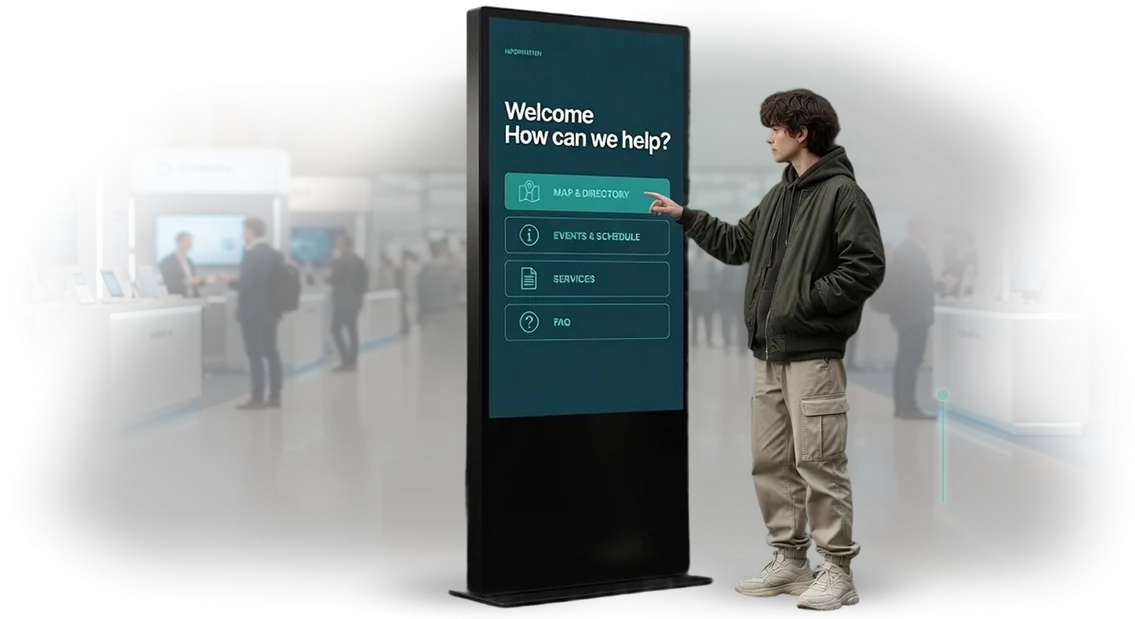
A Court Without Queues: Why Visitors Leave Dissatisfied
A court visitor arrives with a specific goal — to get quick access to a receptionist, submit documents, or obtain a certificate.
But instead, they encounter chaos at office doors, crowds in the corridors, and complete uncertainty: when will their turn come, how long will they wait, will the secretariat lose track of them?
Emotional tension grows with every minute — and by the time they finally speak with a specialist, the person is already primed for conflict rather than constructive dialogue.
Long queues in court are not just a discomfort for visitors; they are also a blow to the reputation of the entire institution. People judge the quality of service by how easily and predictably they can get what they need.
Hours of waiting in a stuffy corridor generate negative reviews, reduce trust in the judicial system, and place an extra burden on staff, who have to keep calming people down and explaining things instead of performing their actual duties.
An electronic queue system and interactive self-service kiosks solve this problem. Visitors immediately see the order of service, receive a ticket or choose a convenient visit time, and know when they will be called.
They stop worrying about being skipped, while staff work at a calm pace without endless questions like "who's last in line?" and "how much longer?".
Advance court registration via a kiosk or at the information desk relieves peak-hour pressure and distributes the flow of people evenly throughout the day.
We help courts at various levels bring order to their waiting areas: we implement a queue management system that makes service predictable and saves time for everyone involved.
This is not just technology in the lobby — it is a tool that shapes the image of a modern, client-oriented institution.
The improvement in service is immediately visible: visitors stop feeling anxious, staff stop working as dispatchers, and the organization's reputation is strengthened.
Visitors feel their time is respected and return without internal resistance, while the court gains order and positive feedback.
What an Interactive Kiosk Delivers: Order and Comfort for Everyone
Every day, dozens of people pass through a court — visitors wait, worry, and ask the same questions. Each such situation distracts staff from their core duties and creates a sense of chaos.
An interactive kiosk changes this: order at the entrance, clear navigation, and fast self-registration instead of a live queue.
Electronic Registration: Fewer Queues
Visitors choose a convenient time and the right specialist themselves via the kiosk. Registration takes a couple of minutes and immediately enters the shared system — no manual scheduling checks needed by the administrator.
During peak hours, queues shrink dramatically, and staff are freed up for actual work with requests.
Information Kiosk: Answers Without Waiting
The kiosk replaces endless "where?" and "how?" questions: building map, list of required documents, step-by-step instructions. The answer appears on the screen within seconds, and the visitor heads straight to the right office. Staff no longer act as a help desk, and visitors spend less time.
A Modern Image and Comfort
An electronic queue and convenient service are a visible sign of care for people. The institution looks modern and predictable, and trust builds accordingly.
Our team develops kiosks with the specific needs of courts in mind, so the interface is clear both for younger visitors and for the elderly.
The result: less workload for staff, order in the lobby, and a positive image — without significant investment in expanding your team. A single kiosk pays for itself through the staff time saved and the trust gained from visitors.
Court Kiosk Formats: Choose What Fits Your Task
Every day, hundreds of visitors cross paths at a court: some come for a hearing, others need a certificate, and others want to book an appointment with a specialist.
A universal "all-in-one" kiosk often loses out to a specialized solution: people find the function they need faster and rely less on staff. That is why the first step is to choose a format that fits your task.
Below are three basic formats that we adapt to your institution's regulations and design. They can be used separately or combined on a single screen.
| Kiosk format | Who it is for | What it gives the client |
|---|---|---|
| Electronic queue in court | For those waiting to be seen at the registry office or by a judge | Eliminates crowds and disputes over order. The administrator sees window workload and redirects people |
| Appointment booking | For citizens who need to see a specialist at a specific time | Reduces staff workload: the schedule fills itself, visitors no longer come "on the off chance" |
| Information terminal | For those who need schedules, requisites, document lists, or office search | Frees the secretary from repetitive questions; visitors get up-to-date information without queuing |
The table is a starting point. In real projects, we often combine formats: the terminal displays reference information and immediately issues a queue ticket.
The key is the screen logic, intuitive enough that no guidance is needed — then the kiosk saves time for both staff and visitors.
Tell us which challenge in your court is the most pressing — we will recommend the format or combination of formats to solve it.
How We Build a Kiosk for Your Needs: The Project Process
We structure our work so that at every stage you know what is happening, what the timelines are, and what results you will get.
No "black boxes": you participate in key decisions, control the budget, and see how the kiosk evolves from an idea into a working tool for visitors and staff alike.
-
Brief and analysis. We study how appointments and queues currently work in your institution, what visitor flows look like, and where delays most often occur. We document the tasks the kiosk must solve: reduce queues, automate registration, relieve staff.
-
Scenario design. We work out the screen logic: how a visitor reaches the right section, how registration works, how they receive a ticket or confirmation. We align the structure with you so that it matches your internal regulations.
-
Design and prototype. We create a clear interface with large buttons, hints, and easy navigation. We show you a prototype — you see how the kiosk will look and work before development even begins, and you make adjustments.
-
Development and configuration. We configure the electronic queue and booking system and connect integrations with your accounting systems if needed. We work with professional hardware and proven tools, so the result is stable and predictable.
-
Testing and training. We check all scenarios: from standard registration to non-standard situations. We train your staff to work with the kiosk and the admin panel so they can manage the queue and access statistics.
-
Launch and support. We install the kiosk, put it into operation, and stay in touch: we update content, help with maintenance, and resolve issues promptly. When necessary, we develop the functionality further — adding new services or sections.
You get not just a device but a working service you do not have to worry about. Transparent stages, clear timelines, and post-launch support are what make the project predictable.
What Is Included in Delivery: A Complete Kit for Kiosk Operation
You are not interested in a single component but in a working kiosk that fulfills the court's tasks from day one — accepting applications, managing the queue, registering visitors.
That is why the delivery package includes everything needed: from the housing with equipment to instructions and staff training. We cover the entire scope so you do not have to coordinate multiple contractors.
- Hardware and housing, fully assembled — an industrial kiosk ready for installation in the waiting area. No extra purchases or self-assembly needed: you receive a product that can be plugged in and used immediately.
- Software configured for court processes — the electronic queue, booking, and information modules are already tuned to your operating procedures. Visitors see a clear flow: got a ticket, waited for the call, proceeded to the right office.
- Interface design and kiosk branding — large buttons, simple navigation, adapted for people of different ages. The kiosk's exterior can be styled to match your institution's identity so it blends naturally into the interior.
- Instructions and operational documentation — short guides for staff and administrators. Employees can quickly learn how to manage the queue, change schedules, or pause registration if necessary.
- Staff training — a hands-on session with your team. We demonstrate on a real kiosk how to handle typical situations: rescheduling appointments, making an emergency call for a visitor, managing breaks. After the training, staff work independently and confidently.
- Warranty and technical support — for both hardware and software. Under the contract, you get direct channels to our engineers, who respond quickly to requests and help resolve any issues.
This approach eliminates the risks of incompatibility and downtime. You work with a single accountable contractor, and after launch we support the kiosk and refine the functionality to meet new challenges.
Everything needed for operation is already included in the cost calculated after audit — all that remains is to switch the kiosk on and start using it.
Case Study: A Court Kiosk Cut Queues by Three Times
Court visitors rarely arrive with time to spare: a hearing at 10:00, and before that they need to register, find the right office, and submit documents. Every extra minute of waiting means stress, lateness, and negativity that people take out on staff.
For a court, this is not just foot traffic — it is a matter of reputation and the smooth operation of the administration.
How We Reduced the Queue by Three Times
Our team at our team installed an information kiosk with an electronic queue and appointment booking in one of the district courts. Previously, visitors crowded the corridor, creating chaos and distracting staff from their work.
Now every guest checks in at the kiosk within a minute, receives a ticket, and sees on the screen when they will be called.
Within a month, the average wait time dropped by three times — from 45 minutes to 15 minutes. At the same time, 9 out of 10 visitors gave high ratings to the convenience of navigation and booking.
They specifically noted that it had become clear where to go and how long they would wait — this used to be the most common complaint.
Administrative staff stopped being distracted by questions like "where is my office?" and focused on their core work. The head of the registry office noted that registration and document intake sped up by a third because people arrived prepared and on time.
For us, this case is confirmation: the right information environment saves time for visitors and staff, reduces tension in the hall, and increases trust in the court. And it works without additional personnel.
How to Choose the Right Kiosk Format for a Court?
Choosing a kiosk format for a court does not start with technical specifications but with the answers to two questions: what is the actual visitor load on the building, and what tasks should the terminal perform?
For a small district with a flow of 100–200 people per day, a single compact touchscreen kiosk is enough — it can provide information about addresses, opening hours, and help visitors book an appointment with a specialist.
For a large court with thousands of visitors per month, you will need two or three devices with an electronic queue and a booking module to prevent crowding in the lobby and to sort visitor flows.
The second criterion is the range of services you want to automate. If the kiosk is only needed for information and ticket issuance, a basic model will do.
If it must accept applications, schedule appointments, print tickets, and display case status, you will need a more powerful configuration with a server component and integration with your database.
The key point: the more operations you move to the terminal, the faster you relieve your staff and the more you reduce the average waiting time for visitors.
The third criterion is the budget, but it should not come down to the price of hardware alone. Calculate how many hours your staff spend on repetitive questions and processing bookings — a terminal typically pays for itself by redistributing this load.
We offer several configurations for different budgets, from simple information stands to full automated queue management systems.
Above all, do not assemble a solution blindly. We design the kiosk around your needs: we visit the site, assess the layout and visitor flows, model peak loads, and select the optimal format — the number of devices, screen size, and feature set.
As a result, you get a system that handles queues, improves information accessibility, and reduces staffing costs.
Common Client Concerns: We Answer Before You Start
Every client asks the same questions before launching a kiosk in a court: will the equipment break on day one, will the staff cope, what will happen to the queue. That is normal.
We address the main concerns before you start, so you can make decisions based on facts rather than guesswork.
Who maintains the kiosk after installation?
An interactive kiosk is not a one-time delivery. We stay with you after launch: we remotely monitor the system, track the condition of the equipment, and update the software.
If something needs attention, our team connects to the kiosk and resolves the issue without an on-site visit.
In the rare cases where physical repair is required, we have a proven module replacement procedure. Court staff are never left alone with the technology — they always have a support contact who responds quickly and to the point.
What happens if the kiosk freezes at peak time?
The system is designed so that failures do not disrupt court operations. Even under heavy load, the kiosk keeps accepting applications and issuing tickets.
If a rare error does occur, the device automatically restarts the affected module — the visitor simply continues using the service without noticing the problem.
In addition, we set up monitoring: if the system detects an anomaly, our team receives a signal and resolves the issue before it affects visitors. Queues do not stall, and staff do not have to "fix things by hand."
How quickly will court staff learn to work with the kiosk?
Training takes one short session — usually no more than an hour. We do not teach your staff to program. We explain what the visitor sees, how to refill paper, and how the administrator screen works. Everything else the kiosk does on its own.
For new employees, there is a built-in hint right on the screen, so even without training a person can figure it out in a few minutes. No complicated 40-page manuals — only what is actually needed on the job.
Is it safe to transmit data through the kiosk?
Visitor data is your responsibility, so we treat it strictly. The kiosk runs in a secure environment, and access to information is restricted by staff permissions. Personal data is not retained in the device memory during idle time and is transmitted only over secure channels.
We also account for physical protection: the housing is resistant to damage, and the internal storage drives are protected against unauthorized removal. Your court gets a working service, not a security headache.
Doubts are no reason to postpone the project. Ask us your questions now — get an honest answer about timelines, costs, and operating conditions before we sign the contract. That way you launch the project with a clear outcome and no surprises.
Order a Kiosk for Your Institution
Leave a request — and we will calculate the cost of a kiosk tailored to your institution's needs, answer your questions, and offer a solution that will pay for itself within the first months.
our team has been developing interactive systems for courts, government institutions, and businesses for over 10 years — we know how to make sure visitors do not stand in queues and staff do actual work instead of explaining the same thing over and over.
Fill out the form on the website or call us — within one business day you will receive a quote and an implementation plan. Design, delivery, configuration, and staff training — we handle everything.
- Consultation — we will analyze your situation and recommend which kiosk format is right for you.
- Accurate cost calculation — no hidden fees; the estimate is fixed before work begins.
- Fast implementation — from approval to launch in as little as 2 weeks, with minimal disruption to operations.
- Post-launch support — updates, maintenance, and assistance for operators.
- Queue analytics — see load by hour and optimize appointment schedules.
- Turnkey — project, installation, integration with your booking system, staff training.
Take the first step toward a modern reception day without chaos and conflicts in the lobby. Leave a request now — we will call you back, answer all your questions, and prepare a proposal tailored to your institution's specifics.