

How to Eliminate Queues at a Russian Post Branch and Improve Service
Queues at a post office branch are not just an annoyance for visitors—they also directly drive customers away. Anyone who spends 20 minutes waiting remembers the experience and the next time chooses an alternative: an online service, a courier service, or another branch.
As a result, the branch loses not just one visitor but an entire stream: dissatisfied customers tell their friends about it, and the reputation declines.
At the same time, the problem is often not the number of operators—workload is distributed unevenly: empty in the morning, peak at lunchtime, and some customers arrive without an appointment and end up in a live queue.
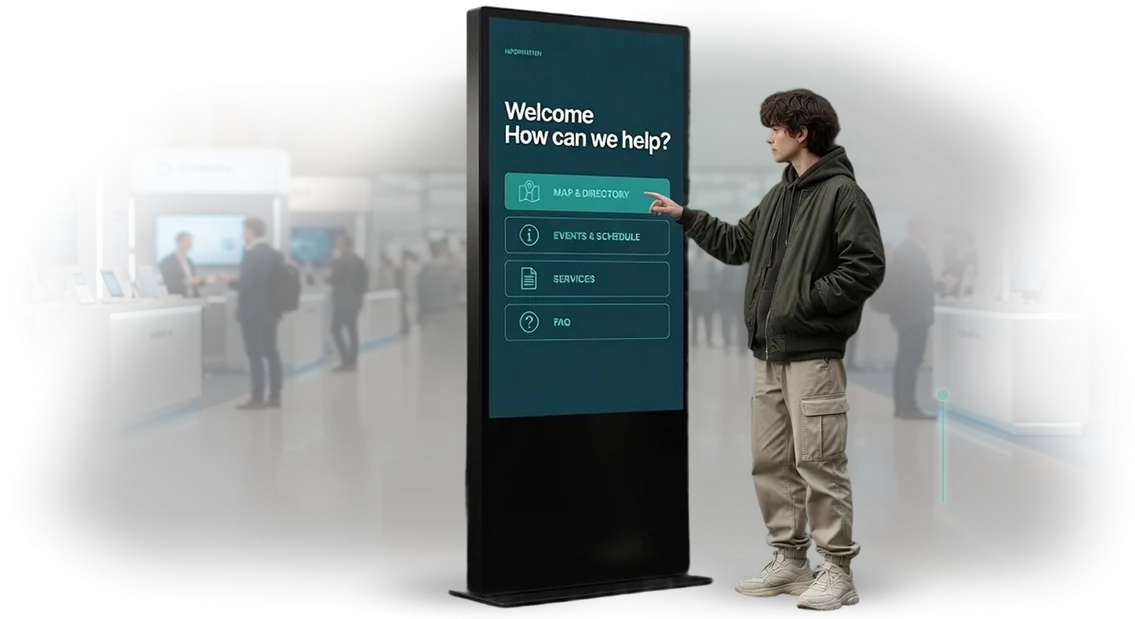
The solution is to implement an electronic queue at the Russian Post branch. When a visitor takes a ticket and sees the real waiting time, stress levels drop, and employees work at a calmer pace.
Electronic queue scheduling lets people plan their visit in advance: a customer chooses a convenient time via a kiosk or mobile app and arrives when it's time. This relieves peak hours and reduces the peak load on operators.
For the branch itself, this means a predictable visitor flow and the ability to manage staff workload.
Improving a branch's service directly affects key metrics: shorter waiting times increase loyalty, and satisfied visitors are more likely to use additional postal services—subscriptions, insurance, financial products.
We help implement such a system turnkey: from configuring the kiosk software to training employees. As a result, the branch is no longer associated with queues and becomes a modern service center that customers return to on their own.
What an Interactive Kiosk Will Bring to Your Branch
An interactive kiosk reshapes how a Russian Post branch works, benefiting both visitors and employees. Instead of tedious waiting in line, there is fast self-service check-in, and operators get more time for direct customer questions and complex operations. Here's what changes in practice:
- Faster service. Visitors choose their service on their own, receive a ticket, and go to the right window. Average waiting time drops, and traffic throughput increases—especially during peak hours.
- Reduced strain on operators. Staff stop being distracted by repeated questions like "where is my place in line?" and "who was last?". The kiosk handles check-in, information, and notifications, freeing employees for truly important tasks.
- Better customer experience. Visitors see a transparent system: which number is being served, how many windows are free, whether there are delays. This reduces tension and creates the impression of a modern, attentive branch.
- Control and order. The kiosk automatically distributes the flow, eliminating arguments and "favorites". The branch manager gets a clear picture of window loads and can manage staff flexibly.
In the end, the kiosk pays for itself not with hardware but with time—time returned to you and your visitors. People receive services faster, leave satisfied, and come back again—while the branch operates like a well-oiled machine.
Kiosk Formats for Different Branch Needs
The effectiveness of a touchscreen kiosk for post offices depends on the format: sometimes the priority is an electronic queue, sometimes self-service, and sometimes an information stand.
Branches differ in traffic, floor space, and range of services, so there is no one-size-fits-all solution. The right format speeds up service and reduces staff workload.
| Format | For whom | What it provides |
|---|---|---|
| Floor-standing kiosk with electronic queue | Branches with high traffic | Organizes the queue, reduces waiting, removes manual check-in |
| Compact wall-mounted kiosk | Small branches | Saves space, speeds up check-in with a specialist |
| Self-service kiosk | Payments, printing, requests | Relieves windows, customers perform some operations themselves |
| Interactive stand | Wide range of services | Helps navigate services, wayfinding, and tariffs |
For Russian Post branches, we select the format based on the floor plan and work scenarios. One kiosk can combine several tasks: issuing electronic queue tickets, providing information about services, or self-service processing. This approach eliminates purchasing mistakes and unnecessary expenses.
We visit the site, assess the premises, and offer a configuration with room for future growth. You get not just a device but a result-oriented solution: predictable branch capacity, fewer queues, and more loyal visitors.
How We Implement a Kiosk: Project Stages
When you order a kiosk for a Russian Post branch, what matters to you is not the device itself but a predictable process: from the first discussion to stable operation. We implement the kiosk turnkey so that you get a working solution without missed deadlines or hidden costs. Below are the stages of the project.
- Brief and analysis of branch needs. We find out which services are in demand, how many visitors come per hour, and how the queue and check-in are currently organized. This allows us to make the kiosk convenient specifically for your customers.
- Approval of the project and mockups. We prepare a proposal for the set of functions, screen design, and workflow logic. You see how the kiosk will look and approve the solution before development starts—this avoids expensive rework.
- Turnkey kiosk development. We set up the electronic queue, check-in with an operator, and status notifications—everything needed for fast service. We test real-world scenarios so a visitor never ends up confused.
- Kiosk launch at the branch. We install the equipment, connect it to your system, and train staff to work with the new queue. The kiosk starts serving the first visitors and immediately reduces the workload on employees.
- Post-launch kiosk support. We monitor stability, update scenarios as services change, and respond quickly to requests. You get technical support that doesn't keep you waiting and doesn't require technical knowledge from you.
This approach eliminates unexpected problems: you know in advance what you will get, when it will happen, and what comes afterward. That is why branches that implement kiosks with us reduce queues and increase visitor satisfaction—without firefighting and operator overload.
What Is Included in Supply and Setup
When you order an interactive kiosk for a branch, you get not just a device but a complete turnkey solution. You don't have to separately find a hardware supplier, an installation contractor, and an interface developer—one team handles all stages.
For a branch manager, this means less hassle coordinating contractors, shorter installation timelines, and a single point of responsibility for the result. Below is the full list of what is supplied and set up.
- Kiosk delivery package: touchscreen kiosk in a protected enclosure, uninterruptible power supply, banknote acceptor, and receipt printer—the unit is ready to operate immediately after installation.
- Kiosk software: electronic queue, service check-in, payment, viewing request status—the interface is already configured, so it can be turned on and used on the day of installation.
- Kiosk installation: we deliver, mount, connect to the network and your infrastructure, and test all scenarios—branch operations are not interrupted.
- Configuration for your branch: list of services, business hours, breaks, check-in rules, and priorities—everything is adapted to your regulations.
- Staff training: a short briefing for operators and administrators, plus a quick-reference guide for standard situations—replacing consumables, restarting, helping a visitor.
- Documentation and warranty: a certificate of completed work, technical passport, and warranty service, including remote diagnostics.
As a result, the kiosk starts delivering value from day one: the queue moves faster, visitors check in and pay without an operator's involvement, and staff focus on complex requests. We handle all technical issues—all that's left for you is to welcome customers.
Case Study: A Branch Reduced Its Queue by a Third
At post office branches, queues are the main source of dissatisfaction. Visitors abandon what they came for and leave, while employees spend time on explanations instead of serving.
For a manager, this is a direct loss of both reputation and revenue: a repeat visit is no longer guaranteed.
We helped one of the Russian Post branches solve this problem.
Instead of a spontaneous crowd gathering near the windows, they installed an information kiosk with an electronic queue—visitors select the service they need, receive a ticket, and calmly wait for their number to be called. Employees can see the sequence of numbers and are not distracted by the crowd.
What changed for visitors
The main change: the feeling of chaos is gone. People no longer crowd around the counters, and everyone has a clear number and an estimated waiting time. Those who used to leave after 5 minutes now stay and calmly wait their turn.
Results for the branch
The effect was immediate. Average waiting time dropped by a third, and the number of visitors who left without being served decreased several times over. Employees began to work more calmly—less stress and conflict, faster service.
Most importantly, visitor satisfaction increased: people are more willing to return, and the branch receives fewer complaints. The manager noted that implementation costs paid off through increased throughput—the same employees serve more customers per shift.
After the successful pilot, the branch ordered similar kiosks for two more locations. This confirms that a systematic approach to the queue delivers measurable results, not just "putting a terminal in the corner".
How to Choose the Right Format for Your Branch?
To choose a kiosk format, first assess two parameters: how many visitors come through the branch at peak hours and how much floor space is available. This determines which type of terminal is suitable—floor-standing, wall-mounted, or a compact stand.
Floor-standing kiosks are indispensable where more than ten people wait at the same time: they are highly visible, don't create a crowd at the entrance, and let visitors check in with an operator without staff assistance.
Types of information kiosks differ not only in size but also in work scenarios. At a Russian Post branch, typical operations are parcels, payments, and subscriptions—so the kiosk must be able to separate the flow by category and direct visitors to the right area.
This is the main selection criterion: the terminal reduces staff workload and speeds up service, not just displays reference information.
Consider the specifics of your branch: the age of visitors, the number of windows, and peak hours. If you have many elderly customers, the interface should be large and clear, with as few steps as possible.
If your main audience is young people, you can add self-check-in and payment. A properly chosen format reduces the queue during peak hours by 20–30% and improves convenience for customers.
Practical advice: don't choose a kiosk based on a picture. Measure visitor flow over two to three days and pay attention to the square footage of the waiting area. For a small branch with high traffic, two compact terminals are sometimes better than one large one.
We help you select the right format as early as the briefing stage—we analyze your branch and propose a solution that fits the space and handles the load.
We Answer Frequently Asked Questions About Kiosks
Most questions from clients are not about functionality but about basic trust: Is the kiosk reliable in daily operation? Will the launch fail? How much does development cost, and how quickly will everything start working? Let's address the main concerns.
For each project, we record requirements, timelines, and commitments in the contract—the price does not change during the process, and the launch date is known in advance. Below are the questions most often asked when choosing a contractor for Russian Post branches.
How reliable is the kiosk?
The kiosk is designed for uninterrupted operation: industrial components, thoughtful protection against dust and overheating, and thousands of touches per day are all normal operating conditions.
Data is stored server-side, so the queue and reservations will not be lost if the power suddenly goes out. Remote monitoring also allows us to notice a failure before a visitor even notices it.
How much does development cost?
The cost depends on the scope of functionality: electronic queue, check-in with specialists, payment acceptance, and integration with internal accounting systems.
We will prepare an accurate cost estimate after the brief—it does not "float" during the work because every function is fixed in the specification.
For standard projects, a ready-made solution is available—it is faster and more cost-effective than developing from scratch.
What are the installation timelines?
A typical project is launched within 2–4 weeks after the mockups and technical specification are approved. This period includes production, delivery, installation, configuration, and testing. If you need it urgently, we can speed up individual stages without compromising quality.
What if the kiosk breaks after launch?
We provide a warranty on the hardware and software and remain available after launch. Our support follows a clear procedure: we resolve most issues remotely and arrange an on-site visit if necessary. Critical requests—for example, a queue stoppage—are prioritized.
Order Kiosk Development for Your Branch
Queues at a branch mean lost customers and extra strain on employees. People leave without services, and cashiers spend time on mechanical tasks instead of personal interaction.
A ready-made kiosk with an electronic queue and check-in solves this problem: visitors select their service, receive a ticket, or book an appointment at a convenient time—quickly and without conflicts.
We develop such kiosks for Russian Post branches: we design the interface around your services, set up the electronic queue, and integrate with your accounting system. We work with professional equipment, so the kiosk runs reliably during peak hours without freezing or glitches.
We design scenarios for different visitors—from young people to elderly customers—with large fonts and simple navigation.
To order a kiosk for your branch, leave a request for a consultation. We will calculate the cost for your specific task and propose a solution that will pay off by reducing workload and improving service quality.
What you will get after contacting us:
- Audit of the branch and recommendations on the number and placement of kiosks;
- Calculation of the development and supply cost for your task;
- Interface design for the services of your branch;
- Development and configuration of the electronic queue and check-in software;
- Staff training and ready-made instructions for employees;
- Technical support and warranty service.
Leave a request—we will call you back within one business day, answer your questions, and prepare a quote. Your visitors will no longer stand in line, and your employees will focus on those who genuinely need help.