

Clients Leave Service Centers Because of Queues: How to Fix It
In a service center, a queue is not just waiting — it's lost clients. When a visitor sees five or six people ahead of them, they usually leave for the nearest service center, even if yours is objectively better.
This turns every peak load into lost revenue and hands clients over to competitors. And it happens day after day, so visitors no longer see your service as a convenient option.
Losing a client doesn't end with one visit. An unhappy visitor will tell friends and leave a negative review online, so the service center's reputation suffers twice over. You can fix this by removing the chaos from the waiting area and giving the person a clear plan of action.
Then even at peak hours there won't be a crowd at the entrance, and every guest will understand how long to wait and when they'll be called.
An electronic queue and an appointment terminal help clients take a spot, get a number, and calmly wait to be called.
No one crowds around the reception desk, the administrator isn't distracted by "who's last in line," and the waiting time becomes predictable for the guest and manageable for you.
This way you turn the waiting area from a source of stress into a clear process that works in favor of your reputation.
We have been developing such systems for service centers for many years now.
We configure appointment terminals, call boards, and scenarios to match your visitor flow — so that clients don't leave and you can plan technicians' workload and know in advance how many people will come during the day.
What a Kiosk Will Give Your Business and Visitors
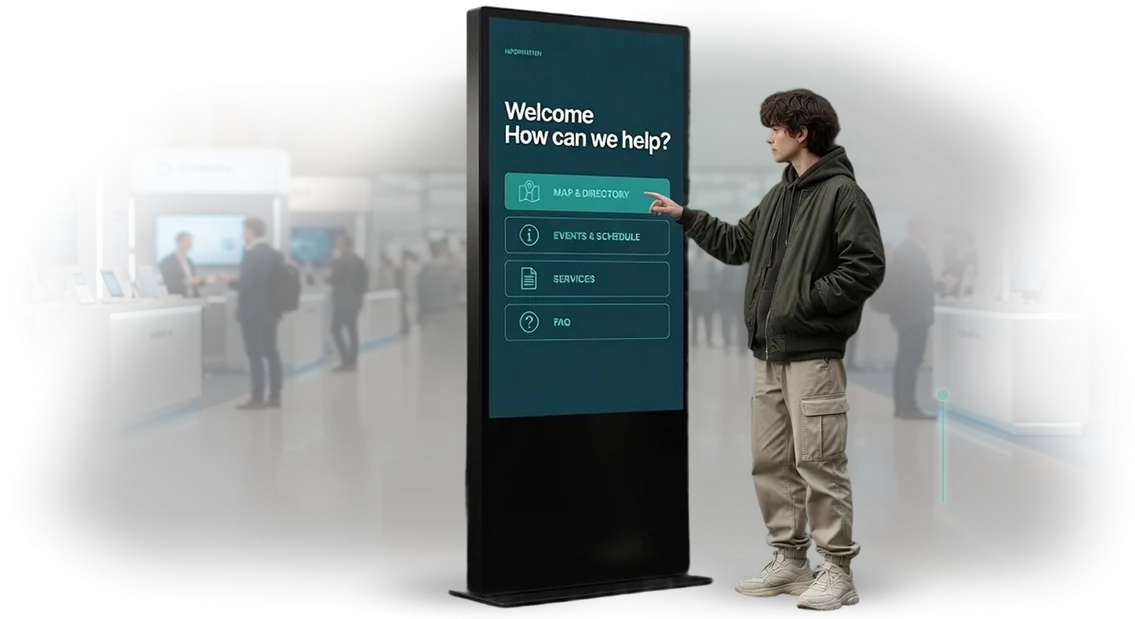
An interactive kiosk is not just an appointment terminal but a full-fledged tool for improving a service center's efficiency. It takes over routine operations, freeing employees for live communication with clients and solving complex tasks.
Using an intuitive interface, a visitor can independently choose a service, join a queue, or book a specific specialist — without waiting at the administrator's desk. This reduces crowding in the reception area and eliminates queues altogether. The average service time decreases, and the center's throughput grows without expanding headcount.
For the business, these are direct measurable results: higher service speed means lower staff costs and more satisfied clients passing through the point of contact.
Automatic enrollment reduces human-factor errors: requests aren't lost, appointment times aren't mixed up, and visitors aren't forgotten. Every guest receives confirmation of their appointment and doesn't waste time checking information.
It's also worth noting the impact on perception of the company. A modern kiosk is a visible sign of technological sophistication and customer care.
It builds an image of a reliable, modern business, increases visitor loyalty, and sets you apart from competitors who still work the old-fashioned way. This enhances the brand image daily, without additional advertising investment.
Installing a kiosk pays off through increased efficiency and a stronger reputation. A visitor remembers that it was fast, convenient, and comfortable here — and comes back again, bringing friends and colleagues.
Kiosk Formats for a Service Center: Which One to Choose
The layout of the service center dictates the kiosk format: some places need a full-size floor-standing terminal at the entrance, others a compact wall-mounted unit by the check-in desk.
The key is that clients can get a ticket or book a convenient time without staff help, and the administrator isn't distracted by recurring questions.
Comparison of formats
| Format | Where to Place It | What It Gives You |
|---|---|---|
| Floor-standing kiosk | Entrance area, high-traffic lobby | Clients take a ticket on their own and see the queue status — the registration desk is unburdened |
| Wall-mounted terminal | Near offices, in narrow corridors, at reception | Saves space, speeds up booking with the right specialist, doesn't create congestion |
| Booking kiosk | Main desk or a separate area | Booking for a specific time, visit reminders, fewer specialist downtime |
The difference isn't just in the enclosure: the usage scenario depends on the format. A floor-standing kiosk handles the "walk in and take a ticket" flow, a wall-mounted one solves targeted tasks, and a booking kiosk turns a queue into a daily work plan.
We'll select a configuration to match your layout and help with placement, so the terminal doesn't get in visitors' way and is visible exactly where it needs to be. All formats work with a single queue management system — you get statistics and control without extra integrations.
How Kiosk Implementation Works: Stages and Timelines
Implementing a kiosk in a service center is a clear process that we support from the first brief to launch and ongoing support. You're never left alone with the technology: we're responsible for every stage, show you the result in advance, and meet the agreed deadlines. Below are the standard steps the project follows.
-
Brief and task analysis — we discuss what services your center provides, how visitors make appointments, and where queues most often form. We define the kiosk's basic functionality: electronic queue, appointment booking, and displaying reference information.
-
Scenario and screen structure — we propose the visitor's journey from the main screen to a ticket or booking. We align the logic, number of steps, and hints so clients can understand it without staff assistance.
-
Interactive prototype — even before programming, you see how the kiosk will look and work. You test the convenience of the scenarios yourself, make changes, and we immediately take them into account — this saves time and budget.
-
Development and integration — we set up the electronic queue system, connect the kiosk to the service database and specialist booking. We enable ticket printing, notifications, and any custom scenarios your center needs.
-
Testing and debugging — we simulate real situations: visitor surges, incorrect data entry, network issues. We make sure the kiosk is stable from day one, and only then prepare it for installation.
-
Installation and launch — we deliver, install, and connect the kiosk in a convenient location and test it with a live queue. We provide brief staff training, so your employees can confidently guide visitors.
-
Maintenance and support — we stay in touch after launch: we update service information, change schedules, and help with new booking formats. The kiosk works, and you get one reliable project partner.
Installation timelines depend on the number of screens and the need for integrations: a typical kiosk takes 2–3 weeks including approval time.
We provide the exact timeline after the brief, fix it in the contract, and stick to it so the launch isn't delayed and doesn't affect your service center's operations.
What's Included in the Delivery: Turnkey Package
A turnkey package eliminates the need to coordinate multiple contractors at once. We are responsible for everything: software development, equipment supply, installation, and training for the service center staff. You get a working kiosk, not a set of promises.
The standard delivery package includes:
- Software for electronic queue and appointment booking: configuration of service sectors, schedules, specialist selection, ticket printing, or electronic check-in for the waiting room.
- Touchscreen kiosk in a vandal-resistant enclosure — durable equipment adapted to the daily workload of a service center.
- Installation and commissioning: delivery to the site, installation, connection to power and network, and verification of all operating scenarios.
- Integration with the service center's accounting system so appointment data and statistics are automatically transferred to your database.
- Staff training: instruction for administrators and cashiers, action procedures for emergency situations, and an operating manual.
- Warranty service and software updates for the entire service life — you handle clients, and we handle the technical side.
As a result, launch takes anywhere from a few days to a week, depending on integration complexity. One manager handles all issues, and technical support stays in touch after project delivery.
Case Study: How We Simplified Booking a Specialist
In many service centers, the morning starts with a crowd at the door while the administrator manually registers clients. By the time one request is processed, five people have already gathered behind them — and they all consume the specialist's already short day.
We replaced the routine with an interactive kiosk with an electronic queue. The visitor chooses a service, joins the queue, and receives an SMS with the visit time. The administrator just needs to welcome the client — without paperwork or shouting.
Implementation Result
For the service center chain, we deployed kiosks at three locations. Within a month, the average queue waiting time dropped from 35 to 12 minutes, and the share of clients who booked through the kiosk reached 80%. Data entry errors disappeared: the system itself verifies the phone number and service.
Client Review
"Specialists have stopped getting distracted by phone calls and paper journals," says the service center manager. "Previously we lost visitors who left without waiting their turn. Now they see the waiting time and can return in half an hour.
The kiosk paid for itself in two months, and we're already planning to roll out the solution to all branches."
From a business perspective, this is both revenue growth and flow management without expanding headcount. The project took just over three weeks from process audit to launch. We continue to support the system and quickly make changes when services or operating hours change.
What If You Need Custom Functionality?
A standard kiosk often doesn't cover a service center's real workflows: each company has its own booking rules, service categories, and customer scenarios.
Individual requirements arise when you need to integrate the kiosk into existing operations — rather than adapt the business to a standard solution.
We don't sell a "box" or force processes into a template. We start with an audit of your tasks: how booking currently works, where clients are lost, what should happen after a service is selected.
Based on that, we design screens and scenarios so the kiosk becomes a natural part of the service center, not an extra device in the corner.
Kiosk customization can cover any specific task: from non-standard service division to special priority queue rules, from integration with an internal accounting system to adaptation for unusual equipment forms.
We handle both the software side and the alignment of logic with your team, plus testing on real scenarios. As a result, the client gets a kiosk that solves exactly their tasks, with no compromises or "good enough" outcomes.
At the same time, we don't compromise on reliability: all customizations go through the same checks as standard solutions, and after launch we remain available for support and further changes.
If new ideas come up at the end of the project, they can be added without rewriting the system from scratch.
This approach has already helped several service centers set up queue-free booking and reduce the workload on administrators, and they come back to us for further functionality development.
Frequently Asked Questions About Kiosk Installation and Setup
Before ordering an interactive kiosk, many people have the same questions: how does installation work, who is responsible for setup, what happens if it breaks, and will you have to handle it yourself.
These are normal concerns — how they're resolved determines how smoothly you launch the service and whether you feel confident at every stage.
We've collected answers to the most frequent questions to ease these concerns before the project even starts. If your case isn't on the list, just write to us — we'll advise you and prepare a solution for your service center.
What if the kiosk breaks down?
The equipment comes with a warranty, and you can take out a service contract for the entire operating period. If a malfunction occurs, just call support — an engineer will remotely determine the cause, or if needed, come to the site and quickly replace the module. Your staff won't have to deal with the technology.
How long does installation and setup take?
Turnkey installation takes one to two days. We deliver and mount the kiosk ourselves, set up the software, and verify that everything works. Your employees continue with their tasks — we don't distract them with technical details.
Can we update information on the kiosk without specialists?
Yes. You get a simple and intuitive interface for uploading files, changing the schedule, or editing the list of services. We handle complex technical updates and system configuration remotely — you only need to confirm readiness.
What does post-launch support include?
Continuous monitoring of kiosk performance, software updates, and consultations on any topic — from design changes to adding new features. In the event of a malfunction, we set priorities so that your service center keeps running smoothly.
If you have doubts about timelines, warranty, or support level, ask before the start. We'll honestly explain how each stage will go and help you choose a configuration that fits your service center.Order a Kiosk Development — Get a Ready Solution
Starting an order isn't just "buying software" — it's getting a clear process with timelines, a scope of work, and a point of responsibility. We eliminate uncertainty: you know what you'll get at each stage and when you'll see the kiosk working.
What You Get After Submitting a Request
- Consultation — we analyze your task: customer flow, queue, booking scenarios, integrations.
- Cost calculation — we fix the scope of work, timelines, and cost, with no hidden surcharges.
- Interface design — we think through scenarios for visitors and administrators.
- Development and assembly — we build a kiosk for your service center with your brand and operational logic.
- Testing and launch — we test in real conditions, activate on site, and train employees.
Why You Can Be at Ease
- Accurate timelines — stages are fixed in the contract, and you control the process.
- Single contractor — we handle the turnkey scope: from interface design to installation and support.
- Transparent payments — paid by stages, with no advances "into the void."
- Post-launch support — service assistance, updates, and refinements as your service center grows.
Leave a request — we'll call you back within one business day, clarify the details, and prepare a cost estimate. Then it's up to you: you'll start with a consultation and finish with a kiosk that unburdens your desk and shortens the queue.