

Queues at Rosreestr eat up visitors' time
Many people know the situation: you come to a Rosreestr office and there is a live queue moving slowly. Even if the building has an electronic queue terminal, visitors often don't understand how to use it and go to the information desk. As a result, waiting time stretches, and one in five potential visitors leaves before being served.
For the institution itself, this turns into citizen dissatisfaction, complaints, and negative reviews. Moreover, employees are forced to constantly get distracted by questions like "who's next?" and "has my turn come?" instead of doing their direct work. Such a load on staff reduces service speed and service quality.
To fix the situation, you need a clear electronic queue system and convenient appointment booking with Rosreestr. The visitor must be able to select a service on an infomat or through advance booking, get a ticket number, and see how much time is left before their appointment. This relieves tension and streamlines the flow.
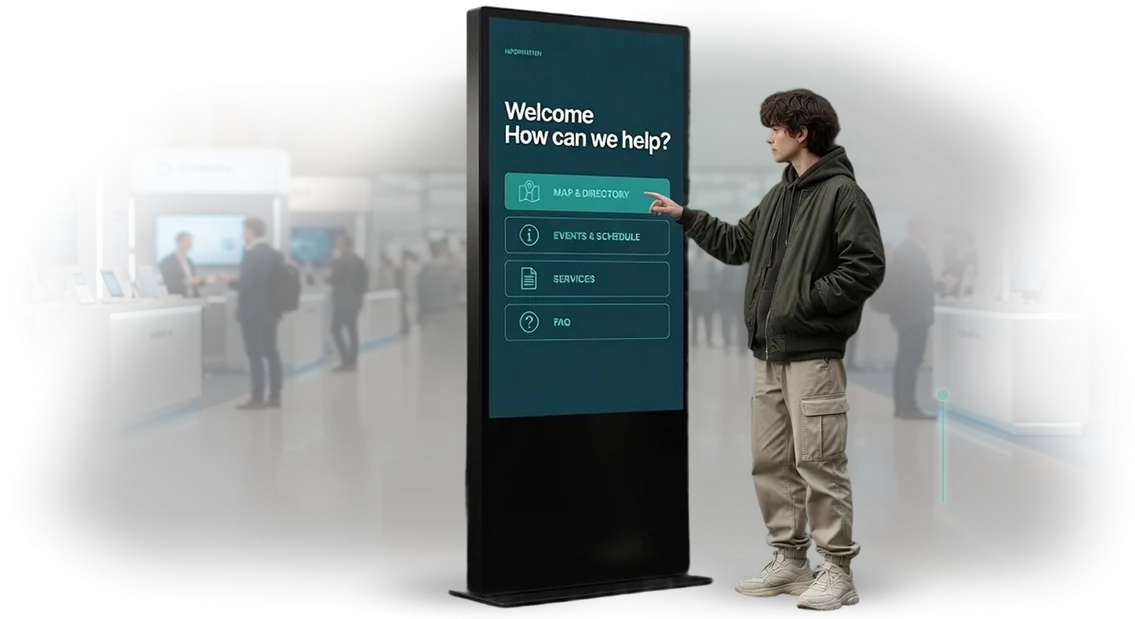
We develop interactive information kiosks specifically for such tasks. The terminal itself guides the visitor on how to book with Rosreestr, prints a ticket, and directs them to the right office.
Employees see the current queue in the system and work without unnecessary distractions, and the manager gets load data to optimize the schedule.
As a result, the load on the office is reduced, waiting time decreases, and visitors leave with positive impressions. This is exactly the effect needed by government institutions and commercial services that work with customer flows.
What benefits you get from interactive kiosks
An interactive kiosk in a Rosreestr office is not just a replacement for an administrator, but a tool that visibly unloads your team and increases throughput.
Visitors independently book into the electronic queue, choose a service, and the right department — you don't need to hire additional staff to handle the flow. As a result, average waiting time decreases, and specialists spend time on real tasks instead of routing visitors.
A direct consequence of faster service is a reduction in the number of conflict situations. People stop waiting in a live queue, getting nervous, and arguing about who arrived first.
The electronic queue records the order transparently and eliminates disputes, so the atmosphere in the hall becomes noticeably calmer. For staff, this means less stress and fewer explanations of "why it takes so long."
Another obvious advantage is image. A modern kiosk in the lobby immediately shows that your office keeps up with the times and values citizens' time.
A positive visit experience boosts your reputation: visitors start recommending you to others, and in the eyes of inspectors and management, such an office looks exemplary.
Data control deserves special mention. The kiosk collects information on the number of requests, peak load times, and the most in-demand services. You can see where to add windows and where to change the schedule.
This data helps you make decisions based on facts rather than guesses and gradually improve the efficiency of the entire department.
Taken together, this delivers measurable results: an increase in the number of processed applications, visitor loyalty, and reduced staff load. You get a modern solution that pays off through time savings and improved key office metrics.
That is why interactive kiosks are a sought-after step for developing government and commercial services where speed and order matter.
Kiosk formats for Rosreestr: choose yours
Rosreestr visitors come with different tasks: someone needs an extract, someone is booking an appointment with a specialist, someone has come to pay the state fee. A universal "all-in-one" kiosk often becomes a bottleneck due to long menus and queues.
It's better to choose a format for a specific scenario — then the flow is distributed evenly, and employees handle complex issues instead of repeating the same instruction.
Here are four typical formats we install in Rosreestr offices. They cover the main visitor needs and reduce the load on staff.
| Kiosk format | For which tasks | What it gives the customer |
|---|---|---|
| Infomat navigator | Suggest room, documents, procedure | Fewer questions to the administrator, faster visitor orientation |
| Electronic queue terminal | Issuing tickets in live queue order | Disputes over place disappear, hall load is distributed evenly |
| Appointment booking terminal | Choosing date, time, and specialist | Booking without staff involvement, fewer scheduling errors |
| Payment kiosk | Paying state fees and services on site | Visitor resolves the matter in one visit, fewer refunds |
How to choose your option? If you have a large flow and many standard requests, start with an electronic queue and appointment terminal. If visitors often ask for directions and document lists, add an infomat at the entrance.
Many offices combine two or three formats: navigation in the lobby, queue in the hall, booking and payment in one node — this is convenient for both visitors and staff.
We have already implemented such solutions for government institutions and know how to adapt the interface to people of different ages and skill levels.
We will calculate the load, recommend the optimal set of kiosks for your traffic, and help with launch — so that the equipment works from day one rather than gathering dust in a corner.
How turnkey project development works
Work on a Rosreestr kiosk follows a clear plan: you see every stage and understand what you will get as a result. No hidden work or unexpected deadlines — only agreed steps from brief to working solution.
- Brief and needs. We listen to how booking and the queue work today and what the kiosks should do. We record requirements for documents, tickets, and specialist schedules.
- Design. We prepare the equipment set, electronic queue logic, and booking interface. We agree on the scheme so the solution fits your regulations.
- Design and prototype. We show what the screens look like and how a visitor books an appointment. You make edits before development starts — this saves time and budget.
- Development and assembly. We create the software, configure integration with your booking system, assemble and test the kiosk: from ticket issuance to booking a specific time.
- Pilot launch. We install the kiosk, train staff, and launch it for trial operation. We observe, collect questions, and quickly fix any issues.
- Full launch. The kiosk operates in normal mode. We help with informational materials for visitors and instructions for staff.
- Support and development. We stay in touch: update the software, add features, and account for changes in requirements. You are never left alone with the equipment.
This is what a surprise-free path to project launch looks like: after each stage you get a clear result and understand what happens next. That is why kiosk implementation goes smoothly, and support continues after opening.
What is included in the electronic queue module supply
When we implement an electronic queue module for a Rosreestr kiosk, the customer receives a complete turnkey solution, not just a program.
The supply includes everything needed to launch booking and tickets within the first few days: licensed software, configuration for your services, an admin panel, instructions, and staff training.
We know that what matters to you is not getting into technical details, but getting a working tool. So below is the exact scope of supply you will see in the contract.
Supply set
- Electronic queue software — interface for visitors, booking terminal, ticket printing, and call screen.
- Admin panel — an intuitive dashboard where an employee can change schedules, add services and windows, and view booking statistics.
- Rosreestr-specific workflow — booking a specific service, selecting a window, limiting duplicate tickets, configuring priority categories.
- Instructions for staff and visitors — short guides on how to use the kiosk and admin panel, without walls of text or technical jargon.
- Staff training — a practical session where your employees learn to manage the queue and handle common situations.
- Warranty support — for the entire period of operation: updates, consultations, and remote assistance in case of failures.
I would like to note separately: you don't need weeks to figure out the admin panel. Setup takes one day, the interface is intuitive, and we support you during and after launch — if a question arises, we help within a business day. The module easily integrates into an existing kiosk and does not require replacing equipment.
Case: how we accelerated Rosreestr booking by 50%
In one of the regional offices of Rosreestr, visitors spent up to 40 minutes just to book into the electronic queue. Operators could not keep up with the flow, and people left without a ticket. We were tasked with reducing booking time and relieving administrators.
Task
We needed to eliminate the bottleneck at the entrance: make it possible for visitors to book a service in a couple of touches without staff help. At the same time, the system had to work reliably even during peak hours.
We audited the flows and proposed a solution based on touchscreen kiosks with an electronic queue software module. Booking happens through an intuitive guided interface — the client selects a service, sees available time slots, and receives a ticket.
Result
After launch, booking time dropped from 5–7 minutes to 2–3 minutes — 50% faster. Throughput increased, queues at the entrance disappeared, and operators stopped being distracted by mechanical paperwork.
Rosreestr continued the partnership and ordered further development of the system for related services. For us, this confirms that a well-designed interface reduces staff load and increases visitor satisfaction.
Answering common questions and concerns
Before ordering a kiosk for Rosreestr, you probably have questions: will the equipment fail during peak hours, is it difficult to integrate into current processes, who will handle support.
These are normal doubts — the answer determines whether you get a stable booking tool or a source of constant problems. Below we address the most common fears and show how we resolve them.
How reliable is the kiosk? What if a visitor encounters a freeze?
The kiosk runs on professional equipment and embedded software that undergoes load testing before launch. We design the system so that the "book a specialist" scenario works without failures even during a long queue.
If an exceptional situation does occur, the kiosk automatically restarts the necessary module and the administrator receives a notification. The visitor will not be left without help: their booking data is saved and not lost.
Is it difficult to integrate the kiosk with our electronic queue system?
We work with various booking and electronic queue systems, so integration is a standard task. On our side, we connect the kiosk to your infrastructure so that data on bookings, tickets, and window load is synchronized automatically.
You don't need to change your employees' familiar processes. All configuration and testing are handled on our side, and after launch you get a single control point and a clear instruction.
Who will service the kiosk after installation?
The kiosk is handed over for operation together with a maintenance procedure. We connect remote monitoring that tracks key performance indicators and take on scheduled maintenance.
If necessary, we visit the site — we agree on the response time in advance so as not to stop visitor booking.
In the end, you don't need to hire a separate specialist. We remain responsible for the system's operability and quickly resolve issues that may arise during operation.
Leave a request — and we will prepare a solution
Leave a request — we will contact you for a consultation, clarify your tasks and scale. After the conversation, you will receive a cost calculation and a proposal for the scenario: from planning to launching a kiosk with electronic queue and booking.
Then we work through clear stages:
- Request: you leave your contacts and choose a convenient time.
- Consultation: we discuss visitor flow, installation points, and kiosk goals.
- Cost calculation: we prepare an estimate for your project, with no hidden fees.
- Proposal: we send the scope of work, timelines, and conditions.
- Implementation and launch: we develop the interface, configure booking and electronic queue, run tests, and train staff.
After your inquiry you will receive:
- Personal consultation on kiosks for government institutions.
- Transparent cost calculation for your scale.
- Realistic timelines broken down by stage.
- Recommendations on electronic queue and booking logic.
- Post-launch support and a workability guarantee.
Leave your contacts in the form below — we will send a proposal and answer your questions. No obligations: only a cost calculation, timelines, and recommendations.
How to choose a format for your Rosreestr office's needs?
Choosing a kiosk format for a Rosreestr office starts not with the equipment model, but with the question: how many visitors pass through a window per day and what operations do they need most often.
If it's a small office with a flow of 100–200 people per day, one compact touchscreen stand for booking and ticket printing is enough.
Large multifunctional centers with dozens of windows operating simultaneously will need several kiosks with different modes: electronic queue, self-booking for an appointment, reference information, and preliminary document package check.
Think about which scenarios should be handled without staff involvement. Most often these are booking a specific specialist, getting a priority ticket, marking documents as ready, and informing about application status.
These scenarios should drive the interface and screen size: for quick selection from 3–5 items, a vertical kiosk with large buttons works well; for long forms, a horizontal panel with an on-screen keyboard.
In any case, we help calculate the number of stands for your peak flow so that a queue does not build up at the machine by noon.
The second important criterion is accessibility for visitors of different ages and physical abilities. For offices with a large share of elderly people, it is better to choose kiosks with adjustable height, large fonts, and voice prompts.
If your office works mainly with young applicants, speed takes priority: a quick three-touch scenario, the ability to scan a barcode from advance booking, and instant ticket printing.
We adapt the software to specific categories of citizens without making you overpay for unnecessary options.
Finally, consider how the kiosk will fit into your staff's workflow. A properly chosen solution reduces the load on service windows by shifting simple operations to self-service and provides up-to-date flow statistics.
We analyze your office, select a standard solution, or develop an individual scenario, and after installation we support the system remotely — this allows you to quickly change the workflow logic if Rosreestr regulations change.
In the end, you get not just a stand with a screen, but a manageable entry point that reduces waiting time and increases visitor satisfaction.