

Is Your Auto Repair Shop Losing Customers to Lines and Inconvenient Scheduling?
Customers don't forgive waiting. When a queue piles up at an auto repair shop and scheduling a repair turns into a lottery, some drivers simply leave for competitors.
Each such loss is not just a lost order, but also a damaged reputation: an unhappy customer will tell a dozen acquaintances about you.
The problem is compounded by the fact that traditional scheduling methods — by phone or through an administrator — place additional strain on staff and inevitably lead to errors.
The mechanic is busy, the administrator can't keep up with calls, appointment times shift, and the driver gets stressed. As a result, even loyal customers start looking for alternatives, and new ones don't return after their first visit.
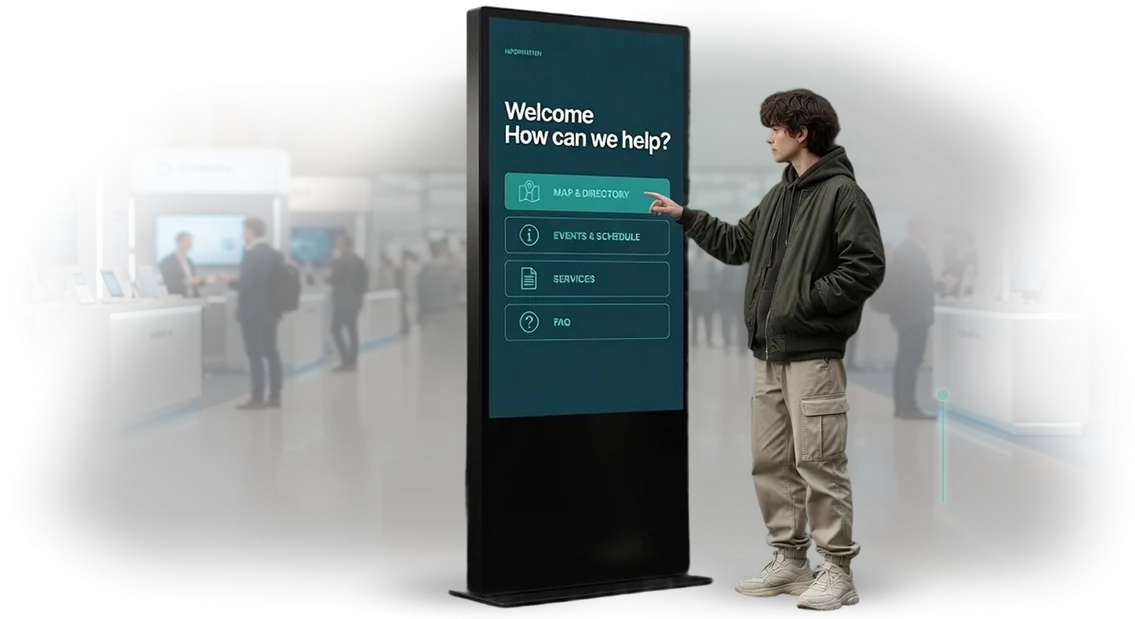
An interactive kiosk in the waiting area solves this problem comprehensively. The customer independently chooses a convenient time, sees the current workload of the shop, and receives an electronic ticket without involving the administrator.
This reduces queues, eliminates scheduling confusion, and gives staff time back for actual vehicle work instead of paperwork.
We've been developing such solutions for over ten years and know how to adapt a kiosk to the specifics of a particular auto repair shop — from scheduling maintenance to vehicle handover.
Implementation takes a few weeks and does not require restructuring existing processes — the system easily integrates with your accounting software. You get transparent scheduling, satisfied customers, and increased repeat visits without spending on advertising.
The 5 Main Benefits of an Interactive Kiosk for Customers and Business
An interactive kiosk at an auto repair shop is not just an electronic queue, but a tool that works for your business. Customers value speed and predictability, and you get more orders with the same resources. Let's look at the five main benefits.
The first benefit is service speed. The customer books a convenient time in a couple of touches instead of waiting for the administrator to become available. Queues shrink, each visitor reaches a mechanic faster, and the shop's throughput grows without additional staff.
The second is customer loyalty. When booking takes a minute and doesn't require phone calls, customers come back again. A convenient kiosk reduces the stress of waiting and creates the Impression of a modern, trustworthy service.
The third is additional sales. The kiosk can offer related services — diagnostics, car wash, replacement of consumables — right at the time of booking. The customer sees the options right away, and the share of orders with add-ons grows noticeably.
The fourth is staff relief. The administrator stops answering the same questions and spending time on manual scheduling. Freed-up hours can be directed toward consultations and working with those who have already arrived — this improves service quality.
The fifth is customer data. The kiosk collects information about visits and preferences: which services are chosen and at what times customers arrive. This data supports reminders and personalized offers that bring customers back and increase the average ticket.
The kiosk pays for itself through increased productivity and repeat visits. It's a solution that's felt immediately by both customers and your budget.
Kiosk Formats and Software for Auto Repair Shops: How to Choose for Your Task
The choice of kiosk format depends on the goals of the auto repair shop: reducing queues, organizing scheduling, or introducing customers to services. Often one scenario leads to another: the customer books, waits, and browses the catalog. Below are typical options so you can estimate what might work for you.
| Kiosk format | For whom | What it gives the auto repair shop owner |
|---|---|---|
| Electronic queue | Auto repair shops with a live flow of customers without pre-booking | Transparent order of service without “who's first” arguments, even distribution of mechanic workload |
| Booking with a specific mechanic | Shops with specialized technicians and varying job durations | The customer chooses a convenient time themselves, fewer overlaps and downtime |
| Service catalog | Auto repair shops with a wide price list and additional sales | The visitor sees the full list of services and prices, is more willing to agree to additional services |
| Combined option | Shops that need both scheduling and informing | One kiosk handles the queue, booking, and service discovery at once |
An electronic queue is useful where customers arrive without prior contact: tire fitting, express oil change, diagnostics. The kiosk creates a live queue, and the customer sees their number and approximate waiting time — this reduces tension at the reception area.
Booking with a specific mechanic suits complex repairs where a particular specialist matters and the duration of work is known in advance.
The customer selects a time slot themselves, the mechanic gets the day's schedule, and the administrator doesn't have to manually coordinate every request.
A service catalog on the kiosk is a way to show the price list and additional work that customers don't ask about directly. While waiting for their turn, visitors see available options and agree to them more often, increasing the average ticket.
The universal approach is to combine scenarios: the customer books, sees the queue, and browses the catalog at the same time. This option covers most auto repair shop needs and doesn't require installing multiple devices.
If you're unsure which format suits you, start with the main bottleneck: what makes you lose customers most often — waiting, scheduling confusion, or lack of awareness about services? Choose your kiosk scenario based on that.
Project Stages: From Brief to Kiosk Launch at an Auto Repair Shop
Developing a kiosk for an auto repair shop is not a “black box,” but a clear process with checkpoints. You see what happens at each stage, approve key decisions, and understand when the system will go live. This approach eliminates surprises at launch and unnecessary rework.
- Brief and task analysis. We discuss which services should be bookable through the kiosk: maintenance, tire fitting, diagnostics, repairs. We take into account peak hours, customer flow, and the specifics of your queue so the kiosk fits into the shop's operations rather than getting in the way.
- Project plan and estimate. We prepare a screen scheme, feature list, and timeline. You receive a transparent document showing what we're doing and why, and you can adjust priorities before work begins.
- Prototype approval. We show an interactive mockup of the future kiosk: how a customer selects a service, sees available time, and confirms the booking. At this stage, edits are made quickly and without rework.
- Development and integration. We configure the system to your processes: connecting it to booking with specific mechanics, ticket printing, and the electronic queue. The kiosk runs on professional hardware, so it remains stable even under high load.
- On-site testing. We test real customer scenarios: booking, cancellation, joining the queue, peak loads. We fix everything before the kiosk is seen by your visitors.
- Launch and support. We install the equipment, train administrators and mechanics, and set up remote monitoring. Then we support the system, update the interface, and add new services as the shop grows.
What Is Included in the Delivery: Kiosk Launch Kit
When you order a kiosk, you get not just a device with software, but a ready-made tool for managing customer flow. The delivery package includes everything needed to launch the electronic queue and scheduling from day one — without extra work or additional investment.
Here's what's included:
-
Software for the electronic queue and scheduling. A ready-made system configured for auto repair shop scenarios: the customer selects a service, a convenient time, and a mechanic — without the administrator's involvement.
-
Perpetual software license. You're not buying a subscription, but a permanent right to use the software. Updates and technical support — for the entire duration of our cooperation.
-
Complete set of documentation. Administrator guide, setup instructions, and staff regulations. Everything any employee needs to get up to speed quickly.
-
Staff training. We conduct training for administrators and mechanics: how to book, manage the queue, and work with statistics. Staff start using the system confidently right after launch.
-
Setup and integration. We connect the kiosk to your customer database, configure scenarios, and display your logo and corporate style on screen. We test all scenarios before handover.
-
Launch and warranty support. We test the equipment, hand over the project, and support the first days of operation. After that — support and remote monitoring.
-
Additional modules as needed: data backup, integration with your accounting system, reports for management. We adapt the package to your tasks.
Case Study: Reducing Queues with a Kiosk — 40% Result
Auto repair shop customers don't like to wait — downtime is perceived as disrespect. Even one lost visitor due to a queue at the reception area is not just a lost sale, but also a negative review that hundreds of other drivers will see.
our team helped one service center solve this problem. Before the kiosk was implemented, customers spent an average of 15-20 minutes just to submit a request: they had to wait for the administrator, dictate their vehicle details, and describe the issue. For a busy person, that's critical — and some simply drove off to the neighboring shop.
How We Changed the Process
We installed a touchscreen kiosk in the waiting area that took over the routine. The driver selects a service, enters their phone number and car make, describes the fault — and immediately joins the electronic queue. The administrator sees the request on screen and calls the customer when a mechanic is ready.
For reliability, we integrated the kiosk with the server-based accounting system — data is not lost even during a surge of visitors. The customer gets a stable result, not a “raw” prototype.
Implementation Results
The main metric — waiting time — dropped by 40%. Peak-hour queues disappeared, and the administrator stopped being distracted by repeated questions: “How long do I wait?”, “When will I be scheduled?”
At the same time, the share of repeat visits grew: customers became more willing to return to the shop, knowing that booking would take just a couple of minutes.
The business owner got a manageable process — the full mechanic workload is visible in reports, not estimated “by eye.” This approach can be replicated at any location with customer flow.
How to Choose the Right Kiosk Format for an Auto Repair Shop and Not Get It Wrong?
You can't choose the right kiosk format for an auto repair shop “blindly”: there is no universal solution. Much depends on your shop's goals — whether you need to simply inform customers, book them for repairs, or manage a live queue with a large flow.
So first, we determine which functions will actually bring value, and only then select the equipment around them.
For example, for a small repair station where booking is mostly by phone, a compact kiosk with a self-service screen is enough: the customer sees available time, leaves a request, and gets confirmation.
But for a busy auto repair shop with a constant stream of visitors, a kiosk with an electronic queue is more logical — it distributes customers across zones, reduces the administrator's load, and cuts waiting time.
In this case, the kiosk works not just as a “display board,” but as a full-fledged service management tool.
Budget is an important but not decisive factor when choosing a kiosk. A vandal-resistant enclosure and professional touchscreen are justified in high-traffic locations where the equipment works constantly.
For a small shop, you can choose a simpler solution that does the job without overpaying. The main thing is that the kiosk pays off: it speeds up booking, reduces staff load, and increases customer satisfaction.
That is achieved not by price, but by the right configuration for the specific tasks of the auto repair shop.
We help you choose the format based on your situation: we analyze customer flow, usage scenarios, and the expected result. We offer the optimal option — without unnecessary features that will never be used, and without skimping on what really affects work quality.
As a result, you get a kiosk that solves your shop's problems and fits your budget — that's why our clients don't regret their choice.
Common Concerns: What If the Kiosk Breaks or Stops Working?
Every auto repair shop owner fears the equipment failing on the busiest day. And that's normal: when a kiosk sits in the waiting area, every hour of downtime means unhappy customers and lost bookings.
That's why we design the system in advance so that failures don't disrupt your operations or require special knowledge from you.
Here's what's covered by our responsibility: remote monitoring of kiosk status, automatic data backup, and fast replacement of faulty equipment. You're never left alone with a problem — our team responds to any signal before it becomes visible to your customers.
What happens if the kiosk stops working in the middle of the day?
You call us or submit a request through your personal account — then a duty engineer takes over. In most cases, the issue is resolved remotely: we see the system status, restart the service, or restore data. If physical intervention is required, a technician arrives with a backup equipment kit.
How quickly will you respond and fix it?
We have a response time protocol: remote connection takes no more than a few minutes after your request. For physical repairs or replacement, a timeline agreed in the contract applies — typically one business day.
While the kiosk is being repaired, customer booking continues through the administrator's tablet or computer.
What if the internet or power goes out?
The kiosk can operate autonomously: the queue won't “freeze,” data is saved locally and syncs with the server once the connection is restored. In case of a power outage, a backup power supply is provided so current sessions can be completed without losing information.
What guarantees do you provide?
We take responsibility for the system's performance for the entire term of the contract. The hardware warranty is separate; the software license is perpetual under the service agreement.
All terms are specified in the contract: response times, replacement time, and responsibilities of the parties. You'll know in advance how we act in any emergency situation.
That's why auto repair shop owners choose us: most of the time we don't intrude, and in rare failure cases we take the problem onto ourselves. All you have to do is work with customers — everything else is under control.Ready to Increase Customer Loyalty? Leave a Request to Launch a Kiosk
A customer waiting for their turn at an auto repair shop remembers not only the quality of the repair, but also how much time they wasted. A booking kiosk removes the chaos, shows waiting times, and gives visitors a clear route — from entry to key handover.
If you've been thinking about this for a while, now is the right time: launch takes just a few weeks, and customer loyalty grows from day one.
Leave a request to launch a kiosk — and we'll handle all the questions. One call will tell you how much a solution for your auto repair shop will cost, how quickly it will pay off, and which processes can be automated right from the start.
What you get after your request:
- A cost estimate for kiosk launch tailored to your tasks and the size of your auto repair shop.
- Consultation on booking scenarios, electronic queue, and customer information flows.
- Recommendations on placement and equipment package — without unnecessary expenses.
- A demonstration of how the kiosk works in your situation: booking, queue, calling the customer to the mechanic.
- A launch plan with clear timelines and areas of responsibility — you see the entire process in advance.
- Staff training and instructions for customers — no blind implementation required.
- Post-launch support and the ability to refine functionality to suit your processes.
We'll start with a short consultation: you tell us how your shop operates, and we offer a solution for your customer flow. Leave a request in the form on this page, call us, or message us — contact details are at the top of the site. We'll respond within one business day, send you an estimate, and agree on the next step.