

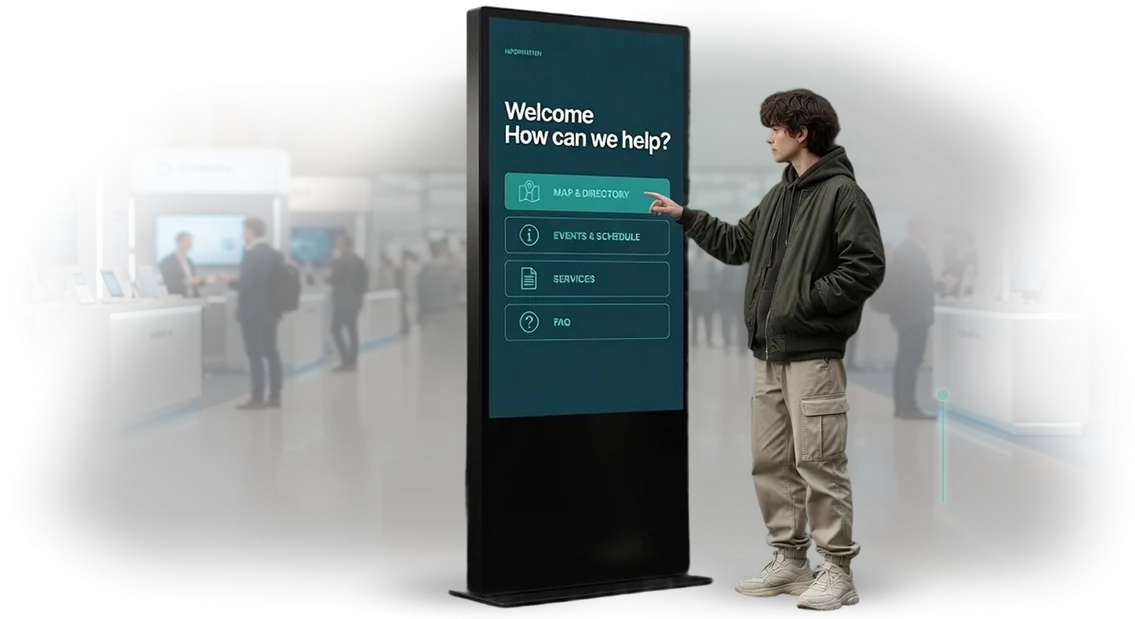
Digital Navigation: Why Visitors Leave and Business Loses Profit
A visitor who cannot find the right department, office, or service — in a shopping center, clinic, airport, or business center — loses patience after 3–5 minutes and leaves.
For business, this is not just a ruined guest experience, but direct losses: every such exit is a lost purchase, and on a monthly scale, a noticeable drop in revenue and fewer repeat visits.
Paper signs and static wayfinding solve the problem only partially: routes are easy to confuse, temporary promotion information must be updated manually, and a new visitor still has to spend time searching.
An interactive kiosk eliminates this risk: it builds a clear step-by-step route, shows current promotions, and reduces search time to 20–30 seconds. Digital navigation removes the chaos, relieves administrators, and prevents the customer from leaving frustrated.
Not only visitors benefit, but also business owners: digital navigation increases the average time spent on site, and therefore the average check.
As the experience of the Galereya shopping center shows, after replacing static signs with interactive kiosks, the share of those leaving without a purchase drops by almost half, and repeat visits grow by 15–20%.
In addition, kiosks can be used as an advertising platform — this offsets part of the implementation costs.
We develop interactive kiosks tailored to the specific needs of a business: from simple department search to multi-level digital navigation with maps, category search, and advertising banners.
Implementation time starts from three weeks, and the project quickly pays for itself through higher average checks and customer loyalty.
What Interactive Kiosks Change: 4 Key Results
Interactive kiosks are a modern way of digital navigation that replaces outdated signs and information desks. They solve four business tasks at once: they make service more convenient, customers more loyal, staff work more efficient, and expenses more predictable.
Growth in Visitor Loyalty
Everyone values speed and independence. When the needed information is found in a couple of taps, the client experiences less stress and feels that the company values their time.
Positive experiences lead to visitors returning and recommending you to friends — this is free advertising and an increase in repeat visits.
Improved Service and Reduced Workload for Staff
Instead of answering the same questions, employees focus on truly important tasks. The kiosk handles routine queries: “where is the office?”, “how can I get there?”, “what’s on the menu?”.
As a result, queues are shorter, and service is faster and friendlier, which directly affects customer satisfaction.
Saving Resources and Time
Printed signs and booklets become outdated — when layouts or promotions change, they must be reprinted. A digital screen updates instantly, with no costs for printing or logistics.
In addition, some administrator functions are automated, which reduces staffing costs and allows more efficient use of resources.
Additional Sales and Promotion
A kiosk is not only a navigator but also a marketing tool. It shows current promotions, recommended products, or services at the right moment — when a visitor is searching for information.
This increases the average check and boosts revenue without additional advertising spending, while thoughtful messaging builds the image of a modern company.
Kiosk Formats for Different Tasks: Informational, Maps, Routes
Every point of contact with a visitor solves its own task: one place needs a quick answer to a question, another needs to guide a person along a route, and another needs to show the entire space at once.
There is no universal kiosk, and trying to save money with a single device often results in inconvenience for guests and extra stress for staff.
That is why we choose a format based on the specific business task — from a compact information stand to a large wayfinding panel. Here is what this looks like in practice.
| Kiosk format | For whom | What it gives the client |
|---|---|---|
| Information terminal | Shopping centers, business centers, clinics, multifunctional centers, and other places with visitor traffic | Quickly answers standard questions, relieves administrators, and shortens queues |
| Wayfinding panel | Airports, railway stations, shopping centers, stadiums, concert venues | Helps visitors orient themselves easily — fewer confused guests and fewer questions for staff |
| Map with signs | Embankments, parks, campuses, enterprise grounds, residential complexes | Shows the path without internet or apps — guests feel confident, and you reduce the flow of inquiries |
| Route kiosk | Hospitals, office complexes, exhibitions, hotels | Builds a route to a specific office or booth and prints a QR code — saves time for both guests and your staff |
Choosing one or more formats directly affects visitor impressions and team workload. We will analyze your scenarios and suggest a configuration that addresses exactly your task — without overpaying for unnecessary features.
How the Implementation Project Works: From Brief to Launch
We have structured the interactive kiosk implementation process so that it is clear and transparent for you. No magic: at every stage, you see what is happening, what result you get, and when the next step comes. Below is a typical project journey from the first conversation to a working solution.
-
Brief and task analysis. Together we determine where and how guests will use the kiosks, and which scenarios matter — from finding an object to navigating to a cafe. As a result, we record goals and timelines so you understand the budget and scope of work.
-
Prototype and design concept. We create a screen map and navigation logic, aligned with your brand style. You see how the interface will look before development begins — edits and requests are made without extra costs.
-
Development and content preparation. We build the interface and load information about your locations, services, and promotions. We connect a management system so you can update content yourself without a programmer.
-
Testing and debugging. We check all scenarios with real examples: from touch interactions to behavior under peak load. We make sure the kiosk does not freeze and works correctly even with intensive use.
-
Launch and staff training. We install the equipment, configure it for the site, and show your employees how to manage the kiosk and quickly resolve common guest questions.
-
Support and development. We stay in touch after launch: we monitor stability, quickly update content on your request, and refine navigation if new zones or services appear. You get a working system, not a “figure it out yourself” manual.
The number of stages can change depending on your task — for a simple kiosk with a catalog, three steps are enough; for a large network, more iterations are needed.
The main thing is that the entire process is tailored to your task, with a fixed cost and clear intermediate deliverables.
What's Included in Delivery: A Complete Package for a Working Solution
We have put together a package so that the solution is fully ready to work from day one. You won't have to assemble it from multiple contractors or dive into technical details — everything is already thought through and included in the delivery.
The standard package includes:
- Equipment — information kiosks and touch panels selected for your tasks and location conditions. We are responsible for the device's operation, not just handing over a box.
- Software — a content management system and interface configured to your brand style and use scenarios. You will be able to update information without involving developers.
- Installation and connection — our engineers visit the site, install the equipment, configure the network, and verify all operating scenarios. All you have to do is accept the result.
- Instructions and documentation — clear guides for administrators and staff: how to turn it on, replace content, and resolve simple issues. No complex technical descriptions.
- Staff training — a short practical workshop for those who will work with the kiosk. Staff will learn how to upload materials, monitor statistics, and respond to unusual situations.
- Warranty and support — official warranty on equipment and software, plus a communication channel with our team. If something goes wrong, we will resolve it remotely or visit the site.
This way, you get a single point of responsibility: we support the project from delivery to day-to-day operations. No hidden items or surcharges — only what is truly needed for a working solution.
Case Study: Digital Navigation in a Shopping Center — 22% Conversion Growth
Shoppers get lost in a maze of corridors: they spend 10–15 minutes looking for a specific store, get annoyed, and leave without making a purchase. Meanwhile, staff answer the same “where is it?” questions hundreds of times a day, instead of helping with choices and sales.
We proposed solving this with digital navigation — and using the CityMall shopping center chain as an example, we showed the impact it delivers for business.
What We Did
We installed interactive kiosks at key points: at the entrance, near escalators, and in the food court area. On the touchscreen, a visitor selects the desired store or service — the system builds a short route right to the storefront.
To do this, we integrated navigation with the tenant directory and floor plans, so information about new locations appears without reflashing every kiosk.
At the same time, we added prompts about current promotions and events: a coffee coupon, a discount at a children's store, an exhibition in the atrium.
This turned navigation from an information service into an upselling tool — the guest sees the offer exactly at the moment they walk past.
Results for Business
Three months after launch, we recorded a 22% increase in conversion: noticeably more visitors reached their target stores and made purchases.
The number of inquiries to administrators and the information desk dropped by almost a third — staff shifted from “where to go” to “what to recommend.”
An added bonus — behavioral data. We saw which areas were idle and where traffic accumulated, and helped the landlord reconsider the placement of stores and the layout.
The navigation paid for itself in the very first quarter, and the client — CityMall — after the successful pilot, requested the solution be rolled out to two more locations in the chain.
This case is a clear example of how digital navigation stops being just a “map on a screen” and begins to influence revenue, loyalty, and staff workload. If you have a similar task — we will calculate the effect for your location and offer a turnkey solution.
How to Choose the Right Kiosk Format for Your Task?
Choosing a kiosk starts not with the model, but with the task it must solve. What will a person do at the screen: find an office, book a service, pay for an order, or browse a catalog?
This determines the type of enclosure — floor-standing, wall-mounted, or tabletop — as well as the interface logic and the number of touchpoints.
The second criterion is the location and visitor traffic. In a spacious lobby with high footfall, a floor-standing kiosk with a sturdy enclosure and large controls works well.
In a narrow corridor or near an administrator's desk, a compact wall-mounted panel saves space and does not obstruct movement.
The third factor is the audience. If the kiosk is used by clients of different ages and skill levels, we make the interface as simple as possible: large buttons, hints, and the ability to go back a step.
For employees or frequent visitors, a quick multi-touch scenario is suitable. We always select the format for the people who will use it, not the other way around.
Our engineers help you decide on the kiosk type already at the brief stage: they examine the premises, assess traffic and the task, and offer the optimal solution in terms of price and timeline.
We design the appearance to match your interior and brand, and integrate the kiosk into the overall digital navigation.
As a result, you get not an abstract terminal, but a working tool: visitors find what they need faster, staff are less distracted by routine questions, and your process becomes more transparent and manageable.
We Answer Frequently Asked Questions About Implementation
Before implementing interactive kiosks, decision-makers tend to have the same concerns: budget, timelines, integration complexity, and ongoing maintenance.
We have collected the most common questions and give short, honest answers — without technical details, only what affects your decision.
How much does implementation cost?
The cost depends on the number of kiosks, screen sizes, and functionality: from a simple map to a catalog with payment. We usually stay within a cost calculated after audit per location — this is a turnkey solution with setup, design, and staff training. An exact estimate is prepared after an audit of your task.
What are the launch timelines?
A typical project takes 2–4 weeks from the moment layouts are approved. We launch the first kiosk faster — in 10–12 days — so you can evaluate the actual result and approve the remaining locations. If you need it by the opening of a venue or an event, we provide an accelerated mode.
Will we be able to update information ourselves?
Yes, you don't need programmers for this. We set up a simple admin panel: you change prices, promotions, maps, and schedules in a few clicks. One employee without special skills can handle updates in a couple of minutes.
For the Orbita store chain, we built a system where information on all kiosks is updated centrally — saving hours of work every day.
What if the kiosk breaks down?
We provide a warranty on equipment and software, along with a support service that responds within one business day. If needed, we quickly replace the device with a backup — your visitors won't notice any downtime. Our statistics show that 90% of requests are resolved remotely, without a specialist visiting.
If your question isn't on the list — just write to us. An engineer will clarify the details and get back to you with an answer within one business day. This way, you will have a clear picture of the cost, timeline, and scope of work before making a decision.Order Interactive Kiosk Development — Get an Estimate in 3 Days
Leaving a request is not an obligation, but an opportunity to get a clear action plan and numbers to work from within three days. We will analyze your task, suggest implementation options, and show how the kiosk will pay off in your scenario.
The estimate will be transparent: work, timelines, equipment, support. You will immediately see where the money goes and when to expect launch. No hidden fees or “surprises” along the way — only what is truly needed for the result.
What you get by leaving a request:
- Personal consultation on kiosk use scenarios at your location.
- A work plan with stages and timelines — from brief to launch and staff training.
- An estimate broken down by items: development, design, equipment, support.
- A payback calculation: how many visitors the kiosk must serve to recoup the investment.
- Examples of our projects in similar fields — so you can see how it works.
- A technical specification and recommendations for integration with your services.
To order a kiosk and get an estimate with a work plan, leave a request on the website or write to us. We will respond within one business day, clarify the details, and prepare a proposal for your task. Then the decision is yours — we simply provide the numbers and timelines to make it easy to decide.