

Lost passengers and tired staff — the pain point of the aviation industry
Every day passengers get lost in airports: some are looking for their boarding gate, some for the check-in counter, some for the baggage storage. Staff answer the same questions dozens of times per hour, distracted from more important tasks. During peak hours this turns into a continuous stream of inquiries that is hard to control.
For the aviation industry this means direct losses: people miss flights, staff workload grows, service quality drops. Poor airport navigation results in negative reviews, loss of trust and lower loyalty — passengers remember not convenience, but stress. The problem is systemic and needs to be solved at the terminal infrastructure level.
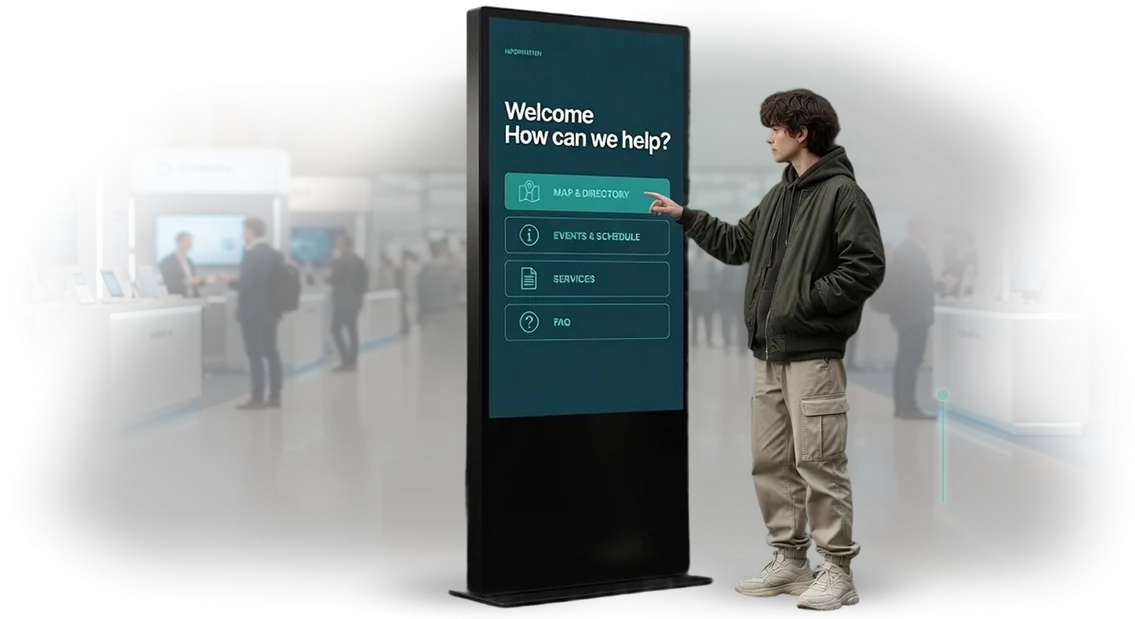
An interactive kiosk with a terminal map, flight search and service hints removes this stress. Passengers can plot their route and see the information they need in 30–60 seconds without going to the information desk.
Staff are freed up for truly complex questions, and the terminal itself starts working as a single navigation system.
Such a kiosk pays off not only through passenger comfort but also through operational efficiency: fewer delays, shorter queues, faster passenger flow.
For the aviation industry this means predictable flight schedules and measurable growth in satisfaction — the key factor that makes passengers choose an airline and airport next time.
We develop interactive information kiosks with the specifics of airports and the tasks of the aviation industry in mind: from interface design to integration into the terminal's overall navigation.
As a result, the client gets not just a device, but a tool that reduces staff workload and saves each passenger's time.
What an interactive kiosk gives passengers and your business
An interactive kiosk at an airport is not just a replacement for a paper catalog, but a tool that simultaneously solves the tasks of both passengers and the terminal owner.
Passengers get quick access to the information they need, and the business gets reduced staff workload and additional revenue channels.
Speed and shorter queues: the kiosk works without breaks and provides answers to frequently asked questions at the touch of a button.
Passengers don't need to find the information desk or wait for a consultant — this is especially important during peak hours and for connecting flights. As a result, queues at the information area shrink and staff focus on non-standard requests.
Passenger convenience: the touch interface lets visitors find the right exit, flight, waiting area, store or café in just a few steps. Guests feel more confident, spend less effort and time navigating — and are more willing to return to your terminal.
Airport upselling: the kiosk can show current offers from shops and restaurants, special deals for passengers with long layovers, and business lounge services.
This turns the interactive catalog into a showcase that increases average ticket size and engages passengers in shopping while they wait.
Bottom line: you get a tool that pays for itself through higher passenger loyalty, optimized staff operations and additional revenue from partners. We implement kiosks for your terminal's needs and support them after launch.
Interactive kiosk formats for the aviation industry
In the aviation industry, passengers value speed, predictability and minimal contact. A well-chosen kiosk format reduces staff workload, shortens queues and increases loyalty.
We work with different types of terminals and will help implement a solution for a specific zone — from the airport entrance to the baggage claim area.
Each format solves its own task: one reduces costs, another increases revenue, a third improves the customer experience. To make the choice easier, we've compiled the main options in a table.
| Kiosk format | Who it's for | What business task it solves |
|---|---|---|
| Self-service check-in kiosk | For airlines and terminal operators | Reduces load on check-in counters, speeds up check-in, lowers staffing costs |
| Navigation kiosk with terminal map | For passengers and greeters | Reduces flight delays, lowers the flow of questions to the information desk |
| Product and service ordering kiosk (duty-free shops, cafés, taxis) | For retailers and services at the airport | Increases average ticket size and upsales, collects demand data |
| Flight status information kiosk | For carriers and the airport | Relieves the support service, increases travel transparency |
The right format is not just a device, but a combination of interface, logic and integration with your systems. We design kiosks so passengers can figure them out without assistance, and you get clear analytics. We'll select the format for your terminal and implement it turnkey.
How we create your interactive kiosk: 6 steps
In the aviation industry, a kiosk operates in dense passenger traffic: failures or an inconvenient interface are immediately noticeable. That's why the development process is structured so you can control every stage and get a predictable result.
We've gone from brief to launch dozens of times and turned it into six clear kiosk development stages.
- Brief and task analysis — we record goals, audience, which products and services to show, and where the terminal is located. You get an accurate quote and timeline without hidden work.
- Plan and prototype — we create the catalog structure and navigation logic. Already at this stage you can see how a passenger will find what they need in two or three touches.
- Layout approval — we show the design and texts. You make edits before approval, and we lock in the final version so the launch doesn't drag on.
- Development and production — we build the interface, connect product updates, and prepare the enclosure and equipment for your terminal's conditions. You have a ready-to-install package in hand.
- Testing and kiosk launch — we check scenarios, performance speed, and failure response. We launch on site with staff instructions so the kiosk works from day one.
- Support and evolution — we update the catalog, monitor stability, and propose improvements based on usage results. You get a working tool, not a one-off stand.
What's included in the interactive kiosk delivery
An interactive kiosk delivery is not just a terminal with a screen. For the aviation industry, we put together a package that helps passengers quickly find the services and products they need, and lets you update information without stopping operations.
- Hardware: a professional enclosure with wear and vandal protection, designed for 24/7 operation in a terminal.
- Interface and design: screens, displays and navigation styled after the airline or airport — passengers immediately recognize your brand.
- Interactive product and service catalog: cards, search, filters, booking or redirection to the needed service.
- Admin panel: easy management of the catalog, prices, promotions and schedules — updates are made without a programmer.
- Integration with your systems: connection to flight databases, booking services and analytics.
- Installation, launch and training: we deliver, install, verify operation and train your staff.
- Warranty support: maintenance schedule, consultations and fast component replacement when needed.
Each interactive kiosk package is configured to the terminal's tasks: from product showcases to waiting areas. In the end, you get a working tool that improves passenger service quality and relieves staff.
Case study: interactive kiosk cut airport queues by 30%
For the aviation industry, passenger service speed is a critical metric.
One regional airport approached us with the task of relieving information desks and inquiry zones during peak hours: passengers were spending up to 15 minutes just finding the right exit and check-in area, and staff couldn't keep up with repetitive questions.
At our team we developed an interactive service catalog for the terminal: at the touchscreen kiosk, passengers could select a direction themselves, view the zone map, flight schedule and estimated walking time to the gate. We installed 4 kiosks in high-traffic locations.
A month after launch we measured the results: queues at the information zones dropped by 30%, the time to get information fell from 15 to 4 minutes, and each kiosk handled more than 500 interactions per day.
Implementation results
For the airport this is not only passenger comfort but also direct savings: fewer crowds, faster passenger flow, higher loyalty from transit passengers.
Management received simple analytics on popular routes and zone load — this data helps plan navigation and allocate staff without additional measurements.
Client testimonial
The terminal manager noted: "The kiosks have become our best employees: they don't get tired, don't get distracted, and answer every visitor just as clearly. Passengers now come to the desk less often, and we've reassigned people to more complex tasks. We've already ordered two more kiosks for next season."
This interactive kiosk case study in the aviation industry shows: the right installation location and an intuitive interface deliver measurable results within the first month. Get in touch — we'll show the numbers for your task and help calculate the effect.
What if you need a non-standard kiosk or a specific scenario?
A standard kiosk works well when everyone has the same tasks: show a menu, process a payment, issue a certificate. In the aviation industry this is rarely the case — each terminal has its own layout, passenger flow and priorities.
That's why we start from your individual requirements from the very beginning, not from ready-made templates.
If you need a non-standard kiosk — an unusual shape, a non-standard size or a special placement in the hall — we design it for your task. First, we study how passengers move through the terminal, where queues form and what information they look for most often.
From this, a specific scenario emerges: dedicated zones for quick flight search, screens for the service catalog, integration with your booking and navigation systems.
For example, for one aviation terminal we developed a floor-standing kiosk with two touch zones: the first helps quickly check flight status, the second lets passengers explore additional services and order them.
This solution reduced queues during peak hours and let passengers navigate on their own without going to the information desk.
We take on the entire cycle — from defining the task to launch and ongoing support. After deployment, we continue to support the project: we update content, add new scenarios, and refine the interface if your terminal's tasks change. This way you get not a one-off product, but a tool that evolves with your business.
Frequently asked questions about kiosk development and launch
When ordering a kiosk for the aviation industry, you want to understand the key things in advance: who is responsible for breakdowns, whether the contractor meets deadlines, and whether you can change content yourself. Below are answers to the questions we hear most often.
What happens if the kiosk breaks down?
The kiosk comes with a warranty on hardware and software. In the event of a failure, we restore operation remotely, and if necessary an engineer comes on site. Support terms are documented in the contract — no surprises.
How long does development and launch take?
A typical project takes 3–4 weeks: brief, scenario, production, installation and staff training. Dates are fixed in the plan and we stick to them. If you need the kiosk for a specific event, we use existing groundwork and speed up the launch.
How do we update content after launch?
You update it yourself through the admin panel: prices, promotions, service composition, news. Publishing takes minutes, no programmers needed. The kiosk always shows up-to-date information, and you manage it without extra costs.
Can the kiosk be connected to our systems?
Yes, we integrate the kiosk with your services — databases, accounting systems, booking. The information on screen matches real data, and synchronization runs without manual intervention.
Ready to discuss your interactive kiosk project?
Leave a request on the website — and we'll prepare a cost estimate for your kiosk tailored to your task in a short time. You don't need to understand the technology: you describe the goal, audience and installation location, and we propose a solution that achieves that goal.
What happens after you get in touch:
- We start by discussing the task: you tell us about the kiosk's goals, visitors and placement conditions.
- We prepare a cost estimate in two or three options — from a basic configuration to an extended one with non-standard scenarios.
- We show a presentation of the solution: appearance, operating logic, implementation timeline and launch stages.
- We agree on integration details with your data and services — so the kiosk becomes part of the infrastructure rather than a standalone device.
- We fix the work plan, responsible parties and launch date — you see the entire path to the result.
- After approval, we hand the project over to production and support the launch, including staff training and technical support.
This approach is already used by companies in the aviation industry: kiosks with service catalogs and interactive maps operate in terminals and waiting areas, relieving staff and speeding up navigation.
Leave a request — let's discuss your project and propose a solution that will pay off through process automation and improved passenger service.