

Why Losing Customers Without an Interactive Catalog for Electronics
In an electronics store, the assortment runs into hundreds of items — from headphones to TVs — and it is not easy for a customer to find their way.
They often arrive with a specific task: find a smartphone with certain specifications, pick out a cable, or compare two laptop models. While they search for the right shelf or wait for a consultant, time passes, and some customers who never got help simply leave.
Each such departure is a lost sale — and not only today’s: an unsatisfied visitor is unlikely to return.
Without an electronic catalog, customers leave as silently as they arrive: they do not say they didn’t find the answer — they just go to another store.
The result is lower conversion, a smaller average ticket, and higher advertising costs to attract new customers instead of retaining the ones who already came in.
Meanwhile, competitors with interactive kiosks offer shoppers independence and speed, drawing away the most solvent customers.
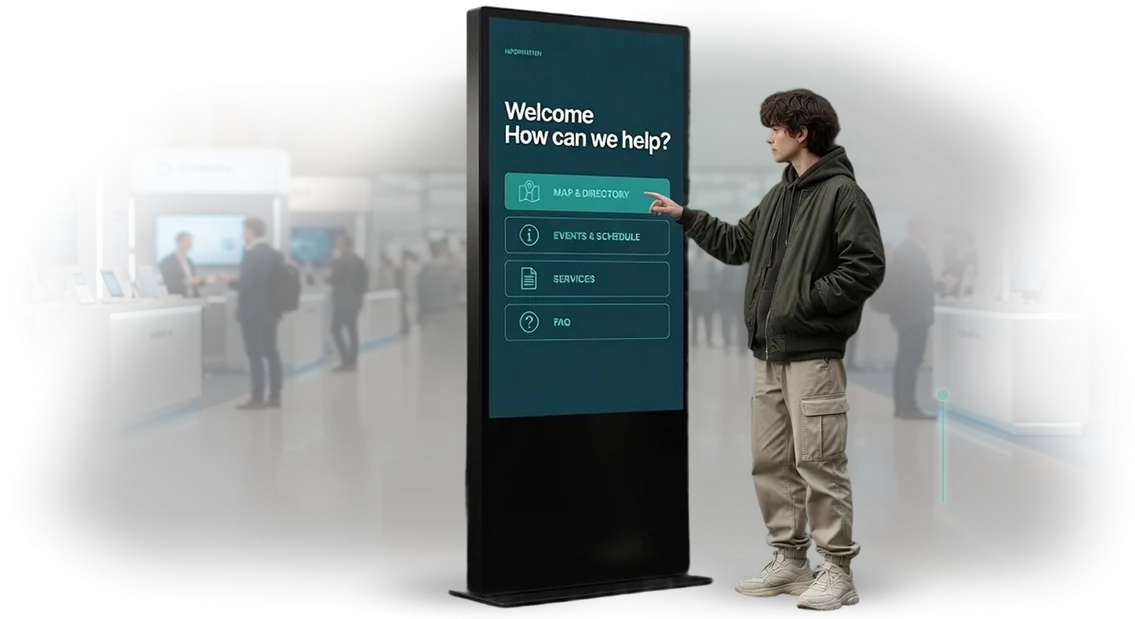
The solution is an interactive kiosk with an electronics catalog that works like a smart sales assistant. Visitors choose a category on their own, filter by characteristics, and see the price, availability, and location of the product on the display. They don’t have to wait for anyone, and they make decisions faster.
We develop such kiosks for the tasks of a specific store: from a simple reference guide to a full-fledged catalog integrated with the accounting system. This is not just a screen with pictures, but a tool that turns interest into purchase and reduces lost sales.
Customers leave not because they didn’t like the assortment, but because they couldn’t quickly see and evaluate it. An interactive kiosk closes that gap and brings revenue back.
What an Interactive Electronics Catalog Gives Your Business
An electronics customer comes not for a specific model, but for a solution to their task. While they wander between shelves or wait for a consultant, some customers go to competitors.
An interactive catalog removes that friction: customers find products themselves, see price and availability — and the store gets more sales.
Growth in Conversion and Sales
The kiosk shortens the path from interest to purchase. Instead of searching with their eyes, the customer enters parameters into the catalog — brand, type, price — and sees suitable options.
This way, the intention to “look” turns into “buy” faster, and the terminal’s conversion increases revenue.
Increase in Average Check
When a customer chooses a product, the catalog suggests compatible accessories: cases, chargers, screen protectors. This works like a virtual consultant that makes a personal recommendation at the right moment. As a result, the average check grows without active staff involvement.
Brand Recognition and Image
A touch kiosk with a well-designed interface is part of the customer experience. It creates the impression of a modern, tech-forward store that people want to return to. A brand-styled terminal also works for recognition and memorability.
Reduced Staff Workload
Consultants spend up to half their time on questions about availability, characteristics, and prices. An interactive catalog answers these questions automatically, and employees focus on complex consultations. This improves service quality and lets you manage customer flow without expanding staff.
An interactive catalog is not a digital display case, but a sales tool. Our team develops kiosks for the tasks of an electronics store: higher conversion, average check, and brand recognition.
Interactive Kiosk Formats for Electronics: How to Choose
The kiosk format determines how customers interact with the catalog and how quickly they find the right product. In electronics, the assortment is wide, so a convenient interface and a properly selected design directly affect the number of orders and the workload on consultants.
A floor-standing kiosk is placed in the entry zone or the center of the sales floor — it is highly visible and allows several visitors to use it at once.
A tabletop terminal is convenient in spaces with limited room: at an information desk, in a consultation department, or in a pickup area. A touch panel is compact, mounts on a wall or stand, frees up floor space, and works as a smart display for products.
Each format has its own scenarios. To make the choice easier, we have gathered the key options in a table.
| Kiosk format | Who it is for | What it gives the customer |
|---|---|---|
| Floor-standing kiosk | High-traffic store, exhibition hall, showroom | Maximum reach, presence effect, instant access to the catalog without staff involvement |
| Tabletop terminal | Pickup points, consultation desks, small retail zones | Space savings, fast product selection, higher average check through model comparison and add-on sales |
| Touch panel | Narrow aisles, checkout area, new arrivals section | Compactness, clear product specifications, short selection session — the customer makes a decision faster |
The optimal option depends on the layout, target audience, and business goals. A floor-standing interactive display at the entrance will attract those who haven’t decided yet, while a tabletop terminal in the pickup area helps with add-on sales. We will build a kiosk for your scenario — install it, configure the catalog, and train your staff.
How We Develop an Interactive Kiosk: Project Stages
When you order the development of an interactive kiosk for an electronics store, it’s important to understand what happens at each step. We work transparently: you have a plan in hand, clear intermediate results, and the ability to influence the project before launch. Below are the stages the development goes through.
- Brief and task definition. You tell us about your assortment, customers, and kiosk goals. We clarify the details and propose optimal solutions — from catalog structure to data update methods.
- Kiosk prototype. We create an interactive prototype: how customers will search for products, compare specifications, and leave a request. You see the logic of the future catalog and adjust it before programming begins.
- Design mockup. We develop the interface in your brand style. You receive a visual image of the kiosk and approve it, while we prepare content in parallel — texts, product photos, descriptions.
- Programming and integration. We set up the operational logic and connect the kiosk to your databases so that the assortment and prices appear automatically. This eliminates manual updates and errors.
- Kiosk testing. We check all customer scenarios: search, filters, request submission, and unusual situations. You also participate — you go through the scenarios and evaluate convenience.
- Launch and training. We install the kiosk and configure the hardware and software. We train your staff: how to properly maintain the terminal and make changes to the catalog.
- Support and development. After launch, we stay in touch: we refine features, update content, and monitor stability. You get not just a one-off project, but a working solution.
The whole process is a partnership, not an impersonal project handover. You control the timeline, make edits at every stage, and know in advance what result you will get. Depending on the catalog complexity, development takes from three to six weeks.
What You Get After the Interactive Kiosk Is Delivered
We deliver not just a device, but a fully functional sales tool. our team handles all stages — from equipment assembly to software setup — so you get a comprehensive result with no hidden work.
The delivery package includes everything needed to launch and run the kiosk reliably in your electronics store. This saves you from searching for contractors and coordinating details.
- Equipment — a touch stand, protected enclosure, screen, and components that are already configured and ready for installation.
- Licenses for all software used are arranged and included with the kiosk. You don’t need to buy or renew anything.
- An interactive catalog of products and services, filled with your assortment, with search and filters. Customers quickly find the right item and see the price and specifications.
- Staff training — a short briefing after which your employees can independently update content, manage the display, and resolve simple issues.
- Kiosk technical support — remote connection, phone consultations, and onsite visits. We respond quickly so downtime doesn’t affect sales.
- A warranty on equipment and work, as well as scheduled maintenance for the entire service life.
After delivery, you receive a working business tool that is immediately integrated into store operations. All that’s left is to turn on the kiosk — and it starts delivering value: increasing recognition, reducing staff workload, and growing revenue.
Case Study: Interactive Catalog for an Electronics Chain — Higher Average Check
A regular shelf shows a product but doesn’t explain why it’s worth paying more for. There’s only one consultant for the whole floor, and at the accessory display the customer gets lost and leaves with only what they came for.
For the electronics chain “Pulse”, we designed an interactive catalog on touch kiosks that closed this gap.
The catalog became a second salesperson: customers choose a category themselves, compare specifications, and see compatible accessories. The system suggests add-ons for a smartphone or laptop at the moment the person is already holding their choice in their hands. In this way, we removed the “afraid to ask” barrier and sped up decision-making.
Numbers After Launch
In the first two weeks, the average check in the pilot stores grew by 40%. The share of purchases with accessories nearly doubled, and selection time dropped from ten minutes to three. One in five customers returned within a month to buy an add-on.
For the chain, this meant revenue growth without expanding the assortment or hiring staff. The catalog paid for itself within one quarter, and the client installed it in five more locations. Today, the solution works as a permanent navigation and product selection tool.
We don’t just install kiosks — we integrate them into the selling process: we help rearrange displays, train staff, and set up reports for purchasing. That’s why this case became a benchmark for us.
How to Choose an Interactive Kiosk Format for Your Business Goals?
Choosing a kiosk starts not with an image or price, but with the tasks of the retail location and the flow of visitors.
For an electronics store, this most often means showcasing a large assortment, consulting on specifications, and submitting a request for a product that isn’t on display.
Before looking at models, ask yourself: what should the kiosk do for your business, and what result do you expect?
In electronics, the main value of a kiosk is showing more products without expanding the floor area.
A catalog on a touchscreen lets a customer find the right model in a minute, compare it with alternatives, and send an order to the salesperson — this increases the success rate of purchases and reduces the load on staff.
If the task is store navigation, a compact stand is enough. If the kiosk should work as an attention-grabbing interactive display, a large-format screen is worth considering.
The store’s floor area dictates the format choice and display capacity. In a narrow aisle or small hall, a vertical stand that takes up minimal space and doesn’t block traffic is convenient.
In a spacious showroom or along a wall, a wide-format kiosk that is visible from afar and draws visitors into exploring products works best.
Choosing the right format is not a technical detail but a way to increase the average check and free up consultants. Instead of repeating prices and specifications ten times, an employee takes the order from the kiosk and moves on to live interaction and add-on sales.
This way, the kiosk pays for itself faster and becomes part of the retail space rather than an extra object.
We help you choose a kiosk for your business goals: we analyze the floor area, visitor flow, and usage scenario, and propose the optimal configuration. Start with the question “what should the kiosk change in sales,” not with its appearance. Then the choice will be accurate, and the investment justified.
Frequently Asked Questions About Interactive Kiosk Development
We understand: before launching an interactive kiosk, practical questions come up — what happens to the device after installation, who maintains it, how quickly everything will be up and running. That’s normal, because the kiosk must work without failures in your electronics store.
Over 10+ years, we have launched dozens of terminals for product and service catalogs. So we’ve gathered the key answers that address customer concerns: reliability, security, timeline, and cost.
What about the warranty and repairs for the kiosk?
All equipment and software come with an official warranty. If something goes wrong, you are never left alone with the problem — an engineer performs diagnostics remotely or visits the site.
We handle repairs and part replacements so the terminal is back in operation as quickly as possible.
How is kiosk security ensured?
The kiosk is designed for autonomous operation: it has built-in protection against power surges, access to system settings is restricted, and the enclosure is resistant to external impacts.
Visitors or staff cannot accidentally disrupt the device’s operation, and changes are made only through a secure admin panel.
How long does development take?
A standard project with an electronics catalog is launched in 2–3 weeks from design approval. If non-standard functionality is needed, the timeline is discussed individually, but it is always fixed in the contract. You know exactly when the kiosk will start working and delivering value.
How do we update products and prices?
You get a clear admin panel where you can independently change the assortment, prices, and promotions. Changes appear on the kiosk immediately after saving — no need to wait for a programmer. All control is in your hands, which saves your team time and hassle.
Is it expensive?
The cost depends on the tasks, but before work begins you receive a transparent estimate — you can see what you are paying for. We use proven solutions and a modular architecture, so the price remains competitive and the kiosk pays for itself quickly. In the end, you pay for the result, not the process.
Ready to Discuss Your Interactive Kiosk Project?
Leave a request for a consultation — and we’ll get straight to business. We’ll explain how an interactive kiosk will fit into your electronics lineup, what tasks it will solve, and when it can be launched. No need to prepare a technical brief — just describe your situation in your own words.
We’ll get back to you within one business day, discuss the details, and propose a solution. There’s no obligation, but you’ll get concrete answers to your questions.
What you get after submitting a request:
- Project estimate for your task: we’ll select the kiosk configuration and software for your electronics catalog.
- Consultation on format: floor-standing, wall-mounted, touch — what’s best for your point of sale.
- Timeline assessment: we’ll give realistic launch dates based on your requirements.
- Budget commitment: you’ll know the development cost in advance and can plan expenses without surprises.
- Examples of similar electronics solutions: we’ll show how this works for other companies.
- Direct access to the team: an engineer, designer, and manager respond immediately, without intermediaries or approvals.
We work with electronics manufacturers and sellers, so we understand the specifics of your catalog. No need to explain the basics — we’ve already built similar kiosks and know how to avoid common mistakes.
Contact us now — we’ll lock in the timeline and budget, and start development right after project approval. Your kiosk request is the first step toward helping customers find the right product in your store faster.