

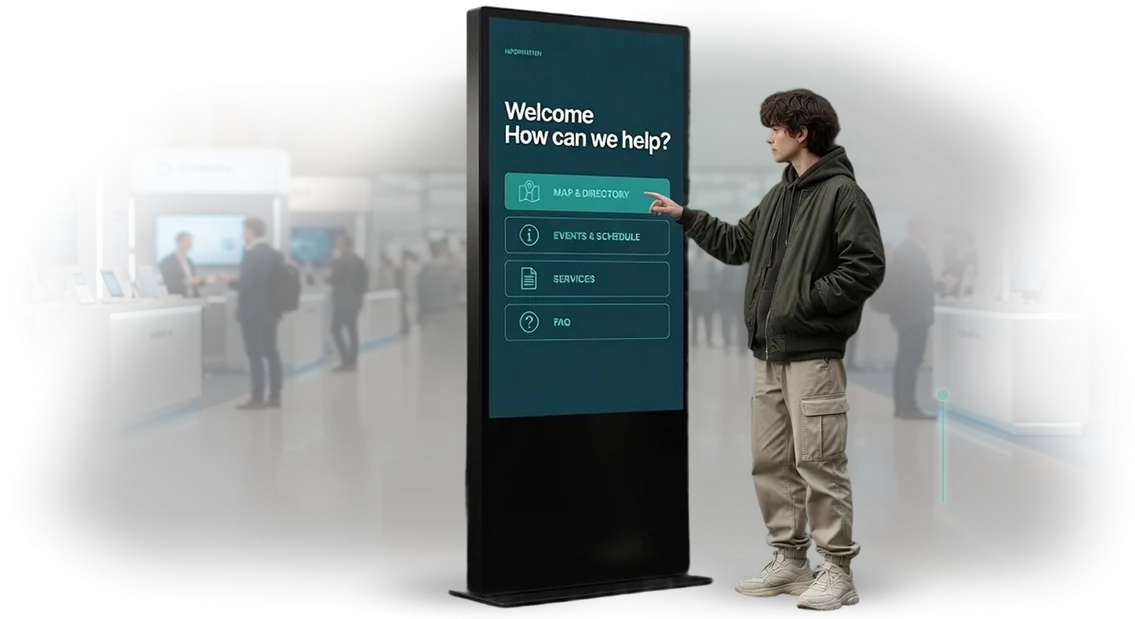
How Interactive Kiosks Solve the Navigation Problem in Pharmacies
Pharmacy visitors spend up to 40% of their time searching for the right medication. According to Pharmaceutical Retail Index research, every sixth customer leaves without getting a consultation.
Every third customer has to ask a pharmacist for help finding their way around the floor. Display cases are overloaded, names heard verbally don't match actual product locations, and the pharmacist is busy with the queue.
This situation hurts revenue: the customer goes to a competitor, and marketing loses data about unsatisfied demand. An interactive kiosk in a pharmacy solves the navigation problem.
On the touchscreen, a visitor quickly finds a product by name or category, sees availability, price, and the exact location on the shelf. Navigation becomes clear even for first-time visitors, and the pharmacist is freed from simple requests and can spend time consulting.
The kiosk works as an electronic catalog of the entire assortment — from prescription drugs to dietary supplements and related products. It also collects search query analytics: you learn what customers are actually looking for and can adjust your assortment.
As a result, the pharmacy speeds up service, retains customers, and gains a channel for informing them about promotions.
We have been developing interactive kiosks for pharmacy retail for over 10 years, adapting the interface to different visitor age groups. Integration with the accounting system allows automatic price and stock updates.
What an Interactive Kiosk Gives the Pharmacy and Its Visitors
A kiosk in a pharmacy is not an electronic reference book, but an assistant that speeds up service and increases sales. It addresses the main pain points: long queues, uncertainty in choosing, and lost sales.
The visitor sees availability, price, and alternatives in seconds, and the first-desk pharmacist isn't distracted by the same questions over and over.
Visitor Convenience and Service Speed
Customers want to quickly find the right medication and feel confident in their choice. The interactive catalog shows availability, price, and shelf location, and also guides them through the floor. Queues shorten, and staff focus on consultations rather than searching for products.
For a large pharmacy, this saves several hours of staff work daily.
Sales Growth and Average Ticket Increase
The kiosk suggests related products — vitamins, personal care, devices — and builds a basket based on symptoms. This way the pharmacy increases each purchase without pushy salespeople, and the customer leaves with a ready-made solution.
Loyalty and Repeat Visits
Complete information about composition and contraindications builds trust. The kiosk reminds customers about the loyalty program and helps build a database for notifications about new stock — a one-time buyer becomes a regular. This data also helps adjust the assortment to match real customer demand.
Why This Works
We have been designing such kiosks for retail and pharma for over 10 years. As a result, the pharmacy gains more satisfied visitors and revenue growth with the same staff costs.
Interactive Kiosk Formats for Different Pharmaceutical Tasks
In pharmacy retail and pharma companies, interactive kiosks serve different purposes — from product catalogs to clinic navigation. Visitors don't want to stand in line to find out if a medication is in stock, and staff waste time on repetitive questions.
There is no one-size-fits-all solution: it's important to choose the format that fits the installation location and the visitor scenario.
We design and produce three basic formats: desktop, floor-standing, and built-in. Each solves a specific task and pays off in its own way. Below is a clear comparison to help you quickly choose the right option.
| Format | For whom | What it gives the customer |
|---|---|---|
| Desktop kiosk | Pharmacy outlets, information desks, waiting areas in clinics | Compact placement without losing floor space — customers check availability and price themselves, reducing the load on the first-desk pharmacist. |
| Floor-standing kiosk | Large pharmacy chains, pharma markets, exhibition stands | Attracts attention, works as a display with a catalog, provides reach and visitor engagement, collects contacts for repeat sales. |
| Built-in kiosk | Display cases, walls, prescription dispensing counters | Saves space, fits into the interior, allows ordering without waiting in line, increases the average ticket through additional products. |
How We Develop a Kiosk for Your Business: 7 Steps
A clear process saves your time and nerves. You aren't just ordering a terminal — you get a managed project to create a tool that genuinely reduces queues in the pharmacy and speeds up medication selection.
We've structured development so you see results at every stage and can influence them without unnecessary approvals.
- Brief and task analysis. We meet, analyze your point of sale: floor area, traffic, assortment, visitor profile. We define the kiosk's goals — medication search, stock checks, pharmacy navigation.
- Design concept and catalog structure. We design the interface for your pharmaceutical line: convenient search by active ingredient, filters by price and manufacturer, cards with instructions. We show how the visitor will interact with the screen.
- Mockup approval. You receive a visualization of the future kiosk and a menu scheme for approval. We make revisions before anything "goes into production" — this removes the risk of rework and unnecessary costs.
- Production and assembly. We manufacture the enclosure and install professional equipment. We factor in anti-vandal protection and durability for intensive daily use — the kiosk operates from morning until the pharmacy closes.
- Launch and testing. We deliver, mount, upload your catalog, and test on real visitor scenarios. We make sure that finding a medication takes seconds, not minutes.
- Staff training. We show pharmacists and administrators how to manage content and update prices. Your employees can change promotional offers without calling a contractor.
- Support and development. We stay in touch after launch: monitor stability, update content on request, and help expand functionality for new chain tasks.
The result: the kiosk becomes part of your service strategy — it reduces the load on first-desk pharmacists and increases visitor loyalty by helping them quickly find the product they need. One transparent process instead of chaotic exchanges with contractors.
What's Included in the Interactive Kiosk Delivery
When ordering a touchscreen kiosk, many people picture only a "stand with a screen." In reality, a working terminal is a well-thought-out package combining the enclosure, software, installation, and ongoing maintenance.
We assemble this package for the pharmacy's needs — from initial setup to the moment the cashier changes promotions on the display.
Our clients receive a complete, ready-to-use solution without having to search for contractors "piece by piece." The interactive kiosk delivery package includes:
- Enclosure and assembled touchscreen kiosk — a durable structure that fits the interior and takes up no extra space on the sales floor;
- Kiosk installation and mounting — our specialists deliver, assemble, and connect the terminal at a time convenient for the pharmacy so as not to disrupt visitor flow;
- Pre-installed software — an interface developed for your product catalog, search, and order placement without a pharmacist's involvement;
- Configuration for your product database — we transfer your assortment, prices, stock levels, promotional items, and catalog structure;
- Staff training — a short session for pharmacists and administrators: how to update data, change banners, and monitor statistics.
- Technical support — remote support and terminal monitoring so it's always ready for use;
- Content updates — help with making changes if the pharmacy doesn't have a dedicated employee for this task.
This way, the kiosk delivers value from the very first day — it attracts visitors' attention, relieves first-desk pharmacists, and speeds up service.
Kiosk installation takes no more than a few hours, and warranty and maintenance are secured by contract so you know what support you can count on after launch.
Case Study: How We Increased Sales in a Pharmacy Chain by 23%
A pharmacy chain approached us — 14 locations in residential areas of the city. Managers noticed that visitors lingered at display cases, asked pharmacists about products, and left without buying if the needed medication wasn't in stock.
Paper catalogs and price tags didn't provide the right information, and competitors were already implementing digital solutions.
We proposed installing an interactive kiosk with a product and service catalog in every store. Instead of a boring list — convenient search by name, category, or symptom, with shelf availability, alternatives, and promotions indicated. Staff spend less time on consultations, and customers find what they need in 30 seconds.
After two months, the chain saw measurable results: sales grew by 23%, the average ticket increased by 12%, and the share of repeat visits rose by 18%.
The alternatives section performed particularly well: when the needed medication wasn't available, the kiosk suggested a substitute — and the customer didn't go to another pharmacy.
The secret to success lies in a scenario that follows the customer's logic: from symptom to shelf. Visitors feel more confident, make decisions faster, and are more likely to return. For the chain, this means revenue growth without additional advertising investment.
This case is not isolated. We adapt the solution to your business needs: from catalog to navigation and loyalty programs. Contact us to discuss how an interactive kiosk can increase sales in your retail operation.
How to Choose an Interactive Kiosk Format for Your Pharmacy?
Choosing an interactive kiosk for a pharmacy starts not with the terminal model, but with the question: what task should it solve at your location? If visitors often ask about medication availability and prices, a compact desktop catalog near the register is enough.
If the pharmacy handles pre-orders or you want to relieve first-desk pharmacists, you need a full-fledged information terminal with order placement capability. The enclosure type, menu format, and method of integration with your accounting system all depend on this.
The main criterion for choosing a kiosk is customer behavior at a specific pharmacy. In a small location with high traffic near the display, a vertical terminal that doesn't take up useful floor space and doesn't create queues works better.
In a spacious pharmacy or a "healthy city" format, you can install a freestanding kiosk with a large screen — it becomes a point of attraction and draws attention on its own.
Assess the average ticket and customer dwell time: the longer a person is willing to interact with the screen, the more functions you can build into the scenario.
The second important block is content and management. For pharma, it's critical that the catalog always reflects current stock levels, prices, and acceptable alternatives.
Therefore, when choosing a terminal, pay attention to how easily it exchanges data with your warehouse program and how often information can be updated without involving a contractor.
Ask whether remote monitoring, protection against unauthorized access, and clear request statistics are included — this will help you see which items are searched for most often.
There is no universal "best" terminal type — the right choice depends on three parameters: pharmacy traffic, floor area, and the tasks you set for the digital assistant.
We select the kiosk format for your scenario, show you in advance how it will fit the interior and which customer scenarios it will cover. We measure traffic, clarify the assortment, and within a few days offer a solution with a clear cost estimate and implementation timeline.
Frequently Asked Questions About Kiosk Development
We understand that questions about warranties, timelines, and compatibility with your accounting system come up before launching a kiosk. We answer the most common ones — honestly and to the point.
What warranty comes with the kiosk and what does it cover?
We provide a warranty on the enclosure, touchscreen, and components — typically from 12 months. If a failure occurs within this period due to our fault, we'll replace the part or fix the issue free of charge.
Importantly, the warranty also covers software. If the kiosk stops working correctly after your 1C update, we'll adapt the integration as part of support.
How long does kiosk development take?
A typical project takes 2 to 4 weeks: from brief to on-site installation. The timeline depends on the catalog size and how complex it is to connect the kiosk to your product database.
For urgent tasks, we can arrange a launch in 10–12 days. The important thing is to share the catalog structure and access to the 1C demo environment in time.
Will the kiosk work with our 1C system?
Yes, this is a standard task. The kiosk pulls current stock levels, prices, and descriptions from your 1C system — data updates automatically, without manual upload.
We configure the data exchange for your specific setup. Visitors see only current products and prices, and your staff don't waste time on synchronization.
What happens after launch? Who helps if something breaks?
We set up remote monitoring: if the kiosk stops responding, we see it before you do and remotely reboot or fix the settings. For complex cases, we dispatch a technician to the site.
Support is ongoing, not "done and forgotten." You get a dedicated engineer who knows your project and responds within one business day.
Order Interactive Kiosk Development for Your Pharmacy
Order an interactive kiosk for your pharmacy that will pay for itself through a higher average ticket and reduced staff load. Contact us any way you like — click the "Order a kiosk" button or use the contacts on the page.
We'll prepare a commercial proposal with a cost calculation for your specific task, not a generic template.
In your request, specify the pharmacy floor area, the number of product SKUs, and the kiosk usage scenarios. That's enough for us to send a preliminary estimate of timeline and budget within one business day.
We'll calculate the cost including equipment, interface development, and integration with your accounting system — with no hidden fees.
What You Get After Reaching Out
- A personalized cost calculation for your pharmacy — tailored to the floor layout and assortment.
- An interface prototype before development starts — you see how the catalog will look and can make changes.
- Clear launch timelines: from brief to a working terminal on the floor.
- A single dedicated manager who handles the project from contract to acceptance.
- Post-launch support: assortment updates, backup, staff consultations.
We work remotely across the country. Over 10 years of experience in interactive terminals for retail and pharma — so you won't have to oversee every detail.
Leave a request now, and within 5–10 minutes we'll get in touch to clarify the task and start preparing your commercial proposal.