

Why Do Clients in the Financial Sector Leave for Competitors?
Clients in the financial sector get used to digital speed: while they stand in line at the counter, a competitor's app has already processed a transfer or opened a deposit. The branch is perceived as a waste of time, so some visitors leave without even waiting for a consultation.
Banks and insurance companies lose more than a visit — they lose client loyalty, and next time that client will simply open an online service.
The paradox is that the most valuable clients are exactly the ones who come to the office: they need to discuss a mortgage, a large deposit, or an investment portfolio.
But if they are forced to wait and ask again, they leave for competitors where the same product is available faster. The problem is not the staff — it is the outdated service scenario where the client depends on the manager's schedule and the availability of a free counter.
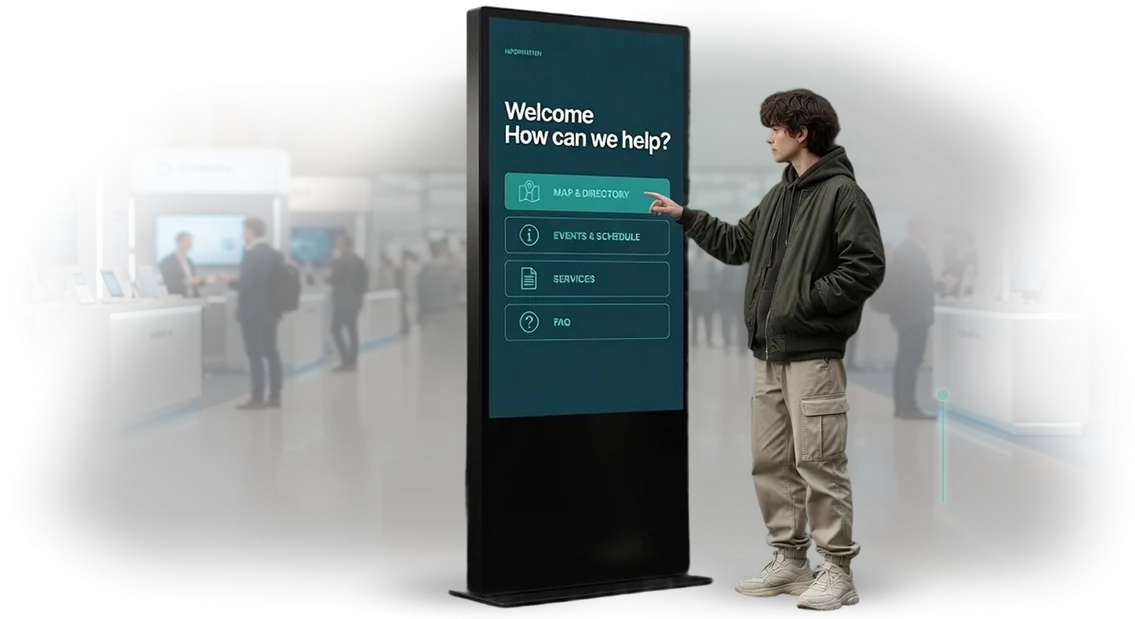
Interactive kiosks give clients back control over their time. Instead of waiting, they can get a statement, choose a rate, check the status of an application, or leave a request for a meeting with a specialist.
This also relieves the load on employees: they handle complex questions while the client resolves routine operations in a couple of minutes. As a result, the queue shrinks, and the branch stops being the place where it is "always so slow."
For a financial organization, this is a way to retain clients at its point of sale and compete with digital services on their own turf. The kiosk works without breaks, speaks the client's language, and remembers their preferences so the next visit is even shorter.
Experience shows that wherever such terminals appear, repeat visits grow, and complaints about service time become a thing of the past.
We create interactive kiosks that address the biggest pain point of the financial sector — losing clients due to inconvenient office service. We combine digital speed with live contact, turning the branch into a place where clients can truly solve their tasks with ease.
That is why banks and insurance companies come to us — the ones that want not just to bring visitors back, but to make them regulars.
Benefits of an Interactive Kiosk for Your Organization's Clients
In client service, waiting time matters a lot. While a visitor stands in line for a consultant, they manage to get tired, irritated, and start doubting your institution.
An interactive kiosk removes this bottleneck: the needed statement, rate, or application form appears in a couple of taps, without visiting an office window.
For employees, this is also relief — operations staff stop answering routine requests and concentrate on complex products that require a live dialogue.
For clients, it means independence and predictability: the service is available at any hour the branch is open, even during peak hours.
The financial sector demands accuracy in every detail — from exchange rates to account balances.
The kiosk displays data exactly in the form your organization approved, eliminating the human "yesterday they said otherwise." This reduces the number of conflict situations and strengthens trust in the brand.
The kiosk remembers the visitor's preferences and adapts to them — regular clients do not need to explain again which product they arranged last time. Personalization at this level is usually associated with a personal manager, but here it scales across the entire visitor flow.
In the end, the client receives not just another service point, but a tool that protects the reputation and frees up the team's resources. The visitor leaves satisfied faster, employees are busy with live sales, and the branch operates as a single mechanism. This is exactly what turns a one-time visit into long-term loyalty.
Kiosk Formats for Your Objectives
Interactive kiosks in the financial sector solve different tasks: they inform clients about products, help submit applications, and reduce queues. But the same scenario does not work both for a bank branch and an exhibition — each case requires its own form factor.
We develop kiosks in various configurations so you get exactly what works for your audience and your budget. The table shows the main options.
| Format | Who it is for | What it gives the client |
|---|---|---|
| Stationary kiosk | Branches, offices with a steady visitor flow | Works without staff involvement, speeds up service, and removes routine from employees |
| Mobile kiosk | Exhibitions, conferences, outdoor events | Sets up in 15 minutes, runs on battery, attracts attention, and collects contacts |
| Tabletop version | Meeting rooms, waiting areas, consultations | Compact, takes little space, helps personally show the client the service catalog |
Stationary kiosks are chosen when you need a permanent self-service channel next to the point of sale. Mobile stands are justified at events where it is important to quickly impress a guest with interactivity.
Tabletop versions work for dialogue with the client — the employee and the visitor see the screen at the same time.
We will help you select the optimal format for your task rather than offer a "one-size-fits-all" solution. You will get a kiosk that people actually use, not a stand gathering dust in the corner.
How We Build a Kiosk: Work Stages
For financial organizations, a kiosk is a way to speed up service and reduce the load on staff. We have structured the process so that you understand what is happening at every stage and get a predictable result — from the brief to launch and support.
- Brief and immersion. We analyze which products and services to show, who the audience is, and which scenarios matter. You get a clear understanding of the project goals and success criteria.
- Scenario design. We think through the catalog structure and search logic. The client finds what they need in two or three taps, not by wandering through menus.
- Design under your brand. The interface is recognizable and inspires trust. The kiosk looks like part of the office, not a separate technical device.
- Assembly and configuration. We connect the interface to your product database, verify data display and stability. Updates do not break the showcase.
- Testing and launch. We check the scenarios: search, viewing details, consultation request. We fix any issues and launch the kiosk in the branch.
- Support and development. We stay in touch: update the catalog, add scenarios, monitor stability. You get a working tool that grows with you.
What Is Included in the Interactive Kiosk Delivery
In the financial sector, a kiosk is not just a stand with a screen, but a full-fledged client service channel. That is why the delivery set includes everything needed for turnkey operation: from the enclosure and display to software and installation at your site. You get a solution that can be switched on and used immediately.
The standard delivery includes:
- Enclosure and display — vandal-resistant, protected against dust and moisture, designed for 24/7 operation in a branch or self-service hall.
- Software — adapted to your products and services, with the ability to update and manage content remotely.
- Installation and setup — on-site mounting, network connection, and verification of all functions before handover.
- Connection to your systems — integration with the product catalog, exchange rates, or online applications so the client receives up-to-date data.
- Instructions for staff and clients — short guides for startup and maintenance, as well as on-screen hints for users.
- Warranty and technical support — maintenance of equipment and software for the entire warranty period, with fast response to requests.
This set covers everything: you do not need to separately look for an enclosure supplier, a software developer, and an installation team.
We are responsible for the entire result, and your employees simply plug the kiosk into a power outlet — everything else is already configured and verified.
Case Study: Kiosk for the Financial Sector Increased Sales by 23%
In a bank branch — a classic financial sector location — a client comes in with a specific question, but often leaves without ever learning about the right product. Managers are busy, the queue builds up, and paper brochures lose to the smartphone screen.
That was exactly the task brought to us by a regional bank: increase sales without expanding the team or investing in advertising.
What We Did
We developed an interactive catalog and installed it in the waiting area. On the kiosk screen, the client found the needed product in 30 seconds: a deposit, a credit card, a loan, or insurance.
A simple scenario led from choosing a goal to the terms and immediately offered to leave an application — without employee involvement and without paper forms.
The key was that the catalog works like a personal consultant: it suggests options, compares terms, and shows how to submit an application online. This relieves the staff, and the client gets an answer at any moment, even during peak hours.
Result
Two months after launch, the bank saw a noticeable change in client behavior. The conversion of branch visitors into applications grew by 23%, and the share of products arranged without a manager's involvement almost doubled. Average waiting time in the queue decreased — some questions were resolved at the kiosk.
This case showed that an interactive catalog in the financial sector works as an additional sales channel. The branch began to be perceived as tech-savvy, and the bank gained revenue growth without expanding the team.
Within the first few months, several more branches ordered the same kiosks — a repeat order became the best confirmation of the result.
How to Choose the Right Format for Your Task?
Choosing a format is not about "more features," but about the logic of working with the client.
In the financial sector, a terminal with a product and service catalog solves different tasks: in a branch, it is fast access to products and applications; at an off-site meeting, it is a live showcase that adapts to the audience.
So first answer three questions: where the kiosk will stand, for how long, and what the visitor should accomplish.
| Selection criterion | Stationary kiosk | Mobile kiosk |
|---|---|---|
| Where it works | In one branch or lobby, a permanent point | Moves across locations: offices, exhibitions, events |
| Scenario | Daily product catalog, application submission, queue reduction | Service presentation, temporary promotions, "field" work |
| Launch speed | Requires installation and on-site setup | Faster: brought in, plugged in, catalog updated |
| Additional value | Stable daily user flow | Covers different locations without purchasing multiple terminals |
If the task is to relieve staff and give clients independent access in every office, choose the stationary format. If the catalog needs to "travel" to clients at meetings and conferences — choose mobile.
A third scenario: combined, when stationary terminals handle the daily flow and a mobile kiosk is used for off-site activities.
Also consider how often the catalog changes. In the financial sector, products and rates are updated regularly, so simple content loading without reflashing is important.
We have over 10+ years of experience delivering both options: we select the format based on your workflow, not "the most powerful kiosk for the sake of a kiosk." At the start, we offer a short brief where we capture the scenario, placement points, and update frequency — this allows us to choose a format that pays off in coverage and convenience for clients.
Answering Questions Before Ordering
Before ordering an interactive kiosk in the financial sector, clients usually ask the same questions: how much development will cost, how long it will take, and whether the contractor can be trusted.
This is fair — visitor service and the organization's reputation depend on catalog stability. We have gathered honest answers to the main doubts, and we will discuss the rest at the briefing.
How much does developing an interactive catalog for the financial sector cost?
The cost depends on the number of services, design, and integration with your information systems. At the briefing, we fix the tasks and prepare an exact estimate — without hidden fees or "extras" along the project. You see a clear breakdown and understand what you are paying for.
What are the launch timelines?
A typical project takes two to four weeks from design approval — depending on the catalog size and the need to connect to your database. The plan spells out the stages, and we deliver the work gradually: you see progress rather than waiting for the result "at the end."
How do you guarantee reliability?
Kiosks in the financial sector operate without breaks, so we use professional equipment and proven content management tools. After launch, we stay in touch: we help update the catalog, monitor stability, and quickly resolve issues if something goes wrong. Guarantees are fixed in the contract.
If you still have doubts — ask them before the work begins. We give a direct answer to every question, and in the estimate and plan we state timelines and cost so you can make a decision without risk.Order Interactive Kiosk Development
To start a project, leave a request for interactive kiosk development via the form below or write to us by email. We will contact you within a business day, clarify the tasks, and offer a solution for your budget.
We prepare a technical proposal in 2-3 days: taking into account the terminal format, your industry, and the complexity of the content. You receive a fixed estimate without hidden surcharges and an understanding of the result before work starts.
Before sending your request, check the standard checklist — this way we will prepare an accurate proposal faster:
- Which products and services the catalog should show: loans, deposits, cards, insurance, investments.
- Who the main terminal audience is: branch visitors, individuals, or corporate clients.
- Where the kiosk will be installed: in the lobby, waiting area, or outdoors — this affects enclosure protection and management method.
- Whether administrator access is needed for independent updates of prices and terms without developers.
- Which scenarios matter: product search, term comparison, printing information, sending an application to email, or calling a manager.
We are responsible for manufacturing the stand, supplying equipment, and installation. You get a complete turnkey package: from enclosure design to server-side setup and licenses.
Therefore, in the request it is enough to specify the desired timelines and the number of terminals — we will design the rest ourselves.
After the briefing, we will send a presentation with examples of our projects for banks and insurance companies. We will show how an interactive catalog reduces queues to consultants and increases conversion into applications. Leave your contacts in the form — we will agree on a convenient time for a demo.