

An Inconvenient Catalog — Lost Orders in the Chemical Industry
Buyers in the chemical industry work with a wide range of products: reagents, raw materials, and production components. When customers have to search for what they need in a paper list or an outdated file, every minute of waiting becomes a reason for doubt.
Clients are not ready to deal with a complicated structure — they want to find an item quickly, see its specifications, and make a decision. When that does not happen, the order goes to competitors.
Lost orders in the chemical industry are rarely related to product quality.
The real culprit is usually an inconvenient way of presenting information: the buyer does not see the right item, cannot tell the difference between similar formulations, and wastes time on clarifications. As a result, even a loyal partner starts looking for alternatives. The company loses not only the current deal but also future repeat requests.
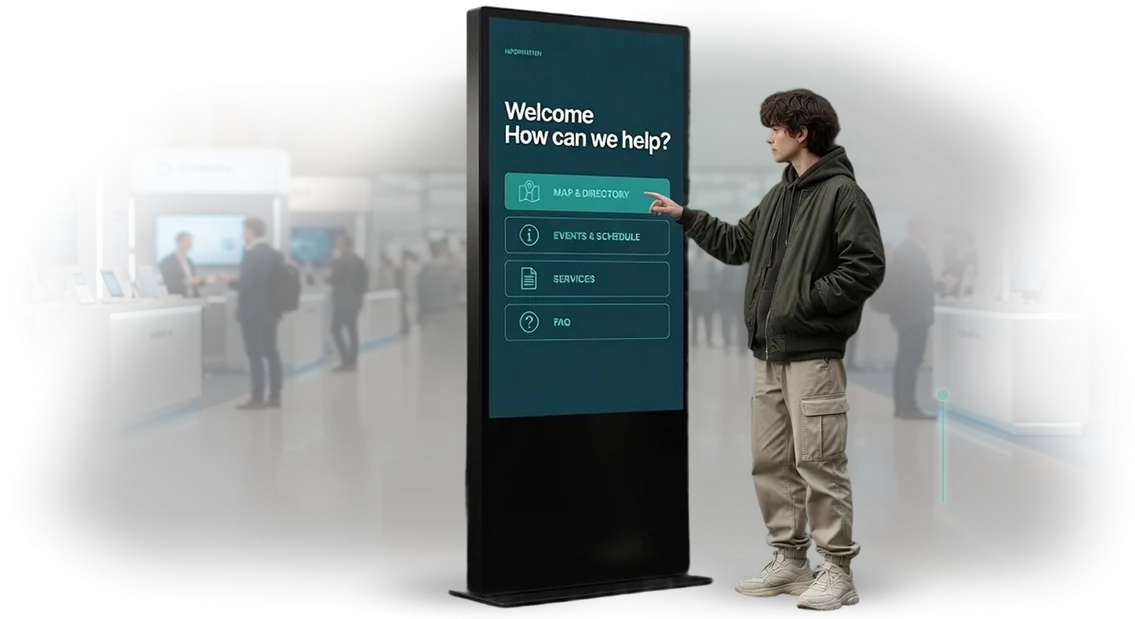
An interactive catalog changes this situation. A customer terminal in the sales area or at the warehouse lets buyers find the right product in a few touches by name, purpose, or parameters.
The customer sees availability, packaging, and current specifications — without calling a manager or going through long approvals. This removes the main objection and speeds up the purchasing decision.
For the business, such a catalog means transparent work with the assortment and higher conversion of inquiries into orders. Employees spend less time on routine answers, and customers get a clear service that sets the company apart among chemical product suppliers. We design the interface around real buyer scenarios and launch a solution that works from day one.
What an Interactive Kiosk Will Give Your Company
An interactive kiosk in the chemical industry solves several tasks at once that previously seemed impossible to handle. Visitors can independently select the right material by parameters: purpose, composition, application conditions — without waiting for a consultant.
For your company, this means more orders because the customer does not leave to «think it over» but immediately submits a request at the terminal.
Product search speed is one of the main advantages of an interactive kiosk. Instead of flipping through a paper catalog or waiting for a manager to respond, the buyer finds the right item in a couple of minutes and sees all available modifications.
The system suggests analogs and related products, which directly increases the average check and customer loyalty.
Another important effect is reducing the burden on managers. Employees stop spending time repeating specifications and can focus on complex consultations and work with key clients. This improves service quality and shortens the deal cycle.
At the same time, the kiosk strengthens the company’s image as a modern, technology-driven supplier that cares about customer comfort.
In the end, an interactive kiosk is not just an information stand but a working tool that speeds up product selection, increases the average check, and frees up your team’s resources for truly important tasks.
Formats of Interactive Kiosks for the Chemical Industry
Scenarios on the production floor and in the sales office are very different: sometimes engineers need quick access to the catalog, and sometimes guests need a presentation-style display.
That is why we choose the kiosk format not «by eye» but according to the specific task — so the terminal works where it is genuinely convenient and does not interfere with the process.
Every site has its own conditions: traffic, floor area, and safety requirements. To help you get oriented, we have collected typical solutions for the chemical industry — from compact touch panels to large floor-standing structures.
| Kiosk Format | Who It Is For | What It Gives the Customer |
|---|---|---|
| Desk | Reception, sales office, security post | A compact touch panel that takes no space; the visitor immediately sees the product catalog, certificates, and contacts. Good for quick consultations. |
| Freestanding | Lobby, exhibition stand, checkpoint | A large screen attracts attention and allows you to show the catalog with striking graphics and video. Suitable for independent product exploration without a manager’s help. |
| Built-in | Narrow corridors, laboratories, limited-space zones | Mounted into a wall or stand — does not create obstacles and is resistant to accidental impacts. Provides access to the catalog and internal instructions anywhere on the site. |
Reliability matters in the chemical industry: terminals operate in workshops with increased dust levels and temperature fluctuations. That is why we use protected enclosures and proven components — the equipment will not fail at the most critical moment.
Whichever format you choose — desk, freestanding, or built-in — the client receives a unified system: a touch panel, product catalog, and an easy-to-understand interface that is simple to update. All that remains is to place the terminal at the right point and put it to work.
How Development of an Interactive Kiosk for Your Catalog Works
Developing a kiosk around your catalog is not a «black box». You see the stages and timelines in advance and understand who is responsible for the result. We run the project from the first discussion to launch and beyond — with support after the start.
-
Task discussion and audit. We study which products go into the catalog, who will use it, and what functions are actually needed. We fix the scope of work, timelines, and assign a manager who runs the project.
-
Catalog and prototype approval. We prepare the screen structure, search logic, and visual style to match your brand. You approve how the kiosk will look before any programming — this eliminates unpleasant surprises at the final stage.
-
Development and content filling. We program the logic, load products with descriptions and specifications, and set up integration with your accounting system if needed. On intermediate versions, you see the progress and can make adjustments.
-
Pre-launch testing. We check the kiosk in real conditions: response speed, reliability, and convenience for visitors. We fix any issues before the equipment reaches the site.
-
Project launch and employee training. We install and configure the kiosk, run through all scenarios, and brief your staff on how to quickly update prices, add items, and change the design without help from developers.
-
Kiosk support after launch. We provide technical support, monitor operational stability, and help update the catalog. When the assortment or tasks change, we refine the functionality to meet new requirements.
What Is Included in the Interactive Kiosk Delivery
When you order an interactive kiosk for the chemical industry, you receive not just a device but a ready-to-use solution.
We provide a complete package — from configured equipment to employee training — so you can start using the kiosk immediately, without a separate implementation project.
Here is what is included in the delivery:
- Equipment set. A touch kiosk with a protected enclosure, configured for round-the-clock operation in a workshop, warehouse, or sales office. Everything is tested and ready to plug in.
- Interface designed for your task. A clear product and service catalog structure, fast search by specifications and materials, and adaptation to your company’s brand style. From the first screen, visitors understand how to find what they need.
- Catalog content. We transfer your items, descriptions, specifications, and photos into the kiosk system. You do not need to deal with the technical side — the data will be presented in a customer-friendly format.
- Instructions and guidelines. Short memos for employees, a guide to updating content, and daily maintenance rules. Everything is written in plain language, without technical jargon.
- Team training. We give a demonstration for your staff: we show typical work scenarios, how to answer visitor questions, and how to make quick changes to the catalog.
- Warranty and support. Official warranty on the kiosk and technical support. If a problem occurs, we help remotely or arrange equipment replacement — so kiosk downtime does not affect customer operations.
In the end, you get a single package where there is no need to assemble a solution from different contractors. We handle all tasks — from catalog content to kiosk maintenance — on our side.
Case Study: Interactive Catalog Increased Requests by 40%
The client is a chemical enterprise KhimProm producing several hundred types of raw materials and reagents. Managers spent up to 15 minutes consulting each customer: they had to manually select analogs and check availability and prices in paper catalogs. Some requests were lost, and buyers went to competitors.
We suggested installing an interactive kiosk in the visitor reception area. The screen shows a catalog with convenient search by name, purpose, or specifications.
Customers find the right item themselves, see the price and current stock, and can immediately create a request — which automatically goes into the order management system. For employees, this removed routine work; for visitors, it accelerated the process.
How It Went
The project took four weeks: we analyzed the assortment, structured product cards, set up the link to the accounting system, and trained the staff. The kiosk was placed at the entrance — the first screen greets guests and shows them where to start.
What the Plant Got
We measured the implementation results two months later. Product search time dropped by an average of two times, and the number of requests through the terminal grew by 40%.
Moreover, almost a quarter of inquiries came for the first time from new customers who previously had not risked contacting the sales department without knowing exact availability and price.
Most importantly, requests began arriving structured, with the required specifications, so managers prepare commercial proposals much faster.
The repeat purchase rate among these customers is noticeably higher, and the interactive kiosk case itself confirmed: a modern terminal at a manufacturing enterprise pays for itself faster than a regular information stand.
How to Choose a Kiosk Format for Your Industry Needs?
A kiosk format is chosen not by appearance but by usage scenarios. In the chemical industry, these include the product and service catalog, terminal navigation, order submission, and informing about safety requirements. Each task is covered by its own cabinet type and set of options.
The main selection principle is task first, configuration second. A warm hall does not need a rugged outdoor enclosure, and a checkpoint is not suited to an office stand. We start with the question «what should the kiosk do» — so you do not overpay for unnecessary options.
| Kiosk Format | Who It Is For | What It Gives the Customer |
|---|---|---|
| Freestanding floor stand | Visitors and clients in the hall | Independently find products and leave a request without a manager’s involvement |
| Wall-mounted kiosk | Employees and terminal guests | Fast navigation, access to safety rules and certificates |
| Compact desk unit | Operators at the warehouse and office | Receive requests right at the workstation without a separate area |
| Outdoor kiosk | Drivers and checkpoint visitors | 24/7 access to information in any weather |
Scenarios can be combined: one kiosk shows the catalog, helps with orientation, and accepts requests. At the discussion stage, we show how the selected format affects visitor convenience and staff workload. If necessary, we adjust the configuration before launch.
If you are unsure, book a consultation. We will review your tasks and propose the optimal kiosk format in three options, without overpaying for unnecessary features.
Frequently Asked Questions About Reliability and Catalog Updates
An interactive kiosk in the chemical industry is a responsible tool: it operates in workshops, warehouses, or exhibition halls. You want to be sure it will not let you down and that the catalog is always up to date. Below are answers to common client questions.
How reliable is a kiosk in production conditions?
We use industrial enclosures and protected components designed for dust, vibration, and temperature fluctuations. The terminal operates around the clock, and the self-diagnostic system will warn about a failure in advance.
How often is the catalog updated, and how is it done?
Updating takes a few minutes and requires no special skills. You upload data through a personal dashboard or send a file to your manager — changes appear immediately. Automatic synchronization with your accounting system is also available.
What is included in the warranty and maintenance service?
The hardware warranty starts from 12 months, and the software is covered for the entire service life. We provide remote support and, if needed, an engineer visit. Average response time is a few hours.
How quickly does a terminal pay for itself?
Reduced product selection time, lower employee workload, and growth in repeat orders cover the investment within several months. The exact period depends on the number of items and usage intensity.
Get an Interactive Kiosk for Your Catalog Within 30 Days
For chemical industry enterprises, a catalog means hundreds of items with technical descriptions and delivery terms. It is difficult for customers to quickly find the right product, so they turn to managers, and managers waste time on the same repeated questions.
An interactive kiosk removes this barrier: visitors find the item themselves, review the specifications, and leave a request for a cost calculation.
To get a kiosk within 30 days, take five steps:
- Leave a request on the website — we will call you back during the working day and clarify the project goal.
- Get a consultation: we determine which products and services to include and who will use the kiosk.
- Get the cost calculated after audit for your number of items and installation points — a transparent estimate with no hidden surcharges.
- Approve the catalog structure and screen mockups — you will see the design before development starts.
- We prepare the content, load the data, test the scenarios, and train your employees.
- Launch the kiosk in your office or at an exhibition and track which products are chosen most often.
We take on information structuring, data transfer, and screen configuration. You control the key stages and receive a ready terminal within 30 days.
Order the development of an interactive kiosk for your catalog today — in a month, it will be taking requests from your clients. Leave a request to get the cost calculated after audit and receive a launch plan with exact timelines.