

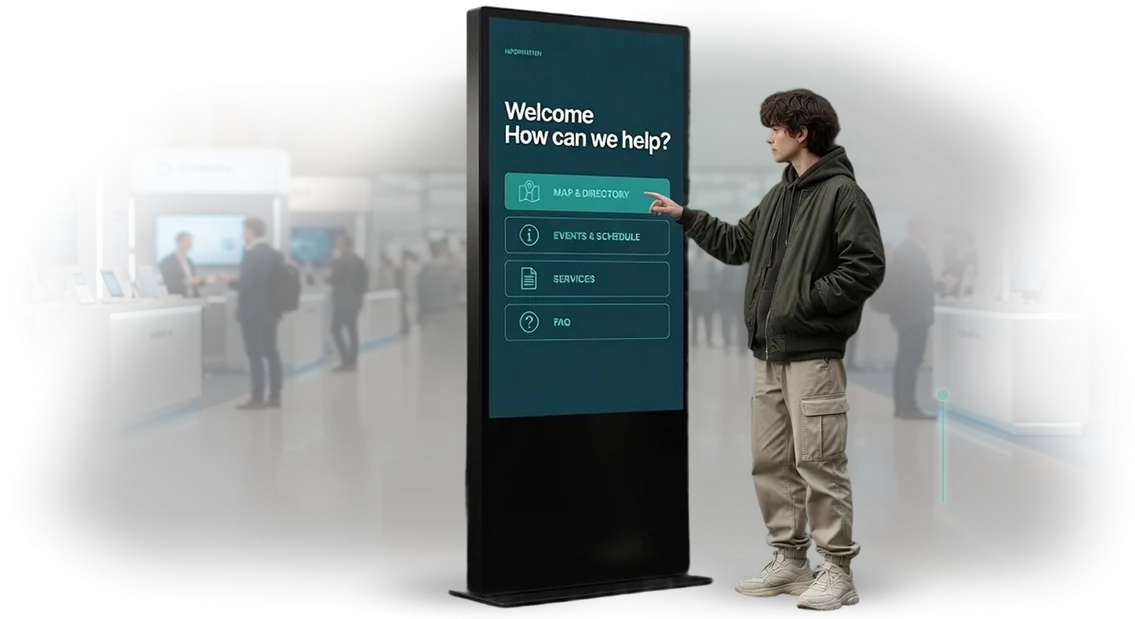
Why do candidates get lost in HR recruitment?
Candidates get lost in HR recruitment long before the interview — already at the waiting and application form stage.
A person arrives on schedule, sees a queue, does not understand how long they will wait, and leaves: the labor market is highly competitive, and there is no reason to stay where the process is inconvenient. Most often, the issue is not the vacancy or the salary, but the first touchpoint with the company.
As a result, recruiting turns into a race with losses: every tenth initial meeting falls through, and its time goes to repeated calls and rescheduling.
Instead of assessing experience, the recruiter spends hours on mechanical actions — explaining where to go, calming people down, redoing application forms.
The hiring department gets fewer candidates, and the business loses speed in filling positions, especially when it comes to mass hiring.
The cause is systemic: classic tools are not adapted to the behavior of the modern job seeker. They are used to a self-sufficient interface without queues and extra people, and a registration kiosk with paper red tape sends them back to the past.
An interactive kiosk in the waiting area changes this scenario: the candidate chooses a vacancy themselves, fills in their data, and receives clear instructions — without the help of a recruiter and without losing motivation.
We solve this task at the level of a tool that has already proven itself in other areas where customer journey speed matters.
An interactive kiosk for HR recruitment reduces the time of initial contact and does not let the candidate "evaporate" on the way to the interview.
What benefits does an interactive kiosk bring to a company
Guests and candidates are used to the same type of stands and paper forms — they walk past without even stopping. An interactive kiosk breaks this pattern: the screen attracts the eye, and the process of getting to know the company turns into a short engaging interaction.
A person chooses what to look at themselves and, as a result, spends several times more time at the terminal than at an ordinary promoter with flyers.
This time works for the business. While a visitor explores vacancies, corporate videos, and career stories, the brand is remembered, and positive emotions become associated with the company.
After the event, guests tell others about the unusual experience on social media and to colleagues — reach grows without an additional advertising budget. A modern kiosk itself becomes part of the employer's image, one that keeps up with the times and cares about job seekers.
The main value for recruiting is quality leads. Instead of scattered paper resumes, the company receives structured application forms in electronic form: contacts, desired position, experience.
Filling them out takes a couple of minutes, so the number of responses increases noticeably. HR managers spend time not on manual data entry, but on live conversations with suitable candidates.
The kiosk pays for itself not only through collected contacts. It sets the company's stand apart from competitors, attracts the attention of even random visitors, and creates a reason to talk to a recruiter.
This is a tool that simultaneously strengthens the employer brand, engages the audience, and fills the funnel with candidates — which means it delivers measurable results after the very first event.
Kiosk formats for working in HR recruitment
Candidates increasingly search for jobs on their own, but during peak hours recruiters do not have time to answer the same questions about current positions.
An interactive kiosk with a vacancy catalog removes this burden: the job seeker explores vacancies and leaves their contact themselves, while staff focus on live communication with those who really need help.
Different kiosk formats solve different tasks: one suits a lobby, another — for events, a third — for a display window. Compare the options and choose a solution for your scenario.
| Format | For whom | What it gives the client |
|---|---|---|
| Floor-standing touchscreen kiosk | Lobbies, waiting areas, employment centers | Attracts attention, allows browsing vacancies and leaving a response without staff assistance |
| Tabletop kiosk | Reception desks, information counters | Compact, quick search, relieves the administrator |
| Vacancy display (wall panel) | Stands, display windows, high-traffic areas | Always up-to-date list of positions, updates automatically, works as advertising |
| Kiosk with application printing | Job fairs, events | The candidate fills in data and receives a printout — the recruiter sees the application immediately |
| Mobile stand | Off-site campaigns, temporary points | Quick launch, no installation required, can be moved |
Every format has a clear interface and adaptation to the corporate style. Development takes from two to three weeks, and then the kiosk works like a full-fledged employee: without days off or breaks.
We will select a format for your task, set up the catalog, and train your staff. Leave a request — we will show examples and calculate the timeline.
How project implementation goes — from brief to launch
Implementing an interactive kiosk is not a "black box" but a transparent process where you see at every step what is happening and when. We structured the stages so that you always have an up-to-date status, and each stage ends with an agreed result.
- Brief and interview with your team. We capture the kiosk's tasks: which vacancies to show, how a job seeker should find a suitable position, and what scenarios HR specialists should have. You receive a structured document with project goals and areas of responsibility.
- Prototype and scenarios. Based on the brief, we develop the screen logic: search by specialization, filters, QR code to go to the full application form. You see a mockup of the future interface and can adjust details before development begins.
- Design and content approval. We select the styling to match your brand, approve vacancy texts, category structure, and additional materials. We sign off on the final version — after that, assembly starts.
- Development and internal testing. We assemble the kiosk on professional equipment and check stability and user convenience — the response should not freeze even at peak hours. At this stage, you receive demo access to the interface for testing with your team.
- Launch and training. We install the kiosk at the desired location, connect it to the network and your internal services, and train administrators and HR specialists in basic scenarios — how to update vacancies, view statistics, and restart the system.
- Support and development. After launch, we stay in touch: we promptly help with operational issues, collect feedback from job seekers, and suggest improvements — for example, additional categories or integrations with your candidate database.
Each stage ends with a short approval, so you always understand what you are paying for and what you get as a result. No unexpected surprises — only predictable timelines and a result that solves your tasks.
What is included in the interactive kiosk delivery
You receive a fully ready solution, not a "box of hardware." We handle the entire journey — from equipment setup to training your employees — so that the kiosk starts working from day one and does not require you to dive into technical details.
The delivery package includes:
- A ready-to-work terminal — a device with a vandal-resistant enclosure and a professional display, designed for 24/7 operation in high-traffic locations.
- An interactive catalog of products and services with an interface adapted for touch control and your corporate style.
- A content management system that allows your employees to update vacancies, promotions, and descriptions on their own without involving programmers.
- Design mockups of virtual reality and user scenarios, aligned with your brand book.
- Installation, connection, and setup at your site — including network and power supply verification.
- Staff training on working with the kiosk and the admin panel, as well as a clear operating manual.
- Warranty on hardware and software with technical support for the entire service life of the solution.
The ultimate goal is to relieve you of the headache of searching for contractors and coordinating different teams. You get a single point of responsibility: one contract, one manager, and a predictable result that will start working for your hiring and service tomorrow.
Case study: how a kiosk for a recruitment agency reduced hiring time
A recruitment agency is drowning in routine: managers spend 20 minutes on each job seeker, answering the same questions about vacancies, salaries, and application forms. Queues in the office grow, and there is no time or energy left for complex positions.
In HR recruitment, this directly hits revenue: while a recruiter explains "how to fill out a resume," the agency loses both a candidate and a client.
To relieve the managers, we developed an interactive kiosk with a catalog of the agency's vacancies and services. The job seeker chooses a direction themselves, sees the requirements, conditions, and salary range, and fills in the application form right on the touchscreen. The recruiter only joins at the live interview stage — the routine is fully automated.
Result after a quarter: the average initial consultation time dropped from 20 to 5 minutes, 60% of application forms began coming in through the terminal, and the flow of office visitors grew by a third.
Managers stopped wasting time repeating the same information — the freed-up hours went toward filling complex vacancies. As a result, the agency began closing 40% more positions per month without expanding its staff.
We did this case for Kadrovy Alliance — a recruiting company with two offices in a city with a population of over a million. At the first location, the kiosk paid for itself in two months, and the client ordered a second terminal for the second branch.
Moreover, the share of repeat visits from job seekers grew — people come back because the terminal instantly provides up-to-date information and does not make them wait for a manager.
This example shows: an interactive catalog in HR recruitment is not a trendy toy, but a working tool for saving time and increasing conversion. We handle scenario design, interface design, and equipment delivery — the client gets a turnkey solution and clear efficiency metrics.
How to choose a format for your task?
Choosing a format starts not with technical specifications, but with the conditions in which the kiosk will operate.
It is important to understand three things: how many people pass through the point of contact, how much time a job seeker is willing to spend at the screen, and how often you update vacancies.
The size of the enclosure, the depth of the catalog, and the method of content management depend on these answers.
If the terminal is placed in the lobby of a recruitment agency or at an enterprise, the job seeker arrives with a specific task — to find a vacancy, learn the conditions, and leave contacts.
Here, a full-format touchscreen kiosk is justified: in two or three minutes, a person filters options by city, profession, and schedule, prints an application form, or sends a resume through a form.
This format works like a first-line recruiter — it handles routine questions and reduces the queue to the specialist.
For job fairs, open house days, and off-site events, the requirements for the kiosk are different: compactness, mobility, and resistance to intensive traffic. Here, tabletop or floor stands with a tablet that can be easily moved to another area are appropriate.
The main advantage is that several points work simultaneously, and each collects applications even during peak hours.
Before choosing a format, assess the volume of content. If there are fifty or more vacancies, you need a catalog with search and filters; if there are five to seven positions, an information screen with a button linking to the vacancies page is sufficient.
Content should be updated by an HR department employee without involving developers, otherwise, the terminal will lose relevance in six months.
We help you decide at the task discussion stage: we analyze visitor traffic, the scenario, and the requirements for the kiosk so that you do not overpay for unused features.
A general concept is enough — we approve the final solution after a trial launch and adapt the interface to the real behavior of job seekers.
Common doubts when ordering an interactive kiosk
Ordering an interactive kiosk for HR recruitment is often held back not by functionality, but by hidden fears: "What if the equipment fails at the most critical moment?", "Who will fix it and how fast?", "What do we actually get for our money?" This is normal — any responsible manager wants to understand how reliable the contractor is.
That is why we address these questions in advance. Below are short answers to the most common doubts that clients have before launching a kiosk. If your question is not here, just call us — we will discuss it individually.
What happens if the kiosk breaks down during an event?
We provide a warranty on the hardware and software for the entire duration of the project. If something goes wrong, an engineer will remotely connect to the system and resolve the issue within minutes.
In a critical case, we will quickly replace the device — so your recruiting campaign or exhibition continues without interruptions.
Who handles kiosk maintenance after launch?
We fully take over maintenance. While the kiosk operates, we monitor its condition, update content and logic, and track usage. You do not need to hire a separate specialist or understand technical details. You get a working vacancy catalog, not a "box with a screen" that needs to be configured.
Is there a guarantee on content and vacancy catalog updates?
Yes. We understand that information in recruitment changes quickly: new vacancies appear, conditions change. Therefore, the warranty includes prompt database updates — both on your request and according to our plan.
The kiosk always shows current vacancies, and job seekers see a live picture rather than an outdated list.
How fast do you launch a project?
The standard timeline is from two weeks after the mockup and catalog structure are approved. During this time, we prepare the interface, test the scenario on a real device, and install the kiosk at your site.
If you need an urgent launch for a specific event, we can discuss an accelerated format — but without sacrificing quality.
Leave a request for developing a kiosk for your recruiting
You already know what it looks like: a stand with a screen, a candidate chooses an interesting vacancy on their own, reviews the conditions, leaves their contacts — and the recruiter gets a ready, interested job seeker.
The kiosk works without days off, does not get tired, and does not forget to ask important questions. This is not just "another screen," but your automatic assistant at the company entrance, at a job fair, or at a recruitment center.
We have been developing interactive kiosks for HR recruitment tasks for over 10 years. We handle the entire cycle: we work out the scenario, design, and logic, install the kiosk, set up integration with your candidate tracking system, and train employees.
You do not need to understand the technology — we make it so that you simply get results: a flow of application forms and freed-up time for your specialists.
What you get when you contact us:
- Reduced time for initial screening — the kiosk independently collects key candidate data, and the recruiter works with already interested people.
- More completed application forms — the interactive format engages better than paper questionnaires and makes the process fast and clear.
- Your team freed from routine — recurring questions like "do you have experience?" and "what is the salary?" disappear on their own.
- Consistent style and quality control — every candidate sees the same, verified information about vacancies, without personal interpretations from staff.
- Flexible scenarios for your tasks — permanent staffing, temporary staffing, working with graduates, or mass events — we configure the logic for each case.
- Support and content updates — change vacancies and conditions at any time, and we support it.
- Instant kiosk performance report — you see how many people passed through, which positions got the most responses, and where activity dropped off.
Take the first step — leave a request for a consultation. We will review your situation, advise where it is best to install the kiosk, and how it will fit into your current hiring process. There’s no obligation — just start with a short conversation. The button below will open the form; we will respond within one business day.