

Why an Interactive Catalog Boosts Sales in Consulting
Visitors to conferences and exhibitions are not ready to wait — if a consultant is busy, they pick up a brochure and head over to competitors. In consulting, where services are complex and require explanation, a static brochure fails to hold attention.
This is a direct loss of leads at an exhibition: an interested client cools off within minutes of waiting.
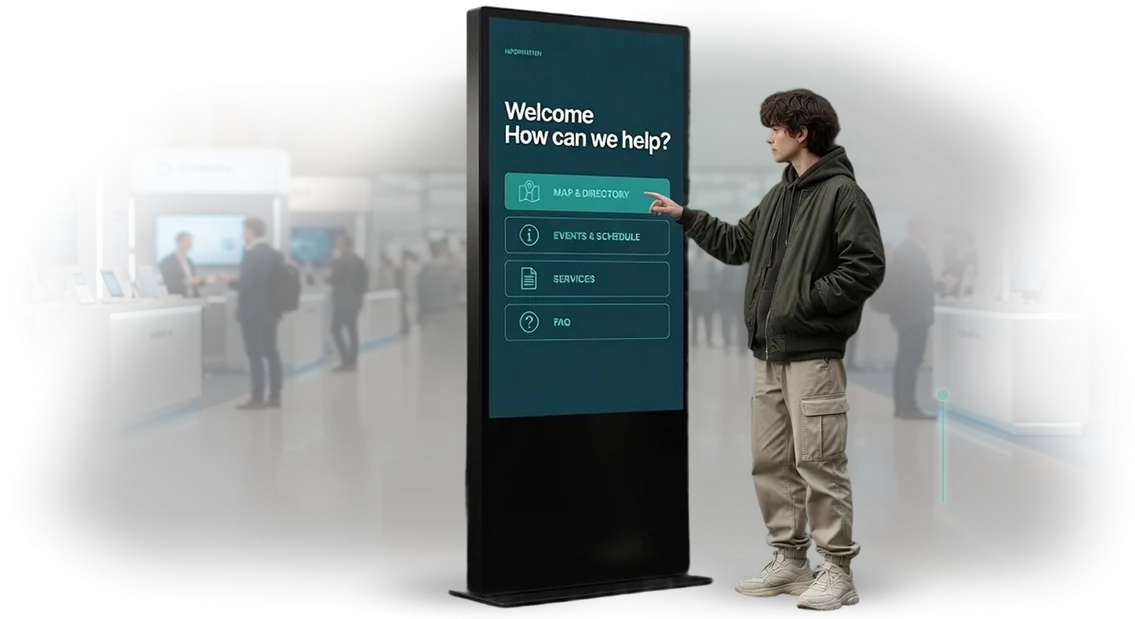
An interactive catalog in consulting changes the mechanics: the guest approaches the terminal on their own and explores services, case studies, and benefits at their own pace.
The terminal works for consultants without pauses, engaging the client in the process while the specialist becomes available. As a result, attention is held and interest does not fade — the person is already inside your product before the conversation begins.
When the consultant finally approaches, the client has already selected what truly interests them.
The dialogue starts with a specific request rather than a general "tell us what you do." This saves the specialist's time and increases the chance of closing a deal — because the client has already seen the value of your solution with their own eyes and asks precise questions.
For a consulting company, such a kiosk is a way to turn the booth into a source of quality inquiries rather than a place for handing out paper. It works all day without breaks, never gets tired, and engages every visitor equally.
An interactive catalog in consulting is a tool that helps avoid losing leads and turns interest into meetings and contracts.
What an Interactive Kiosk Gives Your Consulting Practice
Visitors to a consulting company arrive with a specific request — they need a service, an expert opinion, or an answer to an urgent question.
While they wait for a consultant in the lobby, the value of the meeting begins to fade: irritation sets in, a sense of wasted time, doubts about the partner's reliability. An interactive kiosk solves this problem — it turns waiting into a productive interaction with your brand.
The client gets instant access to the service catalog, descriptions of practice areas, and expert profiles — without phone calls or extra steps.
They choose the section they are interested in, explore case studies, and even leave a consultation request without waiting for a manager. This removes the first-contact barrier and shortens the path from interest to inquiry.
The very presence of a modern interactive terminal raises the company's status in the eyes of visitors. A tech-forward lobby shows that the business respects clients' time and keeps up with trends — this builds trust even before negotiations begin. Consulting sells expertise, and the kiosk becomes the first tangible proof of that expertise.
At the same time, the kiosk reduces the load on consultants: the system handles routine questions about pricing, engagement formats, and documents. Specialists spend their time only on the substantive part of the meeting rather than repeating basic information. This increases the efficiency of every employee and speeds up service for all clients in the queue.
As a result, you get three key benefits: fast access to services, a stronger company image, and freed-up team resources. The kiosk works for you around the clock, greets guests first, and helps them find their way even before they ask the consultant a question.
Interactive Kiosk Formats for Consulting Tasks
In consulting, an interactive kiosk handles various tasks: introducing services at an exhibition, scheduling office consultations, conducting visitor surveys, or showcasing company case studies. There is no one-size-fits-all solution — each task requires its own format.
We select the structure and scenario for your venue: from compact stands to full-size stationary terminals.
Conveniently, the format can be adapted to a specific event or location. An exhibition kiosk is lightweight, mobile, and eye-catching, while a stationary terminal in the waiting area runs all day without staff involvement.
In any version, we design a simple interface and clear sections so visitors can find what they need on their own and leave a request.
Main Formats for Consulting Tasks
| Format | Who It's For | What It Gives the Client |
|---|---|---|
| Compact stand | For exhibitions, forums, conferences | Quickly attracts attention, takes little space, easily set up at a rented venue |
| Stationary floor-standing terminal | For the office, reception area, meeting room | Works without staff: visitors explore services and leave requests at their convenience |
| Touch panel at the reception desk | For the lobby and waiting area | Reduces the administrator's workload, answers common questions, and shortens queues |
| Interactive table or presentation panel | For meetings with clients and partners | Clearly showcases portfolio and case studies, helps conduct negotiations without paper materials |
In every format, we build in a scenario for your business task: consultation, surveying, service catalog, or meeting scheduling. You get a tool that visitors understand from the first touch and that requires no staff training.
How Kiosk Development Works: Stages for the Client
We structure the process so you always know where the project stands and when the terminal will be ready. No "black boxes": every stage is coordinated with you, and implementation timelines are set in the plan before development begins.
- Brief and discovery — we discuss which services and products to showcase, who your audience is, and what a visitor should do at the kiosk. We define project goals and success criteria.
- Prototype and approval — we design the catalog structure, navigation scenarios, and visual style. You see how the screen will look before any code is written and make adjustments.
- Plan and timeline — we create a work schedule: stages, approval checkpoints, launch date. You get a clear plan with assigned responsibilities.
- Design and content — we develop the interface, craft wording for your services, and tailor the presentation to your brand. At every stage, details can be adjusted.
- Assembly and testing — we build the kiosk and connect it to your data: catalog, prices, promotions. We test visitor scenarios to eliminate failures on the first day of operation.
- Launch and training — we install the solution on the terminal, configure the hardware, and show your team how to manage content. We provide a brief instruction manual.
- Support and evolution — after launch, we stay in touch: updating information, adding new services, and refining functionality to meet business needs.
This sequence lets you see risks in advance, make timely adjustments, and receive the kiosk exactly on the agreed date. You stay in control of the process without diving into technical details.
What You Get After Launching an Interactive Catalog
After launching an interactive catalog, you get not just a device but a working tool that simplifies navigation through your services and reduces the load on consultants from day one.
We deliver the project turnkey: installation, configuration, interface design in your style, and staff training. Everything else — information updates, demand analysis, and technical support — keeps working through convenient tools that your employees can easily use.
Now, here is what is included in the delivery:
- A ready-to-use kiosk: assembled, configured, and tested. All you need to do is plug it in and place it in the lobby — it immediately displays your catalog and services.
- An interface that visitors understand without guidance: clients find the service they need in 10–15 seconds, so your staff are not distracted by repetitive questions.
- A content update system that requires no programmer: you change prices, descriptions, and promotions in a simple dashboard, and the changes appear on screen immediately.
- Partner access to content: practice area heads and marketing can independently add news items, export view statistics, and influence the catalog structure.
- Employee training: a personal session for your team, instructions, and short cheat sheets. Staff confidently start the kiosk, help guests, and know how to resolve minor issues.
- Technical support and maintenance: we monitor performance, update system components, and advise when a new content version is needed.
- Business analytics: you see which services are searched most often and which are overlooked. This helps adjust your offerings, menu, or advertising materials.
Case Study: How a Consulting Company Increased Service Inquiries
Consulting services are sold through trust and speed of response. If a client at an event or in the office has to wait for an answer to a simple question, they leave for competitors. We encountered this challenge at Prime Consult, a major player in the business consulting market.
Management noticed that at exhibitions and in meeting areas, managers spent 20–30 minutes presenting basic services, while visitors lost interest and left without submitting a request.
The client needed a way to explore the offerings independently and leave their contact details right away.
How We Solved the Problem
We developed an interactive kiosk with a service catalog. Instead of paper brochures — a convenient touch terminal where a client finds the right practice area in a couple of taps: audit, strategy, financial modeling.
After browsing, they can leave a request right on the screen or scan a code with their smartphone to have details sent by email.
Business Results
A month after launch, average consultation wait time was cut in half, and the number of inquiries from exhibitions and the office grew by 40%. The terminal freed managers from routine questions, and they shifted their focus to working with warm clients.
An additional effect was repeat inquiries: clients saved the catalog to their phones and returned when new needs arose.
The kiosk paid for itself within the first months of operation and is now used at all of the company's key events, from exhibitions to annual forums. Management noted that clients began arriving with more specific questions, making it easier for managers to qualify inquiries.
How to Choose the Right Interactive Kiosk Format for Your Task?
Choosing a kiosk format starts not with the equipment model but with a question: what exactly should a client do at your terminal?
In consulting, it is almost always either a quick selection of a service or specialist, a portfolio and case study demonstration, or consultation scheduling.
The answer to this question immediately narrows the options: a floor stand, a wall-mounted screen, or a compact tabletop terminal — these are all different interaction scenarios.
The next step is to assess the physical space and visitor flow. If a client walks into the office and needs a quick answer about who to approach, a compact kiosk at the reception desk will work well.
If it is an exhibition or a waiting area where people spend time, a floor-standing terminal with a large screen and a service catalog will be more effective. It is important to consider how many people will use the kiosk at the same time to avoid queues.
The third point is the specific requirements of your field. Consulting involves sensitive data and complex terminology, so it is important to plan the navigation structure: a client should find a service in 15–20 seconds without reading long texts.
Additionally, decide in advance whether the kiosk will be integrated with your CRM or knowledge base so visitors get up-to-date information and can leave a request right from the screen.
Once these questions are clarified, the format choice becomes obvious. We help clients go from task to working solution: we analyze your clients' scenarios, propose the right configuration, and tailor the catalog logic to the specifics of consulting.
The key is for the kiosk to blend naturally into your office or event rather than look like a foreign element.
Frequently Asked Questions About Kiosk Implementation and Warranties
Clients considering an interactive kiosk always have three main concerns: hardware reliability, content updates, and behavior during failures. We address them in advance so you can see what guarantees come with the finished solution. All terms are documented in the contract: response times, responsibilities, and support procedures.
What does the kiosk warranty cover and for how long?
We use professional equipment designed for public spaces. The warranty on hardware and software is 12 months and includes repair and replacement of components in case of manufacturing defects.
If a malfunction arises due to our fault, we resolve it within 2–3 business days at no additional charge.
How do we update the catalog and prices without a developer?
There is an admin panel for this: an employee can change prices, photos, and promotions themselves. We configure access for the required role, and training takes no more than an hour. No code — just simple forms in a browser.
What happens if the terminal breaks down or the internet goes offline?
The kiosk continues to work autonomously, and the catalog and information remain accessible. In an unusual situation, the system notifies you and our support team. In most cases, we restore operation remotely, and if an on-site visit is required, we arrive as soon as possible.
Let's Discuss an Interactive Kiosk for Your Consulting Project?
For a consulting company, an interactive kiosk is a way to turn a visitor into an engaged client.
While the guest explores the service catalog and benefits on their own, your experts are not distracted by standard questions — they work with those who have already decided to reach out.
We design and develop kiosks tailored to the specifics of your business: catalog structure, navigation scenarios, presentation format — all of this shapes how visitors perceive your company.
Over 10+ years, we have implemented dozens of similar projects and know how to make a kiosk genuinely useful and easy for users.
Order kiosk development from our agency and you will get a ready-made solution that works toward your results. What the offer includes:
- Consultation: we discuss your project and recommend the right interactive kiosk format.
- Cost calculated after audit — transparent, without pushing unnecessary options.
- We prepare a project timeline with clear deadlines for each stage — from concept to launch.
- We help populate the products and services catalog so the information is current and compelling.
- We handle technical support and content updates after launch.
- On request — usage analytics: how many visitors used the kiosk and which sections are most in demand.
Submit a request for kiosk development and we will prepare a cost estimate, propose a convenient format, and set implementation timelines. Start with a consultation: tell us about your goals, and we will recommend the right solution.