

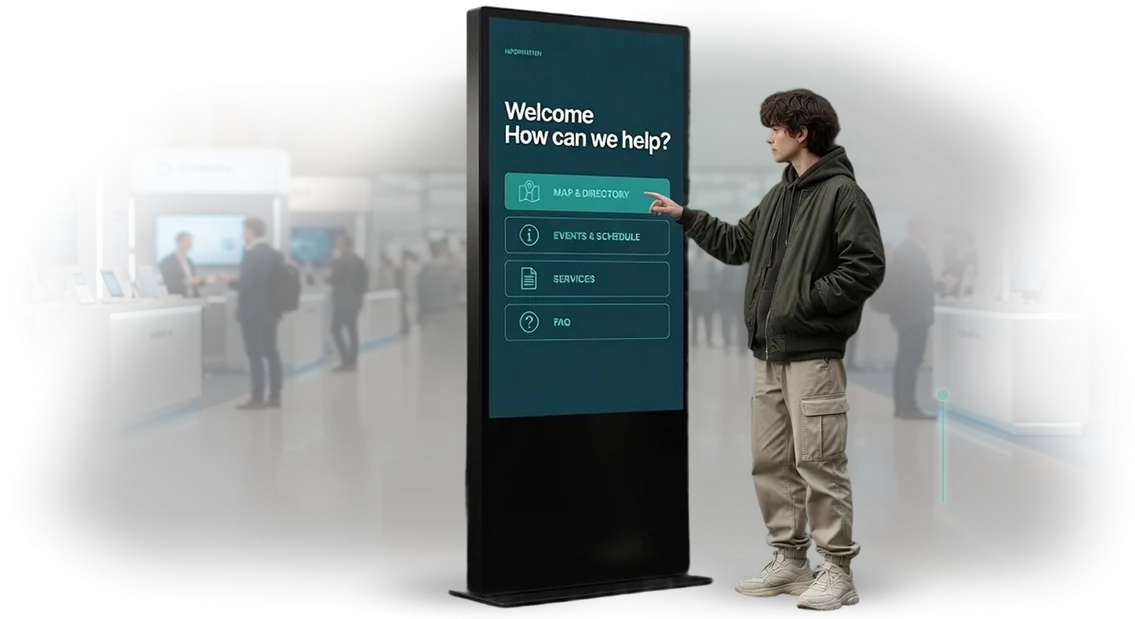
Why laboratory diagnostics need interactive kiosks
Laboratory diagnostics is a flow of people, waiting, and tension. Visitors come with a specific request: to quickly get tests done and receive a clear result.
But without navigation, every visit turns into a series of questions to the administrator, queues at the registration desk, and lost minutes. For the patient, it's stress; for the laboratory, it's overloaded staff and lost loyalty.
Interactive kiosks solve this problem where ordinary announcements and paper signs are powerless. Terminals for laboratories take over the routine: they help choose a service, complete a referral, find the right room, and check the status of readiness.
Information kiosks work around the clock, never get tired, and respond instantly — the queue stops being the main "impression" of the visit.
A modern information terminal is not just a screen with a menu, but a full-fledged digital catalog of laboratory services. The patient sees the list of tests, turnaround times, and preparation costs — without administrator involvement.
As a result, staff handle truly complex questions instead of repeating the same information hundreds of times a day.
For laboratory management, such a kiosk is a way to increase throughput without expanding staff. People orient faster, are less often late for their doctor, and are less irritated by waiting.
The laboratory itself looks like a modern, client-focused center — this works for reputation and patient return.
We've been creating such solutions for over 10 years and know the specifics of your industry. Professional equipment, refined scenarios, and attention to detail deliver results that are visible from day one: fewer queues, more satisfied patients, higher work efficiency.
Contact us — we'll show you how interactive kiosks fit into your process and what exactly they will give your laboratory.
Three groups of benefits for a network of laboratory offices
A terminal with an interactive catalog of products and services for laboratory diagnostics solves three tasks at once: speeds up office work, improves service quality, and reduces the load on administrators.
For an office network, this means a measurable result — fewer queues, higher patient satisfaction, and more rational use of staff working time. This is not just a screen with a list of services, but a tool that pays for itself through increased throughput and client loyalty.
First group of benefits — speed
Instead of a queue to the administrator, the patient finds the needed test in the catalog themselves: services are structured by category, with cost and preparation conditions visible at each step.
Reduced queues are especially noticeable during peak hours — people spend less time waiting, and staff don't have to repeat the same information several times.
The terminal takes over routine questions and helps patients reach the procedure room faster, increasing each office's throughput.
Second group of benefits — service
Patients value autonomy: they can calmly browse the catalog, compare test options, and immediately see the final cost.
A well-designed interface makes the visit comfortable, without haste or a feeling of "being rushed." This directly raises patient satisfaction — they remember care and convenience, not queues and confusion.
In addition, the interactive kiosk adds a modern image to the laboratory, which pleasantly distinguishes the office network among competitors.
Third group of benefits — efficient administrator workload
When administrators don't have to explain to every patient what tests exist and how to prepare for them, they gain time for processing referrals, working on insurance cases, and solving truly complex questions. This redistributed focus saves administrator time throughout the day.
At the same time, the terminal's uninterrupted operation and fine-tuned software guarantee stability: our kiosks don't freeze or glitch even at maximum patient flow, so the office doesn't lose time to technical downtime.
Interactive catalog formats for laboratory diagnostics
Laboratory visitors need to quickly find their bearings: what tests to take, how to prepare, how long it will take.
A single interactive catalog format doesn't cover all tasks — some need a reference kiosk in the lobby, some need a self-booking terminal, and some need a mobile option at the administrator's desk.
Let's break down the main delivery formats of the interactive catalog and which task each one suits.
We supply the catalog in three main formats that can be combined with each other. Below is a summary table: which option to choose to solve a specific task.
| Format | Who it's for | What it gives the client |
|---|---|---|
| Lobby kiosk | Patients waiting for an appointment or who have already had tests done | Reduces the administrator's workload: the patient independently finds information about tests, turnaround times, and preparation rules |
| Self-booking terminal | Patients who want to book without a queue | Increases the number of bookings and reduces waiting time; works around the clock without staff involvement |
| Touchscreen reference guide | Registration desk and call-center staff | Quick search for services and prices, up-to-date data across all laboratory locations |
All formats run on professional equipment with a protected screen and are adapted for everyday use in a busy lobby.
The client gets not a static booklet, but a living system: when prices change or new tests are added, content updates centrally, without manually reconfiguring each kiosk.
How a kiosk is developed: from brief to launch
Developing an interactive kiosk for laboratory diagnostics is not a "black box." We build a transparent process where you understand at every stage what's happening, what decisions are being made, and when the result will appear.
From the initial brief to the terminal launch usually takes several weeks — depending on the size of the catalog and the number of services.
- Brief and immersion in the task. We study your laboratory, audience, and service list. We define the main visitor scenarios: booking tests, viewing prices, getting results, or consultations.
- Technical specification and prototype. We lock down the catalog structure, navigation scenarios, and design mockup. You approve how the terminal will look and work before development starts.
- Design and development. We create an interface in your brand style, fill the catalog with products and services, and connect the required internal laboratory systems.
- Testing and debugging. We check the kiosk against real scenarios: search usability, response speed, correctness of displayed data. We fix any flaws before the terminal reaches visitors.
- Pilot launch. We install the kiosk in the lobby, observe live usage, and collect feedback from administrators and first visitors. At this stage, we make final adjustments without extra costs.
- Launch and support. We train staff, hand over clear instructions, and stay in touch. Support continues after launch: we update the catalog, monitor stability, and add new features when needed.
This approach reduces risks: you see in advance how the kiosk will fit into the laboratory's processes, rather than getting a "surprise" after launch. The result is a working tool that helps visitors quickly navigate services and relieves staff of repetitive questions.
What's included in the interactive terminal delivery
When you order an interactive terminal from us, you get not a device, but a ready-to-use working tool for your laboratory. We take care of everything: from the enclosure and screen to the interface design and catalog content.
The result is a system that helps patients quickly find the tests they need, and your administrators — to be distracted less often by repetitive questions.
The standard delivery package includes:
- an interactive terminal with a touchscreen protected against wear and designed for 24/7 operation;
- software with a clear structure: main menu, search by test name, sections on test preparation;
- interface design in the laboratory's brand style — with your logo, colors, and fonts;
- a catalog of products and services structured by diagnostics areas, with prices and descriptions;
- an administration system that lets you edit prices, add new tests and promotions yourself, without a programmer;
- technical support and warranty service, including remote software updates;
- staff training on the terminal and instructions for quickly replacing consumables.
Each item in the package addresses a specific task: the patient spends less time in line for a consultation, and your staff handle only the questions that genuinely require human involvement.
Updating the catalog takes your manager just a few minutes: changes are made through a simple interface and appear on the terminal screen immediately.
You don't need to wait for developers or figure out complicated settings — the whole system is fine-tuned and works right after installation.
Case study: interactive catalog for a laboratory network
For the Gemotest laboratory network, we developed an interactive catalog that replaced paper booklets in the waiting area.
Previously, patients and clinic representatives spent up to 10 minutes finding the right test in a printout — and often asked administrators the same question. The task was simple: build a catalog that works without staff involvement and reduces service selection time.
We built the catalog on a touchscreen terminal where the patient selects what's bothering them, and the system suggests suitable tests and explains preparation. Implementation took three weeks, including migrating basic information on 400 services and setting up clear navigation. Within a month, it was clear how the catalog was relieving the registration desk.
Result for the laboratory
On average, a visitor spends 2 minutes at the terminal; during that time the catalog helps them choose a test or book an appointment. Hotline inquiries dropped by 30% because patients find answers themselves.
The share of visitors who take a test right after using the terminal rose by 15%. The client reordered the catalog for three new branches — that's a sign of trust, not just a report.
Client feedback
The network's director noted: "The terminal freed administrators from repetitive explanations, and patients feel more confident.
We got a tool that people of any age understand and that requires no training." For us, this is also confirmation: a kiosk pays off when it solves a business problem, not just stands in the corner as a tech novelty.
How to choose a kiosk format for a specific laboratory?
Choosing a kiosk format always starts not with a "beautiful enclosure," but with the question: what exactly should laboratory visitors do at the terminal?
If the main goal is to reduce the queue at the reception desk and speed up booking, the best choice is a stationary floor-standing kiosk with a large touchscreen and a convenient virtual keyboard.
If the laboratory is small and simply wants to relieve the administrator of typical questions, a compact wall-mounted or desktop terminal is enough — it takes up minimal space and fits easily into the waiting area.
It's important to consider the specifics of diagnostics: patients of different ages and levels of digital literacy come to the laboratory. That's why the interface for choosing tests or receiving results must be extremely simple, with large buttons and prompts at every step.
For children's clinics or centers where patients are often taking tests for the first time, a kiosk with on-screen guidance and the ability to print a referral works best.
If the laboratory operates in a "rapid testing" format — for example, at an airport or a large shopping center — high data-entry speed and contactless payment become the priority.
The next criterion is load and peak hours. In large laboratories with a steady flow of visitors, it makes sense to install two or three kiosks in different formats: one for booking and registration, another for issuing results and informing about test readiness.
This distributes traffic and avoids queues even in the morning hours. Also assess the physical parameters of the space: distance to power outlets, availability of a free wall, corridor width.
For narrow spaces, a wall-mounted option with a pivoting screen is the better choice — it doesn't block passage and remains accessible to patients in wheelchairs.
Don't forget integration with the laboratory's internal systems. The kiosk should be able to pull up the current list of tests, prices, and turnaround times — this saves administrators from manually updating data.
Our experience shows that a properly chosen format reduces the time a patient spends in the laboratory by 30–40% and lowers staff workload.
That's why, before choosing, we visit the site, study visitor flows, and propose a specific configuration — with calculations for space, number of terminals, and usage scenarios. That way, you get a solution that works precisely for your tasks.
Frequently asked questions about interactive catalogs and terminals
Before ordering an interactive catalog for laboratory diagnostics, several practical questions usually come up: who is responsible for the terminal's operation, how quickly problems are resolved, and what will happen to the equipment after a year. We answer the main ones so you understand what you get with the kiosk.
What does the kiosk warranty cover?
The warranty covers the equipment and the software part of the catalog for the entire term of the contract. If the terminal fails due to our fault, we repair or replace it free of charge — you don't need to find a contractor or sort out the details.
Who services the terminals and how quickly?
We handle maintenance ourselves: remote monitoring and scheduled checks let us spot failures before they affect visitors. In an emergency, you contact us — we respond within one business day and resolve the issue.
What if the equipment breaks down?
The kiosk runs on professional equipment selected for 24/7 load, so breakdowns are rare. If it does happen, you simply let us know — we then take over diagnostics and recovery, and if the repair takes long, we provide a replacement terminal.
Can the equipment be replaced with new one?
Yes. At the end of its service life or when your tasks change, we'll offer a current kiosk model with an updated interface. You get a working system without needing to find a supplier and arrange integration yourself.
How is the catalog configured?
We customize the catalog structure to match your services and price list: sections, search, test descriptions, contacts. At launch, you get a ready-to-use interface, and when your service list changes, we update the content based on your request.
We address these questions at the contract stage so that after the kiosk launches, you focus on your core work, not on technology. Leave a request — we'll tell you how the terminal will fit into your laboratory and what will be included in maintenance.Get a project estimate for your office's needs
An interactive catalog in laboratory diagnostics is not just a terminal with service descriptions, but a working tool that reduces the queue at the registration desk and helps patients find the right test faster.
But for it to truly solve your tasks rather than become an expensive stand, it's important to calculate the project in advance based on your office's specifics: counter location, service list, visitor flow, and data update procedure.
Leave a request for an estimate — we'll discuss your laboratory's needs and propose a solution that fits into current processes. Based on the brief, we'll prepare a commercial proposal with a clear budget and realistic timelines.
You'll know in advance what you'll get, what you're paying for, and how quickly the catalog will go live.
What you get after submitting a request:
- A project estimate tailored to your office's tasks — not a template solution, but a catalog structure that accounts for the specifics of laboratory diagnostics.
- An expert consultation: we'll explain how the interactive kiosk fits into the service flow and what stages its launch requires.
- A transparent commercial proposal broken down by stages and implementation timelines — no hidden work or unexpected surcharges.
- Content recommendations: which services to feature on the first screen and how to group tests so visitors find what they need in a couple of touches.
- Help with launch and staff training — your employees will understand how to manage the catalog without bringing in a contractor.
- Post-implementation support: we'll help update information and add new services as the laboratory grows.
We work remotely, so your city doesn't matter — we'll start right after approval. Leave a request for an estimate, and we'll get back to you with a concrete action plan within one business day.