

Why Booth Visitors Leave Without a Contact and How to Fix It
Visitors to machine-building exhibitions are busy people. In a single day, they pass dozens of exhibits, and each one has only a few minutes to learn about your products.
If a visitor does not understand what exactly you can offer in that time, they nod politely, take a brochure, and leave — and a potential order leaves with them.
A paper catalog does not solve this problem. It is difficult to quickly find the right item, especially when the product line is broad: visitors have to flip through dozens of pages, search for technical specifications, and match them to their own task.
Next to your booth, competitors have the needed information at hand faster. As a result, the visitor chooses the company that respects their time.
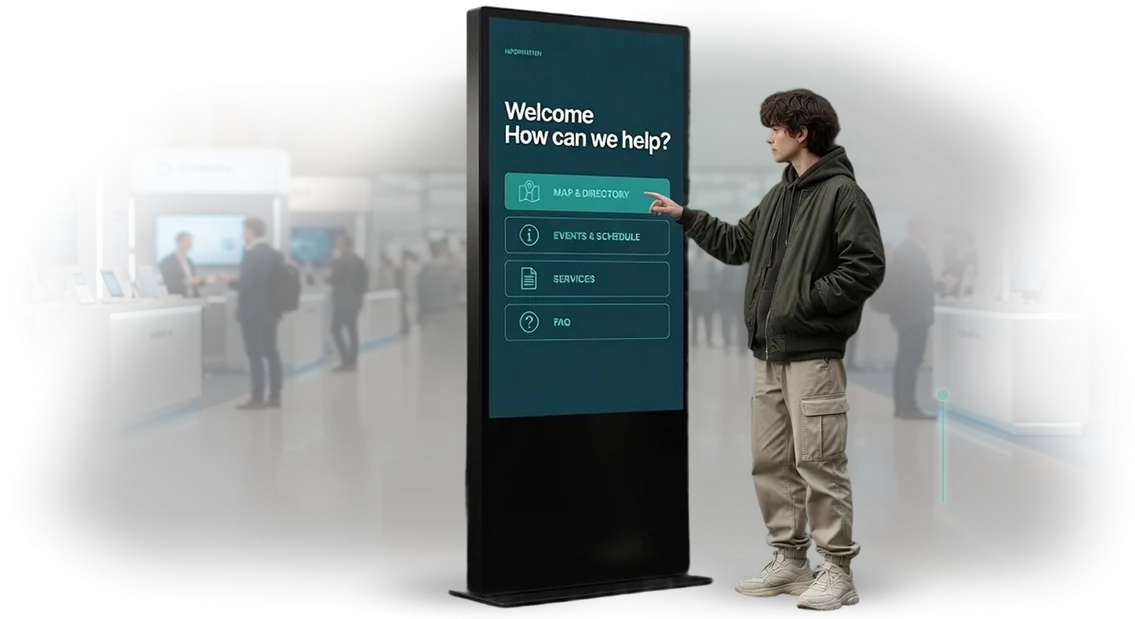
An interactive product catalog on a terminal changes this scenario. Instead of passively flipping through pages, the guest sets the parameters themselves — machine type, power, application area — and sees relevant items in a minute.
Key characteristics are shown on screen, the visitor does not waste time searching for answers and does not leave empty-handed. And most importantly, the catalog terminal records exactly who was interested in the products and turns an anonymous crowd into a list of warm contacts.
Losing leads at an exhibition stops being inevitable when the visitor’s attention is held by interactivity and their contact information is collected on the spot.
We solve this task turnkey: we design the catalog scenario, select reliable equipment, and launch the system before the exhibition starts. After the event, you receive not a pile of dismantled brochures, but a clear list of people who are genuinely interested in your products.
What an Interactive Catalog Terminal Gives You in Machine Building
An exhibition visitor does not want to wait — they need a specific machine, component, or service, not a story “about the plant in general.” A regular booth with brochures forces guests to wait for a consultant and lose interest, while a manager answers the same questions and misses visitors who are already ready to leave a request.
An interactive catalog for machine building solves this problem on the move: the guest finds the item themselves, and the brand looks modern.
We have already brought such solutions to industry exhibitions and know how to turn a terminal into a source of leads, not just a “screen with pictures.”
The Visitor Finds What They Need in Seconds
In machine building, the assortment is hundreds of items: from fasteners to machines and components. Nobody wants to flip through a paper price list or wait for a manager, especially when dozens of guests pass through the booth in a day.
A terminal with an interactive catalog lets the visitor choose a category, filter by characteristics, and immediately view the needed item — without staff involvement.
This way, the guest gets an answer while their interest is still hot. And the manager does not spend time repeating the basics — instead, they join the conversation already on the merits: discussing price, deadlines, or a custom solution.
The Manager Gets a Contact, Not Just a “Someone Looked”
A catalog by itself is convenient, but the main value for business is that a guest’s request becomes a tangible trail. The guest sends a request or leaves a contact at the terminal: what they searched for, in what quantity, and by what deadline.
After the exhibition, the manager receives a ready database of interested people with the context of each request.
This means exhibition leads are not lost in business cards and notepads. A follow-up call after the event becomes personalized: you know that the person needs a hydraulic unit or a metalworking service, and you offer exactly that.
The Brand Looks Modern and Technologically Advanced
A terminal at the booth is a signal to the visitor: the company keeps pace with digitalization, has streamlined processes, and has something to show. Such a tool works for the company’s image no worse than a bright booth because it demonstrates real convenience, not promises.
The guest remembers the brand that was easy to interact with and is more willing to return after the exhibition.
An interactive catalog terminal in machine building is a quiet presentation of your expertise.
It tells the story of your product range breadth and service level better than a dozen brochures, and it works for you even in the minutes when managers are busy talking to other visitors.
An Investment in Repeat Orders
After the event, the terminal can be used in a showroom, at the factory, or in a sales office — the catalog does not become outdated but continues to collect requests.
The result of one investment works across multiple platforms: at the exhibition and in a permanent point of customer contact.
Interactive Kiosk Formats for Your Specific Needs
In machine building, products are chosen by characteristics, configuration, and delivery times — and most often after personal contact with a manager.
An interactive kiosk removes this load: a showroom or exhibition visitor finds the right product themselves, compares models, and leaves a request, while your staff only handles ready inquiries.
The terminal format directly affects how guests interact with the catalog. We select the enclosure to match your space and task: a stationary stand for permanent operation, a mobile terminal for off-site events, or a wall-mounted panel for compact areas.
Each option is configured for your product range and updated remotely — without calling an engineer.
| Format | Who it is for | What it gives the customer |
|---|---|---|
| Stationary stand | Showrooms, factory reception areas, dealer centers | Visitors independently explore the catalog and prices, managers are not distracted by routine questions — higher inquiry processing speed |
| Wall-mounted panel | Narrow aisles, small showrooms, meeting rooms | Saves space, works as a product display with current materials, available without staff involvement |
| Mobile terminal | Exhibitions, conferences, off-site presentations | The full catalog is always with you: easy to transport, set up in minutes, and collect requests anywhere |
| Showroom catalog | Companies with a large number of items and complex products | Replaces paper catalogs and price lists: search by parameters, model comparison, visual product demonstration |
If you are not sure which format suits your production, send us your floor plan and describe the usage scenario. We will propose the option with the best return on investment and prepare a catalog that your own staff can easily maintain.
How We Develop an Interactive Kiosk: Project Stages
Developing an interactive kiosk for a machine-building enterprise is a process in which you remain the main decision-maker. We do not disappear “into ourselves” for several weeks: we agree on every stage with you, show interim results, and take your edits into account. This way, you understand what you are paying for and get exactly the tool your customers need.
- Brief and task analysis. We determine which products and services should be in the catalog, who the main audience of the terminal is, and which usage scenarios matter — from quick search by article number to comparison of characteristics.
- Prototype and layout approval. We prepare the screen structure, navigation logic, and visual solutions. You review the mock-up, make edits, and we approve the final version before assembly begins.
- Assembly and content filling. We load your catalog, specifications, photos, and descriptions. We fill the system so that a visitor finds what they need in a couple of taps, and you can easily change information in the future.
- Configuration and testing. We check scenarios: search, filters, card views, and data accuracy. We make sure the kiosk works reliably under prolonged use and does not require constant intervention.
- Kiosk launch. We install the equipment at the site, connect it to power and network, and configure it for your space. Our specialists train your staff on how to use the terminal and quickly resolve simple issues.
- Project support. After launch, we stay in touch: we update the catalog, make design changes, and help with refinements. If necessary, we expand functionality — adding new sections or integrations.
Thanks to such a transparent process, you get a predictable result within the agreed timeframe. You always know what stage the project is at and can influence it before the final version.
What Is Included in the Interactive Kiosk Delivery
You receive not “hardware” and software separately, but a ready-made sales tool that works from day one.
Everything needed to launch an interactive catalog in machine building is assembled by us into one package and handed over to the customer turnkey: from the enclosure to content and service.
- Enclosure and touch panel — a durable enclosure resistant to dust, vibration, and temperature changes in the workshop. The customer receives equipment that does not fail in continuous operation.
- Catalog software — an interactive system in which a visitor quickly finds the right item: by category, characteristics, or application. No complex settings and no unnecessary on-screen actions.
- Content for your product range — we fill the catalog with your nomenclature: descriptions, specifications, photos, and 3D models. You get material that sells, not just lists items.
- Catalog management panel — your staff can update prices, availability, and add items themselves. No need to call a contractor for every edit.
- Instructions and training — a short reference guide and a consultation for staff: how to turn on the kiosk, change content, and resolve simple issues. Minimum time to learn.
- Installation and launch — we deliver, install, configure, and check operation at your site. You accept the kiosk already working.
- Warranty and support — an official warranty on the equipment and software, plus support on request. If something needs attention, we are in touch — the customer is never left alone with the technology.
Case Study: A Plant Increased Conversion to Inquiries After Implementing a Kiosk
At one industrial equipment exhibition, a machine-building plant called GidroTech — a manufacturer of pumps and hydraulic systems — came to us.
At previous exhibitions, they used a paper catalog: managers manually searched for the right item, answered the same questions, and visitors quickly lost interest and went to competitors. The plant set the task — to hold visitors’ attention at the booth and turn visitors into inquiries.
We proposed an interactive catalog on a touch kiosk: guests choose the type of product, see specifications, photos, and compare models. The manager gets involved only when the visitor has already made a decision — this reduces the load and speeds up the dialogue.
This format gave the plant two immediate results: the booth became a center of attraction, and every contact became warmer.
| Metric | Before kiosk | After kiosk |
|---|---|---|
| Average time at the booth | 2–3 minutes | 12–15 minutes |
| Requests per exhibition day | 15–20 | 45–60 |
| Catalog items viewed per day | 50–70 | 300–400 |
| Share of repeat inquiries after the exhibition | 10% | 34% |
Time at the booth increased fourfold — visitors explored the products independently, and managers managed to process more contacts. In three days of the exhibition, the plant collected almost three times more inquiries than with the previous paper catalog.
The head of the sales department noted that the difference was visible before the end of the shift: the queue at the kiosk did not dissipate, and consultations became substantive.
A month after the exhibition, the plant ordered a second kiosk for its permanent showroom display. Since then, the interactive catalog has become part of their exhibition booth at all trade events.
For us, the main takeaway from this case is that a simple tool, from the customer’s point of view, delivered measurable growth in inquiries — and that is exactly the goal of any exhibition participation.
How to Choose an Interactive Catalog Terminal for Machine Building?
Choosing an interactive catalog for a machine-building enterprise starts not with the screen, but with the task. An exhibition needs one format, a showroom needs another, and a permanent display needs a third.
A mistake at this stage leads to overpaying: the kiosk either gathers dust in the corner or fails to handle the flow of visitors.
At an exhibition, the catalog operates at maximum load: hundreds of engineers and buyers visit the booth, and each has a couple of minutes. The terminal must respond instantly, lead to the right product in one or two taps, and work without failures all day.
This format solves the reach problem — the visitor leaves with an understanding of the assortment and leaves contacts for the sales department.
In a showroom, visitors approach the catalog thoughtfully, often together with a manager and technical requirements. Here, attention to detail is valued: a three-dimensional presentation of products, model comparison, and saving selection history.
The kiosk becomes a second salesperson — it helps answer typical questions while the manager discusses delivery terms.
A permanent display in a lobby or waiting area operates autonomously, without accompanying staff. Simplicity of the interface, protection against accidental touches, and the ability to update content without a programmer come to the fore.
Such a catalog is often connected to a request accounting system: the guest leaves contacts themselves, and the manager gets a ready-made customer.
We help choose the format before development begins — we analyze the scenario, the number of visitors, and the business objectives. You receive not a “kiosk for the sake of a kiosk,” but a tool that pays off through inquiries, manager time savings, and company recognition.
Frequently Asked Questions and Concerns Before Ordering a Kiosk
Before ordering an interactive kiosk for a machine-building enterprise, customers most often ask about the same things: will it break, how long will it take, how to update the catalog, and what it really costs.
We have been making kiosks for industry for more than 10 years, so we answer these questions directly.
What guarantee is there that the kiosk will not fail in a workshop or at an exhibition?
The kiosk operates in an industrial environment: dust, vibration, and temperature changes. That is why we use professional enclosures and components designed for intensive use.
We provide an official warranty on the equipment and software, and in case of failure, we handle repair or replacement ourselves. Additionally, remote monitoring can be set up — you learn about a problem before it stops operation.
How long does it take to develop and launch a kiosk?
A standard interactive catalog with a design tailored to your brand and a management panel takes 2–4 weeks. If you need to connect the enterprise accounting system, the timeframe increases, but after the brief you receive a precise plan with dates.
The first kiosk launches as soon as a month after layout approval — that is enough time to time the launch to an exhibition or the opening of a new showroom.
How difficult is it to update the product catalog?
Updating does not require a programmer. The customer receives a clear administrative panel: you upload a new drawing, change specifications or a price, and the kiosk immediately shows the updated version.
It is enough to train one employee, and the catalog continues to be maintained without your involvement. This is especially important in machine building, where the product range changes regularly.
What does the cost of an interactive kiosk consist of?
The cost depends on the screen size, enclosure, design, and complexity of the software part. After the brief, we provide a transparent estimate: what is included in equipment, development, installation, and launch.
No hidden fees — you pay for a ready, working kiosk, not for separate “parts” and “assembly” during the project. And if the budget is limited, we will select a solution that covers the main tasks: catalog display, search, and inquiry submission.
If you still have a question, send us a brief and we will tell you how much it will cost and when your kiosk will be up and running.Order the Development of an Interactive Kiosk with a Product Catalog
A product catalog in an interactive kiosk is a way to quickly show all your assortment to booth visitors without overloading managers.
In machine building, the nomenclature often runs into hundreds of items, and the customer needs specific parameters — convenient search and filters help them find what they need in minutes without taking negotiations to competitors.
We develop the kiosk turnkey: from catalog structure and design to data loading and launch. Tell us about your task — we will advise which format suits your booth or showroom and offer realistic timelines.
By ordering a product catalog development from us, you get:
- Development of an interactive kiosk tailored to your nomenclature and customer scenarios.
- Design that fits the style of your booth and brand, not a “box with a screen.”
- Quick search by article numbers, specifications, and categories — the visitor does not need to flip through dozens of screens.
- Integration with your databases or simple file upload — assortment updates without a programmer.
- Testing before the event and on-site support — the kiosk will work when it matters.
- Transfer of all materials and training for your team — you are not dependent on us after launch.
Leave a request for a terminal — it will take a couple of minutes. We will discuss the details, answer questions, and prepare a solution for your booth or showroom. Ordering an interactive kiosk is simple, and you will see the result at the very next exhibition.