

Customers are going online while you lose furniture sales?
Furniture buyers are increasingly starting their search online: comparing prices, viewing photos, and reading reviews. When they arrive at a furniture showroom, they expect to quickly find the product they need, see all the options, and get answers to their questions.
But if the store lacks a convenient catalog navigator, the visitor gets lost among the samples, waits for a consultant, and eventually leaves with the thought, “I’ll look online some more.” This is the classic customer loss in furniture retail—and a direct loss of in-store sales.
This scenario repeats every day, and every missed purchase is not only lost revenue but also a blow to the showroom’s reputation.
What makes it especially frustrating is when the customer is already ready to buy: they came for a specific sofa or kitchen set, but can’t quickly confirm that the item is in stock, how it looks in other colors, or what alternatives are available.
Instead, they spend time waiting, while part of the assortment goes unnoticed—for example, warehouse items that aren’t displayed on the floor. That’s how in-store sales decline even with good foot traffic, and marketing investments in attracting customers fail to pay off.
A customer who doesn’t find the information they need in the store will likely order furniture from a competitor—often at a more attractive price, because it’s easy to compare offers online.
As a result, the showroom loses not only the current sale but also future purchases: the customer remembers the inconvenience and goes straight online next time.
This is how once-loyal customers gradually drift away from furniture retail, turning the store into a showroom with rising costs and falling revenue.
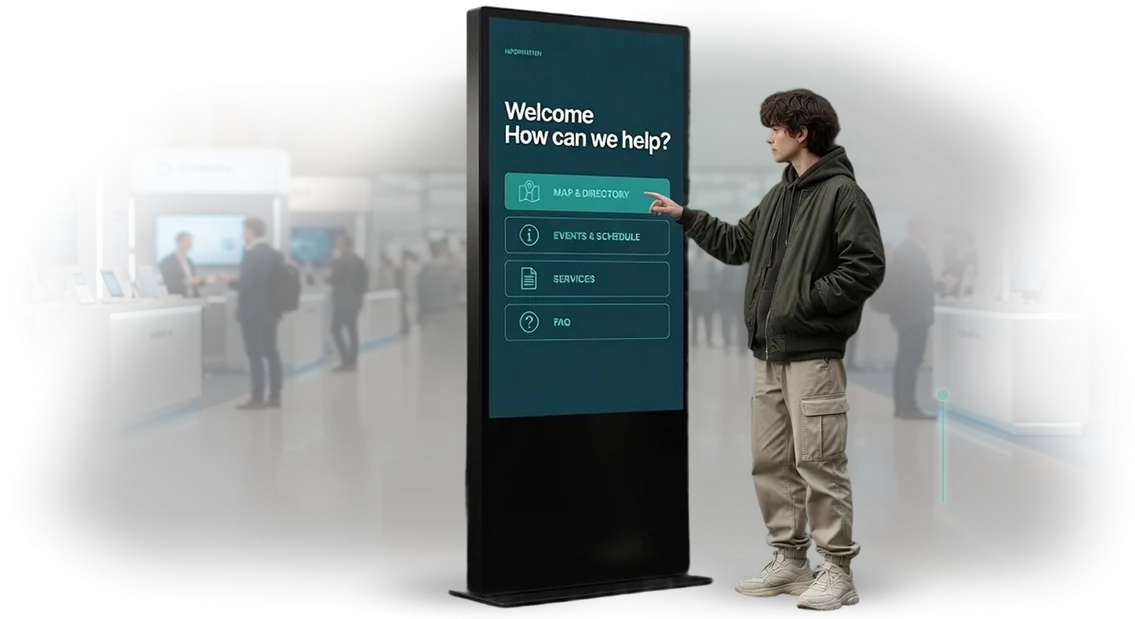
An interactive kiosk solves this problem: the customer independently opens the full catalog, filters products by parameters, sees availability and prices, and calls a consultant when needed.
This puts control back into the shopping process and turns the store visit into a clear, fast path to purchase. We help furniture showrooms close the gap between online expectations and offline reality, retaining customers and increasing in-store sales.
What does an interactive catalog give a furniture showroom?
In a furniture showroom, customers often get lost among the samples, while managers waste time repeating product specifications.
An interactive catalog changes this dynamic: visitors explore the assortment on their own, compare models, and approach a staff member with a concrete question.
The company our team, with ten years of experience, implements such solutions for retail chains and individual showrooms—simply, without restructuring processes.
| Benefit | What it gives the showroom |
|---|---|
| Increased reach | The catalog works both in the showroom and on an outdoor screen—more people learn about the showroom and its assortment. |
| Brand recognition | Brand identity, logo, and polished visualizations are remembered better than paper brochures and price tags. |
| Qualified leads | Customers leave their contact only after they’ve chosen a model—so managers don’t have to process random requests. |
| Staff time savings | Employees answer substantive questions instead of reciting the catalog. Freed-up hours go toward working with warm customers and closing deals. |
The interactive catalog doesn’t replace live communication—it enhances it. While a manager is busy with one customer, another visitor independently explores the collection, reviews sizes and materials. This way, the showroom doesn’t lose a single visitor, even during peak hours.
Data on which models were viewed most often helps replenish the assortment according to real demand rather than intuition.
The catalog is easy to update—whether you’ve brought in a new collection, changed prices, or added a promotion, it all appears on the screens within a couple of hours. For the owner, the result is a steady flow of interested buyers and predictable manager workloads.
If you want the same tool for your showroom, we’ll discuss the task and prepare a proposal with clear timelines and scope of work.
Interactive kiosk formats for furniture retail
In a furniture store, customers rarely arrive with a ready-made decision: they need to see options, compare fabrics, facades, and sizes. An interactive kiosk lets them do this without a salesperson, but it’s important to choose the right format—stationary, touchscreen, or mobile.
This determines how quickly a customer can find the right product and how much time a consultant can devote to other guests.
Let’s look at the three main kiosk formats we install in furniture showrooms. Each solves its own task, and together they cover the entire customer journey: from the display window to order placement.
Comparison of formats
| Format | Who it’s for | What it gives the store |
|---|---|---|
| Stationary terminal | Stores with a large assortment and limited floor space | Customers find products by parameters and see availability—less load on consultants and more time for the guest to choose |
| Touchscreen kiosk for furniture | Showrooms that need to display configurations and fabric options | Visual demonstration of all options—the customer stays in the store longer and more often places an order on the spot |
| Mobile kiosk | Occasional exhibitions, sales, and new store openings | Quick deployment anywhere: the catalog works without being tied to a stationary stand, and you can serve customers right in the showroom |
It’s important to understand: the format shouldn’t “chase” the task—rather, selection starts with where and how the customer interacts with the product.
A stationary terminal works well in high-traffic areas, a touchscreen kiosk is great next to fabric and facade samples, and a mobile kiosk is convenient where there’s no way to install a stand.
We’ll help you choose a configuration tailored to your showroom and assortment so the kiosk starts paying off from the first days. Just send us your floor plan and a list of categories—we’ll prepare a proposal within one business day.
How we launch a kiosk: 6 steps from brief to installation
We support you at every stage of kiosk development—from the initial brief to installation on the sales floor. You don’t need to understand the technology: the process is refined, every step is agreed upon, and timelines and responsibilities are clear in advance.
That’s why launching an interactive kiosk goes smoothly, without surprises and without interrupting trade.
- Kiosk brief. We discuss which products will go into the catalog, how visitors will search for furniture, and what tasks you need to solve. The format is simple—we ask questions and listen, no technical routine. This becomes the foundation of the future interface.
- Mockup and structure. We show the catalog structure and sample screens. You see the future kiosk before launch and can make changes without rework. An approved mockup guarantees that the kiosk will be convenient for your customers.
- Development and content. We load your assortment, descriptions, prices, and promotions. We integrate with your data so information is always current. Added a new collection—it appears on the screen right away.
- Testing. We check how a customer searches for a sofa, table, or wardrobe, and how quickly they get results. We eliminate all issues before installation so visitors never run into errors.
- Kiosk installation. We deliver the equipment, install it in a convenient spot in the store, connect and configure it. The process takes a few hours and doesn’t interfere with sales. You get a ready-made catalog display in your showroom.
- Staff training and launch. We train consultants on how to help customers with the kiosk and how to update the assortment. We provide a short instruction guide and stay in touch during the first weeks of operation. The interactive kiosk launch is carried out officially and with immediate benefit to sales.
What’s included in delivery: a turnkey kiosk
You receive not just a terminal, but a turnkey interactive kiosk—one that can be installed in the showroom and start selling right away. We handle the entire cycle: from equipment selection to staff training and warranty service.
The kiosk delivery package includes:
- Sales floor equipment — a touchscreen terminal with a vandal-resistant housing, selected according to your foot traffic and floor area. It will withstand the flow of visitors and won’t require repairs in the coming years.
- Pre-installed software — a catalog management system already configured for your tasks. You don’t need to hire programmers: the entire interface can be administered by your own employee without special knowledge.
- Product and service catalog with current prices — we fill the kiosk with your assortment, descriptions, and photos. Visitors independently find the product they need, see specifications and availability—so consultants stop being distracted by repetitive questions.
- Protection against breakdowns and emergency situations — system auto-start, protection against power surges and impacts. The kiosk operates during store hours, even when the showroom is crowded.
- Training for your team — a short session for staff: how to enable service mode, update prices, and replace products in the catalog. No dependence on the developer.
- Kiosk warranty and technical support — for the equipment and software. If something fails, we resolve the issue remotely or come to the site. Your sales department doesn’t lose time, and customers don’t leave without the information they need.
In short: you get a working sales tool, not a “software box” that needs to be finished. The kiosk fits into your processes, and we remain nearby for any service-related questions.
Case study: how we doubled furniture sales
When the furniture showroom MebelHall contacted us, it had a typical pain point: customers spent a long time walking around the showroom but couldn’t quickly find the right product, and consultants wasted time repeating the same specifications.
We proposed installing an interactive kiosk with a catalog where visitors could choose a category themselves, compare models, and immediately see the price, availability, and location in the showroom.
The kiosk was placed in the entrance area, next to popular samples. Within a couple of months, we saw noticeable changes: the average time at the display grew from 1.5 to 5 minutes, and the number of requests to consultants for specification clarifications almost halved.
Most importantly, furniture sales in the showroom doubled compared to the same period before the terminal was installed.
The showroom owner also confirmed the results: “We used to think a kiosk was just a replacement for a paper catalog. It turned out to work like an additional salesperson: it suggests, holds attention, and guides the customer toward a choice. Three months later, we ordered two more terminals for other halls.”
This interactive kiosk case showed that even one device pays for itself through a higher average ticket and reduced staff workload.
Today, we are implementing similar solutions in other furniture centers—taking into account their assortment and layout—so that every client gets exactly the result that MebelHall achieved.
Common concerns: what if the kiosk breaks down or doesn’t pay off?
Every furniture showroom owner asks the same questions before installing a terminal: will it break down in the middle of the workday, how quickly will it pay off, and who will handle catalog updates. Below, we address the main concerns—briefly and to the point.
What if the kiosk breaks down on the busiest day?
The kiosk is built on professional equipment designed for long-term operation on a sales floor. The system monitors its own status: in case of a failure, the terminal restarts and is ready to work again without any action from your staff.
For complex situations, we provide remote diagnostics and an engineer visit. Downtime won’t become a headache—the sales floor won’t stop working, and the customer will get the information they need in any case.
How quickly will the interactive catalog pay off?
Payback is achieved through a higher average ticket and reduced staff load. The terminal helps customers find what they might not notice on their own: related products, additional parameters, current promotions.
Based on the experience of furniture showrooms, the investment pays off within a few months—thanks to more items per order and freed-up consultant time.
You can calculate payback as early as the brief stage: we show which usage scenarios will deliver quick results specifically for your retail format.
Is it difficult to update content and prices?
Updating doesn’t require a programmer. The catalog and current prices are changed through a simple control panel—from any tablet or computer, with just an internet connection.
New products, photos, and descriptions are uploaded in minutes, and the entire version history is saved automatically.
If you’d rather not get into the details, we’ll take care of the content: you send the current files, and we quickly update the information on the kiosk. This keeps the catalog always fresh without distracting staff from sales.
Leave a request—we’ll calculate your project in 1 day
Leave a request—we’ll calculate your project in 1 day
To get a cost estimate, you don’t need to write a technical specification or dive into implementation details. Simply describe the task in your own words: how many products are in the catalog, what card formats you need, and where the terminal will be located. We’ll take care of the rest.
After your request, you receive:
- Cost calculation based on your catalog volume — no hidden surcharges for initial refinements.
- Launch timeline — a step-by-step plan from mockup to installation at the site.
- Written commercial proposal — with scope of work and guarantees.
- Format recommendations — freestanding kiosk, wall-mounted, or built into shelving.
- Examples of interfaces for furniture retail that are already working at clients’ locations.
How we calculate the project We rely on similar furniture retail projects. The calculation usually takes a few hours, and you receive the finished commercial proposal the next day.
It contains not abstract figures, but specifics: how much time a visitor spends at the screen, how often the catalog is updated, and who supports the terminal after launch.
What happens after your request
- We contact you within one business day to clarify the task and any installation site limitations.
- We select the kiosk format and catalog workflow—taking into account your product matrix.
- We prepare a cost and timeline estimate and finalize the scope of work.
- We send a commercial proposal with implementation options.
- After your confirmation—a design and development brief.
Why this is convenient for a business owner You get a complete turnkey solution, not a set of fragmented services. We select the equipment, design the interface, configure the catalog content, and provide technical support after launch.
Leave a request—and by tomorrow you’ll understand the budget, timelines, and how the interactive kiosk will fit into your sales floor. This is not binding: we’ll send you the calculation, and you decide whether to move forward or not.
How to choose a kiosk format for your store’s tasks?
You can’t choose a kiosk format “by picture”—it must solve a specific store task: helping customers quickly find a product, compare models, or place an order without waiting in line.
In furniture retail, a kiosk is especially useful when only part of the assortment is displayed on the floor and the rest needs to be shown in a catalog. At the same time, the terminal must be convenient for both customers and managers—otherwise, it will turn into a dusty stand.
The selection criteria are simple: assortment size, foot traffic, floor area, and the typical customer scenario. For a showroom with 30–50 items, a stationary terminal at the entrance is enough, where guests can learn about promotions and new arrivals.
If the catalog has 300–500 items, you’ll need an interactive kiosk with search and filters—by furniture type, size, price, and material. This way, a customer can find the right sofa or kitchen set in a few minutes without waiting for a consultant.
In terms of placement, there are two working solutions. A stationary touchscreen terminal is for constant traffic: entrance, checkout area, exhibition hall. A mobile kiosk on a stable wheeled stand is for spaces where the layout changes for seasonal promotions and exhibitions.
In both cases, the interface is made intuitive: large buttons, photos, price, and warehouse availability—so any visitor can use the catalog without training.
Practical example. The Magnum Furniture Center installed two kiosks: at the entrance and in the order placement area. Within a month, the number of interactions with the electronic catalog tripled, and the share of orders placed through the terminal reached 40%.
The owner summed it up: “The kiosk became a second salesperson—it doesn’t get tired, isn’t distracted, and always knows what’s in stock.”
The bottom line: choose a format to match your store’s tasks, not a trendy design. A properly selected kiosk relieves staff, reduces waiting time, and increases the average ticket.
If you’re unsure which option is right for you, start with a consultation: we’ll study the assortment, traffic, and layout and propose a solution for your specific store.