

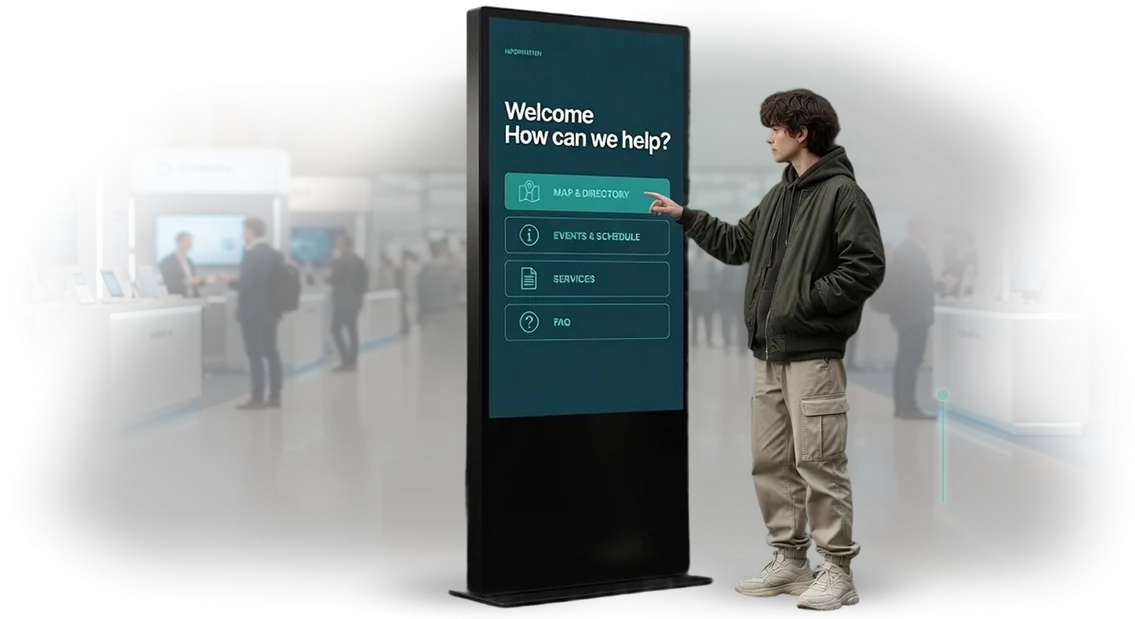
Interactive kiosks in fashion: how to keep customers?
A customer in a fashion boutique often gets lost: displays are overloaded, the right size is not in sight, and the consultant is busy with other guests. As a result, the client leaves without a purchase, and the store loses not only revenue, but also loyalty.
Retaining customers in fashion is the ability to quickly give a person what they came for and show that you have much more in store for them.
An interactive kiosk solves this problem right on the sales floor. Instead of a long search, the customer opens the product catalog in a couple of touches: checks size availability, picks a color, explores new arrivals, and puts together outfits.
It's like a personal consultant who is always available, never tired, and knows the assortment down to the last item. A store kiosk turns boring waiting or an unsuccessful search into an engaging interaction with the brand.
For the owner of a fashion boutique, this is measurable value: fewer missed sales, a higher average check thanks to additional offers, and more repeat visits. Guests remember a store where choosing is easy and pleasant, and they come back again.
The kiosk also collects data on customer preferences — which models are viewed more often, which sizes are requested. This information can be used to improve displays and buying decisions.
We design interactive solutions for the specific needs of a given store: from catalog to smart fitting room. We implement kiosks that work reliably, are easy to update, and don't distract from the main thing — your fashion and your customer.
What an interactive catalog gives your store
A customer in a clothing store doesn't just want to find an item — they want to see how it fits, what it pairs with, and whether their size is available. When the necessary information is missing, they go to a competitor.
An interactive catalog answers these questions in a couple of touches — and turns a random visitor into a buyer.
Walk through the checklist: what your store gets with the terminal?
- Growth in average check. The catalog suggests accessories, footwear, and alternative colors for the selected item. The guest adds more items to the cart than they planned.
- Search speed. Instead of long walks around the floor — selection by category, size, brand, and price. The customer finds what they need in 20-30 seconds and doesn't get frustrated.
- Customer convenience. The terminal shows size availability, fabric composition, and care instructions. Fewer questions for staff, fewer lines at the fitting rooms.
- Loyalty. The guest remembers a store where everything is fast and clear. Through the catalog, they can collect bonuses, browse new arrivals, and save a wish list — that's a reason to come back.
- Brand recognition. A stylish interface and corporate design work for your image. Even those who bought nothing note the store's tech-forward approach and tell others about it.
In fashion, what matters is not only the quality of items, but also the speed with which a customer finds what's theirs.
Global chains like H&M have long used such kiosks not as a replacement for sales staff, but as a service amplifier: the terminal handles routine questions, while staff focus on what truly matters — helping with choices and creating an atmosphere.
In the end, you get a tool that pays for itself through higher conversion, average check, and repeat visits. The kiosk works for your store even at peak hours, when there aren't enough salespeople for all guests.
Interactive kiosk formats for business needs
For a clothing store, it's important that customers quickly find the right model and don't leave without buying. An interactive kiosk helps with this, but the format must match the layout and purchase scenario.
Let's look at three common options — a wall-mounted kiosk, a floor-standing terminal, and a touch window display.
| Format | For whom | What it gives the customer |
|---|---|---|
| Wall-mounted kiosk | Compact halls, area near checkout or fitting rooms | Quick size and color search, ordering an out-of-stock item, doesn't block walkways |
| Floor-standing terminal | Spacious boutiques, entrance area | Full collection catalog, interactive store map, attracts customer attention |
| Touch window display | Street window or entrance | Virtual fitting, fabric composition viewing, a reason to come inside |
Each format solves its own task: wall-mounted saves space, floor-standing becomes a center of attraction, and a touch window display works even outside business hours. The right choice depends on the store's floor area and the customer journey you want to build.
We'll help you decide on the format and adapt the interface to your catalog — from size selection to virtual fitting. As a result, visitors get a self-service product navigator, and the store gets higher conversion and reduced load on consultants.
How the interactive kiosk development process works
A clear process is half the success of a project. When you order kiosk development, it's important to understand where you are in the process, what's already done, and what decisions need to be made.
We've structured the work so you control every stage instead of waiting for a result "blindfolded."
A typical project takes 2-4 weeks depending on catalog volume and design complexity. Below is the standard route we take every client through.
-
Brief and immersion into the task. We discuss your audience, kiosk goals, and the list of products or services. We capture what's critical for you: search speed, appearance, integration with your accounting system.
-
Prototype and screen logic. We show how a customer will move through the catalog: from the first touch to submitting a request or printing a receipt. You see the structure and approve it before money is invested in design.
-
Design mockup and approval. We create visual design in line with your brand: colors, fonts, button placement. You receive the mockup for approval — that's your main checkpoint, where you can make edits.
-
Build and content setup. The assembled interface is filled with your products, promotions, and contacts. At this stage, you already see a working version with real data, not "lorem ipsum."
-
Terminal launch. We install the software on the kiosk, set up auto-launch, and verify operation on-site or remotely. You get a ready-made entry point for customers.
-
Support and updates. After launch, we stay in touch: we promptly make changes to the catalog, fix issues, and train staff. You're never left alone with problems.
The result is a kiosk that works from day one and doesn't require technical knowledge from you. You participate only at key points: brief, mockup, and acceptance. We handle the rest.
What's included in the interactive kiosk delivery
The delivery package includes everything needed to launch an information kiosk in a clothing store — from software to staff instructions.
You get a turnkey solution that starts working on the day of installation, not a set of components you need to assemble and configure yourself.
Standard package includes:
- Software. A licensed catalog management system that lets you independently update prices, add new items, and change promotional blocks. You won't need to contact programmers every time — everything is done through an intuitive interface.
- Interface design. Custom design in your brand style: corporate colors, logo, convenient catalog structure. Customers quickly find the right product, and the kiosk fits organically into the store space.
- Catalog content. Structured product data: photos, descriptions, sizes, and prices. We carefully transfer information about your assortment, so the kiosk is ready to work from day one.
- Staff instructions. Short guides: how to turn on the kiosk, change content, and act in an emergency. Your employees will figure it out in a day without being distracted from their work.
- Warranty and support. Service for the entire warranty period, remote assistance, and fast equipment replacement if needed. You're never left alone with the hardware — any questions are resolved promptly.
Thanks to this package, you won't need to look for separate contractors, dive into technical details, or spend time on launch.
The kiosk is delivered fully ready to work and from day one helps customers explore the assortment, while you increase sales and improve in-store service.
Case study: interactive kiosk in fashion doubles sales
The client is a fashion brand with a chain of boutiques. The main flow of customers comes in the evening hours and on weekends, when consultants physically cannot give attention to everyone.
Visitors lost patience at the fitting rooms and left without buying — which translated into significant lost revenue every month.
The task
We installed interactive kiosks with a full collection catalog in two flagship stores. On the screen, customers independently select category, color, size, view outfit combinations, and immediately send a request to a consultant — who brings the right items to the fitting room. This relieved peak load and reduced waiting time.
The result
Within the first month of operation, the kiosks showed tangible results. During a two-hour evening peak, about 120 sessions passed through one terminal — every fourth ended with a fitting room request.
The average check grew by 35%: customers who previously bought one item left with a complete look thanks to the kiosk's suggestions.
- Revenue of the two pilot boutiques doubled within a quarter.
- Conversion from visitor to buyer grew 1.5 times.
- Load on consultants decreased — they're now focused on selling, not searching for sizes.
Two months later, the brand ordered kiosks for all its stores — that was a repeat inquiry without any additional outreach from us. The case became an example of how a single proper implementation changes retail economics.
How to choose a kiosk format for your task?
First, define the kiosk's main task. What should it do: inform about products, help with navigation, take orders, or collect customer data?
The format depends on this: a floor-standing terminal at the entrance, a compact panel in the department, or an interactive stand for consultations. Only when the goal is clear can you talk about screen size, installation location, and functions. Don't look for a universal kiosk — the right solution is created for your task.
The second important point is visitor behavior. Where will the kiosk stand, how many people pass by, is there time to explore content? If people are in a hurry, you need a large touchscreen with a simple menu and quick access to key categories.
In a waiting area, you can offer a deep catalog, product comparison, and detailed descriptions. Consider who will be the user: an employee, a visitor with children, an elderly person. The interface should be intuitive.
The third step is how well the kiosk fits into current processes. It should be connected to the product database, prices, and stock levels, so visitors see up-to-date information. If the system is properly configured, the catalog updates without manual actions.
So when choosing a format, we decide in advance how the kiosk receives data and who fills the content.
And finally, budget — it's an investment in automation, not a one-time purchase. A multifunctional floor-standing kiosk may be excessive in a small department, while a compact panel with the right interface will deliver the main result.
We analyze foot traffic, tasks, and location, then propose the optimal format. You get a solution that works from day one and pays for itself through improved product discovery and faster service.
Frequently asked questions about interactive kiosks
When a business is just planning to install an interactive kiosk, typical doubts arise: will the terminal withstand constant operation, is it hard to manage, and will it justify the investment.
In fashion, this is especially important — the catalog must update quickly, and the hardware must not fail at peak hours. We've been developing kiosks for retail and events for ten years, so let's address the most common questions briefly and to the point.
Will the kiosk break down under constant operation?
We use professional industrial components designed for a 24/7 duty cycle. Each terminal is tested before launch, and after installation we take on maintenance and monitoring. Therefore, the kiosk works stably even on the busiest day — for example, during sales or events.
Is it difficult to change products, prices, and promotions in the catalog?
No, it takes a couple of minutes. You get a simple control panel: upload photos, change descriptions and pricing, add new items — without a programmer. Changes appear on the kiosk screen immediately, which is especially convenient when fashion assortment updates every season.
How much does such a kiosk cost and when will it pay for itself?
The cost depends on the number of terminals and the feature set. We calculate the economics for your specific task: the kiosk reduces queues, takes over part of the consultants' workload, and increases the average check through upsells.
In most projects, payback occurs within several months — the investment is made once, while savings continue constantly.
What happens if the kiosk stops working?
We take on technical support and remote monitoring: in case of a failure, we respond quickly, fix the issue remotely or send a technician on-site.
The contract specifies our response time, so you're never left without a working terminal, and your customers never leave without the information they need.
Leave a request — we'll design a kiosk for your store
Tell us about your store — and we'll propose a solution that fits your interior and budget.
An interactive kiosk in fashion will help customers find the right size, color, or new arrival faster, relieve consultants, and increase the average check through additional offers for the selected item.
Leave a request on the website — a manager will contact you within a business day, clarify your tasks, and prepare a cost estimate. We work remotely across the entire country, so you don't need to visit our office: just send your floor plan and examples of displays.
Already at the consultation stage, you'll receive a preliminary kiosk placement scheme and a list of integrations with your accounting system.
After your inquiry, you will receive:
- A cost estimate for your project — without hidden charges or fine print.
- Consultation on equipment and enclosure design selection — in the style of your boutique.
- Examples of implemented kiosks for fashion stores with photos and reviews.
- Production and launch timelines — clear even before signing the contract.
- Content recommendations: catalog, SKU search, promotional campaigns, outfit builder.
- A technical specification for your team or for us — if you plan to coordinate with an IT department.
- A clear work plan: from mockup to installation and staff training.
Fill out the form — and within a day you'll know how an interactive catalog will work in your store specifically. We respond within an hour during business hours and will advise which kiosk format will deliver the maximum effect for your traffic and floor area.