

Buyers Leave Without Asking: You're Losing Real Estate Leads
A visitor walks into the sales office, but the manager is busy with another couple, and there's no information about floor plans or installments at the display counter.
After three minutes of waiting, the person silently leaves — and this isn't a rare coincidence, but a systemic loss of leads. In real estate, where every contact is expensive, such departures without a question turn into a noticeable dip in revenue.
The problem grows worse when a company has several residential complexes and the client needs to compare options.
Without the ability to explore the project, prices, and terms on their own, the buyer relies only on the consultant, whose attention is stretched thin during peak hours.
This creates tension and makes a potential client postpone their decision or turn to competitors where information is more accessible.
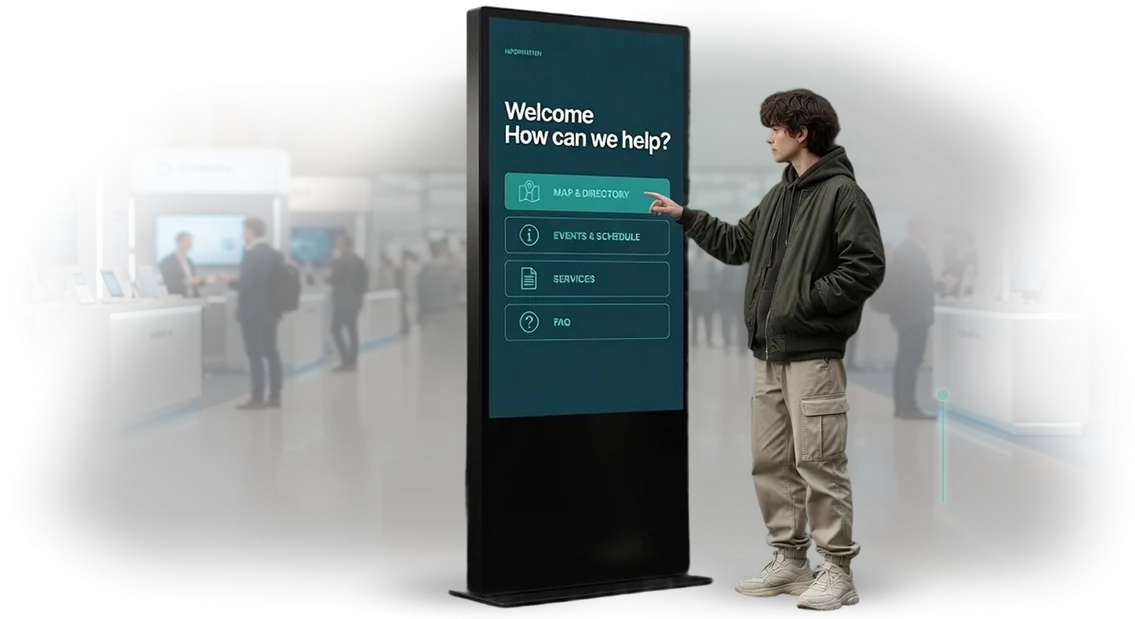
An interactive catalog in the sales office solves this problem — it instantly gives visitors the data they need on floor plans, promotions, and location, taking the load off managers.
A real estate terminal turns waiting time into a productive exploration of the project, helping guests form their request faster and stay in the funnel instead of silently walking away.
We design such kiosks so the interface is intuitive even for those who don't use modern gadgets — this preserves leads and boosts loyalty even before a conversation with an agent.
In the end, the client gets a tool that works on awareness and conversion: the visitor doesn't leave without a question but becomes a qualified lead. We address this need by making information about your property available at any moment during the sales office's working day.
What You Get from an Interactive Kiosk
An interactive kiosk in real estate is not just an information screen, but a full-fledged sales tool. It attracts visitors' attention, keeps them engaged longer than a conventional stand, and turns interest into concrete contacts. Our team build kiosks tailored to the needs of a specific property.
Here's what the client gets:
- Increased sales. Guests find the floor plans they need on their own, filter by price and area, and submit a viewing request. The fewer barriers between the visitor and the request — the higher the conversion.
- Lead generation. The kiosk collects names and phone numbers in exchange for a selection of options or a consultation. The contact database remains yours even after the exhibition closes.
- Higher engagement. An interactive interface holds attention several times longer than a printed display. Visitors explore the property on their own instead of waiting for an available manager.
- Brand awareness. The kiosk is styled to match your corporate identity and works as an additional advertising medium. Both the property and the company name become memorable.
- Customer service and time savings. Managers no longer repeat the same information ten times over; they focus on deals. Visitors get instant answers, even at peak hours.
Each of these points directly affects profitability. At the same time, the kiosk requires no constant supervision: data updates, promotion changes, and new property additions happen automatically.
Want a similar solution? Tell us about your property — we'll show you how to deploy a kiosk with maximum impact.
Interactive Kiosk Formats for Your Business Needs
A flow of visitors is a flow of questions. Buyers, renters, and guests of a property don't want to wait for a consultation to learn about floor plans, infrastructure, or purchase terms.
An interactive kiosk takes this burden off the staff and gives every guest instant access to the information they need — without queues and repeated explanations.
The kiosk format should match the layout and the placement point. We design three base options — floor-standing, wall-mounted, and embedded. All of them run on touchscreens that are easy for any user to understand, regardless of age or experience.
So the choice comes down to where your client finds it most convenient to interact with the information.
| Format | For whom | What it gives the client |
|---|---|---|
| Floor-standing kiosk | Spacious lobbies of residential complexes, business centers, exhibition halls | Attracts attention, handles high traffic, works as navigation and a project showcase |
| Wall-mounted kiosk | Narrow corridors, elevator lobbies, reception areas | Saves space, is always in view, helps visitors quickly orient themselves and book a viewing |
| Embedded terminal | Waiting areas, lobby furniture, meeting room panels | Doesn't disrupt the design, is seamlessly integrated into the interior, provides information about premises and services without a manager's involvement |
When the kiosk is built into the interior or fixed to a wall, it doesn't take up usable floor space or block foot traffic. A floor-standing unit, in contrast, becomes a distinctive accent element in its own right.
In any case, visitors control the touchscreen themselves — they browse the catalog, view photos, study floor plans, and get sales department contacts in just a couple of touches.
This reduces the load on managers: they no longer answer routine questions like "what's available for sale" or "what infrastructure is there." Instead, the kiosk saves hours of staff time, and you get more time for actual deals.
A properly chosen format isn't just a screen — it's a tool that accelerates the client's journey from interest to purchase.
Turnkey Kiosk Development Stages: From Brief to Launch
Developing a real estate kiosk isn't just placing a terminal in the lobby. It's a structured process in which we take responsibility for the result. Your task is to articulate your requirements; ours is to turn them into a working sales tool that generates leads every day.
-
Brief and task analysis. We study your property or sales office and identify who will use the kiosk: buyers, renters, guests. We define scenarios — apartment selection by parameters, cost calculation, floor plans, viewing bookings.
-
Interface design and catalog structure. We design the screens so even a first-time user can find their way within a minute. We approve the look and logic before development begins.
-
Mockup and content approval. We show you a clickable prototype of the future kiosk. You see how the properties and sections will look and make edits — this is faster and cheaper than redoing everything after installation.
-
Development and catalog content. We load up current listings, photos, prices, and promotions. We set up a convenient update system — managers can change information without a programmer's help.
-
Testing and terminal installation. We verify stability, loading speed, and display accuracy. Then we install the kiosk in the right location and set up integration with your services.
-
Launch and staff training. We provide clear instructions and give employees a short training: how to turn the kiosk on, update data, and handle unusual situations.
-
Post-launch support. We stay in touch: we monitor the system, make changes, and add new properties. You get not a one-time installation, but an active lead generation channel.
What's Included in the Kiosk Delivery for Your Business
When you order an interactive kiosk for your real estate business, you receive a complete turnkey solution. We handle every stage — from enclosure selection to launch and staff training.
You don't need to understand the hardware: you get a working tool that helps clients quickly find the right properties and increases sales.
Standard delivery includes:
- Kiosk hardware. A durable enclosure, touchscreen, and built-in computer — all components are selected for your tasks, room size, and interior style.
- Software. An interactive real estate catalog with convenient search, filters, and media materials. You update information on your own without involving programmers.
- Terminal installation. Professional setup at the right location: lobby, entrance area, or waiting zone. All cables are hidden, and the equipment works from day one.
- Staff training. A short training session for your managers: how to turn on the kiosk, update the property database, and resolve common issues. Training takes minimal time.
- Support and warranty. Our company supports the project after launch — we provide consultations on kiosk operation and promptly fix any problems.
This approach saves you time and stress: no need to hunt for separate contractors or control every stage. You get a comprehensive solution that starts working immediately and helps buyers and renters navigate your listings. This boosts visitor loyalty and increases conversion to sales.
Case Study: How an Interactive Kiosk Attracted New Clients
For a real estate agency, the biggest pain point was queues to managers and repetitive questions about prices, floor plans, and completion dates.
An interactive kiosk with a property catalog took over the routine — managers focused on negotiations and deals, while clients gained access to information at any time.
What the Numbers Show
For the agency "Gorodskoy Format" Gorodskoy Format, the kiosk ran in pilot mode for two months.
During that period, the number of viewing requests grew by 38% — visitors selected floor plans on their own, compared options, and left their contacts without waiting for a consultation.
The workload on office staff dropped by roughly a third: routine questions no longer distracted them from preparing documents and meeting with buyers.
Average waiting time in the reception area dropped from 15 to 3 minutes. People didn't leave the office — they explored properties through the screen, which meant no lead was lost due to staff being busy.
The indirect effect was an increase in repeat visits: buyers came back with their families to "take another look," and renters brought their acquaintances.
The terminal paid for itself by the fourth month. The logic is simple: a 38% increase in requests translates into several real deals, and the cost per contact turned out to be lower than with online advertising.
After the pilot, the agency ordered two more kiosks for its branches and added online meeting booking to the system.
For us, this case confirms the rule: a kiosk pays off not as a "screen in the corner," but as a tool that eliminates losses at the entry point, accelerates the deal cycle, and reduces revenue dependence on the number of managers.
How to Choose a Kiosk Format for Your Real Estate?
Choosing a kiosk format starts not with the screen or the enclosure, but with answering a simple question: who will actually use the terminal and what task does it solve?
In real estate, the audience varies greatly — residents of a complex, office workers, shopping mall visitors, or guests at an apart-hotel.
Each group has its own scenarios: some need navigation and delivery, others need a catalog of available spaces and services, and still others need up-to-date information about events and facility operations. These scenarios determine the screen size, control type, and feature set.
The specifics of the property also influence the choice. In a residential complex, a kiosk more often works as an interactive catalog of services and amenities: residents look up the management company, book the stroller room, and check news.
In a business center, the priorities are tenant navigation, a list of available meeting rooms, and a café map. In a shopping gallery, the main goal is to help visitors quickly find a brand, ongoing promotions, and events.
That's why the same kiosk can be a vertical touchscreen at the entrance, an embedded panel in the lobby, or a lightweight stand in the waiting area — it all depends on what matters most to you.
Another important factor is user comfort. If the audience is mixed-age or not very tech-savvy, it's worth choosing large buttons and a simple interface without extra steps.
If the kiosk is placed in a high-traffic area and people queue up for it, speed matters — minimum actions to get a result. Premium properties call for large screens with high image quality, while more utilitarian settings suit compact solutions with an ergonomic enclosure.
The main rule: a kiosk must fit into the space and not obstruct the flow of people — it shouldn't just be a "nice-looking device."
We recommend designing the format based on three things: the profile of your visitors, their typical requests, and the information you want to deliver.
Our engineers and designers help you choose a configuration for your property — you get a terminal that genuinely solves problems rather than simply taking up space.
A professional approach to format selection eliminates unnecessary expenses and ensures the kiosk pays off through active use.
Answers to Frequently Asked Questions About Kiosks
When ordering an information kiosk for a residential complex, business center, or showroom, you want to be confident in its reliability.
Wehave been creating such solutions for 10 years, so we address typical concerns in advance — about warranty, timelines, maintenance, and the risk of breakdowns.
What warranty comes with the kiosk?
We provide a warranty on equipment and installation — for the entire service life. If a malfunction occurs, you receive free repair or replacement of components under the warranty claim.
How long does kiosk launch take?
A standard project takes from two weeks to a month, depending on complexity. At the start, we agree on a precise schedule and monitor it at every stage so you don't have to worry about missed deadlines.
What happens if the kiosk breaks down?
We minimize risks: we use professional components and test the system before installation. If a breakdown still occurs — we run remote diagnostics and, if necessary, quickly replace the device so visitors don't notice any downtime.
How is technical support organized?
Support operates on an ongoing basis: we update content, monitor the condition of the kiosks, and visit the site on request. All issues are resolved promptly, so your clients always see up-to-date real estate information.
These are answers to the main questions that come up when ordering. If you still have doubts — ask us directly, and we'll walk you through your specific case in detail.Leave a Request: We'll Prepare a Solution for Your Task
Leave a request — and we'll prepare a solution for your task. We'll tell you which interactive catalog formats suit your real estate property, calculate the cost, and send you a commercial proposal at a convenient time.
- You leave a request on the website — we get back to you within one business day.
- We conduct a consultation: we clarify your goals, audience, and property specifics.
- We prepare a preliminary concept and select the optimal format for your budget.
- We calculate the development cost and timeline — including integrations, content, and required equipment.
- We send a commercial proposal with a detailed description of the work, stages, and guarantees.
No hidden fees and no vague promises — you know in advance what you'll receive at every stage. After the contract is agreed upon, we hand the project over for development and support you from testing all the way to terminal launch.
We've been working with real estate for over 10 years, so we understand the specifics of your business: what matters is the speed of information access, convenience for visitors, and return on investment.
Our goal is to make the catalog a working tool that increases client loyalty and simplifies the work of your managers.
Leave a request right now, and we'll promptly prepare a solution you can evaluate before development even begins.