

Losing Orders in the Food Industry Because of Outdated Catalogs?
A trade show visitor walks up to your booth, scans the paper catalog to find a product among dozens of options—and a few minutes later leaves for a competitor because a precise answer appeared right there.
This is not a product quality problem but a presentation problem: when the catalog can't keep up with the product lineup, the food industry loses potential contracts right in the middle of live conversations.
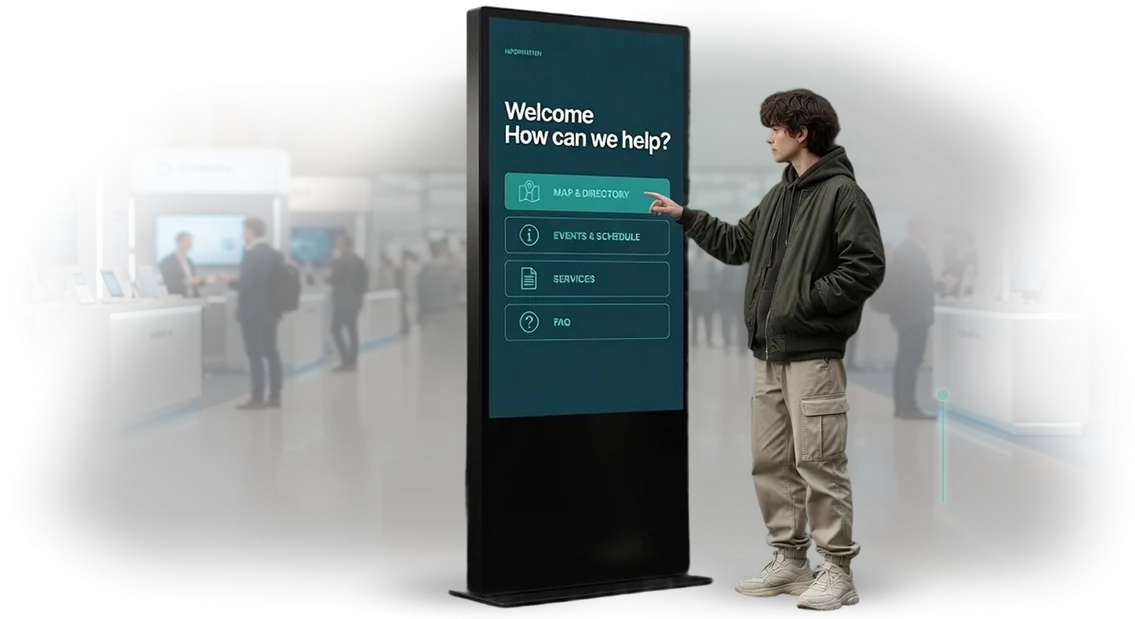
An interactive kiosk changes this dynamic: instead of flipping through pages, the guest gets instant access to the current product catalog, filters by ingredients, packaging, and batch volume.
In less time, they find what they were looking for, and your specialist spends minutes not on searching for information but on selling and negotiating.
The visitor remembers the booth where they were helped quickly and conveniently—and returns after the show with a specific request.
We address this need: we develop interactive kiosks for food industry tasks—from exhibition booths to permanent points in retail spaces.
The client gets navigation without waiting, product presentation without paper, and increased conversion to inquiries without extra advertising.
One kiosk replaces an entire department of catalog consultants, and updating prices and new products takes minutes instead of reprinting a print run.
What Benefits Does an Interactive Kiosk Bring to Your Business
A visitor to a food store or an exhibition of food products makes decisions in seconds. An interactive kiosk immediately provides what they need: ingredients, calories, availability, promotions—without waiting in line for a consultant.
For business, this is not just a “screen at the checkout,” but a way to increase the average check and free up staff.
Sales Growth
The kiosk suggests related products and shows promotions at the moment of choice. According to our projects, this increases the average check by 15–25% in the first months of operation.
Customer Convenience
People increasingly choose self-service: without waiting and unnecessary questions. The customer browses the catalog, compares products, and quickly finds what they need, while your staff spends time on live customers instead of reference work.
Brand Image
Modern terminals in the sales area build recognition and trust. The customer perceives the manufacturer as technology-driven—this is part of the loyalty that brings the customer back again.
We develop interactive kiosks for the food industry: product catalogs, interactive menus, and selection by composition. We work with professional equipment, configure it for your product range, and launch it turnkey.
Group of Companies “ProProdukt”, a producer of farm products: “In three months of kiosk operation at two branded locations, the share of repeat purchases grew by a third.
Customers find new products and promotions themselves, and sellers have stopped spending time on information requests. The equipment paid for itself faster than we planned.”
Interactive Kiosk Formats for Different Tasks
In the food industry, one touchscreen terminal cannot solve all problems. A product catalog, an interactive display, production navigation, or a tasting area require different formats—and each needs its own interaction scenario.
The right kiosk format is not a technical issue but a matter of decision-making speed and service quality. Below are typical options we develop for the needs of food manufacturers and suppliers.
| Kiosk Format | Who and Where It Is For | What It Gives the Client |
|---|---|---|
| Product catalog | For wholesale buyers and distributors in a showroom | Quick selection of items by composition, packaging, and price. The client leaves with a ready list, and the manager does not need to spend an hour on verbal explanations |
| Interactive display | For retail visitors in a branded store or at an exhibition | Detailed product story, ingredients, certificates. Helps the customer choose a product without a consultant and increases the average check |
| Navigation terminal | For guests at a production facility and employees of a large warehouse | Reduces the time needed to find the right department or zone, reduces staff workload |
| Interactive tasting stand | For exhibitions and presentations | The guest chooses their own product introduction scenario and leaves contacts to receive samples |
It is better to implement modularly: start with a product catalog in the showroom, and after evaluating the results, add an interactive display or navigation.
We design terminals for a specific installation point—we select the housing, screen size, and scenario based on traffic and business objectives.
After launch, you get a unified interface with the ability to change the product lineup and promotional materials without involving a programmer. Content is updated remotely, so the system easily scales to new locations or seasonal promotions.
How Kiosk Development Works: From Brief to Launch
When ordering kiosk development for the food industry, you want to understand how the project is built. A transparent process from brief to launch helps you control timelines and budget. We divide the work into stages—at each stage you see the result and make decisions.
-
Brief and task analysis. We record where the terminal will stand, who the audience is, and which products we display. We define goals: increasing the check, reducing queues, a clear catalog.
-
Prototype and scenarios. We agree on the catalog structure and navigation logic. You see how a visitor will search for a product and place an order, and you can make changes before development.
-
Design concept. We design the screens in your style, taking into account lighting and viewing angle. The kiosk looks like part of the brand and is convenient for different ages.
-
Development and integration. We program the terminal logic, connect the product catalog and, if necessary, the accounting system. We show intermediate versions—you control the process.
-
Testing. We check scenarios in real conditions: peak loads at lunch, product search, price accuracy. We fix any issues before installation.
-
Installation and launch. We mount the kiosk, configure it for your location, and train staff. We launch it with instructions for employees.
-
Support. After launch, we update the catalog, add promotions, and monitor stability. You can change content without stopping operation.
What Is Included in the Interactive Kiosk Delivery
When ordering an interactive kiosk for food production or retail, you receive not just a terminal but a complete turnkey solution. We handle the entire process: from equipment selection to launch and staff training, so you can focus on business rather than technical details.
The standard package includes:
- Equipment: a touchscreen terminal with dust and moisture protection—suitable for production floors, warehouses, and retail spaces. The device operates around the clock and withstands intensive use.
- Software: a product and service catalog interface adapted to your product range. Updating the assortment takes minutes and does not require a programmer.
- Installation and commissioning: we deliver, install, connect, and verify operation at your site. You receive a fully functional kiosk on launch day.
- Staff training: we teach your employees how to use the system and show them how to change prices and add items. No special skills are needed.
- Technical support: we are available during business hours, provide remote assistance, or visit the site. Average response time is minimal so your trade is not interrupted.
- Warranty and maintenance: official warranty on equipment and software. If necessary, we perform scheduled maintenance so the kiosk operates without failures.
This package covers all tasks—from informing customers to speeding up orders. You pay once for a ready-made system, not for separate parts that need to be assembled and configured.
As a result, the kiosk starts delivering value within the first days, and your employees are not distracted by technical issues.
Case Study: Increasing Sales with an Interactive Kiosk
One of our clients—a snack producer “Vkusny Mir”—faced a typical problem: at an industry exhibition, hundreds of people visited the booth, but managers collected only a few contacts.
Paper catalogs were taken and thrown away, while negotiations with retail chains were lost in the general flow. We proposed a solution: an interactive kiosk with a product and service catalog.
What We Did
We installed a touchscreen terminal at the booth with a clear menu: product categories, ingredients, packaging options, advantages over competitors. The guest approached on their own, selected what they needed, and immediately saw all the information.
Consultants only engaged with those who showed interest—staff time was no longer spent repeating the same information.
Results
Over three exhibition days, the terminal recorded more than 1,600 sessions—almost every booth visitor used the catalog. 470 people left contacts to receive a commercial proposal, and 185 negotiations ended with price inquiries.
Within two months, two federal chains launched trial deliveries—the repeat kiosk order for a permanent showroom became the best confirmation of the result.
In terms of return, the investment in one terminal paid off through contracts and a direct increase in sales that would have been impossible without a fast, modern presentation of the product range.
An interactive kiosk does not simply inform—it collects inquiries and saves team time. That is why we recommend such solutions to food industry companies planning to participate in exhibitions and develop sales channels.
How to Choose a Kiosk Format for the Food Industry?
Choosing a kiosk format for the food industry begins not with hardware but with a question: who will use it and why.
If the terminal will meet a visitor in a store or at an exhibition, it needs a product catalog, ingredients, allergens, information about new products—and instant response to touch.
If the kiosk is located in production or a warehouse, dust and moisture protection, reliability, and ease of updating instructions and recipes take center stage.
Pay attention to three criteria. The first is the environment: a protected housing and resistance to temperature fluctuations in a production facility are important.
The second is the user: a customer expects an intuitive interface with large buttons and search; an employee expects fast input and minimal errors.
The third is content: a catalog with hundreds of items needs a convenient admin panel so updating prices and promotions does not turn into a call to a programmer.
We select the format for a specific business task rather than “selling a box.” We ask where the kiosk will be located, how many visitors pass through per day, and how often the assortment changes—only then do we propose a solution.
For example, for cafes and canteens we create interactive menus with contactless meal selection, for retail a catalog with filters by ingredients and allergens, and for production a terminal with technical cards and regulations.
This approach pays off quickly: visitors find the right item themselves, fewer questions go to staff, and marketing gets a visible tool for promotions and upsells.
The main thing is not to overpay for unnecessary options and not to save on features that affect the terminal's lifespan. A preliminary audit helps avoid mistakes even before purchase—we provide consultation on format and scenarios.
Frequently Asked Questions and Client Concerns
Even when the solution is obvious, questions remain: what if the equipment fails on launch day, how long will implementation take, and how often can the assortment be changed.
These are normal concerns—they relate not to the structure of the kiosk but to the reliability of your process and your responsibility to people. Below we address the three main fears of food industry clients.
What if the terminal stops working in the middle of the busiest part of the day?
The kiosk is built on professional equipment designed for intensive use. We provide a warranty for each project and handle maintenance ourselves—you do not need to find technicians or keep spare parts.
In the event of a failure, simply contact our support service: we diagnose the problem remotely, and if needed, quickly replace the module. The kiosk itself continues to accept orders or runs a backup mode, so serving guests does not stop.
How long will development and installation take?
From approving mockups to handing over the terminal for launch usually takes two to three weeks. If the catalog, prices, and visual style are ready, it is faster.
At the brief stage, we set exact timelines and provide a step-by-step plan: you see each stage and understand when commissioning will begin. Delays usually arise on the content approval side, so we help create the catalog structure and templates in advance.
How will I update prices, promotions, and product ingredients?
You will not need a programmer or long training. Updates happen through an easy-to-use personal account: upload a file with current prices or make changes manually—and visitors see the new information within a couple of minutes.
You can assign a responsible employee on your side or delegate updates to us as part of maintenance. While the form is being changed, the kiosk continues to operate—no downtime and no paper notices at the entrance.
We considered these scenarios in advance because we work with clients rather than on a “deliver and forget” basis. If you still have questions, see the next section or contact us to discuss your case.Order Interactive Kiosk Development for Your Industry
Ordering a kiosk for the food industry is easier than it seems: we handle the entire journey from idea to launch. Tell us about the needs of your production facility, warehouse, or retail outlet—and get a terminal that helps customers quickly find the products they need.
To order an interactive kiosk, just follow a few steps. Leave an inquiry—then we guide you through every stage and suggest the best solutions for your industry.
- Leave an inquiry on the website—provide your contact details and describe where the kiosk will be located.
- Get a consultation—a manager will contact you within one business day and answer questions about timelines, cost, and functions.
- Agree on the catalog structure—together we prepare product categories, descriptions, prices, and photos that your customers need.
- Choose the design and housing—we will select a look that fits your interior and is convenient for visitors.
- Run testing—we show the kiosk in operation before installation so you can be sure everything works correctly.
- Launch and train staff—after installation, we provide instructions and briefly train employees if needed.
After launch, the kiosk reduces staff workload: visitors independently explore the assortment, ingredients, and prices, while employees focus on sales and consultations.
Both a small retail outlet and a large production complex can order a kiosk for the food industry—the solution adapts to your tasks and working format.
Leave an inquiry right now—we will start with a consultation and prepare a preliminary cost estimate within one business day.