

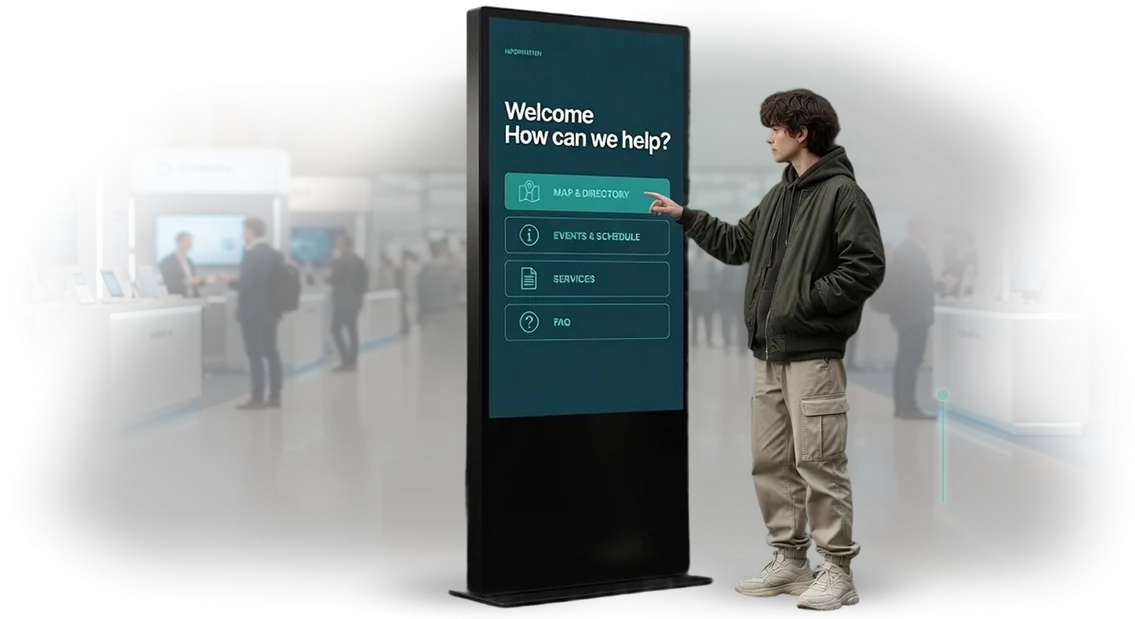
Interactive Kiosks in Retail: How Not to Lose Customers
A visitor walks into a store, glances at the display — and a minute later walks out to a competitor. Static stands and cluttered price tags don't answer their questions, don't guide them, don't engage them.
As a result, you lose not just one customer but an entire flow: people choose stores where they can orient themselves more easily and find what they need.
Inconvenient displays hit revenue directly: the customer can't find the product, doesn't see current offers, and doesn't come back for a repeat purchase. Even an interested visitor leaves if they have to search for the right shelf or wait for a consultant. It's an invisible but constant profit leak that's easy to eliminate.
Interactivity in retail changes the very shopping scenario. Instead of passively viewing a display, a person gets a living tool: they choose a category, compare features, see availability and price.
Such a kiosk removes objections before the customer even approaches a salesperson, shortens the path to purchase, and increases the average ticket. The customer feels cared for, and the store sees sales growth.
The key is for the kiosk to become an assistant, not just another static screen. Properly designed interactivity follows the shopper's logic: it hints, guides, and suggests complementary products.
This increases brand recognition, holds attention at the display, and creates a reason to come back. The business gets a measurable result: more reach, higher conversion, fewer lost customers.
We've been solving these problems for more than ten years. We design kiosks around your customer's logic, set up the catalog so customers find products in a couple of touches, and provide support after launch.
The result is not just a screen on the floor but a working tool that retains customers and pays for itself through increased sales.
What Benefits an Interactive Kiosk Brings to Business
An interactive kiosk works for the customer even before they reach the checkout: a bright touchscreen draws the eye, and a convenient interface holds attention.
The customer doesn't just search for a product — they explore the assortment, compare features, and see offers that a regular display doesn't show. That's how engagement is born, directly affecting the average ticket and repeat visit frequency.
The result shows up gradually. In the first weeks, the kiosk relieves staff and speeds up in-store navigation: customers find the right shelf themselves, and consultants focus on those who genuinely need help.
After a month or two, you notice that orders from the terminal become regular, and sales of promoted items grow noticeably — because the customer sees them at the right moment.
Then the marketing side kicks in. The kiosk becomes a contact-capture point: the customer leaves a phone number or email to get a receipt or info about new arrivals, and those leads turn into a database for mailings.
The brand also sticks in memory — screen design, animations, and exclusive offers make the store recognizable and turn a visit into an event.
Over time, the kiosk starts working for you on its own. It collects data on which products are searched for most often and what gets ordered at different times of day — you see real demand and adjust the assortment and store layout without extra costs.
The business owner gets not just a device but a sales tool that pays for itself through repeat orders and new customer acquisition.
The main result is revenue growth that comes out of nowhere. The kiosk shortens the path from "just came to look" to "found, ordered, picked up," and every served customer becomes a carrier of your brand.
This effect lasts the next day and a year later, because the habit of using the terminal forms quickly, and returning to a familiar store is always easier for the customer.
Interactive Kiosk Formats for Retail
Every store solves its own problems: some need to cut checkout queues, some need to introduce visitors to the full assortment, and some need to make navigation through a large shopping center clear without staff involvement.
Interactive kiosks cover these scenarios in different formats, and it's important to choose the one that will work in your particular location.
Main Formats for Retail
| Format | For Whom | What It Gives the Customer |
|---|---|---|
| Touchscreen stand | Convenience stores, boutiques, pickup zones | Quick info on products, availability, and promotions — without waiting for a consultant |
| Interactive catalog | Retailers with a wide assortment | A complete list of products and services on screen, even when there's no physical room for display |
| Self-order kiosk | Cafés, fast food, supermarkets | Fewer queues, a higher average ticket thanks to upsells during checkout |
| Information kiosk | Shopping malls, hypermarkets | Navigation through departments and services, reduced staff workload |
Each format is not just a screen with a picture but a tool that affects visitor behavior: it hints, speeds up, and sells. We help you choose the right configuration and set up scenarios for your business task — from a simple catalog to a full self-service zone.
Project Stages for Building an Interactive Kiosk
Working on an interactive kiosk isn't just developing a screen interface. To make the terminal genuinely useful — speeding up product search and increasing the average ticket — the process is broken into stages with checkpoints. You always know what's happening and approve key decisions.
How We Structure the Work
- Brief and goal setting. We discuss who will use the kiosk, which products and services need to be shown, and what problem the terminal solves in your store. We lock in timelines and expectations.
- Catalog design. We think through the section structure, search logic, and product card. You get a schematic of the future kiosk — it's easy to see how a visitor will find the right product.
- Design and content. We adapt the interface to the terminal screen and align the visual style with your brand. We prepare the structure for uploading product photos and descriptions.
- Approval and revisions. We show a working version, and you test real-life scenarios. We make adjustments before the kiosk appears on the sales floor.
- Launch and training. We install and configure the terminal, check catalog operation, and train your staff — those who will greet guests at the screen.
- Support and development. We stay in touch: update the catalog, add items, and monitor stability. We refine scenarios as needed.
The full cycle takes two to four weeks depending on catalog size and approval timelines. You participate at key stages and control the result — no surprises on launch day.
What's Included in the Interactive Kiosk Delivery
The complete delivery package lets you launch an interactive terminal quickly and without hidden costs. We've thought through every element — from a durable enclosure to staff training — so the kiosk works for your business from day one.
The delivery includes:
- A professional touch terminal in a protected enclosure. It handles heavy load during peak hours and doesn't let you down even in the middle of a sale.
- An interactive catalog with an interface customers understand. Shoppers find products, check availability and promotions on their own, and consultants stay focused on visitors.
- A content management system for updating prices, promotions, and descriptions yourself. Any changes go live in a couple of minutes and appear on screen immediately.
- Installation and on-site setup. We deliver the kiosk, connect the equipment, test scenarios, and hand over the terminal fully ready to work.
- Instructions and staff training. Your employees quickly get familiar with the device, help customers, and easily handle typical questions.
- Warranty service and technical support. If issues arise, we help remotely or visit on-site so the kiosk doesn't sit idle.
This package eliminates incompatibility, drawn-out setup, and hidden surcharges. You get a turnkey working solution — all that's left is for sales to grow.
Case Study: Increasing Retail Sales with a Kiosk
In retail, what matters isn't just the assortment but how fast a customer finds the product they need.
In one project for a clothing retail chain, we ran into a typical pain point: consultants physically couldn't keep up with all visitors at peak hours, and some customers left without buying because they couldn't find the right size or color.
For a clothing retail chain we developed an interactive catalog based on an information kiosk.
Instead of the usual "go ask a consultant," the guest got a self-service scenario: they chose a category, checked size availability at the specific store, and immediately saw which shelf or rack the item was on.
We measured the results after two months of operation. The average ticket grew by 17% — customers who found their item through the kiosk added complementary products to their cart more often.
Conversion to purchase among visitors who used the terminal was 23% higher than among those who searched on their own.
The reduced staff workload was a particularly pleasant surprise. Consultants stopped getting distracted by "where can I find size M" questions and focused on advising on outfit matching and managing fitting rooms.
This boosted revenue during peak hours — the flow wasn't lost to queues at the registers or fitting rooms.
Why It Worked
We didn't just install a screen with a price list — we designed the customer journey around a specific task: "find and buy." The interface is built so that even a first-time visitor reaches the right product in 30 seconds without hints: large categories, real-time stock, and guidance on in-store location.
The kiosk was integrated with the store's accounting system — data updates automatically, without staff involvement. This eliminated the situation where a guest sees "in stock" on screen but the shelf is empty.
For the client, this isn't just convenience; it's preserved revenue: the customer doesn't leave empty-handed and comes back again.
What to Take Away
An interactive catalog in retail acts like an extra salesperson who never gets tired, never gets distracted, and always remembers stock levels.
After the first launch, the client ordered two more kiosks for neighboring locations — they saw real results at the register, not just a nice screen on the floor.
If you want a similar result for your chain — we'll help you calculate the effect even before launch.
Frequently Asked Questions About Interactive Kiosks
Having doubts before launching interactive kiosks is normal. We've gathered answers to typical questions so you can make your decision with confidence.
How long does kiosk setup and launch take?
The timeline depends on project complexity, but on average it takes 2-3 weeks from the first brief to a fully working terminal. We configure the equipment ourselves, install the software, and run test launches. By opening time, the kiosk is already running without issues.
What happens if the kiosk breaks down?
Our work is covered by a warranty, and after it expires we offer a service agreement. The kiosks are connected to remote monitoring, so when a problem occurs we often learn about it first and restore operation remotely.
If parts need replacing, we deliver them within a couple of days — the sales floor doesn't sit idle.
Can we update the catalog and prices ourselves?
Yes, you don't need a programmer for that. We build a user-friendly interface where you upload current products and prices, and they immediately appear in the kiosk. You save time and always keep information up to date.
What does maintenance and technical support include?
We handle regular equipment checks, system updates, and consultations for your staff. You focus on sales, not technology — this saves your resources and prevents kiosk downtime.
How to Choose the Right Kiosk Format for Your Specific Goals?
Choosing a kiosk format starts not with the model or dimensions but with the question "what exactly should this terminal change in your store?" It's important to understand what tasks you're solving: helping visitors find products quickly, offering a catalog with real-time stock, speeding up order placement, or drawing attention to new arrivals and promotions. Not just the construction but also the kiosk's logic in the daily customer flow depends on this.
The type of business determines the usage scenario. In a hypermarket, visitors need navigation and a full product catalog; in a boutique, a visual presentation of the collection and the ability to book a fitting; in a food service outlet, self-service ordering.
There's no universal "best" kiosk: what works in one format can slow down the flow in another. We match the construction and interface to your guests' behavior rather than trying to fit them into off-the-shelf hardware.
Budget is not a reason to drop the idea but a reason to choose the right scale. Some stores only need a wall-mounted kiosk with a catalog; others benefit from an interactive display that works as a showcase even without touches.
It's far more useful to evaluate not the device price but its return: how many customers will complete a purchase faster, how many calls to staff you'll save, and what share of repeat orders a convenient service will generate.
When choosing a format, we consider all three factors — goals, business type, and budget — and propose a solution that actually pays off.
You don't overpay for unnecessary functionality, and you don't get a useless terminal for the sake of "modernity." Together we set the goal, match the construction, design, and feature set to it, and then show how the kiosk will fit into the existing customer journey.
The final criterion is simple: after the kiosk is installed, staff spend less time on reference work, customers find what they need faster, and some orders are placed without waiting in line. If that description matches your expectations, the format is chosen correctly.
If not, we'll go back to analyzing the tasks and adjust the solution before launch — without wasting budget or deadlines.
Order a Kiosk for Your Retail Business
Retail lives on speed: while a product is on the shelf, it must be found and bought. An interactive kiosk closes this gap — customers find the right item themselves, see current prices and availability, and your staff spends time on consultations rather than product searches.
When you order a turnkey development, you get a ready-made solution that you simply switch on and it works — without needing to dig into the technical side or coordinate multiple contractors.
We've gone from our first kiosk to dozens of launches across different retail chains, so we offer a transparent process with no surprises:
- Request and consultation — you describe the task, tell us about your assortment and store format, and we propose a solution in terms of functionality and budget.
- Brief and analytics — we study customer behavior, kiosk placement points, and typical product-search scenarios. This is the foundation on which a convenient interface is built.
- Design prototype — we show what the catalog and navigation screens will look like. You see the future kiosk before development begins and make revisions.
- Development and integration — we build the system around your assortment and connect it to the store's accounting system so prices, stock levels, and promotions update automatically.
- Real-world testing — we check customer scenarios, load, and interface stability. We fix everything before a visitor sees the kiosk.
- Launch and support — we install the equipment, train the staff, and stay in touch after the start. We work with professional equipment built for round-the-clock operation.
The average development timeline for a turnkey kiosk is 3-5 weeks from brief approval. This is convenient for planning seasonal campaigns, launching new collections, or updating sales-floor navigation.
Leave a request — we'll conduct a consultation and prepare a proposal for your store by the next business day. You'll get a timeline estimate, a feature list, and an understanding of how the kiosk will pay off in your retail. We'll start with a brief — tell us about your task, and we'll handle the rest.