

Are You Losing Construction Customers Due to Complex Catalog Navigation?
In construction, a customer comes with a specific task: they need a certain material, tool, or piece of equipment. If product navigation is confusing, the buyer cannot get oriented quickly and leaves for competitors. Customer loss in construction begins where the catalog looks like an endless list without logic.
This is especially painful for large orders. A person is ready to pay for a batch of fasteners or engineering systems, but is not ready to figure out a list of hundreds of items. Every minute waiting at the terminal reduces the chance of a purchase.
As a result, revenue suffers, and the brand gets a reputation as “a place where it is hard to find what you need.”
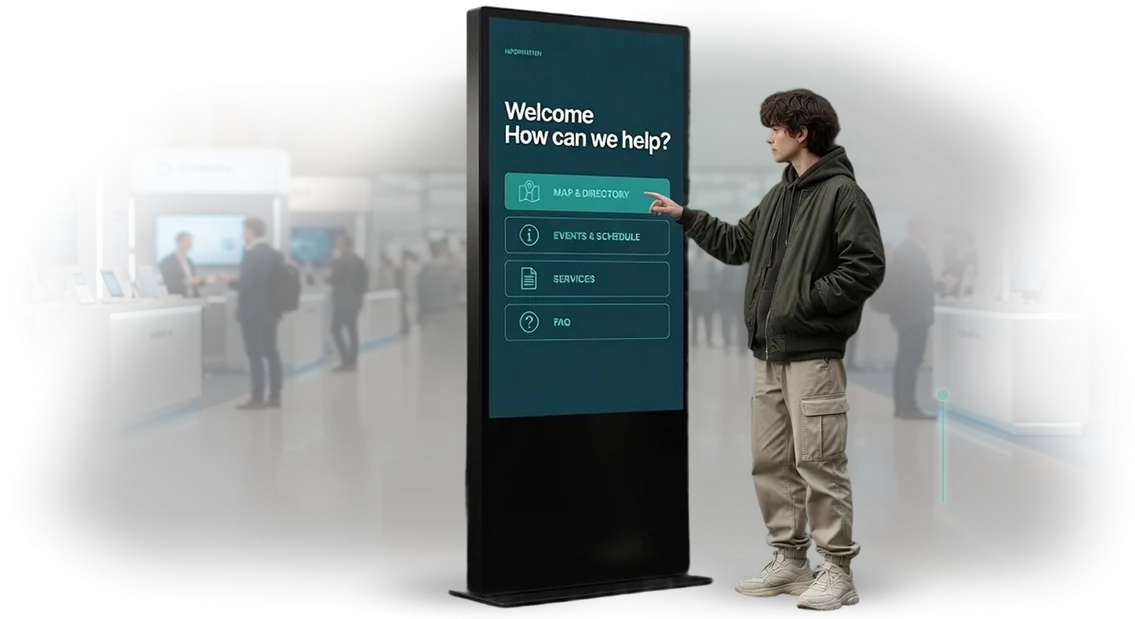
An interactive equipment catalog on a terminal for construction completely changes the scenario. The customer chooses a category themselves, filters products by the needed parameters, and immediately sees availability and price.
There is no need to wait for a consultant, look for a sign, or flip through paper price lists. The buyer feels confident and makes a decision faster.
We design terminals so that product navigation takes no more than a couple of taps. We take into account the specifics of a construction assortment: large units, consumables, related items, and frequent “for project” requests.
Hints, category logic, and a back button make the customer journey intuitive even for those who rarely use touchscreens.
As a result, customer loss in construction turns into growth in repeat orders and positive reviews. A visitor finds what they need in seconds, returns to you again, and recommends the store to colleagues.
This is our profile: we make a convenient buyer journey from “I want to find it” to “I’ve already bought it.” Tell us about your catalog — we’ll suggest how to speed up navigation without rebuilding the warehouse.
What you get from installing an interactive kiosk
An interactive kiosk in a construction showroom or store works as an additional salesperson who never gets tired or distracted.
Visitors independently find the products they need, compare specifications, see current stock and price — this shortens the path to purchase and increases conversion.
Each such request turns into a lead with a name, phone number, and category of interest, which instantly goes to the sales department.
By automating routine questions, time is freed up for live consultants. They no longer have to explain the same assortment ten times or check availability against a paper price list.
Managers focus on complex projects and large clients, where personal communication decides the outcome of a deal, while the terminal takes on the routine. As a result, the staff works more efficiently, and each employee generates more revenue.
The kiosk significantly expands audience reach. Some customers do not like asking staff questions — it is easier for them to browse the catalog on their own and make a decision without pressure.
The device attracts the younger generation, who are used to touchscreens, and those who came during peak hours.
The terminal is available throughout the working day, does not create queues, and keeps visitors at the point of sale longer — every additional hour spent in the store increases the likelihood of an order.
The presence of modern interactive equipment directly contributes to the company's image. The client sees that the business keeps up with the times and invests in customer convenience, rather than simply chasing quick profit.
This advantageously sets you apart from competitors who still use paper catalogs and forgotten price lists.
The positive impression is reinforced after the visit — the guest will tell colleagues about your solution or return themselves, already knowing that here it is quick and easy to find what they need.
The kiosk collects not only contacts but also analytics of interests: the system records popular categories, peak load times, and search scenarios.
Based on this data, you can adjust displays, purchasing, and advertising campaigns, strengthening exactly the positions that are already delivering results.
The terminal becomes a full-fledged sales growth tool — from first touch to repeat transaction, paying for itself within the first months of installation.
Interactive kiosk formats for construction tasks
In construction, the choice of kiosk format directly affects how quickly a client finds the needed product or service and submits a request. A floor-standing display in a showroom is one thing, while a compact terminal at a site or a touch table in a project office is another.
It is worth understanding in advance which tasks the kiosk should solve so as not to overpay and not lose visitors.
Compare three popular formats — each meets its own need:
| Format | For whom | What it gives the client |
|---|---|---|
| Floor-standing kiosk | Showrooms, exhibition pavilions, central sales areas | Attracts attention, works as a standalone display, and provides a catalog without manager involvement |
| Wall-mounted terminal | Narrow spaces, reception desks, waiting areas | Saves space and speeds up product or service search during a short consultation |
| Kiosk with touch screen | Building materials stores, warehouses, pickup points | Allows selecting products by parameters, checking availability, and immediately creating a request |
| Touch table | Meeting rooms, architectural bureaus, procurement departments | Lets several participants review projects and the catalog at the same time — convenient for approvals |
The main thing that unites these formats is an interactive catalog. In construction, it helps select materials and services by purpose, characteristics, and availability, replacing paper price lists and reducing the load on consultants.
To make the kiosk genuinely useful, we first look at the business process logic, and only then propose a format. A floor-standing model in a store is one solution, a wall-mounted terminal in a workshop is another.
It is important that the visitor does not look for help but gets the needed result on their own in a couple of taps.
How the project proceeds: from brief to kiosk launch
We have structured the process so that you always understand what is happening with the project and when you will receive a working kiosk. Each development stage ends with a specific result — you see an intermediate outcome and make a decision. Below are the standard steps, but they may be slightly adjusted for your project.
- Brief and task analysis. We discuss what the kiosk is for, who your visitors are, and which products or services should be visible. You receive recommendations on catalog structure — what to show on the main screen and how to organize search.
- Layout approval. We develop a visual interface prototype — how sections, buttons, and photos will look. You make edits before production begins, so unnecessary costs are avoided.
- Production and installation. We manufacture the enclosure and install the equipment at your premises. You do not need to look for contractors: we handle delivery, installation, and connection.
- Content population. We upload current products, prices, descriptions, and images. You receive a ready catalog that you can update yourself — without programmers.
- Testing and launch. We check usage scenarios: navigation, search, and information display. We launch the kiosk in operating mode and make sure everything is stable.
- Training and support. We train your employees to manage the catalog and change content. After launch, we stay in touch — answering questions and helping with updates.
What is included in the delivery: a complete launch kit
Everything needed for launch comes in a single package — no “assemble it yourself” and no unexpected extra charges. You receive a ready terminal that you just need to plug into a power outlet and connect to the network: after that, it runs on its own.
- Enclosure and touchscreen — vandal-resistant design built for 24/7 operation indoors or outdoors. The screen remains readable even in bright light and is not afraid of construction dust.
- Preinstalled software — the system starts automatically, loads the catalog itself, and updates information. No staff intervention is required: nothing needs to be “configured” before every shift.
- Interface tailored to your catalog — the structure of goods and services is already adapted for the construction sector: search by name, category filters, prices, and availability. The customer finds the desired item in 3-4 taps.
- Admin panel — you change prices, add promotions, and remove items yourself without a programmer. Simply open a straightforward web page from any computer.
- Printed instructions — a short manual for employees (turning on, replacing price tags) and a quick guide for the client. Everything is written in plain language, without technical details.
- Warranty documents and certificates — a complete package: warranty for the enclosure, screen, and software, as well as compliance certificates for your accounting department.
The key advantage of the kit is that you get a working turnkey business tool. You do not need to separately order design, find a contractor for the enclosure, or hire a developer for the interface. We have already assembled and fine-tuned everything ourselves.
If modifications are needed — expanding the catalog, adding new functionality, or a custom enclosure design — this is handled as a separate stage after launch. But the basic kit fully covers the interactive catalog task and starts delivering value on the day of installation.
Case study: how a terminal doubled the speed of finding building materials
The GiperStroy chain of building hypermarkets came to us with a typical pain point: customers got lost in the building materials catalog and spent 10–15 minutes searching for the item they needed.
Queues piled up at the shelves, consultants answered the same questions over and over, and this directly affected loyalty and revenue. Managers spent their time searching instead of advising — both time and customers were lost.
We installed an interactive kiosk with a catalog of products and services in the building materials area. The customer selects a category, product type, budget and the required quantity — the terminal shows current items, the price and the location in the warehouse.
In essence, it is smart navigation that replaces endless wandering through the aisles and takes the load off the staff. No training is required — the screen guides the shopper with prompts.
Project results
A month after launch we measured the metrics: selection time was cut in half — from 12 to 5–6 minutes. The average basket grew by 18% thanks to fast comparison and cross-selling of related products. Customer satisfaction was rated 4.8 out of 5, and managers got rid of the routine.
This implementation case shows: the right digital tool at the point of sale drives growth in selection and repeat visits.
The terminal paid for itself within the first two months of operation — and the collected data on popular categories helps the hypermarket plan purchases more accurately.
Such a tool is in demand in construction: the kiosk has become part of the service, customers come back because they spend less time and always find what they need.
How to choose an interactive kiosk for your facility's needs?
Start with the task. In construction, a kiosk is usually needed so that a visitor can quickly find the right material in a large catalog, staff no longer have to answer the same questions, and the company collects customer contacts. The format and location depend on the goal.
Assess visitor flow. In a waiting area or at the entrance, a person is willing to spend two or three minutes at the kiosk — a floor-standing unit is convenient here. Next to a consultant, a compact terminal is needed for quickly checking price and availability. Under high traffic, search takes a couple of taps; otherwise, the visitor will leave.
Take into account the specifics of the facility: the range of building materials is huge, and the buyer compares items by size, color, load, and price. Therefore, the kiosk catalog is designed with filters for these parameters and a clear visual difference between items. We build this structure together with you in advance, rather than uploading a bare price list.
Format selection — in the table:
| Format | When it fits | What it provides |
|---|---|---|
| Floor-standing kiosk with a large screen | Entrance area, high traffic, hundreds of items | Guides the visitor to the right category on its own |
| Compact terminal at the counter | Work next to a consultant | Quick price and availability check |
| Wall-mounted kiosk | Narrow aisles, small assortment | Saves space without losing functionality |
Not sure which format fits your facility? Send us the layout and a description of the flow — we will suggest the optimal solution and prepare a catalog demonstration. Consultation stage, no obligations.
Frequently asked questions about how interactive kiosks work
When ordering an interactive kiosk for a construction catalog, every customer has the same doubts. Who is responsible for equipment operation, how often should the assortment be updated, and when will the investment start bringing benefits. Below are answers to four key questions that we hear most often.
What warranty applies to the interactive kiosk?
We provide a warranty on the equipment and software. During the warranty period, we fix malfunctions, replace parts, and update the software free of charge. You do not bear unexpected costs for troubleshooting.
Who will service the kiosk after launch? We take technical maintenance upon ourselves: we remotely monitor the system condition and, if necessary, travel to the site. We perform preventive maintenance so the terminal operates without failures even during peak sales seasons. All you have to do is use the ready-made solution.
Is it difficult to update the product and service catalog? No. Updates take a few minutes: you upload a new price list, photos, or description through an intuitive control panel, and the information immediately appears in the kiosk. There is no need to involve programmers or wait for a contractor.
When will the kiosk pay for itself? Usually an interactive catalog pays for itself through growth in the average check, an increase in the number of orders, and savings on consultants. The exact timeframe depends on turnover and installation location.
At the start, we will calculate a forecast for your metrics so you can see the result before launch.
If you still have doubts about your facility, ask a question directly. We will advise how the terminal will fit your trading format and show a calculation based on your prices.
Ready to discuss your project? Leave a request for a consultation
Tell us about your task — we will take care of the rest. You get a ready-made terminal solution that helps customers in a building supplies store quickly find the right product, compare options, and place an order without waiting in line.
The first step costs nothing and takes 10 minutes on the phone. You describe how customers currently search for products, which items they ask about most often, and what difficulties salespeople face.
We listen, ask clarifying questions, and propose a scenario that has already been tested on projects for construction retail chains.
After a short conversation, you receive:
- a preliminary estimate of cost and timelines for your task — the very figures you use to decide whether to start;
- a recommendation on the format of an interactive catalog: from a simple searchable reference to a full-fledged assistant with filters, comparison, and add-to-cart;
- examples of catalog structure and product selection logic for the construction topic — how it will look on screen and in use;
- a demonstration of a similar working project so you can see for yourself how convenient the interface is;
- answers to questions about launch, support, and system development after start.
There are still open slots in the schedule this week — every request is processed on the day it is received. The consultation takes place remotely at a time convenient for you, and you receive the result of the conversation by email immediately after the meeting.
Leave a request to lock in your timeline. It commits you to nothing and will definitely save you time on searching for a contractor on your own. We are on the same path — let's build a project that your customers and employees will praise.