

Telecom Customers Are Leaving for Competitors. How to Stop It?
Customers leave not because they don't like the operator, but because they have to wait in the communications store. While the manager is busy with another visitor, the person opens a competitor's app, sees a more attractive offer — and customer loss becomes a fact. In telecommunications, slow service is often the deciding factor, not connection quality.
Customer retention directly depends on the speed and simplicity of choice. If a visitor can compare plans, review terms and promotions within two minutes, they will most likely make a purchase here and now. If not, they will go where it's more convenient. In telecommunications, the fight for subscribers is about time and attention.
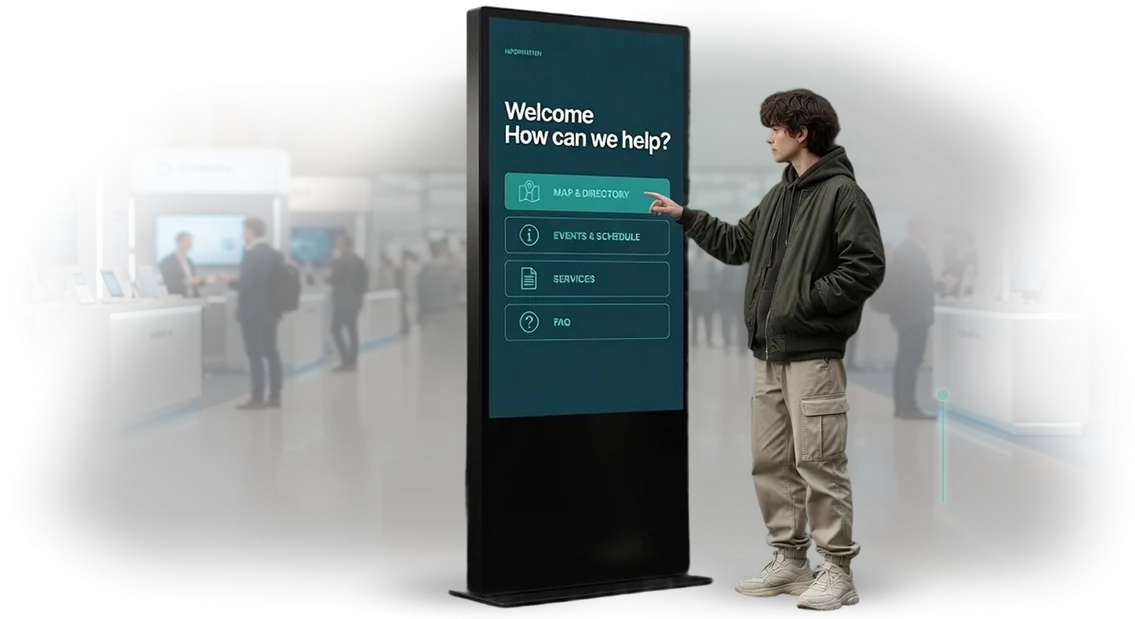
An interactive kiosk solves this problem. It works like a personal virtual consultant: the catalog displays all the operator's plans and services, the customer independently selects the desired section, compares options, and leaves a request. This relieves staff, reduces queues, and cuts customer loss even during peak hours.
For the business, this means retaining customers without hiring additional staff. The kiosk doesn't get tired, doesn't get distracted, and is always ready to help.
Visitors see that the company cares about their time — this strengthens loyalty and motivates them to come back again.
We develop such interactive kiosks for telecommunications with the specifics of communications stores in mind: from catalog structure to an interface that any user can understand.
As a result, the owner gets not just a terminal, but a tool that turns visitors into regular customers and directly affects revenue.
Benefits of Interactive Kiosks for Your Business
In telecom, a customer often gets lost among dozens of plans and options. Paper catalogs are outdated, and a consultant can't always cover everything. An interactive kiosk solves this: the customer selects services themselves, and the business gets a measurable result. We have been developing such kiosks for over 10 years, so we know what really works.
Here's a checklist of the benefits you get:
-
Higher average ticket. The kiosk analyzes the customer's selection and offers upsells: an additional SIM card, content subscription, extended warranty. The customer sees relevant options, so they agree more often — the average ticket grows.
-
Increased loyalty. Nobody likes standing in line and figuring out plan differences. With a kiosk, selection takes minutes, and the interface is clear even to a beginner. A satisfied customer comes back and recommends your store to friends.
-
Analytics and control. Every kiosk touch is data: which services are viewed most often, where customers get stuck, which offers don't work. You see real demand and adjust your offering without spending budget on blind decisions.
Check off these areas — and you'll see the kiosk transform from a display into a tool for growing sales and loyalty. Start with the service catalog — everything else will build around it.
Interactive Kiosk Formats: What Suits You Best
The kiosk format is determined not by appearance but by the scenario: what the customer should do at the screen. In telecom, there are three typical scenarios — find out the terms, choose a suitable one, or pay for a service. When the format matches the task, the queue moves faster and consultants handle complex questions.
Three Basic Formats
| Format | Who it's for | What it delivers |
|---|---|---|
| Information kiosk | Store with queues and typical questions | Answers questions about plans, coverage, and services without a consultant's involvement |
| Catalog with payment | Operator with a broad service line and a cash register | Self-service selection and payment of a service in one visit |
| Plan display | Point of sale and waiting area | Visual comparison of plans and promotions, helps prepare the customer for a conversation |
The information kiosk handles the flow of "which plan to choose" and "how to enable a service" questions — customers get answers without waiting in line. The catalog with payment automates the purchase: selection, option comparison, and payment in one visit.
The plan display guides the customer toward the right plan, and a consultant helps complete the connection.
Based on our telecom projects, a properly selected format reduces service time by one and a half to two times and noticeably lowers staff workload. The kiosk collects statistics on popular plans — you see real demand.
If you're unsure where to start, choose an information kiosk. It covers basic needs and easily expands into a catalog with payment. We'll advise which format will deliver the maximum effect at your locations and implement it turnkey.
Turnkey Interactive Kiosk Development Stages
An interactive kiosk project is always a joint effort: you know your customers better, and we know how to turn their behavior into a screen scenario.
That's why the process is structured so you see the result at every step and can influence it, rather than getting a "surprise" right before launch.
-
Brief and task immersion. You tell us about your customers and goals: what should grow — sales, loyalty, service speed. We study your point of sale and competitors to propose a scenario that genuinely solves the task.
-
Kiosk project: structure and design. Based on the brief, we prepare a prototype: which sections, in what order, how the customer will interact with the screen. We align the visual style with your brand. At this stage, you already see the future interface and can make edits.
-
Approval and refinement. We lock in the structure, texts, and navigation logic. This is the key control point: everything approved here goes into development without unexpected changes that derail deadlines.
-
Implementation and content. We build the interface on configured hardware and populate it with your data: plans, services, promotions.
You receive a working prototype for testing — you can "walk through" the screen, find inconvenient spots, and fix them before the official launch.
-
Kiosk testing and launch. We test scenarios: what happens if a customer makes a mistake, swipes quickly, or queues up. We set up automatic reboot and health monitoring so the kiosk runs without your involvement.
-
Maintenance and evolution. After launch, we don't disappear: we update plans, add promotions, and monitor stability. If the offering changes or new services appear — you send the data, and we promptly update the content.
This process saves your time and money: all changes are made at the project stage, not after launch when rework costs more. You always know where the work stands and what you'll get in the end.
What's Included in the Interactive Kiosk Delivery
When you order an interactive kiosk, you receive a complete turnkey solution — from hardware to staff training. No self-assembly, no hunting for contractors, no hidden stages: we handle the entire cycle so the terminal starts delivering value from day one.
The delivery package includes:
- Kiosk hardware — a touchscreen terminal with an anti-vandal housing, protected against dust and moisture. The screen works in bright light and in high-traffic areas — visitors won't miss the service display.
- Interface built around your catalog — an intuitive menu with plans, services, and options, adapted to a telecom operator's needs. The customer finds what they need in 2–3 touches, without turning to a consultant.
- Integration with your systems — we connect the terminal to billing and the database so prices and service availability are always up to date. No manual sync — data updates automatically.
- On-site installation and setup — we deliver, mount, connect, and verify operation. You get a working kiosk without your IT department's involvement.
- Staff training — we conduct a briefing for employees: how to accept payments, replenish consumables, and handle typical situations. A quick reference card for staff is included.
- Warranty and technical support — we provide a warranty on hardware and consultations and remote assistance throughout operation. If a problem can't be solved remotely, we dispatch promptly.
This approach saves your time and eliminates downtime. You pay once and get a working tool that increases sales conversion and reduces employee workload — without hidden surcharges or lengthy approvals.
Case Study: How an Interactive Kiosk Increased Telecom Sales
For a federal telecom operator — one of the large players in telecommunications — we developed an interactive product and service catalog for in-store terminals.
The task was twofold: relieve consultants and let customers independently explore plans, smartphones, and accessories — without lines and sales pressure.
Previously, customers waited 10–15 minutes for a consultant, and display information was limited. The catalog terminal closed that gap: on a large screen, you can compare plans, view device specs, and pay for a service.
It's not a replacement for staff but a tool that frees employees for complex questions and increases tickets.
What the Implementation Showed
Two months after launching kiosks in pilot stores, we measured the changes. Sales of additional services grew by 27% — the kiosk suggested suitable options at the moment the customer had already chosen a plan.
Queues nearly halved: wait time dropped from 12 to 5 minutes because about 40% of visitors began using the terminal on their own.
Consultants stopped repeating the same plan terms and focused on connection sales and resolving complex issues. Service quality also improved: the customer satisfaction index rose by 11 points.
Why the Client Scaled the Project
After the successful pilot, the operator deployed interactive kiosks in 120 more stores. The company gained not only sales growth but also manageability: we set up an analytics dashboard showing which plans are viewed most often and which services are ordered from the terminal.
This data allows the catalog to be updated without involving programmers — changes are published in minutes.
Now the kiosks operate in three regions, and the client plans further scaling. We continue to support the project: monitoring hardware stability, updating interfaces, and adding new scenarios — from balance top-ups to scheduling SIM card replacements.
How to Choose a Kiosk Format for Your Task?
The kiosk format is not a technical parameter but a business decision that determines how well the terminal pays off at your location. A device that works perfectly in one store may be inconvenient in another: it all depends on the audience, tasks, and installation site.
The first criterion is your target audience. If the terminal is mainly used by young customers who are accustomed to touchscreens and do everything quickly, a simple and intuitive interface is enough.
If many visitors are older adults or tourists, it's important to design large elements, hints, and minimize the number of steps to the desired service. How many customers can use the kiosk without staff assistance depends directly on this.
The second criterion is the functionality you build in. A catalog of plans and services is the basic task, but often the terminal must also accept payments, schedule office visits, provide application statuses, or collect feedback.
Each additional capability changes the menu structure and interface requirements. Here, it's important not to overload the screen for the sake of "functionality" but to choose exactly the scenarios that solve your store's tasks and genuinely reduce staff workload.
The third criterion is the installation site and operating conditions. A compact stand suits a store lobby; a reinforced housing and protected screen are needed for outdoors or high-traffic areas.
Consider lighting: in bright light or behind a glass storefront, the image must remain readable. Finally, response speed matters: at peak times, when a queue forms at the terminal, every extra second of waiting is an unhappy customer.
We help you choose a format for your task rather than imposing a ready-made solution. Just describe the audience, usage scenarios, and location — and we'll propose an option that's convenient for visitors and profitable for you. If needed, we'll adapt the design and interface to a specific point of sale.
Frequently Asked Questions About Developing Interactive Kiosks
Telecom clients most often ask the same things: will the kiosk freeze during peak hours, how quickly can we launch the project, and will the catalog integrate with billing. We'll answer briefly and to the point.
We have been working with interactive kiosks for over 10 years — half of our projects are in telecom, so all the "scary" questions are already resolved.
How reliable is the kiosk under heavy load?
The kiosk easily handles a full workday in a communications store — 300–500 operations: viewing plans, submitting requests, checking balances. We use industrial components and polished software, so frozen screens or "endless" loading don't happen.
What are the development timelines?
A standard catalog with plans and services takes 3–4 weeks, including design approval and content population. If integration with your accounting system is needed, add another 1–2 weeks for testing the connection between the kiosk and the database.
How does integration with the accounting system work?
The kiosk exchanges data with your billing system or CRM over a secure channel: it pulls current plans, checks subscriber status, and routes requests to the appropriate department. Data is not stored on the terminal itself — only in your system, so leakage risks are minimal.
Who supports the kiosk after launch?
We stay in touch after delivery: we update content, monitor stability, and help if the plan structure changes. We offer support packages for any duration — from one-off adjustments to full management.
We leave technical details to the engineers, and you get a measurable result: shorter queues, faster service, and growth in additional sales through the terminal. Still have questions about your scenario? Describe the task — we'll propose a solution for your network.Ready to Launch an Interactive Kiosk? Leave a Request
A terminal in a communications store can solve several tasks: select a plan, submit a connection request, sell accessories, and reduce staff workload. Only then does it pay off and become a full-fledged business assistant. We design such solutions for telecom companies and help launch them without unnecessary costs.
So you can make a quick decision, after your request we prepare not just a cost estimate but a complete startup package:
- Consultation — an expert will review your situation, suggest kiosk usage scenarios for your network, and answer questions.
- Cost calculation — a transparent estimate without hidden fees: layout preparation, hardware, setup, launch.
- Interface prototype — a clickable mockup showing how a visitor selects a service and pays.
- Project plan — a schedule with stage dates: from brief to launch and technical support.
- Payback tips — we'll explain which scenarios bring the most value and how to measure results.
- Integration with your accounting system — we'll show how the terminal sends requests and reports to your system.
We work remotely with clients across the entire country, so you don't need to find a contractor in your city. We accompany the kiosk launch from the first presentation to the moment the customer makes their first transaction. We handle all the technical work — you get a working sales channel.
Don't postpone the decision — competitors are already using such channels. Leave a request, and by the next meeting you'll have a launch plan that's easy to defend to management.