

Clients Leave Veterinary Clinics Because of Reception Queues
A veterinary clinic owner loses clients not because of the quality of treatment, but because of chaos at the reception desk. While the administrator answers calls, fills out cards, and looks up records, pet owners with sick animals wait in line. After 10-15 minutes of waiting, many leave for a neighboring clinic — and usually never come back.
According to a VetBiz study, more than a third of pet owners change their veterinary clinic after the first long wait. Furthermore, 60% of repeat visits are lost specifically at the booking and registration stage, not in the doctor’s office. The problem is not the specialists’ competence — the problem is the service at the entrance.
The reception desk at a clinic is the first point of contact and simultaneously the bottleneck. This is where the impression of the clinic is formed, and this is where the patient flow most often stalls.
When the reception area is overloaded, even an experienced administrator physically cannot serve everyone quickly and attentively.
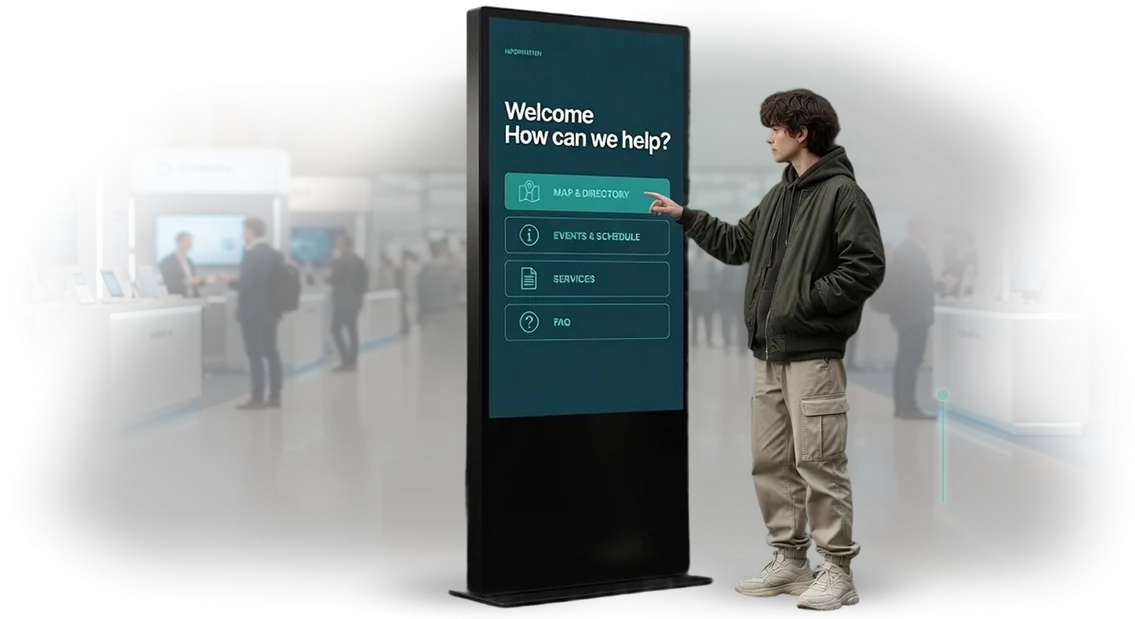
The solution is an interactive product and service catalog for a veterinary terminal. It takes over routine tasks: booking an appointment with a doctor, updating prices, displaying medications and services.
The pet owner no longer crowds at the counter and can attend to their own matters while the system finds the necessary information and arranges the visit.
What does this give the clinic? The flow stops getting stuck at the first step. Queues in the vet clinic shrink, administrators work more calmly, and veterinary service becomes noticeably more modern and caring. This means the owner stays with you instead of going off to find another veterinary clinic.
What Benefits Does a Clinic Get from an Interactive Kiosk
An interactive kiosk in a veterinary clinic is not a replacement for live communication but a way to make it faster and more efficient. The main benefit is obvious: booking a pet appointment takes less than a minute, and the queue in the lobby stops being a headache.
The client chooses the doctor, time, and service themselves, without waiting for the administrator to become available.
Second, staff are freed up. The administrator stops spending time on repetitive actions — booking, reminders, payment processing — and focuses on matters that require personal involvement. This reduces peak-hour workload and lowers the risk of human error.
Third, the kiosk works as an upselling tool. On the screen, the client sees additional services, pet care products, promotions, and prevention programs — things owners often forget to ask about. This increases the average ticket and clinic revenue without aggressive sales from staff.
An additional plus is pet owner loyalty. The ability to quickly book an appointment, browse the product catalog, and receive a visit reminder is a form of care the client feels from the first seconds. The kiosk creates the image of a modern clinic that respects the client’s time.
As a result, the clinic gains greater throughput, freed-up staff hours, and additional revenue — without expanding the team or making significant expenses. The implementation pays off through faster service and a higher average ticket, and clients return and bring their friends.
Interactive Kiosk Formats for Veterinary Medicine
Different veterinary businesses solve different problems: a clinic directs patient flow, a pet store increases the average ticket, a grooming salon fills its schedule.
There is no universal off-the-shelf solution here — it is important to choose a kiosk format that matches your business model so that it pays off from the first weeks.
We design interfaces with visitor scenarios in mind: from quickly finding the needed service to thoroughly exploring the range of food and accessories. Below is a table of typical formats that helps you choose a solution for your task without diving into technical details.
| Kiosk format | For whom | What it gives the client |
|---|---|---|
| Interactive product catalog | Pet stores, veterinary pharmacies | Shows the full assortment, stock levels, and prices. Increases the average ticket through upselling and promotions. |
| Clinic navigation | Vet clinics, hospitals | Helps visitors find the right room and avoid creating queues. Reduces the administrator’s workload. |
| Appointment / grooming booking | Clinics, grooming salons | Visitors choose an available time and service themselves. Fewer phone calls, fewer no-shows thanks to reminders. |
| Service showcase and price list | Clinics, laboratories | Transparent prices and procedure descriptions. Fewer questions at reception, higher trust in the clinic. |
| Info kiosk with additional services | Pet stores, pet hotels | Sells food, toys, subscriptions to regular services. Additional revenue without hiring staff. |
How to Choose a Format for Your Task
If you have a small visitor flow, a single on-screen scenario is enough: a catalog or booking. For a busy clinic, it is better to use a kiosk at the entrance as navigation and information, and a separate terminal in the waiting area as a catalog of additional services.
In all cases, the client receives a control panel where they can independently change prices, promotions, and descriptions. This means the kiosk does not become obsolete: you update content in a couple of minutes rather than waiting for a programmer.
Technically, we use proven touchscreen solutions that start quickly and run reliably — visitors get an instant response rather than a frozen loading screen.
Thus, the right format addresses a specific pain point of the establishment: it increases revenue, frees up staff, and improves the customer experience.
Start with the question, “What should happen with a visitor within 30 seconds at the screen?” — we will configure the rest for you.
How an Interactive Kiosk Implementation Project Works
Implementing an interactive kiosk is not just installing a terminal; it is a structured process that delivers value right after launch. We manage the project turnkey: you get transparent stages, clear timelines, and trained staff, not a “black box” with an unpredictable outcome.
Implementation Stages
- Brief and goals. We determine what the kiosk should solve: product catalog, vet appointment booking, navigation. We document expectations.
- Prototype and scenario. We present the structure of sections and search logic so visitors immediately find what they need.
- Design and content. We create a design in the clinic’s style and adapt the product and service catalog. You approve mockups before development.
- Development and content population. We assemble the system, set up the catalog, and integrate with your data if needed. We verify speed and stability.
- On-site testing. We install the kiosk at the clinic and test it under real conditions: lighting, traffic, touchscreen, visitor convenience.
- Staff training. We provide instruction for administrators and consultants: how to help clients, update the catalog, and resolve common issues.
- Launch and support. We put the kiosk into operation, provide support during the first weeks, collect feedback, and make adjustments.
As a result, you get a tool that from day one reduces staff workload, speeds up product and service search, and increases the average ticket. Well-thought-out launch stages help avoid downtime and unnecessary costs.
What Is Included in the Interactive System Delivery
When ordering an interactive kiosk, you receive a ready-made turnkey solution — without needing to assemble the system from parts or deal with technical details.
The delivery package includes everything needed to launch and run the terminal daily in a veterinary clinic or pharmacy.
Here is what is included in the package:
- Ready-made screens and scenarios. Product and service catalog, clinic navigation, promotions, and useful information — everything is designed for your brand and already configured. Visitors understand how to find what they need from the first touch, and you get an additional sales channel without administrator involvement.
- Catalog control panel. You change prices, add new items, promotions, and photos yourself, without involving developers. Updates appear on the kiosk immediately — no need to wait for a contractor or pay for every edit.
- Equipment and installation. We select a reliable touchscreen terminal for your tasks, deliver it, install it, and connect it. You will not have to search for compatible components or handle setup yourself.
- Instructions for staff. Simple guides: how to turn the kiosk on, replace consumables, and quickly resolve common issues. Staff do not need to be tech experts — everything is described in plain language.
- Training and support. We show how to work with the control panel and stay in touch during the first weeks after launch until the system gets into a steady rhythm.
- Warranty and support. If something goes wrong, you will not be left alone with the problem — we help remotely or with an engineer visit.
In summary: you get not just a kiosk but a working tool that speeds up visitor service, increases the average ticket, and frees up staff. Everything else is our concern.
How a Veterinary Clinic Network Speeded Up Appointment Booking with a Kiosk
The veterinary clinic network VetLife faced a typical pain point: at peak hours, a queue of pet owners formed at the reception desk.
Booking one patient took up to ten minutes: the administrator simultaneously answered calls, searched for the record in the database, and talked to veterinarians. Some clients could not stand the wait and simply left for a competing clinic.
We installed interactive information kiosks in three branches. The system guided the owner through the steps: choose a branch, doctor’s specialty, convenient time, and book an appointment.
The administrator was left only with unusual cases and phone calls, while the kiosk handled routine operations.
Two weeks after launch, we measured the results: appointment processing time dropped from ten to five minutes, i.e., by half. The queue at reception stopped growing even on the busiest evenings.
Owing to a reduction in client losses, the number of visits grew by 12% in the first month, and the share of repeat bookings through the kiosk reached 40% of the total flow.
The main thing is not the numbers but the change in daily routine. Staff stopped working themselves to the bone during peak hours, and pet owners come to their doctor without unnecessary stress.
The kiosk paid for itself in four months and still remains one of the network’s main tools: the clinics have already ordered system development — they added a driving map and reminders about the next vaccination.
How to Choose a Kiosk Format for a Clinic’s Needs?
Every clinic faces the question: which kiosk do we need? There is no universal answer — everything depends on the tasks you want to solve.
One terminal helps book pets for appointments and frees up the administrator, another introduces visitors to the range of food and medications, and a third shows room locations and waiting times. That is why it is important to first define the main goal and only then choose the equipment.
How do you choose a kiosk based on tasks? Start with the visitor flow: if the clinic sees many people per day, you need fast navigation and simple booking to avoid queues. If the product range is wide, the focus should be on a catalog with search and filters.
The location also matters: a tabletop kiosk fits compactly at the desk, while a floor-standing kiosk is clearly visible in the lobby and suitable for self-service.
Our specialists can help you navigate between formats during a kiosk consultation and choose a solution for the clinic’s task.
Selection criteria are not only about appearance. Think about who will use the screen: pet owners of different ages and levels of tech literacy. The interface should be large, clear, and require no long learning curve.
A separate issue is integration with the clinic’s management system: if the kiosk shows current prices and product availability, staff are less distracted by inquiries, and clients have more time to talk with the doctor.
We select the format individually. For a small practice, a compact kiosk with a service catalog is sufficient; for a network, a full-fledged terminal with booking, payment, and multiple scenarios is better.
In any case, the format directly affects the result: a properly chosen kiosk speeds up service, reduces the workload on reception, and creates a modern image for the clinic.
If you are unsure which option suits you, start with a short consultation. We will ask a few questions about the number of visitors, the list of services and products, and desired features — and then propose a solution that fits the clinic’s space and needs.
Leave a request on the website, and we will get in touch and help you choose the right kiosk for your clinic.
Answers to Frequently Asked Questions About Kiosk Implementation
Implementing an interactive kiosk in a veterinary clinic is often held back not by price but by doubts: will staff manage, will clients find it convenient, who will solve problems if something goes wrong.
These fears are understandable — no one wants to get “one more complex device” that requires constant attention.
We address these issues at the briefing stage: we select an interface based on real clinic scenarios, build in simple controls, and provide a clear support system. Below are answers to the questions business owners most often ask before launch.
Will staff be able to work with the kiosk without special knowledge?
For employees, the kiosk works like an ordinary tablet with a clear menu. Training takes no more than an hour, and we deliver all necessary instructions together with the project.
If staff have a question, they can always contact our support — we respond quickly and help remotely.
Who handles maintenance, and what does its cost include?
Maintenance means regular checks of the touch sensor, catalog updates, and connection monitoring. We offer a service package in which we take on these tasks: we arrive on request or monitor the condition remotely.
The clinic owner does not need to think about what and when to update — the system stays current and fully populated.
What about the warranty, and what happens if the kiosk breaks down?
The equipment comes with an official warranty, and the work is covered by our own obligations stated in the contract. In the event of a breakdown, you receive a replacement or repair request as quickly as possible.
Importantly, this means minimal downtime for the clinic: during repairs, we help display the content on a backup tablet so the catalog continues to work.
Will clients understand the touchscreen? What about elderly people?
The interface is designed for your audience: large buttons, clear icons, a simple path from “selecting a service” to “booking.” We test the logic before launch and refine it if we see complicated steps.
For most people, the kiosk is no more difficult than an ATM, and staff are always ready to help at the entrance.
Order a Consultation on an Interactive Kiosk
Veterinary clinic owners often postpone implementing an interactive kiosk, thinking it is complicated and expensive. In fact, all it takes is leaving a request — we will select a solution for your clinic’s tasks and calculate the budget even before work begins.
After contacting us, you will receive:
- An interactive kiosk consultation — we will figure out which functions your patients and their owners actually need: medication catalog, appointment booking, service information.
- Accurate cost calculation for a kiosk tailored to your format — equipment, design, software, and catalog content listed separately, with no hidden fees.
- A solution selection for the clinic: shorter queues at the administrator’s desk, convenient product search, reminders about vaccinations and promotions.
- A proposal in two options — basic and extended — so you can choose the one that best fits your budget.
- Help with content — we will transfer your services, price list, and useful information into a clear interface.
- Launch support — we will train staff and verify that the kiosk works reliably during peak hours.
Submitting a kiosk request takes a couple of minutes. We will call you back during business hours, answer your questions, and send a file with the calculation and implementation options — without obligations or pushy follow-up.
Show that your clinic keeps up with the times: the kiosk reduces the workload on administrators, increases client loyalty, and makes product and service information available at any time. Leave a request — we will start with a consultation and a cost calculation.