

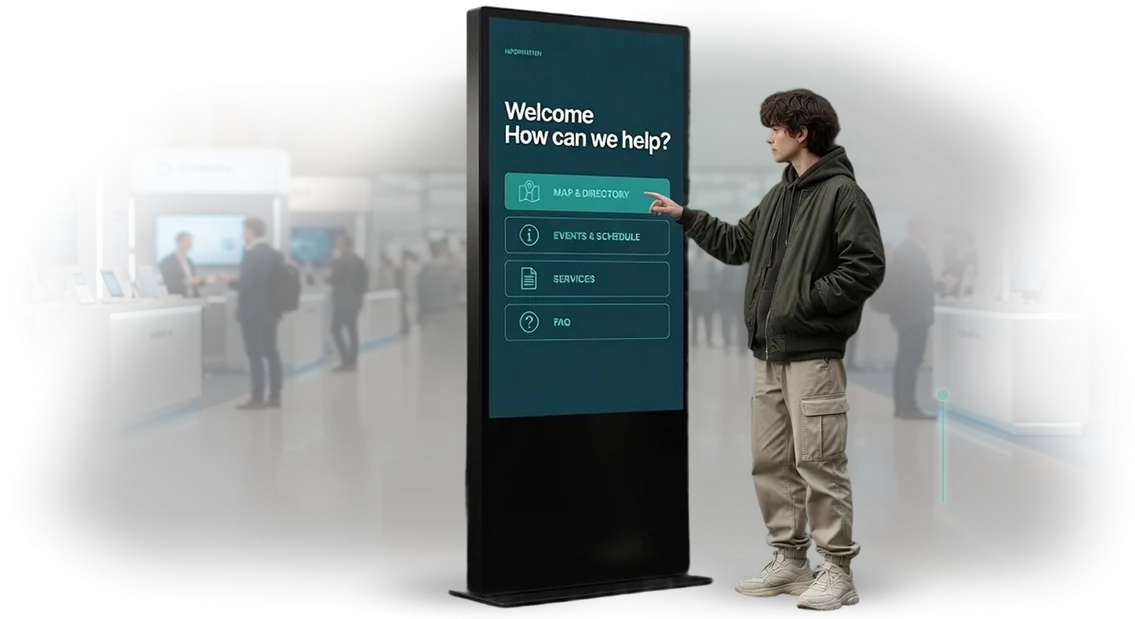
Exhibition Activity Is Missing an Interactive Kiosk
At an exhibition, each booth has only a few seconds of attention. A visitor walks past if they don't see a clear interactive kiosk with a catalog of products and services. As a result, the company loses customers even before a conversation with a manager.
Without an interactive catalog, presentation materials work idle. Visitors don't want to wait for a consultant, flip through paper brochures, or get details from booth staff.
They spend less than a minute at your booth and move to a competitor — and their contacts never enter your funnel.
An exhibition is a race for visitor attention. Hundreds of companies pass through the expo area in a single day, each with its own story.
Retaining interest, letting guests explore the assortment themselves, and still not losing their data is nearly impossible without an interactive tool.
For exhibition activity, this means a double loss: not just a missed contact here and now, but also the absence of a measurable result after the event. Management doesn't understand how many real inquiries the booth brought or what the conversion to negotiations was.
Without these figures, it's difficult to plan the budget for the next exhibition and prove the effectiveness of participation.
An interactive kiosk solves this pain. It holds attention, presents products and services with convenient navigation, lets you quickly collect visitor contacts and pass them to managers.
This way the booth starts generating a measurable flow of customers, rather than just being a place for conversations.
What an Interactive Kiosk Will Bring to Your Booth
At an exhibition, a booth has only a few seconds to stop a visitor. Ordinary brochures and posters dissolve into the flow, while an interactive kiosk works like a magnet: it catches the eye, holds attention, and engages guests. Our team create such solutions for exhibition activity — here is what the client gets.
- [ ] Attracting visitors. A bright touch scenario attracts people on its own — a queue forms at the kiosk, and the booth stands out among its neighbors.
- [ ] Greater reach. Guests approach and explore the catalog on their own, while the consultant remains free for complex questions — more interested prospects are handled.
- [ ] Contact collection. In exchange for useful content or participation in a giveaway, the kiosk asks visitors to leave an email and phone number — the lead base grows without manual effort.
- [ ] Brand recognition. Interactive experiences are remembered; visitors tell colleagues and share on social media — reach continues to work after the exhibition.
- [ ] Booth image. A modern tool reflects the company's level, increasing trust in the product and in the next interaction with your managers.
- [ ] Team relief. The kiosk handles standard questions and presentations, while employees focus on closing meetings and working with hot leads.
Result: an interactive kiosk pays for itself as early as the exhibition — every contact turns into negotiations, and the booth is remembered as a vivid, tech-savvy experience.
Kiosk Formats for Exhibition Activity and Your Goals
An exhibition is hours of intense work where every visitor matters. The format's job is to interest, hold, and push toward action: leaving a contact, viewing the catalog, taking part in a promotion.
The same terminal can serve as an interactive catalog, a product showcase, or a game zone — what matters is choosing a scenario that fits your objectives.
| Kiosk format | Appropriate tasks | What it gives the client |
|---|---|---|
| Interactive catalog | Large assortment, consultation without waiting in line | The visitor finds the right product on their own, staff is relieved, fewer lost leads |
| Touch booth with presentation | Show the product in action, video and 3D review | Holds attention, increases time spent at the booth, strengthens brand impression |
| Exhibition terminal with game or quiz | Attract traffic, collect contacts | Emotional engagement, more contacts, word-of-mouth effect |
| Terminal for sign-ups and surveys | Collect requests, feedback | Direct conversion of visitors into leads, measurable exhibition results |
Formats are easy to combine: a single exhibition terminal can switch between catalog and game depending on visitor flow. We design the interface for touch control so visitors figure it out in a few seconds and your staff aren't distracted by repetitive questions.
We'll choose a format for your task — from a simple catalog to a branded game scenario. We'll show you how it works on a test mockup and launch it by the event date. Leave a request on the website — we'll discuss your case in a couple of days.
How the Project Works: From Brief to Launch
We operate on a transparent scheme: you always know what stage the project is at and what you'll get as a result. No "black boxes" — after each step there is a control point where you make a decision.
- Brief and task analysis. We define the kiosk's goals for the exhibition: what visitors should do — browse the catalog, leave contacts, find the booth. Based on this, we determine the structure and composition of sections.
- Scenario prototype. We show how the guest will interact with the screen: the path from the first touch to the desired action. You see the logic before development begins and can make changes without extra cost.
- Design and approval. We prepare visual styling in your brand's style. At this stage, the screen mockups are approved — you know exactly what the kiosk will look like at the exhibition.
- Development and testing. We build the interface and test it against real scenarios: rapid tapping, long queues, no internet connection. We fix everything before launch so nothing fails at the critical moment.
- Launch and training. We install the software on the terminal, configure it for the hardware, and show your team how to manage the content. You receive a fully operational kiosk exactly on time.
- Support and development. We stay in touch after launch: we update the catalog, add sections, and monitor stability. The kiosk keeps working at all future exhibitions.
What's Included in the Interactive Kiosk Delivery
You get not "hardware with a manual" but a turnkey solution: from the terminal enclosure to trained staff.
No self-assembly from various contractors — all elements of the catalog, equipment, and software are tuned as one mechanism and work immediately after installation.
The standard delivery includes:
- Enclosure and touch terminal — vandal-resistant, with dust and moisture protection, designed for round-the-clock operation in high-traffic locations. The enclosure design can be adapted to match your booth's style.
- Kiosk software — catalog interface, product and service navigation, search, filters, and storage of visitor requests. The software is deployed together with the equipment and is already configured for your tasks.
- Catalog content — transferring your assortment into an interactive format: product cards, descriptions, photos, prices, promotions. We help structure the information so visitors find what they need in 2-3 touches.
- Staff training — we separately train booth administrators and those who will update content during the exhibition: uploading new items, editing prices, adding promotions. No programming skills are required.
- Documentation and access — a simple instruction manual in Russian, a login and password for working with the catalog, and a tech support contact in case of questions.
This is a base package that already fully solves the task of an interactive catalog of your products. If you need more, we'll add CRM integration, visitor contact collection, or a custom enclosure design. Everything is discussed at the briefing stage.
As a result, you get a working attention point for your products, not just a screen on a stand. Visitors explore the assortment on their own, freeing your employees for negotiations with key clients.
Case Study: How an Interactive Kiosk Doubled Exhibition Contacts
At exhibitions, guests walk past booths in 3-5 seconds, and managers often don't have time to ask a clarifying question.
The organizer of the business program Promtech-Expo faced the same problem: paper catalogs gathered dust, and after the event the sales department went through boxes of business cards without knowing which contacts were genuinely interested.
We installed three interactive kiosks with a participant catalog at the entrance to the exhibition hall. Visitors could find the right product by category, review a company card, and leave their contacts in one click. Requests were automatically distributed to exhibitors — no manual processing, no wasted time.
The result the client saw
Over three days of operation, the kiosks collected 1,340 requests from visitors. After the event, the number of qualified contacts for participants doubled compared with the previous exhibition.
Managers also received requests with a precise category of interest and could prepare for calls before the exhibition even ended.
What the client says
"For the first time in the entire history of the exhibition, we saw the numbers on the day of the event, not a month after it.
Participants ordered updated data every evening, and for the next organizing season they asked to expand the number of kiosks by another two points," comments the project manager on the organizer's side.
After the event, the client returned to us for support for the next season. For us, this is the main marker of quality: the interactive kiosk solved a concrete business problem and became part of the exhibition infrastructure.
How to Choose the Right Format for Your Task?
The answer is simple: the format in exhibition activity is determined not by the "coolness" of the equipment but by the specific task of the exhibition.
If visitors need to quickly find products in your catalog, a compact touch terminal with convenient navigation is enough. If you want to hold attention at the booth and create a line, it's worth looking at large-format screens with an interactive scenario.
A common mistake clients make is choosing the largest kiosk "for future growth" or with the maximum set of functions. This leads to overpaying for features that aren't used: the exhibition lasts three days, and all that's needed is a catalog and contact collection.
We help you navigate and honestly tell you when a simple model will do and the budget can be spent on design or an interaction scenario.
Our specialists select the format based on three parameters: the number of guests at the booth, the visitor's target action, and the floor area available.
For a narrow B2B niche, a single terminal with a catalog is enough; for a mass B2C presentation, a combination of a large screen and touch tables works better. With the right scale, you get the coverage you need without unnecessary investments.
You can send us a description of your task, and within a short time we'll offer 2-3 options: from basic to impressive, calculated against your budget. We'll advise which formats deliver a quick return at an exhibition and which ones are better to postpone for a permanent display. That way you make decisions based on facts, not under the influence of advertising.
Common Doubts Before Ordering and Our Answers
An exhibition is all about dynamics: any hiccup with the interactive catalog can cost visitor attention and leads. We've been creating kiosks for exhibition activity for a long time and know the doubts clients have. Here are the most common ones.
Is it hard to install the kiosk before the exhibition?
We configure the system in advance, before delivery. All you have to do is connect power and the network — no more than half an hour, and the catalog is ready to go.
What if the terminal breaks?
We use professional equipment and outage protection: the catalog restores itself. If necessary, an engineer will connect remotely or come on site; repairs or equipment replacement are carried out under warranty.
How quickly are products and prices updated?
No more than an hour — you upload a file or change data in your personal account, and everything appears on the screen. No technical specialists needed.
Who will support us during the exhibition?
A dedicated manager is assigned to you. They will respond within minutes and resolve the issue remotely. The average response time is about an hour.
If you still have doubts, write to us — we'll tell you how it works in practice and prepare a solution for your exhibition.Order an Interactive Kiosk for Your Exhibition
Leave a request on our team and receive a cost estimate for your exhibition kiosk on the very same day. We'll clarify your goals, the number of visitors, and the terminal's location in order to offer an optimal configuration with a load margin and convenience for guests.
What you get immediately after your inquiry:
- Expert consultation: we'll advise which interactive catalog scenario engages visitors best — carousel, category search, or virtual guide.
- Preliminary cost estimate within 1 business day — no hidden fees and no "fine print".
- Interface prototype: we'll show the screen structure before development starts, so you can approve the catalog logic.
- Launch plan tailored to your deadline: we'll map out stages from approval to on-site installation.
- Support at the exhibition: if needed, we'll come, set up the kiosk, check its operation, and train staff.
- Warranty on equipment and software — you get a well-functioning terminal throughout the entire exhibition period.
Ordering a kiosk for an exhibition is one call or a message via the form. After that, we take on the project: we'll prepare the estimate, approve the design and logic, install and launch the system. Meanwhile, you focus on conversations with visitors.
Don't wait until competitors capture guests' attention. Leave a request for a consultation — we'll respond within a business day, calculate the cost, and show you how your catalog will come to life on screen.