

Why Do Visitors Leave a Car Dealership Without Buying?
Visitors come to a dealership ready to buy, but often leave without placing an order. It's not about price or selection — it's about how the car information is presented.
When a customer can't quickly make sense of trims, options, and terms on their own, they lose interest and postpone the decision.
Managers physically don't have time to give everyone enough attention, and a verbal pitch doesn't provide the full picture. The customer remembers about twenty percent of what they heard; the rest drowns in the stream of details.
As a result, they leave to "think it over" — and often come back to a competitor where everything was visual and clear.
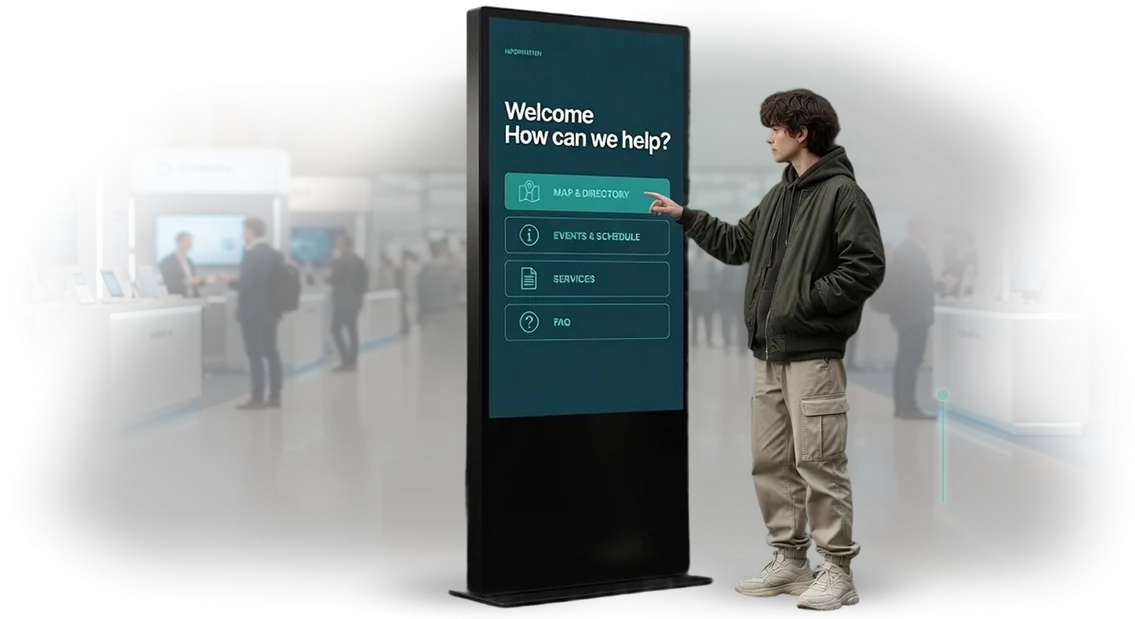
The solution is an interactive kiosk with a car presentation. It lets the visitor explore the model on their own: view the exterior and interior, compare trims, evaluate options, and calculate the cost.
An interactive car presentation works without a manager, at a comfortable pace and with the needed depth — so the customer quickly gets answers to their questions and feels in control of the selection process.
This directly reduces customer loss and increases conversion. A visitor who has explored the car on their own makes a decision faster and with more confidence. The manager steps in at the ready-to-buy stage — spending no time on basic explanations, only on selling and paperwork.
We develop interactive kiosks for the automotive business: from presenting information to collecting potential buyer contacts. Experience shows that this format noticeably reduces walkouts without a purchase and makes the showroom look more tech-savvy in customers' eyes.
What an Interactive Kiosk Gives Your Business
Car dealership visitors rarely want to talk to a manager right away. They need time to explore the models and compare trims. Without that, hot customers leave to "think it over" and never return.
An interactive kiosk removes this barrier: the guest chooses their own browsing pace, and you get engagement, contacts, and purchase readiness.
Benefits for Your Dealership
- Engagement: a touchscreen holds attention three times longer than paper catalogs.
- Leads: the customer leaves their phone number after viewing — you get a base of "warm" contacts.
- Sales growth: hints and comparisons speed up the choice, and the manager closes more deals per day.
- Staff relief: the kiosk answers common questions, and managers only work with ready-to-buy customers.
"We installed a kiosk in the showroom — within a month we collected 140 leads and saw real demand for trims. Now it's part of our sales system," — head of sales at the «AutoPrime» dealer.
How It Works
The kiosk guides the customer through a scenario: from body type selection to test-drive booking. Every action is recorded, so you see which models are of interest. This data makes it easier to plan advertising and inventory.
We handle the scenario, design, and setup. All you have to do is gain engagement growth, a lead flow, and increased sales. Leave a request — we'll discuss a scenario for your dealership.
Interactive Solution Formats for a Car Dealership
A buyer at a dealership makes a decision when they see their future car in detail. Paper catalogs don't provide that level of clarity. An interactive kiosk in the showroom helps explore models, compare trims, and creates the impression of a modern dealership.
We match the format to your goals: from a large display at the entrance to a compact touch panel in the waiting area. What matters is not just installing a screen, but a scenario that guides the customer toward a choice.
Which Formats Suit a Dealership
| Format | For whom | What it gives the dealership |
|---|---|---|
| Interactive display | Entrance area, showroom | Attracts attention, highlights new models, creates a "wow" effect before talking to a manager |
| Touch panel with catalog | In-showroom work with a customer | Full model lineup and trims without paper brochures, quick selection |
| Interactive table for option selection | Meetings with a manager | Visual car builder, feature comparison, shorter deal time |
| Stand in the waiting area | Self-service exploration | Keeps guests occupied, boosts loyalty, collects contacts for the sales department |
We adapt the format to the showroom's style and presentation logic: new models, promotions, comparison tables. The solution works as a catalog, a display, and a consultant's tool.
In the end, the customer gets more value from their visit, and the dealership gets more qualified inquiries.
Stages of Developing an Interactive Presentation
Developing an interactive presentation for a car dealership is a transparent process: you see every stage and control the result. We record the brief, approve decisions, and launch the project within the agreed timeline. Below are the 6 steps we work by.
How the Work Goes
-
Brief and goals. You tell us about the dealership, models, and visitors. We clarify what the kiosk should give the customer: introduce new models, help choose a trim, book a test drive. We set the timeline.
-
Concept and scenario. We propose the screen structure: what the visitor sees at first, how they move between models, what we emphasize. We approve the texts and logic before design begins.
-
Design and prototype. We create mockups in the dealership's brand style. You see the future kiosk before assembly and can make edits — this is cheaper than redoing it after launch.
-
Assembly and content. We turn the approved mockup into an interactive presentation, adding photos, specifications, videos, and test-drive request forms.
-
Testing. We check all scenarios on the touchscreen: response speed, navigation usability, button behavior. We fix issues so visitors never face freezes.
-
Launch and support. We install the project on the kiosk and train the staff. After launch we stay in touch: we update models, change promotions, and refine features on request.
Each stage ends with an approval, so you always know what you're getting. This approach saves your time and gives a predictable result for the dealership.
What You Get When You Order
Ordering interactive kiosk development means getting a complete solution, not just a "program on a disc." We build a turnkey project: from scenario to post-launch support.
This saves your team's time and eliminates a situation where several different contractors share responsibility for the result.
What's Included in the Package
- Interaction scenario. We design the screen structure, navigation logic, and hints so a dealership visitor finds the right model, trim, or promotion on their own.
- Brand-style design mockup. We adapt the visuals for touch control: large buttons, readable text, car photo gallery, and video reviews.
- Software. We install and configure the software on your hardware, checking touch response, sound, and content updates.
- Support and maintenance. We help promptly — by phone or remotely. We make changes to the catalog, prices, and promotions without lengthy approvals.
- Staff training. We provide a short guide for managers: how to start the kiosk, replace content, and what to do if the screen "freezes."
- Warranty and launch. We check all scenarios before handover and help with on-site installation if needed.
Each item solves a specific problem: guests don't get lost in the interface, the brand looks modern, and employees don't get distracted from visitors. All work is documented in the contract, so you know the timeline and scope in advance.
After launch, you're not left alone with the equipment. Support is included in the cost — contact us for changes whenever new models or promotions appear. This is more convenient than looking for a new contractor every time.
Case Study: How We Increased Sales for a Dealership Center
One of our case studies is the Автопремиум dealership center. Its pain point is familiar to any showroom: during peak hours managers couldn't keep up with consultations, and paper catalogs didn't hold attention. People left before reaching the test-drive department.
We proposed interactive information kiosks — a virtual showroom where the buyer explores the model, compares trims, and leaves a request on their own.
How We Solved the Task
The kiosks didn't replace live salespeople — they became a digital assistant. On the touch panel, a visitor chose a car, viewed trim options and features, and at the end got a QR code to book time with a manager. This relieved staff during the busiest times and kept the guest engaged even when a queue formed.
Results We Achieved
Two months later, we compared the results with the dealership center's accounting system and recorded sales growth:
- conversion from visitor to test drive nearly doubled;
- average self-service car exploration time increased from two minutes to 7–8;
- sales grew 28% with the same customer flow;
- customers started returning to the showroom — to clarify details on the kiosk.
The head of sales said at the time: "We stopped losing buyers during peak hours.
People get acquainted with the car on their own, and the manager steps in with an already interested customer." After the first phase, the dealership center ordered system expansion to two more of its showrooms — the best sign that the case worked.
How to Choose the Right Format for Your Task?
Choosing the interactive presentation format starts with the question: what should the touch panel do for your business? If the goal is to introduce visitors to the model lineup and provide basic information, a structured catalog is enough.
If you need to hold attention and highlight the car's key advantages, a scenario with visual comparisons and an emphasis on important details is better.
For a car dealership, the key is not to overload the screen. The visitor is in a showroom, distracted by sounds, movement, and other customers. So the format should guide a person along a short path — from the first touch to the right model or the answer to a question.
A thought-out structure helps show the essentials in 2–3 minutes, then shift the customer's attention to a manager. That's how a touch panel becomes not interior decoration, but a working sales tool.
Rely on real usage scenarios. Common questions, sticking points, trim comparisons — all of this can be placed in separate blocks. If your task is to collect requests, add a clear feedback form on the last screen.
If you need to train managers, provide a mode with detailed specifications. Choosing a format always comes down to one thing: what action should the user take after interacting with the panel.
In our practice, we don't offer a ready-made template; we start from the goals of the specific dealership. At the first step, we record the goals, audience, and list of key models, then select the structure and visual style.
This approach eliminates unnecessary screens and makes the presentation understandable even to those who don't know cars. In the end, you get a tool that works for results — it helps sell, not just entertain visitors.
FAQ About Development and Operation
Any car dealership owner asks the same questions before ordering an interactive touch panel: what if the equipment breaks down, how often will the presentation need to be updated, and how long will launch take.
That's normal — a kiosk works in a busy place and must be as reliable as your business. Below we address the main concerns and show how we handle them at the project stage.
What happens if the kiosk or touch panel breaks?
We use professional equipment designed for intensive use in public spaces. All work and components are covered by warranty, and after launch you get direct contact with an engineer.
In an emergency, a specialist diagnoses the problem remotely and, if needed, replaces the equipment as quickly as possible. Kiosk downtime means lost leads for the dealership, so we build in a backup scenario and keep spare modules.
Is it difficult to update the information on the kiosk?
Content needs regular updates: new models, promotions, price changes. We make it so updates take minutes, not days. You get an easy-to-use admin panel where you can change text, photos, and videos without involving developers.
Changes publish immediately, and visitors see up-to-date information. If needed, we take on maintenance ourselves and regularly refresh the presentation to match your goals.
How long does launch take from the moment I submit a request?
A typical project — from brief to working kiosk — takes 10–14 days. This includes interface design, scenario programming, content filling, and on-site testing. If you have ready-made materials (logo, car photos, model descriptions), launch can be speeded up to a week.
We work remotely, so you don't need to allocate space or meet specialists — just approve the mockups and connect the kiosk to the network.
Who is responsible for the kiosk after the project is handed over?
We don't disappear after launch. The base price includes warranty service and operation consultations. If you wish, we add an extended plan: monthly monitoring, equipment maintenance, and prompt support.
For you, this means peace of mind: the panel will work reliably, and any issue gets resolved in working mode. A kiosk is a sales tool, and we make sure it never lets your managers down.
If you still have a question — just call us. We'll tell you how a kiosk fits into your showroom, show examples for the automotive business, and propose a scenario that will increase the time a customer spends with your cars.Order Interactive Kiosk Development
Ordering interactive kiosk development for a car dealership means getting a tool that helps visitors explore models, trims, and promotions on their own while managers are busy with other guests.
The kiosk doesn't get tired, doesn't get distracted, and instantly produces the right information, while the visitor feels more confident and makes decisions faster.
After ordering, you receive:
- A ready concept and design mockup in the showroom's style — the kiosk becomes part of the interior and emphasizes the brands' status.
- A user-friendly interface that any visitor understands: even someone using a touchscreen for the first time will easily find the right model or promotion.
- Content filling: trim descriptions, prices, photos, video reviews, and test-drive booking — everything is already uploaded and verified.
- A simple update system: the manager changes prices, promotions, and new models on their own, without spending time coordinating with programmers.
- Staff training and a short guide so employees confidently help guests and use the kiosk in sales.
- A workmanship warranty and prompt support: if a question arises, you get feedback without long waits.
Leave a request via the feedback form — we'll call you back within a business day and schedule a consultation. We'll discuss your dealership's goals, the right kiosk format, development stages, and launch timeline.
You can order development right now: we'll start by discussing your goals, and you'll see how an interactive kiosk fits into your showroom and starts driving sales growth.