

Guests leave for competitors — how can festival interactivity keep them?
A festival is a battle for guests' attention. Hundreds of booths and entertainment options surround them, and you have just a few seconds to get a visitor interested.
Ordinary tables and flyers don't hold attention: people walk past, lose interest, and drift toward flashier neighbors. As a result, the organizer loses not only a brand impression but also real contacts of future clients.
Without a retention tool, every guest is just a passerby. They don't stop at the booth, don't explore information, and don't leave their data. Yet it is at festivals that a live audience is formed — the audience that later returns and brings friends. A lack of interactivity quietly eats away at your reach and leads.
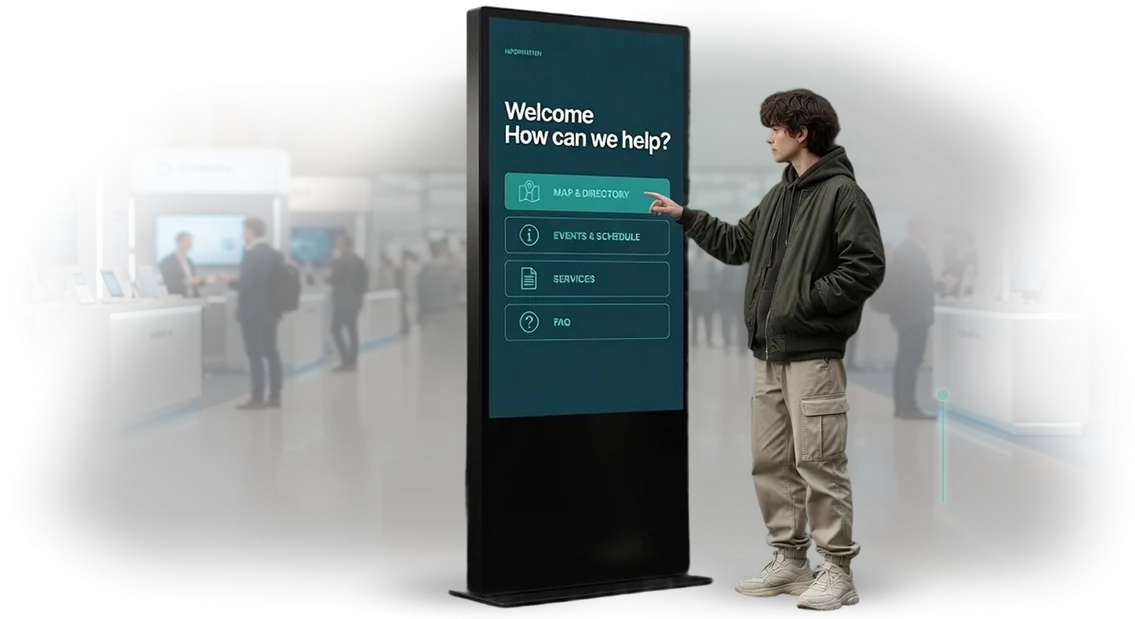
An interactive kiosk with a touch panel turns attention into results: guests engage in a game or presentation themselves, spend several minutes at the booth, and willingly leave their contacts.
Wehelp make this happen — from concept to a finished kiosk that works to retain guests and collect leads. A professional touch panel won't hang or glitch at the height of the event.
Instead of passive observation — active participation. The touch panel attracts both children and adults, creates a queue, and therefore draws attention to the booth. At the same time, the contacts collected stay with you, rather than scattering into other databases.
This kind of festival interactivity keeps guests engaged until the end of the event and gives you a measurable base for future mailings and repeat sales.
What you get from an interactive presentation on a touch panel
Guests come to a festival for experiences, not for text on a banner. An interactive touch panel is a format that stops people, holds attention, and creates an emotion even before the visitor reaches the main stage.
For the organizer, this is not just entertainment but a working tool: it helps fill the program, collect contacts, and deliver measurable results.
We create interactive presentations for the needs of a specific festival: from quizzes and location maps to voting and game mechanics. Here are the key benefits you get from the moment the panel launches.
- Guest engagement without staff effort. The panel works on its own: it attracts attention, guides guests through the scenario, and doesn't require an employee standing at the screen. Guests don't crowd in line — they get involved in the process and have a positive experience.
- Visitor data collection. Through interaction, you learn who came, what they are interested in, and what matters to them. This data can be used immediately — for example, offering the guest a newsletter subscription or an invitation to the next event.
- Strengthening the festival's image. A modern interactive point is seen as a sign of quality: people trust the organizer, talk about the event, and share it on social media. The panel becomes part of the visual style and stays in memory.
- Return visits. A guest who spent an interesting time and got a personal result (certificate, photo, route recommendation) is more likely to come back and bring friends.
Different zones of the festival suit different mechanics: a quiz in the waiting area, a route map at the entrance, voting on the main stage.
The set of ready-made scenarios has already been tested at events of different formats, so you don't need to test an idea from scratch: we'll choose a solution for your goal and adapt it to your festival in a short time.
Interactive kiosk formats for events and occasions
Every festival follows its own scenario: somewhere you need a quick overview of the program, somewhere a deep partner presentation, and somewhere guests should choose their own route. The same touch kiosk can easily be adapted for a stage, business area, or entrance group. That's why we pick the format to fit the task, not the other way around.
Below are three main options that cover almost any request from organizers and event partners.
Options for festival tasks
| Kiosk format | Who it suits | What the client gets |
|---|---|---|
| Standard kiosk | Organizers who need fast launch and a clear interface | Ready-made solution with standard design and logic. Launched in a few days, easily filled with the festival program, map, and schedule |
| Custom project | Brands and partners who want to stand out and surprise guests | Unique design, non-standard interaction scenarios, and engagement mechanics tailored to a specific venue. Full control over the visitor's experience |
| Kiosk rental | Teams trying interactive for the first time or running a one-off event | No equipment purchase costs. Fast launch, on-site technical support, transparent budget with no capital investments |
A standard kiosk is suitable when the main things are informativity and stable operation throughout the day. A custom project is for when it's important to create a wow effect and engage the guest in a dialogue with the brand.
Rental is convenient for a trial run: you assess the audience's reaction and decide whether to scale the format to future events.
In any option, guests get a simple and clear interface: the festival program, location map, performance schedule, and partner information. Organizers get a tool that reduces staff workload and collects data on what visitors are truly interested in.
How we create a festival presentation: 5 stages of work
A festival is high intensity: thousands of guests, information noise, and only a couple of seconds to capture attention. An interactive presentation must be ready exactly for the start — without failures or long approvals on the last day.
That's why we turn the creation process into five clear stages — you always know what's happening, who is responsible for what, and when the result will be ready.
It all starts with a brief: we discuss the event format, guest profile, key touchpoints with the screen, and goals. Then we assemble the scenario and concept, showing you the interactivity logic to resolve all questions before the design is even drawn.
After the structure is approved, we create the visual style and software part, sending intermediate versions for approval. Before launch, we run final testing — on the same touch panel models that will be used at the festival.
And at the event itself, we deliver, install, check everything, and stay in touch with the venue team.
- Brief and immersion — we call with you, break down the tasks, audience, installation location, and technical requirements.
- Scenario and logic — we propose the screen structure, navigation, and guest behavior scenarios, and align them with you.
- Design and development — we create the screen's visual identity, animation, and interactive scenes, showing intermediate versions.
- Testing and approval — we check performance on touch equipment, fix issues, and get final sign-off.
- Launch and support — we deliver, install, train staff, and accompany you during the festival days.
In the end, you get not just a "picture on screen" but a working tool that helps guests navigate and engages them interactively. No fuss and no unexpected surprises at the height of the event — only a predictable launch and positive visitor emotions.
What's included in the delivery: a complete set for your event
You get not "just a program" but a ready-to-launch interactive kit for the festival: from scenario to files and support. Everything is already packaged, tested, and adapted to your task, so installation takes minimal time, and the result won't fail you on the event day.
What's included in the delivery:
- An interactive presentation scenario themed around the festival: greeting, location navigation, surveys, and guest contact collection.
- Source design files — editable layouts where you can independently change the logo, dates, program, and texts.
- A ready installation kit for the touch panel: upload to your equipment or a rented kiosk.
- A launch guide for staff: setup in 15 minutes, answers to typical visitor questions, and procedures in case of failure.
- Technical support on the event day: a specialist is available before and during the festival, helping quickly if something goes wrong.
- Content updates after the festival: we'll make changes to the schedule, poster, or participant list for free if they change.
This set eliminates surprises at the most critical moment. You get predictable interactivity that looks professional, launches quickly, and handles a large flow of guests.
Case study: festival interactive collected 10,000 contacts
Collecting visitor contacts at a festival is no easy task: people come to relax, not to fill out forms. Ordinary stands with paper forms go unnoticed, and handing out flyers doesn't produce measurable results.
Organizers get vague reach and rare fragments of data instead of a database for future events and mailings.
We solved this task for the City Colors festival. Instead of a static banner, we set up an interactive kiosk with an engaging quiz about the city. Passersby approached on their own, answered questions, and then left a phone number or email to receive a personal result.
During the festival, the kiosk collected 10,000 contacts — nearly half of the guests left with a completed request.
Why it worked
The key was giving guests something valuable, not just a "take a flyer" approach. The quiz engaged people, sparked excitement, and motivated them to share their results.
The organizers didn't get one-off touches but a ready-made database for mailings and targeted advertising. Repeat visits and ticket sales after the event confirmed that the contacts were "hot" — people remembered the brand.
From a budget perspective, such interactivity pays for itself several times over: you build it once and use the database throughout the year.
Plus, the kiosk itself became a point of attraction: a queue gathered around it, increasing time spent at the booth and creating genuine interest among other visitors.
The client was so pleased with the result that they ordered similar interactivity for the next season. For us, that's the main indicator — it means the tool delivers real value, not just a pretty picture.
How to choose the right interactive kiosk format?
There's no universal "best" format — the right option depends on the goal, audience, and budget.
Before ordering an interactive kiosk, decide what task it should solve: attract attention to the booth, entertain guests in line, help choose a tariff, or collect contacts of potential clients.
For large events with a diverse audience, large touch panels with a simple interface are optimal — they don't intimidate older people or children and work even in a crowd.
If the target audience is young, active, and used to digital services, you can emphasize gamification: tests, quizzes, or a "lottery app" with prizes. Such mechanics hold the guest at the booth 2-3 times longer, increasing contact time with your brand.
The budget most often determines not technical complexity but the depth of the interactive scenario. A small budget — one or two clear screens with a presentation and lead collection.
A medium budget — add a quiz with a results board, a photo with a branded frame, and automatic sending of the photo to the guest's email.
A large budget — create an entire interactive zone with several panels, where guests walk through a scenario from meeting the brand to receiving a promo code.
Remember that a kiosk at a festival operates under maximum load: hundreds of people approach it, and each one has 10–30 seconds of attention.
So more important than "extras" is a clear interaction scenario: large buttons, instant screen response, and minimum steps to the result.
We choose the format based on your tasks and the specific event — depending on who your visitors will be and what action you want them to take.
Frequently asked questions about interactive kiosks for events
Festival organizers ask us the same things: what if the equipment fails at the worst moment, will you make it in time for the event date, and will the budget balloon. That's normal — the event's reputation and guest experience are at stake. So we answer common questions in advance.
What happens if the kiosk stops working during the festival?
We provide a warranty on the equipment and take on technical support throughout the entire event. Our specialist is on duty at the venue: they respond instantly to any failures and restore operation so guests don't notice a pause.
Will you have the kiosk ready by the event date?
The standard development time for an interactive kiosk is from 5 business days. For festivals with fixed dates, we offer an accelerated format: we take the project into work right after the brief and align each stage so everything is delivered in 3 days. The main thing is to send us the content materials in advance.
How much does an interactive kiosk for a festival cost?
The cost depends on the number of scenarios, design complexity, and equipment format. We fix the cost in the contract after the brief and don't change it during the process. The estimate immediately includes rental, delivery, installation, and support — with no hidden fees.
What does technical support include?
Support includes remote monitoring, backup equipment, and an engineer present at the venue on the event day. This means any issue is resolved within a few minutes, and your staff can focus on guests rather than technology.
Discuss your festival task — get a proposal in 1 day
Leave a request — we'll call you back the same day and discuss the task. Tell us where the festival will be held, how many guests are expected, and what result you need: visitor engagement, social media reach, or on-site navigation. That's enough to move to specifics.
Within just 1 day, you'll receive a commercial proposal with cost and timeline estimates. No unnecessary approvals or technical details — only clear options you can show to management and put into action.
The proposal includes:
- Task clarification: an interactive presentation scenario tailored to the festival format — from navigation to a game quest.
- Format consultation: touch panel, projection, or mobile version — we'll select the right one for the venue and reach.
- Cost and timeline estimate: we fix the scope of work and the completion date before the event starts.
- Scenario prototype: screen structure and interaction logic, so you can see the solution before development.
- Festival support plan: on-site testing, a backup plan in case of issues, and help for your team.
- Post-launch support: refinements and content updates for future events.
This approach has been proven at events of various scales — from city celebrations to business forums. You get a clear plan that covers the festival's goals and doesn't require technical resources from your team.
Leave a request for a consultation — we'll prepare a proposal for your festival in 1 day. This doesn't obligate you to anything: we start with a short conversation, and it's simple from there.