

Bring Galleries or Contemporary Art Exhibition Spaces to Life
Visitors don't linger at the most interesting exhibits: the walls speak to them in the language of labels. Even in a gallery or contemporary art exhibition space, the display loses its emotional charge when the viewer has to wade through dense descriptive text.
The modern brain scans the space in seconds looking for a familiar interactive element — and, not finding one, moves on.
Passive contemplation leaves no trace. The guest photographs the overall view, glances briefly at the displays, and walks out in a few minutes with the feeling of having seen something but remembered nothing.
Yet it is precisely art that calls for dialogue: only when a person uncovers meaning for themselves does that impression arise — the one that makes them come back.
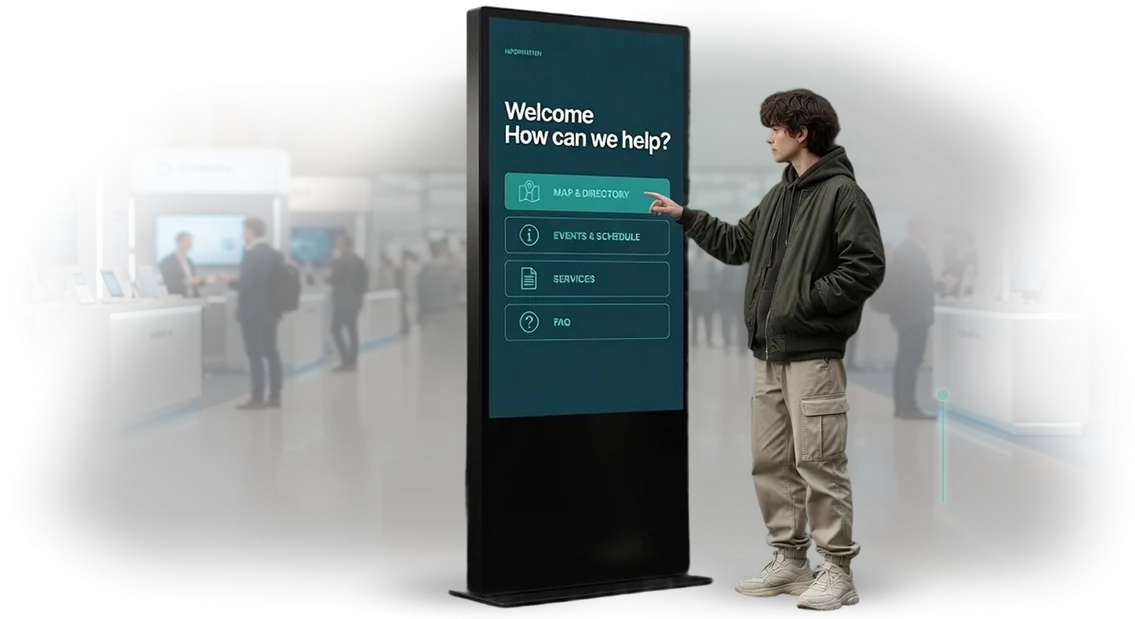
An interactive kiosk turns this silence into a conversation. Visitors choose for themselves what to explore: browse the artist's story, zoom in on a detail, compare early and late fragments.
Instead of a pre-scripted route, they get a live exploration in which each person has a personal experience with the exhibition.
This kind of engagement changes visitor behavior: they linger at the screen, return to works they've already seen, and share their discoveries. For the gallery, this means more time in the halls, a deeper impression, and a higher chance of a return visit.
We create this effect with interactive kiosks that are carefully integrated into the space's concept and reveal the art from an unexpected angle.
What an Interactive Kiosk Will Bring Your Exhibition
An ordinary label next to an exhibit holds a visitor's attention for a few seconds. An interactive kiosk turns the encounter with art into a dialogue: the visitor chooses the depth of immersion themselves and remembers the exhibition as a whole.
More Time at Each Exhibit
Each work gets its own story — video, curator commentary, sketches, and close-ups. The visitor stays for several minutes instead of a quick glance, has time to absorb the artist's intent, and shares the impression with their companions.
Memorability and Brand Recognition
A vivid interaction with an art object is an emotion people want to experience again. Guests post photos and videos and tag the gallery on social media — the space gains organic reach and becomes firmly associated with contemporary art.
Leads and Contacts for the Gallery
Through the kiosk, visitors can subscribe to a newsletter, leave a request for a tour, or receive an invitation to a new exhibition opening. Each exhibition becomes a database of interested contacts you can work with after the event ends.
Repeat Visits
The kiosk remembers guest preferences and suggests which new works are worth seeing. Personalized recommendations and announcements of private viewings bring visitors back — visit frequency and interest in the gallery's program grow.
Our team delivers such a kiosk turnkey: from scenario and design to installation and training for your staff.
Format for a Gallery or Contemporary Art Exhibition Space
In modern galleries, visitors expect not only a visual impression but also a clear narrative about the exhibits. Some guests want to orient themselves quickly and head to the hall that interests them; others want to stop and explore the context of a work.
The choice of information kiosk format directly affects whether you can hold attention and build a route through the exhibition.
Choose a Format to Match Your Scenario
We start from the needs of the hall and the placement zone. A floor-standing kiosk, wall-mounted kiosk, mobile cart, or slim information panel — each option solves its own task. The same content can perform differently depending on where and how the touchscreen is installed.
| Format | Who it's for | What it gives the client |
|---|---|---|
| Floor-standing kiosk | Permanent exhibitions and large halls where a stable reference point is needed | Withstands visitor flow, stands out as an art object, provides room for a large screen and expressive graphics |
| Mobile cart | Temporary exhibitions, partner projects, events with changeable layouts | Easy to move and remove, requires no installation, suits changing locations — saves the team time |
| Wall-mounted kiosk | Small halls and walk-through areas where it's important to keep the space open | Takes up minimal floor space, looks like part of the wall, directs attention to a single work |
| Information panel | Entrance areas, navigation, multimedia guides | Quickly answers the guest's main questions, reduces staff workload, sets the tone for the exhibition |
At the same time, every format is built to order: the cabinet color, screen size, and mounting method are matched to the style of the space. This way the kiosk becomes not an extra element but part of the exhibition.
How We Build an Interactive Kiosk for Your Project
We know that for a gallery or exhibition space, an interactive kiosk is not just a screen but part of the exhibition. That's why the process is structured so that at every stage you understand what's happening, when the result will be ready, and who is responsible for it.
You don't need to dive into technical details — we make all decisions together, lock in deadlines, and agree on key steps.
-
Brief and project immersion. We study the space, the audience, and the exhibition's goals. We clarify which content matters, how visitors move through the hall, and what impressions should remain. The result is a clear understanding of objectives and success criteria.
-
Concept and scenario. We propose the interaction logic: what the guest sees at the start, how they switch between sections, and what materials are available. We develop a visual style that fits the exhibition and doesn't pull attention away from the works.
-
Approval and work plan. We lock in the scope, timeline, responsible parties, and delivery milestones. You receive a document where every task is tied to a date and a person. No "we'll figure it out later" and no surprise edits on the last day.
-
Design and implementation. We create the interface and assemble texts, images, video, and audio into a single structure. We configure touch zones so that control is intuitive even for those approaching the panel for the first time.
-
Testing and debugging. We test scenarios on a real panel: quick taps, long text, simultaneous use. We eliminate errors and bring response speed to a comfortable level. You receive a preliminary build for final approval.
-
Installation and launch. We install the structure, tune it to the specific location, and train your staff. After launch, we stay in touch: we answer questions, update content, and make sure the kiosk keeps running reliably.
What's Included in the Delivery: Launch Package
We deliver a turnkey package — you get a working system, not a set of parts. Our goal is for the kiosk to start delivering value from day one: attract visitors, be easy to manage, and require no technical knowledge from your team. Everything needed for launch is already included in the cost.
- Hardware. A touch panel with a bright screen and a sleek cabinet — it will fit into the gallery or exhibition hall and withstand constant use by hundreds of visitors.
- Software. An easy-to-use management system: you change exhibitions, update work descriptions, and upload new materials yourself, without involving programmers.
- Content setup. Design mockup, processing of your images and texts, configuration of interactive scenarios — the presentation looks professional and matches the style of your space.
- Installation and configuration. We deliver the equipment, install it, connect it, and verify it works on site. You won't need to search for contractors or coordinate multiple teams.
- Staff training. We provide a short training session for administrators and floor attendants: how to turn on the kiosk, launch the right scenario, update content, and resolve common issues — an hour is usually enough.
- Warranty and support. We provide an official warranty on the hardware and stay in touch after launch. We help with updates and provide advice whenever questions arise.
This package covers all stages — from delivery to the first visitor. You receive a finished point of engagement with your audience, not a "build-it-yourself kit" that needs assembling and refining.
Case Study: How an Interactive Kiosk Brought an Exhibition to Life
The private contemporary art gallery Art-Potok had a problem typical of exhibition spaces: visitors walked through the halls in 15–20 minutes and left without leaving contacts or feedback. The curators knew the exhibition was strong, but without engagement, viewers quickly lost focus.
We proposed installing an interactive kiosk at the entrance to the central hall. On the touch panel, guests could choose an artist, view the story behind the works, and play video interviews — all controlled with simple taps, with no staff assistance.
To keep the screen from distracting from the art, the interface was made large and clear — suitable for both adults and children.
What Changed
The average time spent viewing the exhibition grew 2.5 times: visitors began lingering at each work instead of walking past. The number of positive reviews in the visitors' book and on online maps increased by 40%.
They also noted that the kiosk became a gathering point for groups — people discussed what they'd seen right at the screen.
The Result for the Gallery
A month later, the gallery ordered a second kiosk for a new hall and began using the panel as its main tool for collecting visitor contacts.
For us, that's the key indicator: the interactive element didn't just "decorate" the exhibition — it began delivering measurable value: longer dwell time, more genuine reviews, and a repeat order.
Frequently Asked Questions and Client Concerns
Before launching any interactive project, you ask yourself the same questions: what happens if the equipment fails in the middle of an exhibition? How hard will it be for staff to update content? And how many years will the kiosk last without major investment?
That's normal — we hear these concerns from every second client. A professional approach to design and service support removes almost all these risks, so let's go through the typical worries.
What if the touchscreen kiosk breaks down during an exhibition?
We design the system so that critical components are protected and operate reliably. If an unusual situation does arise, you won't be left alone with the problem: the package includes a clear instruction manual for staff, and our support is available during business hours.
In most cases, the issue is resolved over the phone or via remote connection in 15–30 minutes. If a part needs replacing, we'll provide a spare kit in advance — so the exhibition keeps working while repairs are underway.
Can gallery staff manage the kiosk and update content themselves?
Yes, no programmer is needed. We develop a simple admin interface: upload a new exhibit description file, replace images or video, change the slide order — everything takes a couple of minutes through an ordinary browser.
Staff training takes no more than an hour, and clear in-system hints rule out mistakes. Any of your employees can update the information for a new project on their own after a short instruction.
How long does an interactive kiosk last, and when will additional investment be needed?
We use industrial components designed for long-term round-the-clock operation — unlike consumer devices that overheat and fail quickly. With careful use, the equipment lasts 5–7 years without significant investment.
Routine maintenance consists of basic cleaning (dust removal) and software updates once or twice a year — this takes minimal time and is usually covered by the contract. Replacing consumables, if needed, will cost only marginally relative to the overall cost of the exhibition.
How safe is the kiosk for visitors, especially when there are children among the guests?
The cabinet design and materials are chosen with the understanding that children and elderly people may approach the screen. The touch surface is sturdy and the cabinet is stable — the kiosk can't be accidentally tipped over or damaged by active tapping.
There are no sharp corners or protruding elements, and protective glass prevents scratches and chips. The electronics are insulated, so there's no risk of electric shock.
We also provide a screensaver mode: when few visitors are around, the screen switches to a power-saving mode and wakes on touch — this protects both the equipment and electricity.
Before starting work, we always offer to test the kiosk at your venue for a few days — so you can see it working in conditions as close to real life as possible and make sure every technical issue is solvable. If any doubt remains, don't hesitate to ask directly — we'll discuss the details on a short call.Launch an Interactive Kiosk This Season
The exhibition season won't wait — a new project takes preparation in advance. An interactive kiosk helps a gallery stand out and hold guests' attention: visitors choose for themselves how to explore the exhibition, which increases dwell time and how memorable the show is.
We handle the entire journey from idea to launch. Submit a request, and we'll provide a consultation, clarify the goals and specifics of your space, and prepare an individual estimate.
The proposal will include exact timelines and the scope of work, with no hidden stages or unexpected surcharges.
What You Get When You Reach Out
- Request on the website — we'll get back to you within a business day and answer your initial questions
- Format consultation: we'll advise what suits your exhibition best — a touch panel, multiple locations, or an interactive zone
- Project estimate: we'll factor in the number of screens, interaction scenarios, and interior specifics
- Proposal with exact timelines: you'll know the launch date before the work even begins
- Adaptation to your space: we'll create a design in the exhibition's style, not a template solution
- Support after launch: we help update content and quickly resolve any issues
Submit a request to get an estimate for your project. We'll prepare a proposal within a few days — and you'll have plenty of time to launch the kiosk this season.
How to Choose the Right Interactive Kiosk Format for Your Exhibition?
There's no universal kiosk for every gallery — and that's a good thing. Choosing a format comes down to three criteria: the exhibition's goals, the hall's floor area, and the audience.
If you answer these before development begins, the interactive element will enhance the impression rather than become an obstacle.
The exhibition's goals determine how much information needs to be conveyed and what role the interactive element plays. For getting acquainted with the collection or navigating the halls, a compact kiosk with a catalog and map is enough.
To immerse visitors in the artist's world, show the story behind the works, or reveal the process, a large touchscreen with video content and a tactile scenario is needed.
The floor area of the room dictates the placement format. In small halls, wall panels or slim stands work well — they don't break the visitor route and save space.
In spacious areas, floor-standing kiosks with large screens and queue zones perform best: visitors don't crowd around but take turns exploring the material.
Finally, the audience determines how simple the interface should be. For families with children or elderly visitors, we make large buttons, hints, and short scenarios — 1–2 minutes per session.
For a young, tech-savvy audience, we can add multi-level navigation and additional materials. The same content performs differently depending on the format — and that's the true measure of a good choice.
We select a format for your goals and hall parameters, then adapt the interface and scenario to your specific audience. As a result, the kiosk becomes a point of attraction, not just a terminal with information.