

Conference Visitors Are Lost Without Interactivity
At business conferences, the competition for visitor attention is enormous: hundreds of booths, dozens of speakers, an endless flow of information. A guest walks the exhibition in 15–20 minutes and only stops where they can participate, touch, and see a result.
Ordinary brochures and passive demonstrations no longer work — the booth becomes part of the background, and our team is left without new contacts.
When there is no interactive element at the booth, a potential client does not linger and does not ask questions. This directly leads to low interest in your product and lost leads: you paid to participate, but did not collect a database of interested companies.
Guests remain passive observers — they feel uncomfortable approaching a manager until they have at least visually explored the product, and without the ability to view information on their own, they move on to competitors who already have interactive content.
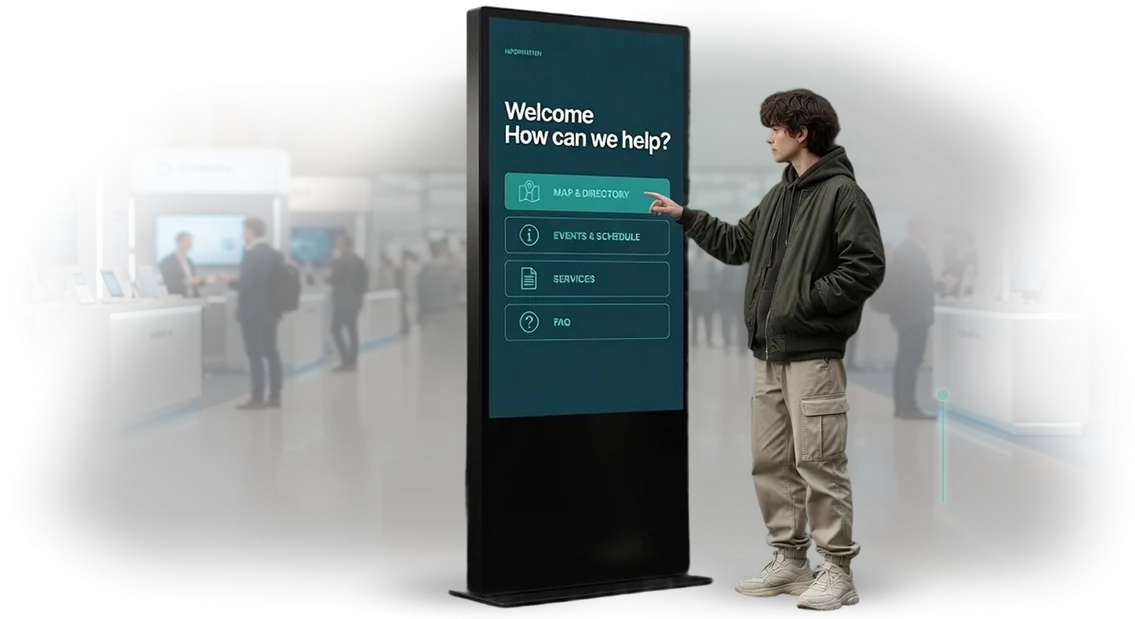
We solve this problem with interactive information kiosks and presentations on touch panels. Visitors control the content themselves: they explore your solutions, watch videos, receive materials, and leave their contacts — all at their own comfortable pace.
This turns the booth into a point of attraction that holds attention and collects real leads. We have implemented this approach in dozens of projects for conferences across various industries.
What an Interactive Touch Panel Brings to Your Booth
A visitor walks past dozens of booths in one day. To make them stop at yours, you need a reason: something that engages and holds attention for longer than five seconds.
A touch panel is not a replacement for a consultant, but a tool that turns casual interest into a deliberate introduction to the product.
The guest chooses what to explore: a catalog, case studies, or videos. This time at the booth delivers what matters most to the brand — memorability and a contact that does not get lost in a pile of business cards.
| Format | Who it is for | What it gives the client |
|---|---|---|
| Catalog with filters | Conferences and exhibitions | The guest finds the right product on their own — the consultant does not waste time on routine tasks and manages to serve more visitors. |
| Case studies with photos and figures | B2B booths | A convincing demonstration of results without unnecessary conversation. The client “tries on” the product for themselves. |
| Quiz or survey | Marketing promotions | Engages the guest in a game and collects their interests at the same time — you can use them later in email campaigns. |
How It Works in Practice
A person spends 3–5 minutes at the panel — several times longer than at a static poster. During this time, they manage to explore two or three sections and make a decision: leave contacts or request a commercial proposal right at the booth. For the brand, this is a ready-made lead with minimal effort.
The measurable result is a contact database. Instead of a stack of business cards, you receive a tidy list of guests with their requests. This list then turns into invitations to demos, catalogs, and useful materials. Thus, the booth continues to generate inquiries long after the forum has closed.
What Will Change for Your Booth
More time with each visitor. Interactive content holds attention, and a live consultant steps in at the right moment — when the guest is already interested.
Strong memorability. A bright, easy-to-use panel is a detail people talk about and remember a week later. Your brand speaks the visitor's language: clear, modern, and open.
A ready-made contact database. The panel gives the guest a clear incentive to leave their data in exchange for useful material or a cost calculated after audit.
We have been making such panels for over 10 years and know how to make a guest stop, get interested, and leave a contact. We work with professional equipment — we guarantee stable operation even under heavy visitor flow.
Tell us about your booth’s objectives — we will recommend the format that will deliver the most value at your specific conference.
Interactive Presentation Formats for Conferences
At conferences, guests face a shortage of time and an overflow of information. A classic booth with brochures barely holds attention, while an interactive presentation holds it for 3–5 minutes. The question is which format suits you best: a touch panel, a touch table, or a video wall.
We deliver all three options turnkey, but they work differently. If guests need a quick answer — choose a panel; if they need deep engagement with the product — a table; if you need a striking background and a sense of presence — a video wall. Compare them by key scenarios.
| Format | Who it is for | What it gives the client |
|---|---|---|
| Touch panel | Guests who need fast navigation | Instant access to the program, zone map, and schedule. Reduces the load on the information desk and queues. |
| Touch table | Guests who explore the product in a group | Engages 2–4 people simultaneously and allows them to browse catalogs and case studies. Increases the time of contact with the brand. |
| Video wall | Organizers who need an impressive zone background | Attracts attention from a distance, broadcasts key messages, and gathers guests at the right point in the space. |
In any case, we handle content preparation, installation, and technical support on the day of the conference. Send us your event plan — we will tell you which format will definitely work at your venue and organize everything turnkey.
How We Create a Project: From Brief to Launch
We have structured our workflow so that every stage is clear and transparent for you. No “black boxes”: you always know what is happening, what we are approving, and when you will receive the result. Below are the typical stages of developing an interactive presentation for a conference.
-
Brief and immersion in the task. We discuss your booth’s goals, the visitor profile, and key messages. We record scenario and deadline requirements so that all wishes are accounted for from the start.
-
Concept and interactive scenario. We propose the screen structure, navigation logic, and interaction mechanics — how the visitor will receive information and what they will do at the panel. You approve the overall idea before development begins.
-
Design mockup. We create a visual style that matches your event: brand colors, fonts, tone. We show mockups of the key screens — you see in advance what the product will look like.
-
Prototype assembly and testing. We build a working version on real touch equipment. We check touch response, startup speed, and stability — so there are no failures at the conference.
-
Approval and revisions. We show the working version, collect your comments, and make changes. We repeat iterations until you are completely satisfied — without unexpected delays.
-
On-site launch. We deliver the finished solution, install it at the booth, and check connection to the screen and power supply. We train your staff: how to turn it on, restart it, and help a guest in seconds.
-
Support during the conference. We stay in touch during the event days. If any questions or issues arise, we resolve them promptly so your booth runs without interruptions.
Thanks to this process, you get a predictable result: an approved design, tested mechanics, and a kiosk ready to work exactly by the event opening. And the peace of mind and confidence in the technical side allow you to focus on talking with guests.
What Is Included in the Interactive Kiosk Delivery
You order an interactive kiosk for a conference and want it to work on the very first day, not after a week of coordination with various contractors.
We deliver a turnkey solution: from the housing and touch panel to the design, content, and staff training — one team is responsible for the entire result.
The delivery package includes everything needed for launch:
- Touch panel and housing — we select them to match your event style, install, and configure them right on site.
- Interface design in the conference’s brand style — guests recognize the brand from the first screen instead of seeing a template.
- Interactive content: program, venue map, speaker information, navigation — the things participants look for most often.
- Content loading and testing before the event, so everything works without failures on the big day.
- Staff training: your employees master kiosk operation and independent material replacement in 20 minutes.
- Warranty on hardware and software for the entire duration of the event, plus remote chat support.
No hidden fees, no “this is paid separately”: you receive a complete package and know the budget in advance. If the conference program needs to be updated or a sponsor block added during the event, we make changes remotely without stopping the kiosk.
Case Study: How We Brought a Conference to Life with a Touchscreen Booth
At a conference, the main battle is for visitor attention. Guests walk past standard booths in seconds, contacts are collected by hand and then lost. We needed participants to stop on their own and leave their data.
We proposed an interactive presentation on a touch panel to the client, instead of the usual screen with a video. The booth became its own host: it attracted visitors, engaged them in a brand game, and finally invited them to leave a contact. Staff only spoke with those who had already become interested.
The result exceeded expectations. At a conference where people previously spent no more than a minute at the booth, engagement time increased by 70%. Guests came back on their own and brought colleagues.
Over two days, the booth collected 3,000 contacts — enough leads for the sales department for several months.
For the client, this was measurable value: more time at the booth — deeper contact; 3,000 contacts — a flow of inquiries without paying extra for advertising. After the conference, they returned to us again to adapt the booth for an industry exhibition. We are working on new scenarios.
We track time at the booth, number of contacts, and visitor return rate for every project — we show businesses a concrete effect, not just a “beautiful booth.” If you want the same result at your event — tell us about your task, we will recommend a format and calculate the expected impact.
Answers to Common Questions About Touchscreen Kiosks
A touchscreen kiosk is not just a pretty picture but a working tool for a conference. Before deciding to start development, clients ask the same questions: will the equipment fail, will we make the deadline, and what happens to the content afterward. We answer directly so there are no doubts at the start.
What happens if the kiosk breaks down in the middle of the event?
We will come and resolve the problem within a few hours, and provide replacement equipment while repairs are underway. We give a warranty on installation and hardware for the entire duration of the conference, so your program will not stop.
Will we have time to prepare the kiosk by the conference date?
The standard cycle is 2 to 4 weeks for design, programming, and testing. We meet with you at every stage and include a buffer in the schedule for final revisions.
How do we update content after launch?
You send new banners, announcements, or schedules — we update the data remotely, without traveling to the event and without involving you in technical details.
Who is responsible for maintenance and repairs?
We handle the full cycle: preventive checks before the event, on-site presence, and resolution of any issues during the booth’s operation. Repairs and related costs are also covered by our warranty obligations.
These principles are built into every project, which is why most clients return to us for their next conferences.Get a Cost Estimate for Your Booth
Every booth at a conference competes for visitor attention, and an interactive presentation must justify its cost. To achieve a real result, it is not enough to choose a “screen with buttons” — you need an accurate calculation of budget, timeline, and format for your venue.
We have been developing touchscreen kiosks for exhibitions and conferences for over 10 years. Leave a request — and we will prepare an individual proposal rather than an average price list.
After you contact us, you will receive a practical plan that you can already discuss with your management.
- Cost calculated after audit for your booth, taking into account screen size, number of languages, and expected visitor flow.
- Production and installation schedule aligned with your event date.
- Format selection: interactive presentation, catalog, exhibition map, or quiz to hold attention.
- Scenario recommendations — how to make visitors approach, start using, and come back for more.
- Examples of similar projects for your industry and conference types.
- A clear commercial proposal with fixed deadlines, guarantees, and launch procedure.
Requesting takes a couple of minutes, the consultation is non-binding. Tell us about your booth — and you will receive a cost estimate the very next day, one you can use to make a decision.
How to Choose the Right Interactive Format for Your Conference Goal?
Choosing an interactive format always starts not with technology, but with the goals of the conference. What matters more to you — introducing guests to a new product, training employees, collecting contacts, or creating a memorable impression?
Each task has its own suitable type of solution: one format works well for presentations, another for game engagement, a third for navigating a large space. There is no universal “best” option — only the one optimal for your situation.
The second factor is the audience. It is one thing if your guests are technically prepared specialists, and quite another if they are the general public at a public event.
A competitive format works for a younger audience, while a restrained, informative one works for a business audience. Headcount also matters: a scenario for a flow of one hundred people is different from one for two thousand.
The more precisely you understand your visitors, the easier it is to choose a format that truly engages rather than goes unnoticed.
The third criterion is budget, but it should not narrow your choices prematurely. An interactive presentation on a touch panel is one of the most flexible options: it can be adapted to various scenarios, from a simple catalog to a gamified quest with bonuses.
Moreover, investments in this format work not only during the conference itself, but also afterward — the materials remain with you for future events or training.
We help you decide on a format based on your goals, not a ready-made template.
At the start, we ask a few questions about your objectives, audience, and expected results — and then offer two or three suitable options with a description of how each one solves your task. You see the difference before launch, not after.
The main advice: start by answering the question, “What should change after the conference?” If guests leave with new knowledge, impressions, or contacts — the format was chosen correctly. If not, even the most spectacular technology will not save it. We will help you find a solution that delivers measurable results, not just decorates the hall.