

Interactive Kiosks for a Science Museum: Why Do Visitors Walk Past?
A modern visitor comes to a science museum for an experience but is met with static display cases and long descriptions. Within minutes, attention fades — the visitor moves through the exhibition without stopping at any single stand.
This is a familiar picture: the excitement of the first moments gives way to indifference, and the museum loses what matters most — live visitor engagement.
The problem is not the quality of the exhibits but the way they are presented. Today, people are used to fast-moving content, interactive formats, and instant feedback.
Placards and static installations provide no such feedback, so the museum exhibition loses the competition for audience time and attention. As a result, public interest drops: visitors return less often and do not recommend the museum to friends.
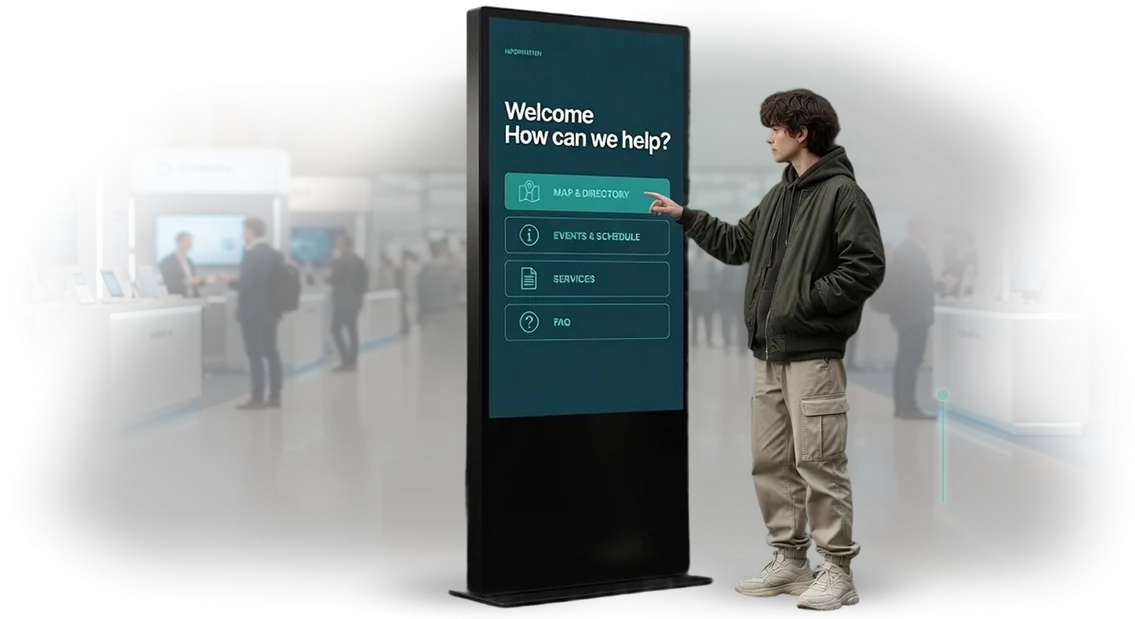
The answer is an interactive kiosk placed right next to the exhibit or in the hall. The touch panel invites the visitor to take action: explore a 3D model, launch a process animation, compare data, answer questions.
This turns passive viewing into exploration and a tour into an engaging journey visitors want to continue.
Visitor engagement grows immediately: people stay at an exhibit longer, remember more, and share their impressions. For a science museum, this means more repeat visits, more family outings, and new audiences who previously considered the museum boring.
We know how to turn a static exhibition into a space of discovery: we design scenarios around the museum's goals, create interfaces that are intuitive for every age group, and install kiosks that run reliably even under heavy visitor flow. Below, we explain what that looks like in practice.
What a Kiosk Will Give Your Museum: From Impressions to Repeat Visits
An interactive kiosk turns the familiar walk through an exhibition into a live dialogue with the exhibits.
Instead of passively reading placards, visitors choose their own scenario, launch animations, and answer questions — engagement grows from the very first seconds, and the museum is remembered as a modern space people want to return to.
The longer a guest stays in the hall, the more they get to see and the higher the value of their ticket.
A touch panel holds attention on one topic 2–3 times longer than a regular stand: people explore additional materials, compare facts, and share discoveries with their families.
For the museum, this means not only a richer visitor route but also natural interest in neighboring exhibits — the route unfolds without staff involvement.
The kiosk also works as a brand awareness tool. When a guest finds the answer to their question or sees an unexpected fact, they tell friends and post photos on social media.
This way, the museum gets free mentions during the visit itself, and the exhibition keeps sparking conversation for days afterward.
Most importantly, this effect drives repeat visits.
A visitor who controlled their own scenario is more likely to return with someone who has not been yet, or to come to a new exhibition to try “that same screen.” In addition, the kiosk collects anonymized statistics: which topics generate the most interest, how much time guests spend at each section. This data helps plan future exhibitions and create content that audiences truly want.
By installing an interactive kiosk, you get not just equipment but a tool for growing the museum’s key metrics: deeper engagement, more time in the halls, higher exhibition visibility, and a steady stream of returning visitors.
Interactive Kiosk Formats for a Science Museum: For Any Exhibit
In a science museum exhibition, visitors behave differently: at the entrance they need a quick orientation, at a complex exhibit they need time to study it, and in an experiment zone they want to touch and try things. No single universal kiosk can cover all these tasks at once. The practical approach is to choose a format for the specific exhibition zone.
Below is a cheat sheet to help you decide. The table covers the three basic formats we use most often in science museums.
| Format | Where to place it | What it gives visitors | What it gives the museum |
|---|---|---|---|
| Floor-standing kiosk | In the lobby, at hall entrances, next to large exhibits | Quick start: navigation, event schedule, short videos | Relieves staff workload, helps visitors find their way |
| Touch table | Zones with collections, interactive laboratories | Collaborative exploration: several people can interact at the same time | Keeps groups at the exhibit, sparks discussion and shared discoveries |
| Museum guide | Halls with individual routes, temporary exhibitions | Personal pace, additional materials, convenient large font | Increases time spent in the hall, enables deeper immersion in the topic |
When choosing, we look at hall traffic, installation height, and lighting — these directly affect visitor comfort. Sometimes a single floor-standing kiosk at the entrance is enough; in other cases, a touch table in the center of the hall brings more value.
Formats can be combined: for example, navigation on floor-standing kiosks and detailed content on museum guides.
The key criterion is that visitors should not have to think about how the device works — they should immediately get an answer or an impression.
That is how an interactive kiosk becomes a natural part of the exhibition, strengthens interest in science, and raises the overall rating of the museum visit.
How the Project Works: From Brief to Interactive Launch
A transparent process: at every stage, you see the result and can make edits. First, we design and approve the scenario, then we create content and install — no rework at the last minute.
- Brief and analytics. We study the audience, exhibition goals, and visitor behavior. We determine what to put on the touch panel so the kiosk is useful rather than just decoration.
- Kiosk design. We create navigation logic, section structure, and screen transitions. The prototype shows how visitors will move through the interactive experience before the design is even drawn.
- Interface approval. We develop a visual style that fits the exhibition: fonts, icons, colors. We approve layouts and the panel’s location in the hall.
- Content creation. We adapt scientific materials into short scenarios and add graphics, video, and animation. You get materials that are easy to update without a programmer.
- Production and installation. We build the enclosure, install the software, and test touch control. We deliver, mount at the museum, and check with real visitors.
- Project launch. We launch the interactive experience, watch the first sessions, and make final adjustments. We train staff: power on, restart, content replacement.
- Support and development. We provide post-launch support: monitor stability, update materials, add sections. If the exhibition changes, we adapt content without replacing hardware.
What Is Included in the Delivery: A Complete Package for Your Museum
The museum receives a ready-made turnkey solution: we handle everything — from equipment selection to staff training. You do not need to understand technical details or hire contractors; you simply accept the finished kiosk and integrate it into the exhibition.
The delivery package includes:
- Kiosk equipment — a touch panel, protective enclosure, and mounting hardware selected for your hall. The equipment is built for intensive use and can handle active visitors.
- Software — an interactive presentation with an easy-to-use content management system. You will be able to change texts, images, and videos yourself without a programmer.
- Content — adaptation of your materials to the touch format: exhibit navigation, descriptions, multimedia. We make sure visitors find the information easy and enjoyable to interact with.
- Installation and connection — our specialists arrive, install the kiosk at the right spot, connect it to power, and test all scenarios. You do not need to search for a contractor.
- Staff training — a short session for your team: how to turn the kiosk on, replace content, and resolve simple issues. Usually one session is enough; after that, your team works independently.
- Warranty and support — official warranty on equipment and software, plus technical support for the entire service life. If anything needs attention, you always know who to contact.
In the end, the museum gets a completely finished interactive exhibit that starts working immediately. You pay once — and receive everything needed for the kiosk’s launch and long-term service, without distracting your own staff with technical issues.
Case Study: How Interactive Technology Doubled Visitor Time at the Exhibition
For Laboratorium, a science museum for family audiences, the challenge was typical: visitors rushed through the exhibition and left.
The average visit lasted less than an hour, and the new halls did not create an “engagement effect” — guests simply skimmed the displays and headed for the exit.
We proposed turning the central exhibition into an interactive zone with touch panels. Instead of reading placards, visitors take part in the experiment themselves: they launch physical processes, change parameters, and see the result immediately.
This creates the emotion of discovery — people start moving from point to point, eager to try every scenario.
What we measured
According to museum data and panel counters, the average time spent grew from 45 minutes to an hour and a half — double. Repeat visits for the season increased by a third, and the interactive stations became the most photographed places in the exhibition. Visitors post photos themselves, giving the museum free social media coverage.
For the museum team, the project matters beyond the numbers. Staff no longer need to lead groups by the hand: children naturally distribute themselves across the stations, while guides help those who need a hint.
The interactive system runs reliably, and the client can easily add new scenarios to the exhibition — making the project a long-term investment in attendance.
How to Choose the Right Interactive Kiosk Format for Your Museum?
Choosing an interactive kiosk format starts not with the equipment model but with your museum’s goals: what should visitors learn, feel, and remember.
The same content can be delivered as a short, dynamic overview for someone visiting for 40 minutes, or as a deep immersion for school groups and researchers.
First, look at the specifics of the exhibition and the audience.
For children’s halls, game-based scenarios with large touch areas work well; for scientific exhibits, use visualizations of processes and data comparisons; for temporary exhibitions, compact solutions that are easy to reconfigure for a new project.
It is important that the format does not draw attention to itself but strengthens the impression of the exhibit itself.
The project budget also influences the format, but not in a “cheaper is better” sense. It is about a reasonable scope: at the start, 2–3 key scenarios that serve the museum’s main goals are enough.
If you spread too thin across a dozen features, you will end up with an expensive development that visitors use only partially. Better to do less, but make every screen useful and make visitors want to return.
Most importantly, a clear understanding of the point of contact helps you avoid mistakes: where exactly the kiosk stands, how much time a person has at the screen, and what next step you want to offer — moving to the exhibit, saving information, or sharing an impression. This is the foundation for choosing the format, size, and interface logic.
We match the format to your specific exhibition and budget rather than selling a one-size-fits-all solution. Send us a description of your hall and goals — we will calculate the optimal option and show how it fits into the museum’s space.
Frequently Asked Questions About Interactive Kiosks for Museums
Museum directors often worry: will an interactive kiosk become “a constant reason to call a specialist”? In practice, modern touch panels run in “set and forget” mode — like an ordinary TV, but with a smart core.
Below, we answer the typical questions museum teams ask before starting such a project.
Is it difficult for staff to manage the kiosk every day?
No. The main tasks are turning the panel on and off and wiping the screen. The entire interactive program starts automatically and runs without staff involvement.
If urgent changes are needed — replacing an event poster or adding news — this is done through a simple admin panel. An employee without a technical background can learn it in one day.
How is content updated, and will the exhibition become outdated?
Updating is a simple file upload, like changing slides in a presentation. You can change texts, images, videos, and even add new scenes without rewriting the program.
You are not tied to the developer: content for the kiosk can be prepared by your own staff or by contracted designers. Most importantly, we build the structure in advance so adding material takes minutes, not days.
Will the kiosk fit into the existing exhibition?
Yes. The device is designed for your specific space: we take into account the hall’s style, the placement of display cases, and visitor routes.
The appearance is not limited to standard “stands with screens.” You can order a custom enclosure that echoes the shape of an exhibit or build the panel into an existing podium. Wiring is hidden so the interior stays neat.
What happens if the kiosk stops responding during a tour?
We use commercial-grade components built for daily operation from 9:00 AM to 9:00 PM. The system automatically restarts if it freezes, and visitors hardly notice.
All projects come with a warranty and remote support. If an issue arises, a specialist connects to the kiosk remotely and resolves it without coming to the museum.
Submit a Request — Get a Kiosk Concept for Your Museum
Submit a request for a museum kiosk — and within two business days you will receive a personalized concept.
This is not a general description but a plan tied to your halls, exhibits, and target audience: how the interactive will be positioned, how it will fit into the visitor route, and what goal it will accomplish.
The kiosk concept includes:
- Analysis of museum goals and kiosk use scenarios.
- Recommendations on format and placement.
- Description of the user scenario and screen logic.
- Visitor interaction scheme and content options.
- Preliminary installation and exhibition integration plan.
- Estimated timeline and development stages.
This structure allows you to align all details before work begins and avoid costly revisions later. You will know in advance which specialists are needed, how long each stage will take, and when the kiosk will be ready for opening.
From there, the work follows a clear schedule: after the concept is approved, we lock in project timelines, sign the contract, and move on to design and software development. At every stage, you receive intermediate versions for review — edits are made before launch, not after.
The next steps are simple: you submit a request, we schedule a call within a day, clarify the goals, and send the concept within two business days. If it fits, we start production. If it needs adjustments, we refine it together with you.
There is no need to pay for the preliminary analysis — it is our part of the responsibility for the result. Get in touch, and you will understand exactly how a kiosk will work in your museum.