

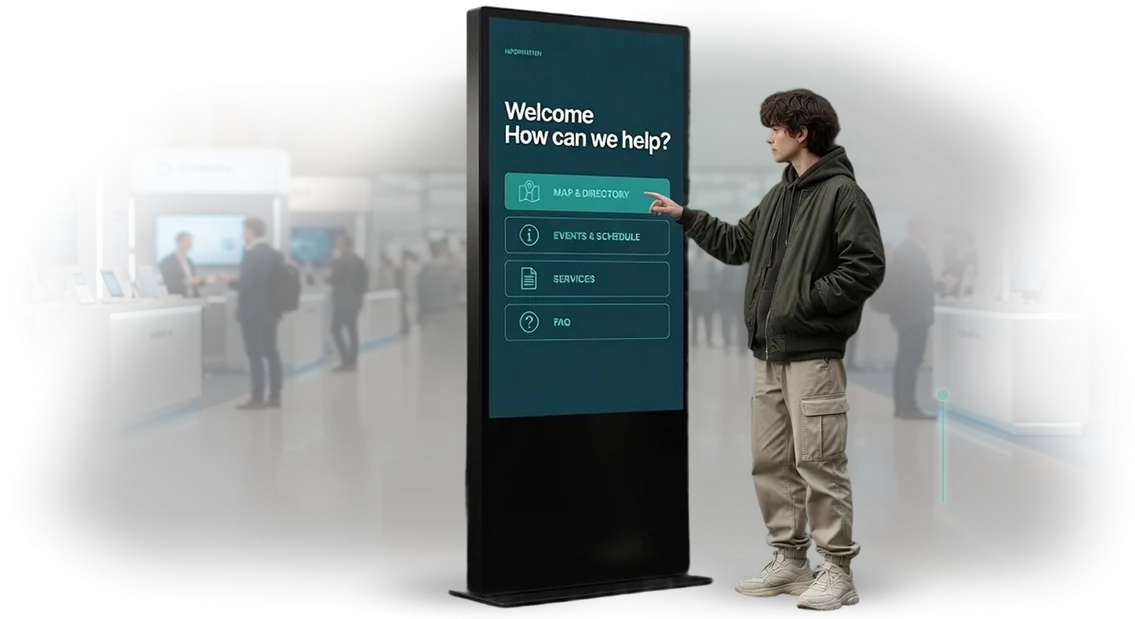
Why an oil and gas company needs interactive kiosks at exhibitions
At an exhibition, an oil and gas company's booth competes for visitor attention with dozens of participants. Ordinary banners, posters, and booklets don't hold the gaze for more than a couple of seconds — a person decides whether to approach or walk past.
Without interactive kiosks for exhibitions, the booth risks going unnoticed, and the participation budget — wasted.
Visitors are your potential partners, investors, and clients. They come not for flyers, but for an impression and an understanding of who they're dealing with.
Touch panels make it possible to showcase the product visually: field maps, drilling stages, supply logistics, environmental programs. All of this can be explored at a comfortable pace, switching sections with a finger.
This way, a presentation for an oil and gas company turns from a dull report into a lively, manageable dialogue.
Attracting visitors to the booth is the first task, but not the only one. The interactive kiosk itself answers common questions, displays key figures, and collects contacts from interested guests.
This takes the load off booth staff and increases the time a visitor spends at the booth. As a result, you get measurable outcomes: more qualified contacts, higher brand recognition, and clear statistics for reporting to management.
We have been building interactive kiosks for exhibitions for over ten years. We help formulate a scenario that solves your business challenges, select reliable touch panels, and handle launch right on schedule for the event date.
That's why your booth becomes a place of attraction, not just a pass-through point on a visitor's route. We take care of it all — from idea to a working kiosk at the exhibition.
What an interactive presentation on a touch panel delivers
An interactive presentation on a touch panel turns a standard introduction to the company into a live dialogue.
Instead of a static booth that guests skim past, you get a tool that holds attention on its own: a person touches the screen, chooses an interesting scenario, explores areas of activity, and remembers the brand.
For an oil and gas company, this is especially valuable — complex technological processes and the scale of assets are presented visually, without overload or industry jargon.
A high level of engagement directly affects recognition. A visitor who independently explores an interactive presentation spends several times longer at the booth, and therefore absorbs key messages better.
This interaction creates a sense of personal discovery: the guest didn't just see information, but got to it themselves — and is more willing to discuss it with colleagues and partners.
A separate bonus is contact capture. The touch panel lets you offer the guest useful material: a presentation, brochure, or a recording of a talk — in exchange for a business card or email.
The company gets a database of interested specialists and clients to work with after the exhibition, forum, or conference.
Essentially, you accomplish three business goals with one tool: you engage visitors, boost brand memorability, and build a foundation for future deals.
At the same time, the client receives a complete turnkey solution — from scenario and design to on-site technical support — which saves your team unnecessary hassle and lets you focus on negotiations.
Formats of interactive kiosks for an oil and gas company
One interactive kiosk format doesn't fit all tasks for an oil and gas company. At an exhibition, it must stop a visitor in seconds; in an office lobby — tell about the company without an employee; in a meeting room — hold investors' attention. So we select the enclosure, interaction method, and scenario for the specific task.
The larger the audience, the simpler and larger the interface. For a narrow group, we build a detailed scenario with charts and diagrams. Below is a table of formats for the oil and gas industry.
| Kiosk format | For which tasks | Effect for the company |
|---|---|---|
| Floor-standing touch kiosk | Exhibitions, forums, open days | Attracts attention, holds visitors at the booth, helps collect contacts |
| Touch panel on a stand | Negotiations with partners and investors | Shows metrics and projects in 5–7 minutes, strengthens arguments |
| Wall-mounted panel | Office lobbies, visitor centers | Introduces guests to the company without staff involvement |
| Mobile touch panel | Off-site presentations, staff training | Deploys anywhere, content is easy to update |
We assemble all options on professional exhibition equipment. Content is adapted to the format: for exhibitions — fast scenarios for high visitor flow; for negotiations — an in-depth presentation with charts. The client receives a cohesive solution: a unified brand at any venue. We'll advise which interactive kiosk solves your task in the oil and gas industry.
How turnkey interactive kiosk development works
Turnkey interactive kiosk development is a transparent process: you control every step. We structure the work so that you don't have to dive into technical details — at each stage, you get a result for approval and make the decision.
- Brief and task analysis. We pin down the tasks, target audience, and installation locations. We align the scenario logic with your goals.
- Prototype and design concept. We show the look and navigation in mockups. You see the interface before development and make changes.
- Content approval. We prepare texts and graphics. In projects for oil and gas companies, it's important to present production and occupational safety data — everything goes through final review.
- Interactive development. A working presentation on the touch panel: transitions, animation, hotspots — all as per the approved prototype.
- Equipment testing. We check screen response, font readability, and stability. We invite you to a test run for final comments.
- Launch and training. We install the kiosk at your venue, hand over instructions, and train administrators.
- Warranty support. We stay in touch: help update content, fix issues, and provide recommendations.
What's included in the interactive kiosk delivery
You receive a ready turnkey solution: we handle the development, production, configuration, and launch of the interactive kiosk for the oil and gas company. No hidden stages and no unexpected expenses — only what works from day one.
The base delivery includes:
- Enclosure and touch panel — professional equipment built for round-the-clock operation in lobbies, at exhibitions, and in waiting areas.
- Software with an interface tailored to the task — staff and visitors figure it out in a minute, without instructions or training.
- Interactive content — presentations, production diagrams, 3D equipment models, video clips: everything needed to showcase the company's capabilities.
- Installation and commissioning — we deliver, set up, verify operation, and hand over the finished kiosk.
- Staff training — a short briefing after which your employees can manage the content themselves.
- Warranty support — for equipment and software, with fast response to requests.
- Content updates — on your request, we adjust texts, prices, photos, and videos so the kiosk always stays current.
Options are ordered separately: custom enclosure design in corporate style, integration with the company's internal systems, remote management of a kiosk network, and collection of user interaction statistics. This way, you pay only for what your business actually needs, not for extra features.
In the end, you get a predictable result: a kiosk that solves the task from launch day, and a partner responsible for it at every stage — from idea to support.
Case study: interactive kiosk at an exhibition doubled time at the booth
The company "GeoEnergia" participated in a major industry exhibition where dozens of booths were operating nearby. Ordinary booklets and presentation screens got lost in the flow: visitors skimmed past the booth and moved on.
The marketing director set the goal — to hold guests, tell them about the technology, and collect contacts.
We proposed an interactive kiosk that became the central piece of the booth. Instead of a dull video, guests controlled the scenario themselves: they compared extraction stages, opened the field map, and saw how the company's solutions work on real projects. Each screen had its own mini-quest, which created a live queue.
The results exceeded expectations. Average time at the booth nearly doubled — from a couple of minutes to focused time on the screen.
Over the two exhibition days, the kiosk logged more than fifteen hundred sessions, and managers collected three times more meeting requests than at the previous event.
Visitors also approached consultants themselves and asked substantive questions — marketing didn't have to call people over.
The company's marketing head noted: "The kiosk became the main point of attraction. For the first time, we didn't have to persuade visitors to look at materials — they came to us on their own.
We've never had this kind of interest in the booth at any other exhibition." Within a month, the client had reserved the kiosk for the next industry conference.
How to choose the right interactive kiosk format for your task?
Choosing an interactive kiosk format starts not with equipment, but with a question: what exactly do you want to achieve from the exhibition?
One client needs to show all technological stages of production, another — to collect contacts of potential partners, a third — to take visitors through a virtual workshop they wouldn't normally be allowed into.
Each task has its own panel scenario, and the right format is the one that gets you to the desired result by the shortest route.
If the goal is to present a complex product or service, choose the "virtual guide" format: the visitor flips through sections, watches videos and diagrams at their own pace.
For navigation around a large booth or pavilion, a map with points of interest and routes works better. And when the task is to collect leads and contacts, a scenario with a form and instant delivery of a commercial proposal by email comes to the fore.
Sometimes one kiosk combines two or three scenarios — we make the switching logic between them as clear as possible for a guest seeing your booth area for the first time.
A separate question is who your visitor is. An oil and gas industry specialist is ready to dig into details, a technologist needs deep diagrams, and a student or general exhibition guest needs a vivid, engaging story.
The right format adapts to the audience: the depth of content changes, the pace of delivery changes, even how long a person spends at the screen. We design the scenario so that information is absorbed easily, not turned into a wall of text.
Keep in mind: the kiosk itself is only a vehicle. The result comes from the combination of "format + content + interaction logic." That's why at the start we discuss not screen sizes, but your task and expectations from the event.
After that, we propose a format that delivers measurable results: more engaged visitors, more collected contacts, better understood product messages.
Tell us what task your booth faces — and we'll advise which kiosk format will solve it faster and more effectively.
Frequently asked questions about interactive kiosk development
Clients from the oil and gas industry rarely ask about the kiosk's "internals" — they care about practical issues: will the equipment fail on launch day, who will update the data, and what happens after project handover.
These are understandable concerns: a stationary kiosk works for years, and any malfunction hits the company's image.
We mitigate these risks at the design stage and build in post-launch support. Below are answers to the questions we get asked most often.
What if the kiosk breaks down during operation?
The kiosk is assembled on proven industrial equipment designed for long-term, uninterrupted operation. We build in a safety margin and connect remote monitoring: we learn about a failure before staff even notices it.
If a problem does occur, most cases are resolved remotely, and if necessary, we come out under the warranty agreement.
The key thing for you is minimum downtime and predictable operation on the day of an event or exhibition. That's what we focus on when selecting components and configuring the system.
How do I update content after launch?
Updating takes a few minutes: a designated employee changes texts, figures, photos, and videos through a simple admin panel. No programmers, source code access, or special knowledge needed — everything is done in a browser from a computer or tablet.
You control the accuracy of the information yourself: added a new facility, changed a regulation, or decided to feature a different menu — make edits at any time. We can also set up automatic data updates from your internal sources.
Who is responsible for the kiosk after project handover?
We don't disappear after launch. The work is done under a contract with warranty obligations, which include technical support and maintenance. On request, we can add an extended plan with rapid equipment replacement.
For oil and gas companies, stability is critical, so we sign a contract that spells out response procedures and points of responsibility. You don't need to understand technical details — just call your account manager.
If you have more questions, leave a request — we'll walk you through how the process looks at each stage and find a solution that fits your timeline and goals.Discuss your interactive kiosk project with an engineer
For the oil and gas industry, an interactive kiosk is not just a screen, but a tool that replaces a static booth and dozens of paper brochures. Guests independently explore products, company history, or field maps — without queues or booth staff involvement.
But for the kiosk to truly work toward results, it's important to choose the right format for the task: a stationary panel, a mobile stand, game mechanics, or an overview presentation.
Leave a kiosk request — and we'll discuss your task with an engineer, recommend the optimal solution, and prepare a turnkey interactive kiosk proposal. It's non-binding: you get an expert assessment and an understanding of how interactivity will strengthen your event.
What you get immediately after contacting us:
- analysis of the task and kiosk usage scenario at your event;
- format recommendation: touch panel, mobile stand, or interactive presentation;
- a rough content structure and screen logic for your audience;
- an estimate of turnkey development and launch timelines;
- equipment selection for your venue, lighting, and operating conditions;
- a technical support plan for the event, so the kiosk doesn't let you down at the critical moment;
- a clear cost calculated after audit, with no hidden extras.
After the consultation, you get a ready foundation for a decision: an understanding of the format, scope of work, and realistic timelines. From there, we handle content development, assembly, and setup — you arrive at the event and simply switch on the kiosk.
You can leave a request in the form below or in a messenger — an engineer will contact you within one business day, answer your questions, and prepare a proposal for your scenario.