

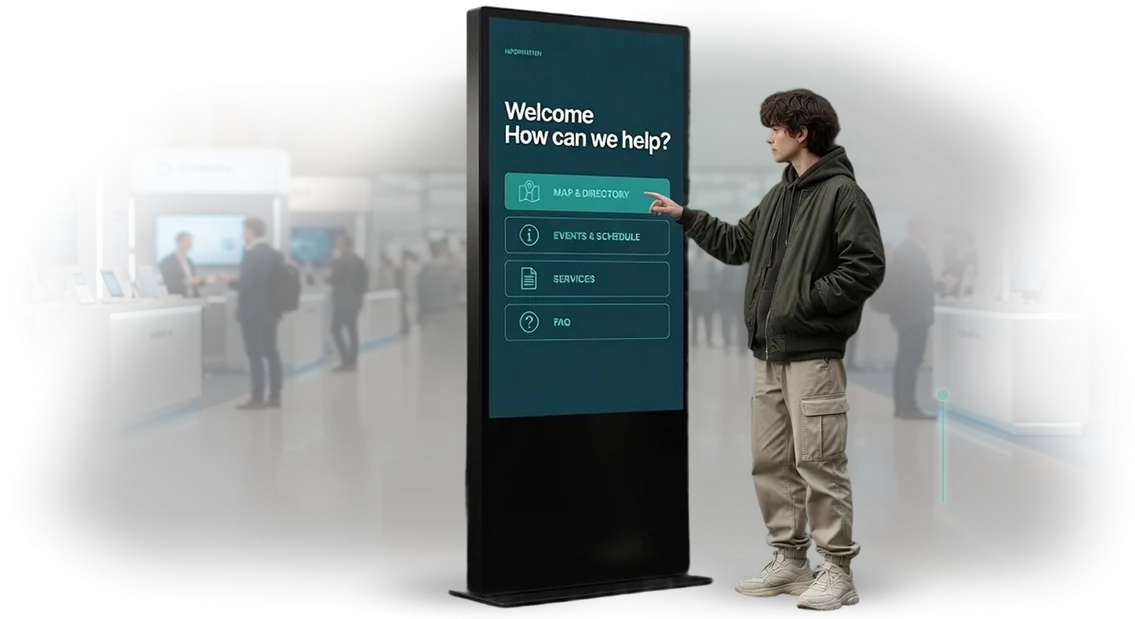
Interactive Kiosks for Amusement Parks: Why You Need Them
A visitor comes to an amusement park for excitement, but often gets queues and confusion instead. Rather than enjoying the rides, they study a paper map, check the schedule with staff, and miss half the events. Every such lost hour is missed revenue from cafés, souvenir shops, and rides.
Interactive kiosks for amusement parks turn this chaos into a clear route. In 30 seconds, a guest finds the nearest ride, sees real-time wait times, and the show schedule.
Navigation stops being a headache: the visitor spends more time on the grounds and less time searching — and spends more money.
Kiosks take over the work of the information desk and partly the ticket office. Guests choose tickets themselves, learn about special offers, and book seats for evening programs. For the park, this means less staff workload, shorter queues, and a higher average check.
An additional plus is collecting data on visitor behavior. You can see which rides are in demand, where bottlenecks form, and which services deserve more active promotion. This information helps plan the season and increase revenue without investing in new facilities.
We've been creating interactive solutions for parks and entertainment venues for over 10 years.
Our kiosks run on professional hardware, withstand outdoor conditions, and start delivering value from day one — guests are happy, staff are relieved, and money isn't lost.
What Installing Interactive Kiosks Ultimately Delivers
Interactive kiosks in an amusement park are not just a replacement for a paper map. They are a point of contact that turns a visitor into an engaged guest and brings the park measurable results. Below are five key benefits you get after installing such solutions from our team.
- Guest engagement — a touchscreen draws people in: visitors eagerly explore rides, watch videos, and build their route. This increases time spent at the park and the desire to try more.
- Brand recognition — branded interface and content on kiosks work as an additional advertising platform. Bright graphics and animation create the brand's atmosphere and stay in visitors' memory.
- Higher average check — the kiosk suggests additional services to guests: from photos and popcorn to express tickets for popular rides. Such recommendations increase the average purchase amount.
- Data collection — every touch becomes statistics: which zones are popular, how long guests spend at the screen. You get data to improve navigation and marketing.
- Shorter queues — kiosks relieve information desks and ticket offices. Guests find what they need faster and make purchases on their own, while staff work more efficiently.
All five effects reinforce each other. If you want kiosks to truly pay off, it's important to configure guest behavior scenarios correctly — that's something we take on. Tell us about your park's goals — we'll propose a solution for your format.
Interactive Kiosk Formats for Amusement Parks
At the entrance, guests need navigation; in line, they need entertainment; at the rides, they need real-time wait times. No single format covers all scenarios: a park wins when equipment is matched to visitor traffic flow and the specific installation point.
Matching the Format to the Park Zone
We match kiosks to the goals of each zone to shorten queues, entertain guests, and help with orientation. The formats differ by installation location and operating scenario.
| Format | Who it's for | What it gives the customer |
|---|---|---|
| Floor-standing kiosk | Entry area, main avenue, ride zones | Attracts attention, shows map and schedule, relieves staff of repetitive questions |
| Wall-mounted panel | Ticket offices, waiting areas, food court | Takes up minimal space, entertains guests in line, and suggests what to do next |
| Outdoor kiosk | Open areas, summer stages, park entrance | Works in any weather, provides navigation and show announcements where there's no roof |
Combining Formats for Full Coverage
At the entrance — a floor-standing kiosk with a map; at the rides — wall-mounted panels with wait times; outdoors — weather-protected stands with event listings. This combination improves guest comfort and reduces staff workload.
We adapt each format to the park's brand identity: content updates take minutes, not days. The equipment runs on a reliable professional base, so guests get quick answers and the park gets orderly navigation and fewer chaotic requests to staff.
How the Interactive Kiosk Project Process Works
We've been developing kiosks for amusement parks for over ten years. The process is designed so you stay in control at every stage and get results without setbacks.
A Transparent Process Without Surprises
-
Brief and goals. You tell us who will use the kiosk and what task it solves: navigation, entertainment, information. We record the requirements and propose the optimal format.
-
Concept approval. We show you how a park visitor will move through the screen: where they'll touch, what they'll see, what result they'll get. You approve the logic before development — so there are no surprises after launch.
-
Prototype and design. We create a visual mockup in the park's brand style. You immediately see the future interface and can adjust details before programming begins — this saves budget.
-
Development and content. We fill the kiosk with content: maps, descriptions, photos, and videos. We use professional hardware and proven tools so everything runs stably even at peak hours.
-
Testing. We test scenarios the way guests do: touchscreen response, touch feedback, button clarity. We make sure a child can figure it out without staff assistance.
-
Launch and support. We install the kiosk, configure it, and train your team. After the opening, we stay in touch: updating information and responding quickly to any questions.
What's Included in Kiosk Delivery and Implementation
A kiosk is not just a stand with a screen — it's a tool that helps visitors find their way around the park faster and reduces staff workload. We handle the entire cycle: from interface design to installation and employee training, so you get a turnkey solution.
-
Interface design for your brand. We develop the visual style and screen logic in line with the park's brand identity. Visitors easily find rides, cafés, and restrooms, and the map and navigation scenarios are intuitive even for first-time touchscreen users.
-
Supply of professional hardware. We use reliable touch panels with vandal-resistant enclosures and protection against moisture and dust — they withstand active visitor flow and run stably throughout the season. All equipment passes quality control before shipping.
-
On-site installation. We deliver, mount, and connect the equipment ourselves, tuning it to the current site conditions. If needed, we run cabling and coordinate placement with park management — you don't have to handle it yourself.
-
Training for your staff. We conduct a briefing for your personnel: how to turn the kiosk on and off, upload new content, and quickly resolve minor issues. After training, your team feels confident and doesn't waste time on technical details.
-
Warranty and post-warranty support. We provide a warranty on equipment and work, plus prompt technical support by phone and remotely. If something needs adjustment or updating — you know we're available.
-
Content creation and ongoing updates. We help prepare texts, maps, photos, and menus for the kiosk. When tariffs or schedules change, you can request content updates from us or train your staff to update them independently.
This comprehensive format eliminates unpleasant surprises: everything stated will be installed and configured within the agreed timeframe, and your guests will get convenient service from day one.
Case Study: How Interactive Kiosks Increased Ticket Sales
An ordinary kiosk with a schedule and map is a navigation point, not a revenue source. Guests glance at it for a couple of seconds and head to the ticket office, where a line forms.
As a result, some visitors never make it to the ticket purchase — they get tired of waiting and leave.
We started with a simple question: what if the kiosk could sell tickets itself, show rides in action, and build a route for the day? That's how the interactive guide format was born — and it delivered measurable results for an amusement park.
Project Numbers
For the Adventure amusement park, we installed three touchscreen panels at the entrance with an interactive scenario: guests choose how much time they're willing to spend at the park and receive a personalized route with ride order.
In the first month, the average session time at the kiosk grew from 30 seconds to three minutes — people weren't just looking for the ticket office; they were planning their visit.
Ticket sales through the kiosk accounted for 40% of the total — the ticket office ceased to be a bottleneck and the queue was cut in half. Repeat visits grew by a quarter: guests who completed the route came back with friends and ordered custom programs for groups.
Why the Client Stayed
Metrics turned out to matter more than technical specs: revenue per square meter at the kiosk exceeded that at the ticket agent.
And after we added on-screen booking for evening shows, the park also gained a base for upselling — on average, one in three guests added an extra service to their ticket.
The client extended the contract and expanded the kiosk network to the entrance zone and the food court. Today, these aren't just information panels — they're a full-fledged sales channel that works without staff involvement.
How to Choose the Right Interactive Kiosk Format for Your Task?
There's no universal kiosk — each amusement park task needs its own format. Navigating the grounds, entertaining guests in line, and selling tickets are three different goals, and each requires its own approach to the screen, enclosure, and interface. That's why choosing the format starts with choosing the goal.
Start with the goal. If visitors get lost on a large site — you need a format with an interactive map and routes. If guests are bored waiting in line for rides — an entertainment format with games and photo activities works.
If you want to shorten ticket office queues — a self-service kiosk with payment. The same enclosure can change its role along with the content, and it makes sense to use that.
The second step is to study the installation conditions: where the kiosk will stand, what visitor flow it will serve, and whether there are other signs nearby.
These requirements determine the touchscreen size, enclosure durability, and environmental protection: conditions are different for open areas versus indoors, and we take that into account when selecting a solution.
The third step is to plan the guest scenario: how a visitor approaches the kiosk, how many seconds they're willing to spend on it, and what should happen after the touch.
A good interface is one where the guest understands the kiosk immediately, without staff help, and returns to it again.
Choosing a format is a dialogue, not an exam. During a consultation, we ask questions about your goals, location, and expectations, suggest the right format, and show examples from parks.
That way you get a solution that works for guest experiences and attendance — not just another device.
Frequently Asked Questions About Interactive Kiosk Development
We understand: an interactive kiosk for an amusement park is an investment in visitor experience and business security.
So before ordering, you want answers to the main questions: won't the equipment break, how long will it take, what does it cost, and who will support the project after launch. Below is a direct look at typical concerns.
What happens if the kiosk breaks down at the height of the season?
We use professional industrial-grade equipment designed for round-the-clock operation in high-traffic locations. Every delivery comes with a warranty and service support: in case of a breakdown, we'll run diagnostics and, if necessary, replace the module as quickly as possible.
Backup operating scenarios are provided for your event so guests are never left without interactive features.
How long will development take?
A standard project takes two to four weeks from concept approval. This timeframe includes design development, scenario programming, testing on a real panel, and installation.
If you need a faster launch, we have ready-made solutions and an accelerated workflow — but we always maintain quality and stability.
What does it cost?
We don't quote an "average market price" because the cost depends on the number of scenarios, graphic complexity, and the number of installation points. You don't need to guess your budget: after the brief, you receive a transparent estimate with no hidden charges. We can also offer a standard feature set that covers the park's main needs at a predictable price.
What about support after launch?
We stay with you after project completion. You get technical support by phone and messengers: we resolve issues promptly, update content, and monitor device health remotely.
If the park map needs to change or new promotions are added — we'll make the edits without replacing equipment.
Order Interactive Kiosk Development for Your Business
Leave a request today — and tomorrow we'll start working on your scenario. An interactive kiosk for an amusement park shouldn't just stand in the lobby; it should help guests find rides quickly, buy tickets, and come back to you again. We handle all the development: from idea to launch, so you get a ready-made tool, not a headache.
After every inquiry, we provide each client with a clear work plan. Here's what's included:
- Estimate — we assess the task and name the timeline before we even start, with no hidden conditions.
- Consultation — we review your goals, audience, and kiosk usage scenarios, and propose solutions.
- Fixed timeline — we outline the stages and deliver the project on the agreed dates, no delays.
- Turnkey implementation — we handle design, logic, content, and testing; you stay in control of the process.
- Post-launch support — we train staff, answer questions, and help update materials.
This approach has already helped dozens of venues: guests find their way faster, queues at information desks are shorter, and the park gains a modern communication channel.
You get not "just a screen with a menu" but a tool that improves service quality and frees up your staff's time.
From there it's simple: leave a request, we'll get back to you within a business day, clarify the details, and prepare an estimate. You have nothing to lose — you'll only learn the exact cost and timeline for your project. Write to us, and let's take the first step toward a kiosk that works for your business.