

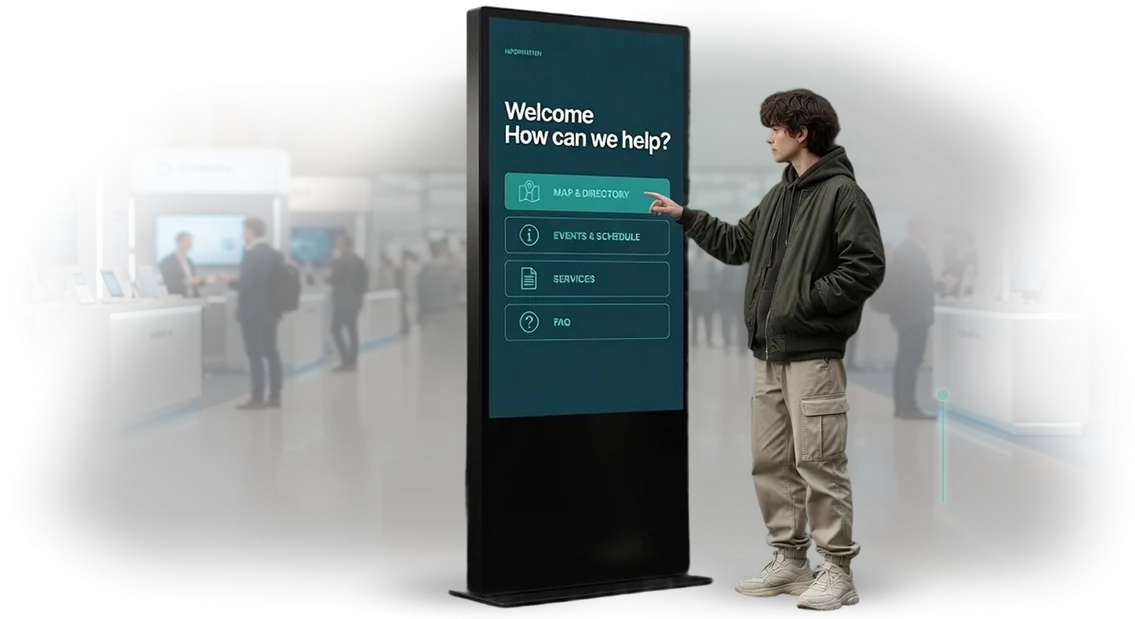
Interactive kiosks for schools or universities — why they are needed
Modern applicants decide where to enroll within a single visit — and often based on their overall impression of the university.
Information kiosks for universities help give visitors a sense of order and care from the very first minutes: directions, admissions office schedule, faculty presentations.
Without such a digital assistant, an institution loses ground to those who already use convenient services for visitors.
The same applies to schools: parents at open houses want to quickly understand the curriculum, admission requirements, and extracurricular activities.
Touch panels for educational institutions solve this instantly — without searching for an administrator or standing in line in the lobby. This relieves staff and gives visitors independence: answers to common questions are just one touch away.
The need for interactive kiosks is not just about convenience. They shape the image of a modern educational institution that is evolving and keeping up with technology. Visitors remember such a detail more than any brochures or posters.
A high-tech kiosk becomes part of the experience and increases trust in the institution — a direct contribution to its reputation.
In addition, interactive kiosks for schools or universities can replace part of paper navigation: floor plans, important announcements, event posters. The administration gets a centralized point for managing information, and visitors always see up-to-date data. Screens are easy to update without retyping and printing — changes appear within minutes.
We design interactive kiosks specifically for the needs of educational institutions: we plan screen logic, help with content, design, and launch.
Your kiosk will work every day and meet visitors' need for quick information — a solution that pays off through applicant attention and parent loyalty.
What you get from an interactive presentation on a touch panel
A touch panel in the lobby of an educational institution is not just a screen, but an assistant that works for your image, guest comfort, and staff workload relief.
our team has been creating such solutions for schools and universities for over 10 years and knows what delivers results.
Applicant engagement — from the first touch
Applicants choose a university with their hearts, and the first minutes in the building matter a lot. Instead of a stack of brochures — a live introduction to the campus, labs, and student life.
The touch panel lets them explore programs, watch videos, and even take a virtual walk through classrooms. Guests get engaged and leave with vivid impressions rather than boring handout materials.
The image of a modern educational institution
A technology-driven presentation makes a school or university stand out against competitors in the education market. Visitors and parents perceive such an institution as progressive and attentive to detail.
This boosts recognition and earns extra points before a personal conversation even begins — especially when the decision to enroll is made by the whole family.
Fast campus navigation
It's easy to get lost in large buildings, and an interactive kiosk with a map solves this problem. Finding a classroom, cafeteria, gym, or admissions office takes less than a minute.
Visitors stop asking the front desk for directions, and first-year students adapt faster in the first weeks of study.
Reducing staff workload
Admissions office, dean's office, and security staff answer the same questions dozens of times a day. The kiosk takes on typical requests: admission rules, schedule, contacts, list of required documents.
The team is freed from routine and focuses on meaningful tasks, while guests always have access to current information — even outside working hours.
Formats of interactive kiosks for different tasks
In a school or university, an information kiosk solves different tasks: helping applicants find their way around buildings, introducing guests to the institution's achievements, or relieving the admissions office or dean's office.
There is no one-size-fits-all model — what matters is the installation location, visitor flow, and operating scenario. Below we compare the main formats so you can choose the one that will work for your specific case.
Comparison of formats for schools and universities
| Format | Target audience | What it gives the client |
|---|---|---|
| Single-sided kiosk | Applicants, guests, lobby visitors | Simple navigation to classrooms, schedule, contacts. Quickly answers common questions and reduces staff workload. |
| Double-sided kiosk | Information desk in the middle of visitor flow | Two people can use the screen simultaneously — twice the throughput without extra devices or queues. |
| Floor-standing kiosk | Entrance area, lobby, outdoor events | A large touch screen attracts attention and sets the tone, building the image of a modern institution. |
| Wall-mounted kiosk | Narrow corridors, elevator lobbies, dean's office | Saves space and is always in sight — convenient for schedules, announcements, and internal navigation. |
| Mobile stand | Open houses, conferences, off-site exhibitions | One kiosk can be easily moved between locations — it serves multiple events without permanent installation. |
If you're not sure which format fits your institution, send us your floor plans and describe your usage scenario. We'll prepare a recommendation that accounts for visitor flow and interior features — so the kiosk solves your tasks rather than just standing in a corner.
With dozens of school and university projects behind us, we'll show you how to get the most out of a touch panel.
How turnkey interactive presentation creation works
We run every project according to a transparent plan — you always understand what stage the work is at and what you'll get as a result. This is especially important for schools and universities: applicant and guest experience, event reputation, and budget are on the line. We handle all stages — from brief to post-launch support.
-
Brief and audience analysis — we find out what event the presentation is needed for: open house, campus navigation, interactive stand at an exhibition. We define goals, expected visitor numbers, and their main questions.
-
Prototype and interaction scenarios — we create a logical screen map and plan user paths: from the main menu to the needed information. The structure is approved before design work begins — this saves time and money.
-
Layout approval — we show a visual concept: button placement, fonts, photos in your brand style. You'll see the layout before programming starts and can make changes.
-
Design and animation development — we draw all screens, add smooth transitions, video clips, and infographics. The result looks modern and holds visitors' attention.
-
Interface programming — we build the project on professional software, configure touch controls, multimedia, and content updates. You get a stable system without freezes.
-
Testing on the touch panel — we check touch response, performance speed, and all access scenarios. You get a guarantee that the hardware won't fail on the day of the event.
-
Launch and support — we install the project on the equipment and train staff to work with the system. After launch we stay in touch: updating information, fixing issues, and providing consultations.
What's included in interactive kiosk development
Interactive kiosk development for a school or university is a complete turnkey solution. You get not just a touch panel, but a full package: interactive presentation, content management, staff training, and technical support. Below is the complete set included in the project.
-
Touch panel tailored to the educational institution's tasks: we install and configure the screen so it works in standby mode and is comfortable for visitors of all ages — from applicants to parents.
-
Interactive presentation with a logical structure: faculties, majors, admission rules, event schedule, and contacts. Guests find what they need in a couple of touches, without staff assistance.
-
Content management system: update news, add photos and documents through a simple interface. No programmer needed — after a short training session, a secretary or administrator can handle it.
-
Staff training: we conduct a hands-on session and walk through all scenarios — replacing materials, rebooting, common questions. We provide reference guides so staff feel confident.
-
Post-launch technical support: we assign a contact person, respond to requests within one business day, and update content on request when needed.
-
Design in corporate style: we style the screen and graphics with the school's or university's colors and logo, so the kiosk becomes part of the interior and strengthens brand recognition.
Real case: interactive kiosk for a university
our team developed an interactive kiosk for a large university: campus navigation, class schedules, and an event poster all in one touch window. The task was challenging — information changes almost every hour, and users encounter touch panels for the first time. So we made the interface intuitive and content updates centralized, without involving programmers.
Kiosk implementation results
A month after launch, we collected statistics from the panel and showed the client the measurable impact on campus.
| Metric | Result |
|---|---|
| Campus audience | 8,000 students and faculty |
| Touches in the first month | 12,000+ |
| Average session duration | 45 seconds |
| Reduction in dean's office questions | by a third |
| Repeat order | second building within two months |
These numbers became a strong argument for management: the kiosk is not just a "pretty panel" but a working tool that saves staff time and helps students find their way.
We expanded this successful campus project into a network of three locations, and content is now synchronized automatically.
Why it's reliable with us
Over 10+ years, we've completed more than a hundred projects for schools, universities, and business centers, and we support each one with post-production: schedule updates, backups, and administrator training.
For a university, this means the kiosk keeps working after project handover instead of becoming a frozen display.
Frequently asked questions about kiosk development and maintenance
A kiosk in a school or university is not a one-off event but an infrastructure element. That's why clients naturally have questions: how long will it take, what happens to the equipment after launch, and how quickly can information be updated. We've collected typical scenarios and answer them honestly — the way it actually works in practice.
our team supports kiosks at all stages: from manufacturing to daily operation. All answers below are based on real projects, not on "turnkey" promises.
How long does kiosk development take?
A standard enclosure with a touch panel and basic content takes two to three weeks. If you need a custom enclosure design, schedule integration, or complex graphics, the timeline extends to five to six weeks.
We provide an exact date after the brief and layout approval. While manufacturing is underway, we prepare content in parallel — this saves time.
What does the warranty cover?
We provide a warranty on both equipment and work. If a failure occurs during the warranty period, we'll come, diagnose, and resolve the issue.
The warranty on the enclosure and touch panel is from one year. For software — preventive maintenance for the entire service life.
How do we update content without a programmer?
No technical specialist is needed. The client gets an easy-to-use admin panel where they can independently change schedules, announcements, news, and photo galleries.
Changes are published in a couple of minutes and immediately appear on screen. We provide brief staff training — usually one session is enough, and then they work on their own.
What should we do if the touch sensor starts acting up?
In most cases, the issue is resolved remotely — within 15-30 minutes. We have access to the service mode, can see the event log, and guide you on what to do.
If an on-site visit is needed, we'll arrive within one to two business days. While the repair is underway, we can offer a temporary solution so the kiosk keeps working.
The client gets a clear entry point into the project and clear support terms. All that's left is to discuss your needs — contact us, and we'll prepare a proposal for your specific school or university.How to choose the right format for your task?
Choosing an interactive kiosk format for a school or university starts not with screen size, but with answering the question: what exactly should the system solve?
If the main goal is helping applicants and guests find their way around buildings, a compact floor stand with navigation and a schedule is enough.
If the kiosk will be part of the admissions campaign or a presentation of study programs, you'll need a larger touch panel with vibrant graphics, video, and the ability to leave a request.
The second important factor is installation location and audience. In a high-traffic lobby, you need a durable structure with a vandal-resistant screen, and navigation must be visible and clear from a distance.
For the entrance area of a library or dean's office, a wall-mounted option works well — it takes up less space and doesn't block walkways.
For a career guidance office or admissions office, a mobile panel on wheels is a better choice: it can be moved between classrooms and events.
The budget determines not so much quality as the format and depth of content. Even with limited resources, you can build a useful kiosk: for example, with an interactive schedule, campus map, and news.
At the same time, it's worth planning for future growth — the platform should allow adding new screens, sections, and scenarios without reworking the entire system. We match the format to your tasks and budget rather than offering a standard solution just to check a box.
The guideline is simple: the larger the user flow and the more diverse the tasks, the bigger and more functional the structure should be. If the kiosk is for targeted information delivery, a compact model works.
If it will represent the institution at an Open House or during the admissions campaign, choose a panel with a larger diagonal, built-in sound, and a well-planned presentation scenario.
We'll help you find the right balance between cost and impact so the kiosk serves your goals from day one.
Ready to discuss an interactive kiosk for your organization?
Choosing an interactive kiosk is an investment in your institution's image and visitor comfort. With dozens of school and university projects behind us, we can take the entire technical and organizational load off your shoulders — from idea to launch.
Leave a request, and within one working meeting we'll put together a solution for your needs. After your inquiry, we take the project into work and guarantee transparency at every stage.
- Cost and timeline estimate within one day — you receive a quote that covers all turnkey work, with a fixed price and no surcharges during the project.
- A clear launch plan — a step-by-step schedule: what we do, when we show intermediate results, and when the kiosk starts welcoming its first visitors.
- A solution tailored to your audience — we design the interface and scenarios for applicants, students, and guests: from campus navigation to interactive program presentations.
- Adaptation to your branding — a consistent style, logo, and kiosk graphics that highlight the status of your educational institution.
- Staff training — a short guide for administrators so they can update kiosk content without developers.
- Post-launch support — maintenance, updates, and quick help whenever needed during the academic year.
You don't need to understand the technology — just tell us what you want to show visitors, and we'll propose a format that fits your school or university. Leave a consultation request — it's completely non-binding but will answer all your questions before the project starts.