

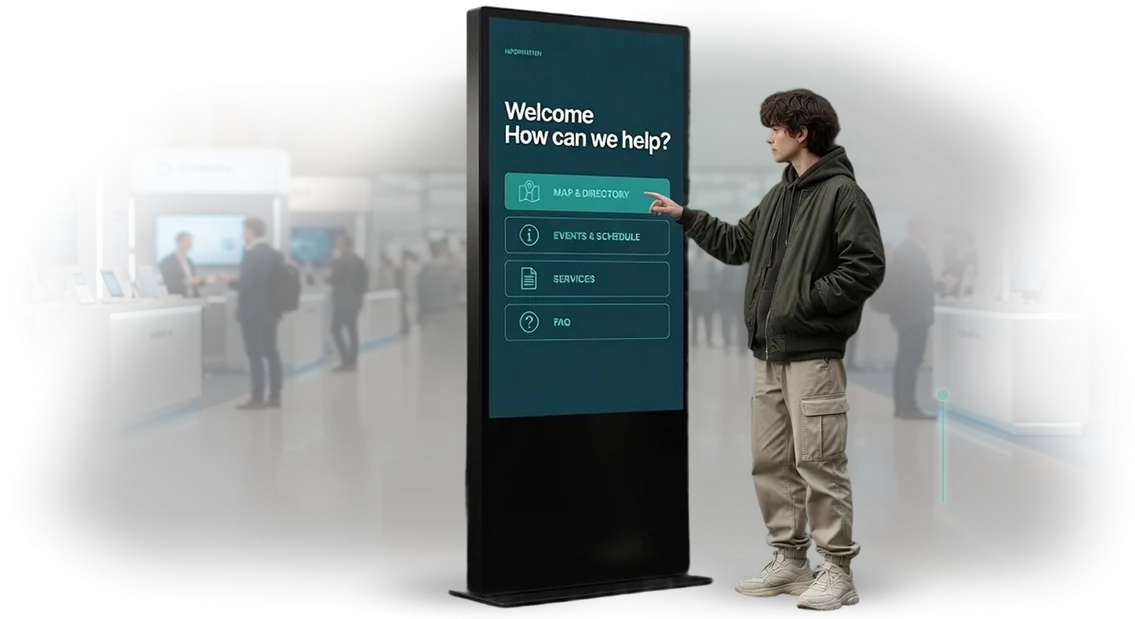
Sports complex or stadium guests get lost without navigation
A visitor to a large stadium or sports complex spends on average 10–15 minutes just finding the right stand, sector, or café. Lost among identical corridors and signs, they miss the start of the match, get anxious, and spoil their impression before even seeing the game.
This confusion is especially noticeable at large venues with multiple floors, exits, and service areas.
A lost guest is not just a ruined evening for them. It means queues at the coat check, crowding at the entrance, and empty seats at food outlets because visitors simply cannot find them.
As a result, the club and tenants lose revenue, and the venue owner gets negative reviews on social media. In an era when the impression of a stadium is formed before the whistle blows, navigation becomes part of your product.
We solve this problem with an interactive venue map and tactile information panels.
Instead of static signs, you get a system that instantly answers the guest's main question: "Where am I and how do I get there?" Our development takes into account crowd flows, group routes, and special attention zones so that every fan feels confident from the first minute of their visit.
This is how we turn a complex area into a space where guests relax and focus on the game, not on finding an exit.
What benefits the venue gains from interactive kiosks
Guests arrive at a sports complex for emotions and convenience, not to decipher schedules. An interactive kiosk delivers information instantly: arena map, session times, available lanes, cafés, and shops — all in one touch.
When a visitor doesn't have to seek help, they are satisfied, and a satisfied guest comes back and brings friends.
For the administrator, a kiosk is an assistant that handles a stream of routine questions. Instead of explaining dozens of times how to get to the pool, staff engage in live communication rather than repeating the same instructions.
This effect is easy to measure: the number of inquiries at the information desk drops significantly, and staff gain hours for more important tasks.
Here is what the venue gets from implementing interactive kiosks:
- Increased guest comfort. Visitors find the answer themselves in 30 seconds — this reduces stress levels and improves the overall visit experience.
- Reduced staff workload. Typical questions like "where are the locker rooms?" and "when is the workout?" are handled by the kiosk; employees stop being a directory service.
- Advertising on the kiosk. It becomes an additional advertising medium: partner banners, event announcements, sponsorship integrations. The venue gains a new revenue stream without spending on ad space.
- Information is always up to date. Schedules change — updates happen in minutes through the admin panel, without printing new stands or dealing with outdated paper sheets.
- Analytics for improvements. The kiosk collects statistics: what guests search for most often, which sections are popular. Based on the data, you can restructure navigation or add in-demand services.
- A modern venue image. Digital solutions highlight the status of the sports complex, and technology becomes part of the service — something guests appreciate.
We have already implemented such kiosks at sports venues and know how to adapt the interface for different visitor groups — from children to the elderly.
Every project starts with an analysis of your complex's tasks, so you get exactly the features your guests need. Let the kiosk become a full-fledged member of your team — without sick days or breaks.
Interactive kiosk formats for navigation and information
Stadium guests need clear navigation from the very first step: from the entrance to the sector, from the parking lot to the café. The kiosk's job is to provide an answer in 10–15 seconds, without queues or staff assistance.
The format depends on the zone: at the entrance there is one scenario, at the food court — another. That is why we select the kiosk type for each specific location and task, from floor-standing to wall-mounted options.
| Format | Who it's for | What it gives the client |
|---|---|---|
| Floor-standing interactive kiosk | Guests at the main entrance, food court, fan zone | Quick sector and route search, stadium map loading, reduced flow of questions to staff |
| Wall-mounted touchscreen | Visitors in corridors, recreation areas, near elevators | Floor and zone navigation, match and event schedules in high-traffic areas |
| Kiosk with interactive presentation | Fans, VIP lounge guests, potential partners | Showcasing club history, services, and development plans — engagement without a manager's involvement |
| Mobile countertop format | Administrators and event staff | Flexible placement: moving the kiosk to the needed zone depending on visitor flow |
Stadium formats are easy to combine: a floor-standing kiosk at the entrance greets guests, wall-mounted screens accompany them through corridors, and an interactive presentation works in waiting areas.
All devices are united into a single system — content updates centrally without a site visit. You get clear navigation, fewer questions to staff, and additional communication points with fans on match days and regular days.
Stages of developing an interactive kiosk for your venue
Developing an interactive kiosk is not a "black box" but a transparent process you control at every stage. We structured the phases so you always know what is happening, what results you get, and when the project will be launched at your venue.
-
Development brief. We meet or hop on a call, discuss the kiosk's tasks, target audience, and installation location. You receive a document with goals, usage scenarios, and timelines — so you can immediately see the scope of work and budget constraints.
-
Scenario design. Based on the brief, we develop the screen logic and navigation. You see how a visitor will move through sections: complex map, schedule, ticket purchase. It is important that the user path is intuitive — especially at the reception area or entrance.
-
Layout approval. Designers create a visual concept aligned with your brand style. You approve the structure, texts, and visual design. Nothing is done "blind": after layout approval, you know exactly what the kiosk will look like at your venue.
-
Development and testing. Programmers write the code, integrate content, and verify operation on professional equipment. We simulate real scenarios: queues, touch errors, awkward viewing angles. The client receives a stable version that won't fail on launch day.
-
Launch and installation. We deliver the kiosk to the venue, mount it, and adjust it for lighting and the local network. We run a test check in your stadium or sports complex environment and train administrators and staff to work with the panel.
-
Support and development. After launch, we stay in touch: update schedules, add new sections, monitor reliability. You can order extended functionality — from maps to ticket system integration — without going through all the stages again.
This process prevents surprises: each stage ends with a clear result that you approve personally. As a result, the kiosk isn't just installed — it starts working for your business from day one.
What is included in the interactive kiosk delivery
When you order an interactive kiosk for a sports complex or stadium, it's important to understand what's included. We are responsible for the turnkey result: from equipment selection to staff training.
In the end, you get not just a device but a ready-made tool that helps visitors find their way, check schedules, and use the venue's services.
To keep you in control of every stage, we document the full delivery scope:
- Equipment with a protective enclosure — a touchscreen panel designed for heavy use in public areas and resistant to external impact.
- Content for the touchscreen — interface design, navigation structure, and informational content tailored to your venue: stadium map, training schedule, news, event announcements.
- Panel installation and connection — on-site mounting, equipment setup, and verification of all functions before launch.
- Staff training — hands-on training for administrators and managers: they learn to update information, change schedules, and make edits without involving developers.
- Instructions and documentation — clear guides for operating and maintaining the kiosk that are easy to pass on to new employees.
- Warranty and technical support — prompt assistance with any issues during operation, plus content updates included in the price for the first month after launch.
All of this is part of a single solution — no need to find separate contractors. You get a working kiosk from day one: visitors use it immediately, and your staff save time answering routine questions.
Case study: how interactive kiosks helped guests navigate faster
Guests at a sports complex often get lost on their first visit: they need to find the right sector, ticket offices, coat check, and food outlets.
While visitors figure out the navigation, they are late for the start of the match, and administrators answer the same questions instead of providing real help.
For the sports complex «Northern Arena», we solved this problem with interactive kiosks in the lobby — so guests could build their own route in 30 seconds, without queues or staff hints.
Implementation results
| Metric | Before installation | After installation |
|---|---|---|
| Average time to find one's sector | 7 minutes | 2 minutes |
| Information desk inquiries during peak hours | 40+ | 12 |
| Share of guests satisfied with navigation | 64% | 91% |
Data was collected two weeks after launch and compared with the same period before installation.
Sector search time dropped threefold, and staff workload fell by nearly three times — administrators now have time for event-related matters instead of repeating directions to the restroom.
Client testimonial
"Guests stopped being late for the start of matches, and questions at the desk are no longer about 'where to find' but about the content of the program.
Six months later, we ordered a second kiosk at the entrance to the stands and adapted the interface for guests with limited mobility." — Sports complex manager.
This case became a starting point for further infrastructure development: the company now plans to connect the kiosks to the merchandise sales system to also increase the average ticket size.
The client stayed with us for long-term support — and that is the best indicator that the solution delivers results, not just looks good.
How to choose the right interactive kiosk format?
The right interactive kiosk format is not a technical specification but a strategic decision. It should help visitors navigate the stadium or sports complex, reduce queues, and increase loyalty.
To choose the right model, start from two questions: where will the kiosk be installed and what task will it solve?
At the entrance zone, it makes sense to place a device with navigation for courts, stands, and venue infrastructure. If the kiosk is near a café or shop, it can take orders and relieve staff.
An interactive map with training schedules and available time slots will reduce the flow of calls to the reception. That is why we first analyze guest routes and their behavior scenarios — and only then select the format, not the other way around.
For a sports venue, high traffic matters: the enclosure must withstand heavy use and look neat so it fits the interior. It's worth planning the screen size and orientation in advance — vertical for posters and schedules, horizontal for maps and interactive activities.
Often the same kiosk works as a navigation guide during the day and turns into an entertainment panel with quizzes and interactive photo zones in the evening. This becomes possible when you choose a software platform that flexibly switches between modes.
A good interactive panel selection always comes down to budget, interior, and target actions. For a high-traffic lobby, a floor-standing touch kiosk at human height works well; for a children's area — a low horizontal table.
You don't need to be a technical specialist to make a decision: it's enough to understand that the kiosk should deliver value — help, surprise, and sell.
Our experts will help you choose the exact format that suits your stadium or sports complex. We'll assess the premises, write usage scenarios, and propose options across different price ranges.
You'll get a kiosk that fits organically into the space and fulfills your business tasks from day one.
Common doubts when ordering an interactive kiosk
The most common reason to postpone launching an interactive kiosk is the fear that the equipment will fail at a critical moment. The screen goes dark, the touch sensor stops responding, data won't load.
For a sports complex or stadium, this is critical: on event days, hundreds of guests expect navigation, schedules, and up-to-date information.
We eliminate this risk in advance: we provide an official warranty on the kiosk and panel, and we handle maintenance ourselves. If something goes wrong — we resolve it quickly without disrupting your event. Below are answers to typical questions.
What happens if the touchscreen panel breaks?
The kiosk is covered by the manufacturer's warranty and our service support. You submit a request — we diagnose the issue remotely, and if necessary, bring replacement equipment or send a technician on-site.
While the kiosk is being repaired, we provide a temporary replacement so the venue keeps running without interruptions.
Who handles kiosk maintenance after launch?
We support the project: update content, monitor stability, and perform preventive maintenance on the screen and touch panel. You don't need to find a separate specialist — our team handles all technical matters under the contract.
How quickly will you respond if the kiosk stops working?
During business hours, we respond to a request within two hours; on-site visits within the city — within a day. We take the request into work immediately, keep you informed, and don't close the ticket until the kiosk is back in operation.
How long is the kiosk warranty?
The standard warranty is 12 months from launch. The touchscreen panel and mechanics have the same coverage. During this period, you can count on free repairs and consultations. After the warranty expires, we offer an extended service agreement — with the same level of support.
Shall we discuss an interactive kiosk for your stadium?
Leave a request — and we'll prepare a custom proposal for an interactive kiosk specifically for your sports complex or stadium. We'll show how guests can independently find sectors, schedules, cafés, and shops, while your staff deal with fewer repetitive questions.
After you reach out, you receive:
- A kiosk consultation: we'll discuss tasks, placement locations, and navigation logic for fans and visitors.
- A preliminary cost estimate — no hidden fees or "surprises" at the approval stage.
- Format selection: floor-standing, wall-mounted, or mobile option — tailored to your space and arena style.
- Examples of sports venue projects: we'll show how interactive kiosks reduce queues at the info center and increase guest satisfaction.
- A clear launch plan: from layout to installation, with transparent timelines and a dedicated manager available.
- Post-launch support — content updates, interface consultations, and quick responses to questions.
We've been creating interactive solutions for business for over 10 years and understand how to turn a touchscreen panel into a working navigation tool, not a "screen to tap." Fill out the form or write to us — we'll get back to you within a business day with initial recommendations and a cost estimate for your stadium.