

How to Keep Guests at a Tourist Complex Engaged with Interactive Technology
Guests at a tourist complex walk past static stands in a matter of seconds — posters and signs stopped holding attention long ago. Even the brightest banner earns only a brief glance, not real contact with the audience.
The visitor doesn't remember the information, the complex receives no inquiries, and the route around the grounds stays chaotic.
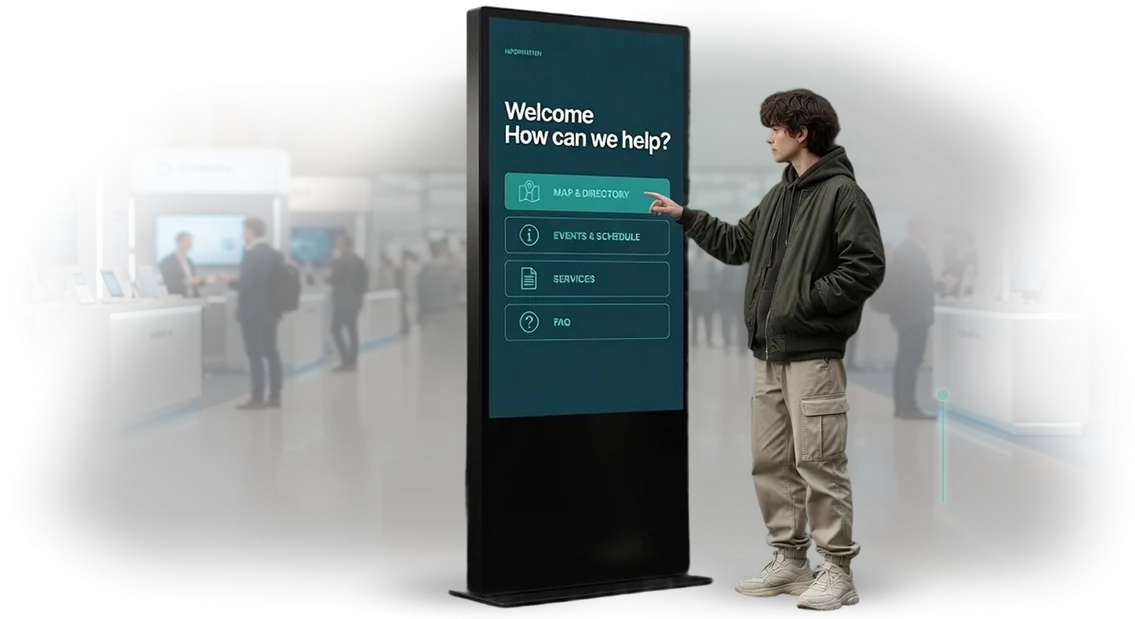
An interactive kiosk on a touch panel solves this problem differently: it invites the guest to act. Instead of passive reading, the visitor taps, swipes, chooses a route, and explores facilities at their own pace.
This kind of engagement holds attention 5–10 times longer and, most importantly, turns a random guest into an interested visitor who understands what the complex has to offer.
From a business standpoint, this means more than just an "interesting stand." The kiosk helps manage guest flow, suggest popular routes, and show services and extra activities at the right moment.
Visitors leave their contacts themselves, take part in surveys, or subscribe to news — and the complex gains a database for repeat visits and well-targeted mailings. Every touch of the screen becomes a point of interaction that can be measured and used.
The touch panel gives the complex one more important advantage — managing the impression. A guest who easily finds the way to the café, viewing platform, or kids' zone leaves satisfied and comes back again.
And if the kiosk offers promo codes, quests, or photo zones, that becomes a reason to post on social media and an extra stream of visitors that spreads without an advertising budget.
We develop interactive kiosks that work for results: they keep guests engaged, collect contacts, and raise the complex's visibility. A well-thought-out interface, adapted to the specifics of a tourist facility, is easy to launch and requires no complicated staff training. Tell us about your goals — we'll offer a turnkey solution.
What an Interactive Presentation on a Touch Panel Delivers
Visitors to a tourist complex rarely read long texts on stands and in brochures — they want experiences and quick answers. A presentation on a touch panel turns waiting into lively interaction: the guest chooses what to view, flips through photos, and explores routes and the map.
This format engages far more strongly than a static poster, which means the information about the facility is truly absorbed rather than passed by.
A touch screen holds attention at an exhibit several times longer than a regular stand. While the guest explores interactive sections, they get the chance to look at key points of interest and learn about promotions and special offers.
For the complex, this is extra time in contact with the audience — time to communicate everything important about itself.
A built-in scenario helps collect visitor contacts right at the screen: the guest leaves a request for a consultation, subscription, or booking without having to search for an administrator. The collected database becomes a base for repeat visits and mailings about new events.
In addition, the interactive presentation boosts recognition — vivid graphics and striking transitions create a memorable image of the complex that guests talk about and recommend.
Finally, well-designed screen scenarios gently suggest additional services: the café, souvenir shop, excursion, or spa. An unobtrusive hint at the moment of choice increases the average check and makes the visit richer.
In the end, a touch-panel presentation solves several tasks at once: it increases engagement, collects leads, strengthens recognition, and softly encourages additional sales — without active staff involvement.
Interactive Kiosk Formats for Tourist Complex Goals
A visitor to a tourist complex makes decisions in seconds: where to go, what to see, where to eat. If the information is scattered across brochures and reception counters, some guests get lost and some leave without buying additional services. The right kiosk format solves this problem at the point of decision.
Which Format for Which Task
| Kiosk format | Best for | What it gives the client |
|---|---|---|
| Floor-standing kiosk | Entrance zone, lobby, high visitor traffic | Quick information about routes, areas, and schedules. Relieves staff and shortens the queue at the information desk. |
| Wall-mounted kiosk | Narrow spaces, corridors, transitions between zones, elevator lobbies | Helps with wayfinding, shows nearby facilities and events. The guest doesn't have to look for staff — they see the direction right away. |
| Touch table | Lounge area, café, hotel lobby, exhibition space | Group interaction: visitors plan a route together, study the map, browse the photo gallery. Increases dwell time and engagement. |
| Mobile stand | Events, exhibitions, seasonal promotions, temporary zones | Easy to move and remove after the event. Quick navigation for event guests without being tied to permanent infrastructure. |
Each of these formats works toward a single result: the guest finds what they need faster, buys more, and comes back. We match the construction and interface to your layout and visitor-flow scenario — without spending unnecessarily on zones that don't work.
How Kiosk Development Works for Your Project
Developing a kiosk for a tourist complex is a transparent process with no technical complications. You see the result at every stage and make changes, and the timeline depends only on the amount of content and the complexity of the scenario. Below are the seven steps a project goes through.
-
Brief and goals — you tell us who your guests are, what they look for in the kiosk, and which sections are mandatory. We record the input and propose a structure.
-
Concept and scenario — we define the logic of the screens: map, routes, facility descriptions, promotions. You receive a clear document for approval.
-
Layout approval — we show what each page will look like. You make changes before production — this saves budget and time.
-
Production and content — we assemble the design, texts, photos, and video into a working version of the kiosk. Everything in your complex's brand style.
-
Setup and testing — we check the touch panel for response speed, readability, and durability under continuous use.
-
Kiosk launch — we deliver the equipment, install it on site, and train the staff. The kiosk starts working on launch day.
-
Support and updates — if you need to change prices, add an event, or correct text, we do it remotely. The kiosk is always up to date.
At every stage you communicate with the project manager and see the timeline. This process has already helped tourist complexes cut the queue at the info center and give guests self-service answers to their questions.
What You Get After Launching an Interactive Kiosk
After launch, you get not just a touch panel but a ready-made solution that works for your business from day one. No "raw" delivery: everything is configured, filled with content, and tested against real visitor scenarios.
The package includes:
- Equipment — a touch kiosk with a protected enclosure, selected for the conditions of the tourist complex (humidity, outdoor installation, heavy guest flow).
- Interface and navigation — a clear menu, large buttons, adapted for different visitor categories: from children to older adults.
- Content — the route structure, facility descriptions, photos, video, and maps that you approve before launch. The content is easy to update by your own staff.
- Instructions — short guides on powering on, replacing content, and daily maintenance. No complicated technical details.
- Staff training — we conduct a session for your team: how to operate the kiosk, quickly resolve common guest questions, and what to do in an emergency.
- Kiosk warranty — an official warranty on the equipment and installation work. In the event of a breakdown, we restore operation as quickly as possible.
- Technical support — feedback by phone and messengers, remote diagnostics, and help with content updates. We respond quickly so the kiosk never sits idle.
All of this removes the client's main risk: the technology doesn't turn into an "expensive advertising stand" but consistently delivers value — it guides guests, reduces the load on staff, and improves the impression of the complex. You get not just a device but a working tool that stays up to date.
After launch, you know what to do next: how to change the menu for the season, add a new route, or add a language version. The kiosk stays manageable and lives alongside your business — it doesn't become outdated in a month.
Case Study: How a Kiosk Tripled Time Spent at the Stand
For the tourist complex Green Valley, we developed an interactive information kiosk — a touch panel with a map of the grounds, an activity schedule, and route descriptions.
Before that, guests approached the administrators with the same questions over and over, and the counter constantly had a queue. The goal was to relieve the staff and give guests the ability to find answers on their own.
The problem was that guests came up to the stand but almost never stayed: brochures and posters didn't hold attention. Average time at the counter was about 30 seconds, and most of the information simply went unread.
We installed a kiosk with an intuitive interface, large buttons, and lively descriptions. In a couple of touches, the guest opens the map, upcoming events, routes, and prices.
The hardware and software were chosen for round-the-clock operation in high-traffic locations — no freezing during peak hours.
The result exceeded expectations: guest time at the stand grew 3 times — from 30 seconds to a minute and a half. Guests began booking excursions right at the panel more often, and administrators gained time to work with those who really needed help. By the end of the season, the complex ordered a second kiosk for another recreation area.
"The most important thing is that guests figure out their leisure options on their own, and we see the interest through the number of bookings made from the panel. For us, it's both guest convenience and additional revenue without hiring staff."
The investment in the kiosk paid off within a single season: the growth in time at the stand directly affected sales of additional services and visitor loyalty.
In essence, the kiosk is a full-fledged information-desk employee that doesn't ask for vacation, doesn't get tired, and is equally welcoming to every guest.
Addressing Common Doubts Before Ordering a Kiosk
Before ordering an interactive kiosk, tourist complex owners ask the same questions: "What if the equipment breaks down?", "Will we be able to change information without developers?", "Will the timeline slip?" These are normal concerns — let's go through them point by point, honestly and without technical details.
What if the kiosk breaks down during operation?
We provide a warranty on the equipment and installation, as well as service support for the entire duration of our cooperation. If a breakdown occurs, you submit a request — within two business days a specialist performs remote diagnostics and, if necessary, visits the site. Repairing the kiosk requires no special knowledge from your staff: all support is on our side.
Will we be able to update content on our own?
Yes, and you don't need a programmer. The complex's administrator logs into a simple control panel and changes texts, photos, prices, and promotions within minutes. Content updates happen without stopping the kiosk — changes are published immediately and appear on the screen.
Will you meet the deadline for the season opening or an event?
We work on a clear schedule: from brief to kiosk launch takes 3–4 weeks on average. For urgent projects, there's an accelerated format — the team prepares a base version in 10–14 days.
All stages are agreed with you in advance so the launch doesn't slip and the kiosk meets the first guests on time.
We also think through the kiosk's integration into the tourist complex's design: we match the enclosure, screen size, and styling to the location's aesthetic. The technology doesn't look like a "foreign" element — it becomes part of the space and doesn't disturb the atmosphere of the place.If you still have doubts, just send us a question through the feedback form — we'll tell you about warranty cases, timelines, and show examples of similar projects. We're available before, during, and after launch.
Order a Turnkey Interactive Kiosk for Your Facility
Ordering a turnkey kiosk means handing over all the stages to us: from idea to launch and maintenance. You focus on your facility, and we take on design, production, installation, and technical support.
That's why marketing directors and business owners choose us for a predictable result and a clear process.
Leave a request on this page — our manager will contact you within a few minutes. After that, you get a clear plan:
- Consultation. We discuss the task: where the kiosk will be placed, who will use it, and what materials need to be shown. You receive recommendations on format and functionality.
- Cost calculation. We prepare an estimate for your project. The price is fixed in the contract — no additional charges along the way.
- Contract and work plan. We set out the timeline and stages. You know when you'll receive the finished kiosk and what happens at each stage.
- Interface and content development. We create the presentation structure and fill it with your texts, photos, and video. You approve the layouts — and we start production.
- Production and installation. We build the enclosure, install the equipment, and program it. We deliver to the site, mount, and test.
- Launch and acceptance. Together with you, we test all scenarios and make sure the kiosk works stably. We hand over the instructions and access details.
- Post-launch support. We update content remotely and carry out equipment maintenance. You can always reach out for help.
Call us or send a request — we'll calculate the cost and offer a solution that fits your tourist complex. We work across the entire country and travel to sites for installation.
How to Choose a Kiosk Format for Your Goals and Budget
When choosing a kiosk format for your goals and budget, it's important to start not from technical specifications but from the usage scenario: who will approach the panel and in what setting.
If visitors walk past in a flow and you need a noticeable point of attraction — choose a floor-standing kiosk. It establishes a presence, stops the eye, and lets you create the effect of an "interactive guide" that easily gathers a group.
A wall-mounted kiosk is a more compact and practical option when space is limited. It fits into the information desk area, lobby, or corridor, doesn't take up usable floor space, and works as a quick reference: routes, opening hours, infrastructure.
This format is easier to blend into an existing interior and works with a smaller project budget — without losing speed of information delivery.
At the same time, the choice of format is directly tied to the project budget. A floor-standing kiosk requires a more substantial structure and a stable platform, so the investment is higher.
But it becomes a standalone art object or part of the exhibition and can present the entire complex at once. The wall-mounted option saves money — it suits tasks where functionality matters more than a striking look.
Make the final decision by three criteria: installation location, expected number of simultaneous interactions, and the kiosk's main purpose.
For a large waiting area and an interactive map, a floor-standing kiosk fits; for navigation near an elevator or at the administrator's desk, a wall-mounted one.
Both formats are easily adapted to your brand style, and we'll help you choose the optimal configuration for your goals and budget.