

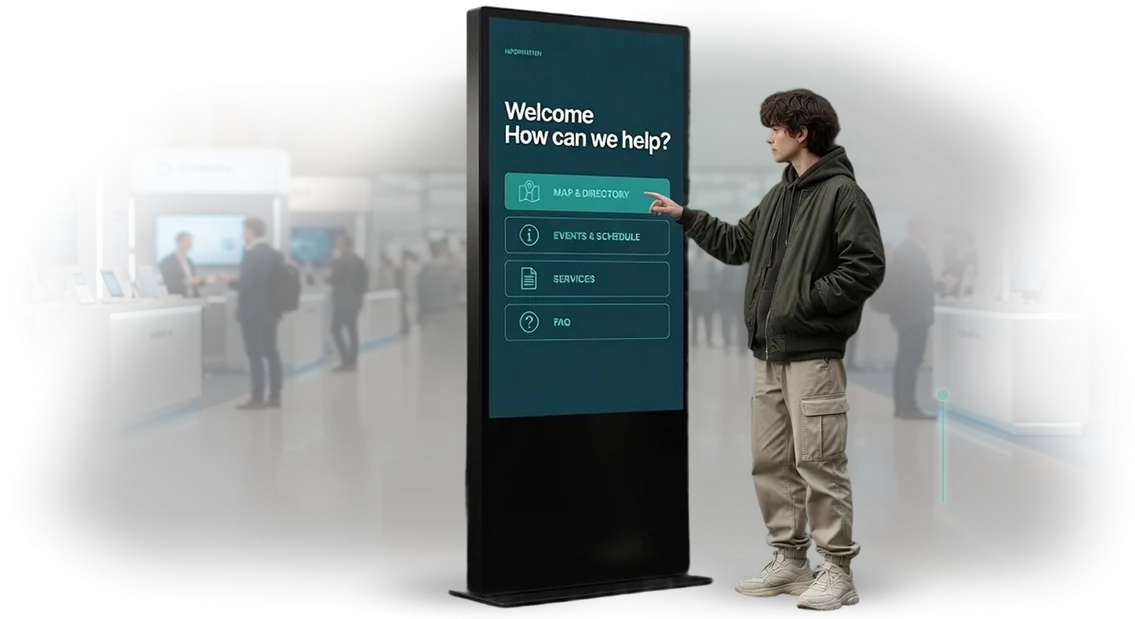
Why Visitors to a Developer's Visit Center Lose Interest in the Project
Every family walks into a visit center with one question: "Is this home right for me?" But the developer often greets them with a static model and a generic presentation where all layouts look the same.
The guest looks at the facade, doesn't find their future lifestyle, and within a few minutes leaves — the conversation with the manager never happens, and the lead is lost.
The problem isn't a lack of desire to engage on the buyer's part, but the absence of a reason to stay. It's hard for a person to imagine how morning light falls into the bedroom windows, where the kitchen will be placed, and whether there's enough room for a children's room.
While they flip through paper brochures on their own, interest fades, and the manager wastes time repeating the same explanations instead of handling objections and matching options.
This is exactly where an interactive kiosk for the visit center helps: a touch panel turns exploring the project into a live dialogue.
The visitor chooses the floor themselves, rotates the layout, compares square footage, and literally "walks through" the future apartment.
This format holds attention many times longer, and the developer gets buyer engagement without extra staff — the manager steps in precisely at the moment of interest, with a specific question from the client.
A presentation for a developer on a touch panel solves three tasks: it keeps the guest engaged, showcases the strengths of each layout, and nudges them toward a conversation with a consultant.
As a result, sales office conversion grows because the visitor leaves not with a "looked and left" impression, but with an understanding of which option suits them and a desire to discuss the terms.
We cover this: we design an interactive kiosk for your visit center's objectives — so the model comes alive, layouts become clear, and guest interest turns into an inquiry before they even leave the site.
What an Interactive Panel Will Give Your Showroom
A developer's visit center is where the client makes the key decision: whether to buy an apartment. Standard stands with layouts and the manager's pitch often overload visitors with information, and the visitor is too shy to ask questions. As a result, they leave with misunderstandings, and you lose a potential deal.
An interactive touch panel for the showroom turns exploring the project into a lively dialogue. The client sets their own pace, examines the details, and leaves with a clear understanding of their future home. It's an intuitive tool that improves lead quality and trust in the developer.
Visual presentation of the project
Instead of a stack of brochures — all the information about the residential complex on a single screen. The visitor sees the placement of buildings, number of floors, landscaping, and infrastructure in a convenient format.
A visual story is remembered better than a verbal one, so the client takes away a vivid image of the new development.
The panel even shows what hasn't been built yet: the future courtyard, the entryway, the views from the windows. This removes the fear of "buying into a construction site" and helps speed up the decision.
Self-guided exploration of layouts
Every client needs to see their future apartment: square footage, room arrangement, furniture options. A touch panel for the showroom lets them do this without a manager's help. The visitor switches floors, compares layouts, and models their own scenarios on their own.
This means the manager doesn't waste time repeating the same information. They step in at the selection stage and clarify the details — which noticeably boosts the efficiency of the sales department.
Longer visits and better lead quality
The longer a potential buyer stays in the visit center, the higher the chance of a deal. An interactive presentation holds attention — visitors spend several times longer at the panel than at a regular stand. During that time, the image turns into an emotional attachment to the project.
Clients who have studied the layouts on their own come to the manager with specific questions. Such leads are much warmer for the developer: they've already shortlisted the right options and are motivated to buy.
Project recognition
The interactive panel becomes the showroom's center of attraction. Guests photograph the screens and share their impressions on social media — that's free reach and extra advertising for your property.
Modern equipment underscores the developer's status and builds trust before negotiations even begin.
We deliver these solutions on reliable, battle-tested hardware and tailored to your visit center's objectives. The client gets an intuitive tool that works for you and increases sales conversion.
Formats of Interactive Kiosks for a Developer's Visit Center
Choosing an interactive kiosk format isn't a question of technology — it's a question of how guests will explore your project.
Wall-mounted, floor-standing, or mobile — each has its own scenario: one works at the entrance, the second creates a center of attraction, the third travels to external venues.
We match the enclosure to the visit center's area, layout, and sales office objectives. Below are three core formats that cover most property exploration scenarios.
Three formats — one result: a visitor who wants to learn more
| Format | Best for | What it gives the client |
|---|---|---|
| Wall-mounted kiosk | Visit centers with limited floor space | Saves space, always visible at the entrance, immediately engages the guest in browsing layouts |
| Floor-standing touch stand | Spacious sales offices and showrooms | Draws attention, allows detailed review of layouts and floors, creates a wow effect |
| Mobile kiosk | Exhibitions, presentations, temporary sales points | Moves without installation, deploys quickly at a new venue, easy to change locations |
The important thing isn't just placing a screen — it's integrating it into the customer journey: from the first touch to a request for a layout calculation.
For each format, we design a custom navigation and content presentation scenario — based on your exhibition layout, typical visitor questions, and manager objectives. This way the kiosk becomes a full-fledged participant in the sale, not just a decoration in the lobby.
If you're unsure which format suits your visit center, send us the floor plan and a description of the visitor flow — we'll suggest an option with the optimal balance of value and cost.
How a Project Goes from Brief to Launch in 2–4 Weeks
Turnkey presentation development for a developer's visit center is a project with clear stages of kiosk implementation. We take the client from the first brief to a working kiosk in 2–4 weeks — that's the timeline for creating an interactive kiosk you'll be happy with.
- Inquiry and interview. We discuss the visit center's objectives, target audience, and kiosk placement point. We identify the key visitor scenarios — what they should see and do.
- Structure prototype and design. We put together the section scheme and navigation logic, and show the visual solution and placement of accent materials. The client sees the future kiosk before programming even starts.
- Approval. We make edits based on your feedback and approve the final structure. After that, we move on to content.
- Content development. We work with your materials: building descriptions, layouts, photos, infographics. If content is lacking, we help structure it and supplement it to support sales objectives.
- Development and testing. We build the interactive presentation, set up touch control, and verify performance on the same type of hardware that will be installed in the visit center.
- Launch and support. We install the kiosk, train the staff, and show them how to update prices and news independently. If needed, we remain on support after launch.
What's Included in the Delivery and Setup of an Interactive Kiosk
You get more than just a program — you get a complete turnkey solution, from scenario to installation. Everything needed to launch a kiosk in a developer's visit center is bundled into one package and adapted to your visitors.
What's included in the delivery package:
- Interactive presentation scenario — screen structure, navigation logic, copy. The visitor chooses what to view: layouts, finishes, infrastructure, or construction progress.
- Design mockups for the touch kiosk — large buttons, readable cards, brand style. The guest figures it out in seconds, without a consultant's help.
- Software shell — stable operation on the touch panel, fast response to taps. No freezes at the most important moment of a conversation with a buyer.
- Content — texts, photos, layouts, videos. We prepare and structure materials so they sell, not just inform.
- Hardware installation and setup — we deliver, install, connect, and verify everything on site. You receive a finished kiosk, not a "half-finished product."
- Staff training — within half an hour, your employees confidently work with the kiosk. Plus a short instruction card: how to turn it on, restart, and quickly update content.
We lock in timelines and scope of work at the start — you know what you'll get and when. After launch, we stay in touch: we'll update layouts, adjust the scenario, or add new materials if selling conditions change.
Case Study: How We Raised Sales Office Conversion by 38%
There's a hidden problem in developer sales offices: while a manager explains layouts to one client, other visitors wait and often leave. Paper brochures don't hold attention, and a standard video on a screen doesn't answer a buyer's specific questions.
For one developer, we solved this scenario — we built an interactive kiosk that became a standalone sales tool.
We used a developer's visit center with a typical complex model as the foundation. Instead of a static script, we installed a touch panel where the buyer selects the building, floor, and layout themselves and immediately sees the price with promotions applied.
Materials — renders, option comparisons, answers to frequently asked questions — are now explored without a manager's involvement. This isn't a "screen for show" but a working tool that turns a cold visitor into a warm contact.
Implementation results
Average guest interaction time with materials doubled: from 15–20 minutes to 35–40. Managers stopped spending time on basic explanations and focused on mortgage, reservation, and negotiation questions.
During the two-hour opening day, visitors made over 250 interactions with the kiosk — that's 80% of all visit center guests.
The key result — growth in conversion to target actions: booking an apartment viewing, making a call, or submitting contact information. Over three months of operation, the figure rose by 38% compared with the same period using regular brochures.
The developer placed a repeat order: now we're preparing interactive modules for two new phases of the complex.
This interactive kiosk case confirms: if you give buyers a convenient way to explore the product, the developer's sales office starts working more efficiently without expanding the team.
Think of the kiosk as an extra manager who works without lunch breaks or vacations — it handles the routine and delivers warm contacts to you.
How to Choose the Right Format and Not Overpay?
Every developer opening a visit center asks: how much should we invest in touch panels so they drive sales rather than sit as decor? Nobody wants to overpay, but an overly cheap solution won't handle the visitor flow either.
Choosing a format isn't about price — it's about matching three parameters: your objectives, floor space, and visitor flow. For a compact developer visit center, a single touch panel with a clear presentation is enough.
For a large exhibition hall, multiple points with different scenarios are better — that way you don't overpay and get a properly calculated budget.
The main rule when choosing a kiosk: first determine what functions it needs to perform. For showing layouts and neighborhood infrastructure, a classic horizontal panel works well.
If you plan group presentations or self-guided detail exploration — consider a vertical screen with an interactive map.
The cost of an interactive presentation depends on the volume of content, the number of scenarios, and the ease of updating. Don't chase the lowest price — it's usually a static video rather than a living product.
We'll help you choose a touch panel that fits a visit center budget and build a presentation you can easily update on your own. Give us a call — we'll explain how to choose a kiosk based on your objectives and floor space, and offer an option that pays for itself.
Answers to Frequently Asked Questions About Kiosk Implementation
Information kiosks trigger the same question from clients: "What happens with it after launch?" We address the main concerns — content updates, breakdowns, and day-to-day operation. You get a working tool, not another headache.
How do I update content on the kiosk?
You don't need to call a developer or learn programming. We hand over a simple control panel: change layouts, prices, promotions, and news in a couple of minutes. The update appears on the kiosk immediately after saving — visitors get fresh information without delays.
What if the kiosk breaks down?
The kiosk runs on professional equipment, but even it needs attention. We handle technical monitoring and respond quickly to failures: most issues are resolved remotely. If a repair is needed — we arrive within the agreed timeframe and restore operation. Guests continue to receive information while we fix the cause.
Who handles day-to-day operation of the touch panel?
The panel is designed to work in "set it and forget it" mode. We configure auto-start and screen protection; the device runs on its own after that. Visit center staff spend no more than a minute a day on the kiosk — just wiping the screen. Everything else is on us.
What warranty comes with the kiosk?
We provide an official warranty on the hardware and on the implementation work. During the warranty period, we fix any issues free of charge; after it, we offer a maintenance agreement. You always know who's responsible for stable operation — and it's not your staff.
Discuss Your Task and Get a Commercial Proposal in 1 Day
A developer's visit center works on impressions: while a visitor explores layouts, the interactive panel holds their attention and guides them toward a choice. All that's left is deciding who will build this tool quickly and without surprises.
We've been creating interactive kiosks for over 10 years and know how to turn a touch screen into a sales assistant rather than a useless artifact.
To order an interactive kiosk for your visit center, no technical specification is needed — just describe the task in a couple of words.
We'll suggest the format, content, and launch plan ourselves, and the next day we'll send you a cost estimate for the kiosk with a breakdown: hardware, design mockups, programming, installation, and support.
The consultation on the interactive panel is non-binding. We discuss the task — we send the proposal, and then you make the decision without pushy calls or reminders.
What you get with the commercial proposal:
- a cost calculation tailored to your specific visit center — no standard packages or hidden surcharges;
- format selection: floor-standing kiosk, wall-mounted panel, or touch table;
- preliminary content plan: layouts, 3D walkthrough, mortgage calculator;
- development and launch timelines aligned with your opening schedule;
- a fixed estimate that won't change during the project;
- warranty and support: maintenance, content updates, refinements.
Leave a request on the website or message us — we'll send examples of residential complex projects and answer your questions. By tomorrow, you'll know the cost, timeline, and the next step to launch an interactive kiosk in your visit center.