

Why Visitors to Military Museums Pass by the Displays
A visitor to a military museum arrives expecting to see living history, but encounters static display cases and long texts on plaques.
Even the richest museum exhibition loses visitors' attention within the first minutes: the gaze glides over the displays, a person takes a couple of photos and moves on to the next hall.
Facts are not absorbed, emotions are not sparked — the museum fails to achieve the essentials: a memorable impression and the desire to return.
The problem is not the value of the exhibits, but the way they are presented. When a visitor does not engage with the museum exhibition, the work of curators and historians is devalued. A person looks at the displays but does not understand where to look or what matters most.
As a result, the museum loses repeat visitors — those who bring their families and recommend the venue to colleagues.
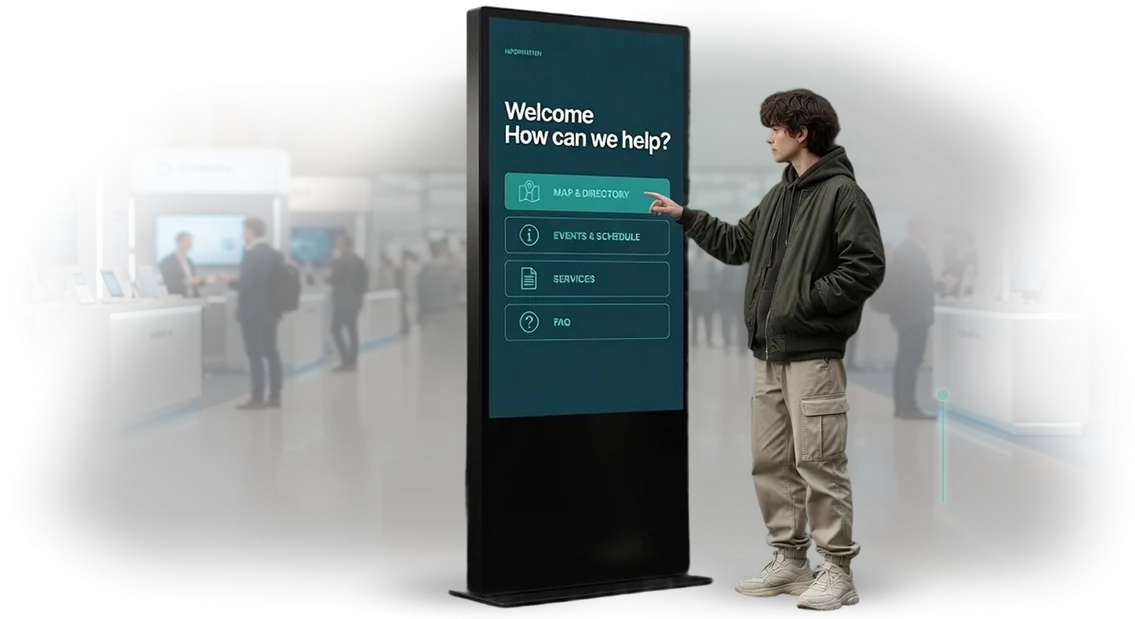
An interactive kiosk changes this dynamic. A touchscreen panel turns passive viewing into active exploration: guests themselves open historical documents, compare maps, rewatch archival footage, and find answers to their own questions.
Based on our observations, visitors' attention at such a panel is retained several times longer than at a regular display stand. People do not simply walk past — they experience the story and share their impressions.
This is what we solve: we develop interactive kiosks for military museums that work like a personal tour guide. The touchscreen panel takes into account the hall's layout, the specifics of the exhibits, and the age of visitors.
This approach turns "viewing the exhibition" into an exploration — and directly increases visitor engagement, time spent in the museum, and the desire to return.
What an Interactive Kiosk Offers Visitors and Administration
A visitor to a military museum comes for a story that can be not just read but experienced.
An interactive kiosk turns the exhibition into a vivid narrative: instead of plaques and static display cases — touchscreens where one can zoom into details, follow the chronology of events, and see how equipment and uniforms evolved.
Such immersion is memorable, evokes emotion, and creates the desire to return — so the museum gains a loyal visitor rather than a one-time guest.
For the administration, an interactive exhibition addresses several challenges at once. The kiosk independently answers typical visitor questions: where a hall is located, what to see first, which exhibit is the most important.
Staff are freed from repetitive explanations and can devote more attention to those who truly need assistance or a guided tour. This reduces the workload on employees and improves the quality of service.
From a brand recognition standpoint, the kiosk works as an additional carrier of the museum's visual identity. It maintains a cohesive design concept, presents exhibits in an impressive format, and makes the museum more visible in visitors' eyes.
A modern format signals that the museum is developing, keeping up with audience expectations, and offering more than a standard tour.
The main advantage is flexibility. The kiosk can be easily updated for new exhibitions, significant dates, and important events: just load the current materials, and the exhibition is working at full capacity again.
No reprinting of panels and lengthy approval of mockups — only the right information at the right moment. This is convenient both for the museum and for visitors, who always see fresh content.
In the end, the interactive kiosk unites the interests of both sides: guests get vivid experiences and self-guided engagement with history, while the museum gets reduced staff workload, increased loyalty, and a modern image.
This is not just a screen in the lobby, but a tool that strengthens the educational and reputational role of the exhibition.
Formats of Interactive Kiosks for a Military Museum
A visitor to a military museum comes for a story that can be experienced, not merely read. Static display cases and plaques hold attention for 20–30 seconds, while interactive formats engage for several minutes and create an emotional response.
To make the exhibition work for retention and the return of visitors, it is important to select a format suited to the specific task — from a temporary exhibition to a permanent hall.
We offer several proven formats that are easily integrated into the existing exhibition and do not require reconfiguring the space. Each solves its own problem: speeds up viewing, deepens content, or highlights key artifacts.
| Format | For whom | What it provides to the client |
|---|---|---|
| Touchscreen kiosk for the exhibition | Exhibition halls with high visitor flow | Holds visitors at the stand for 3–5 minutes, provides access to supplementary materials |
| Display case with backlighting and sensor | Valuable exhibits that need to be highlighted | Draws attention to the artifact, activates backlighting on touch, reveals the object's story |
| Multimedia guide panel | Hall routes, guided tours | Replaces paper maps, guides guests along the route, increases viewing time |
| Interactive battle map | Permanent historical halls | Shows chronology, troop movements, and key events — complex material becomes visual |
Touch panels for exhibitions are the most common request: they are compact, fit next to a display case, and operate autonomously. For large halls, an interactive map with a timeline is a better fit — it gathers groups around itself and gives visitors the role of an explorer.
A thoughtful choice of format increases exhibition viewing time by an average of 1.5–2 times. Guests do not simply walk past — they study details, return to exhibits, and share impressions, while the museum gains a living exhibition that people talk about.
How the Kiosk Development and Launch Proceeds
Kiosk development is not a one-off push but a structured process with clear stages. We formalize agreements at every step so you always know what is happening, when it will be ready, and which decisions have been made. Below is a brief route from the brief to the exhibition opening.
- Kiosk brief — we discuss the exhibition's goals, the visitor profile, and key emphases. You tell us about the museum's materials and atmosphere — we propose a scenario, scope of work, and timeline.
- Prototype and structure — we describe how visitors will move through the sections, what they will see on the first screen, and how quickly they will find the information they need. You approve the logic before resources are invested in design.
- Mockup approval — we prepare design mockups of the screens in your museum's style: from fonts to the arrangement of photos and descriptions. Revisions are made before programming begins, so the final result matches expectations.
- Programming and content — we build the interactive presentation, uploading texts, images, and videos. Professional equipment and refined tools make the interface responsive and stable.
- Touchscreen panel installation — we arrive at the venue and install the kiosk with consideration for lighting, foot traffic, and safety. We verify that the placement is comfortable for visitors of different heights.
- Test run and training — we run all scenarios under real conditions and ensure that touches respond accurately. We conduct a brief training session for museum staff so they can assist guests.
- Exhibition launch and support — we open the kiosk to visitors and remain available. If needed, we update content and monitor system performance.
As a result, you receive a finished focal point for the exhibition that does not require technical expertise from your team. Every stage is documented — you understand what you are paying for and what you will receive.
What Is Included in the Interactive Kiosk Delivery
You receive not just a touchscreen panel, but a complete turnkey solution — from the enclosure and interface to content and support.
No self-assembly, no hunting for subcontractors, no "finishing touches on site": the kiosk is mounted, configured, and launched within the agreed timeframe.
The delivery package includes:
- Touchscreen panel with a vandal-resistant enclosure — withstands continuous use and is protected against accidental impacts. Suitable for high-traffic areas.
- Interface adapted to the museum exhibition — large controls, clear navigation, and a mode for visitors with disabilities. Guests navigate without assistance from staff.
- Content for the museum — texts, photographs, archival footage, videos, and timelines of events. We present the stories of equipment, battles, and human destinies in a way that holds attention.
- Administration system — museum staff independently update information: change texts, add new exhibits, modify schedules. No programmer required.
- Staff training — we conduct instruction for administrators and tour guides, demonstrating all usage scenarios. The staff use the kiosk confidently from day one.
- Installation, configuration, and operating instructions — we set up the equipment, connect it to the museum's network, and provide clear documentation in Russian.
- Technical support and warranty — if questions arise, you contact us directly. We resolve issues remotely and, if necessary, visit the site.
Thus, you receive a single set of hardware, software, and content from one responsible contractor. We formalize the scope of work and deadlines in the contract — all that is left is to accept the finished kiosk and invite visitors.
Case Study: Kiosk on Key Battles for the Exhibition
When Museum of Military History approached us, its team faced a typical pain point: visitors lingered at the classic battle map for 15–20 seconds and moved on.
Static displays did not convey the dynamics of events and failed to hold attention — especially among young people accustomed to interactivity.
We proposed replacing the text panel with a touchscreen kiosk featuring an interactive battle map. Instead of lengthy descriptions — a visual scenario: chronology, troop movements, key points, and short explanations on touch.
Visitors choose the pace and depth of engagement themselves, so the exhibition works equally well for a quick pass-through and for close study.
The implementation results exceeded expectations. Time at the stand grew from 20 seconds to 4–5 minutes — almost 12 times longer than before. About a third of visitors return to the kiosk after surveying the hall to check details or show a discovery to companions.
Tour guides also began using the screen as a focal point for their narrative — reducing the burden on staff.
The administration noticed the effect as well: in the first month of the kiosk's operation, repeat visits by school groups increased by 35%. The museum ordered two more such kiosks for neighboring halls and requested content updates for new exhibitions.
This case showed that an interactive map is not a passing trend, but a tool for managing attention.
The kiosk does not merely entertain — it increases the time visitors spend in contact with your history — and that means a greater chance they will remember the exhibition and tell others about the museum.
How to Choose the Format of an Interactive Panel?
Choosing an interactive panel format starts not with screen specifications, but with two questions: what task the panel must solve and how much exhibition space is actually available.
The answer determines whether the panel becomes a central object around which a group gathers, or a compact assistant for one or two visitors.
If a dedicated hall or a wide zone is allocated for the panel, it makes sense to use a large touchscreen that is visible immediately at the entrance and works as a self-contained exhibit.
This format can accommodate a detailed chronology of events, biographies of heroes, battle maps, and a timeline — visitors study the material at a comfortable pace without creating queues.
When space is limited — a niche, a corridor, a section of wall next to a display case — a compact touchscreen panel integrated into an existing stand is the better choice.
It complements the analog exhibits: allowing visitors to view archival photos, veteran video interviews, or zoom into a map without taking up extra floor space.
The visitor gains value in 1–2 minutes, and the museum gains an additional layer of information without reconfiguration.
A common mistake is ordering "the largest screen" instead of a panel suited to the specific task. If the goal is immersion in history, a wide-format screen with deep content works best.
If the goal is quick access to reference information in a busy passage, a vertical panel with simple navigation is more practical.
That is why at the start we work with the client to define the scenario: who will use the kiosk and how, how much time they have, and what they should do afterward.
The answer is simple: there is no single best format — there is a format that fits your space and your visitor.
That is why we do not offer a "catalog of screens" but a selection service — we visit or receive the exhibition floor plan, clarify the objectives, and propose a solution that delivers measurable results: more time at the exhibit, new visitors in the autumn-winter season, and higher engagement with museum programs.
Frequently Asked Questions About Kiosk Implementation
The adoption of a kiosk in a military museum is often slowed not by the price, but by doubts: will the equipment fail, will the staff manage, will visitors notice it?
In practice, all these questions are resolved at the launch stage when there is a team nearby that is accountable for the result.
We install and support touchscreen kiosks at dozens of sites — from small halls to museums with high visitor traffic. Below are answers to the questions most commonly raised during initial discussions.
Is the equipment reliable under a constant flow of visitors?
We use professional touchscreen panels with protection against dust and impact. The software withstands thousands of touches per day and restarts itself in the event of a failure — the kiosk operates from the museum's opening to closing.
Will museum staff quickly learn how to use it?
The interface is simple: large buttons, clear sections such as "weapons," "battles," "heroes" — visitors will figure it out on their own, and an attendant needs only a one-hour orientation.
What about warranty and support after launch?
We provide a warranty on the equipment and software, connect to the kiosk remotely, and resolve issues without a site visit. The response time is set in the contract.
When does a kiosk pay for itself?
A kiosk strengthens the impression of the exhibition: guests stay longer in the hall, return with their families, and recommend the museum to friends. Visitor interest analytics also help plan new exhibitions — without extra marketing budgets.
Discuss Your Interactive Kiosk Project
Submit a request for a kiosk — and we will provide a consultation on your museum project. We will discuss how an interactive panel fits into the exhibition, which materials to present first, and how to make visitors linger longer.
As a result, you will receive a cost estimate and timeline — no template solutions, tailored to your hall and your audience.
Every request is reviewed together with a manager and a technical specialist, so the response you receive is not just figures, but a clear work plan. Here is what is included in the project discussion:
- Initial consultation: we analyze the kiosk's objectives, expectations for interactivity, and the target audience.
- Site audit: we advise where the panel will look best and which enclosure format suits the exhibition.
- Cost estimate preparation: a transparent list of work, materials, and options — you know exactly what you are paying for.
- Adaptation to a military museum project: from military chronicles to multimedia maps and interactive timelines.
- Scenario approval: how long a guest will spend at the screen, and what modes are needed for children and older generations.
- Content recommendations: which facts, photographs, and archival videos will strengthen the exhibition's impact.
- Launch and support plan: what the museum provides, what we take on, and how we train the staff.
After the discussion, you will understand the full scope of work and schedule — from the first mockups to installation and launch. No hidden conditions or unexpected surcharges: all agreements are fixed in the estimate and calendar plan.
Submit your request via the form below — we will calculate the kiosk cost for your museum and answer your questions within one business day.